
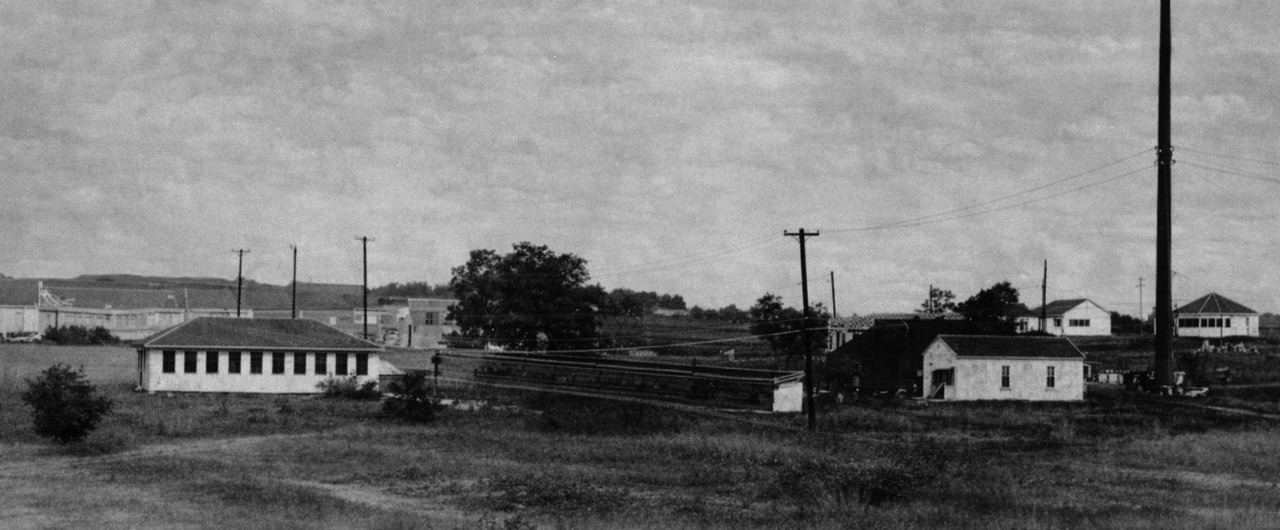
Not the sentimental dust of memory, but the real prairie dust — the kind that settles on cuffs and hat brims while men stand on open ground trying to imagine streets that do not yet exist, customers who have not yet arrived, and a town that is still more promise than place.
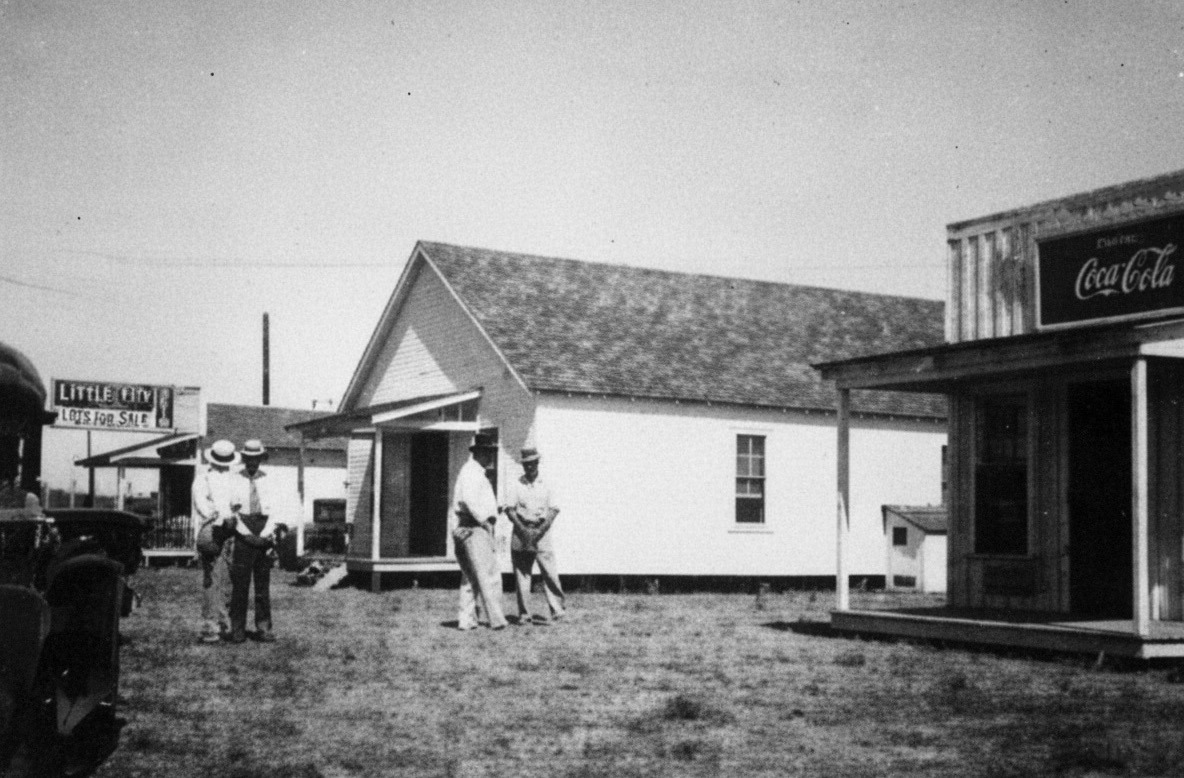
As one entered the town, one of the first things one saw was a small building with a large sign hanging over the front door, declaring: “Little City — Lots for Sale — Information — Office.”
Thebuildingwasthesmall LittleCitylandoffice.Nearby, a modest café wearing a proud Coca-Cola sign like a badge of legitimacy. And in between was a new, large grocery store, “The Palace Grocery.”
That is where we paused. Because Part II was about the audacity of the idea — the belief that a town could be called into being with little more than stakes in the ground, painted words on lumber, and the stubborn optimism of men who had seen this done before on other stretches of Oklahoma prairie.
ButwhenwearriveatPart III, something important has changed. Little City — or Pure City, as it was still known in some quarters — was no longer a plan. It is barelymorethantwomonths old.
Two months! But it was no longer a plan.
Two months were long enough for the excitement of the opening day to fade. Long enough for the first buyers to wonder if they had been wise. Long enough for the prairie to begin testing whether this place would take root… or be reclaimed.
The question was no longer whether a town can be imagined. The question was whether it could survive its infancy. This is where the sign stopped doing the talking.
This is where we begin to watch what happened when hopeful names, fresh lumber, and open lots withstood the quiet, unyielding reality of daily life on the frontier of Marshall County.
Part III is where Little City stops being an announcement…and starts becoming a test.
By the time the Madill Record of September 5, 1940, appeared (datelined September 2), Massingill’s letters were no longer introducing new buildings as curiosities. They were describing a place settling into rhythm.
He reported that business was still picking up and that Mrs. Alice Dixon had purchasedJimAdams’service station. With that purchase came more newcomers: Mr. and Mrs. Howard Swindell, who had moved from St. Louis, Oklahoma, to operate the station for her. The oil field was still pulling people in from hundreds of miles away.
Massingill recorded progress that, again, spoke to permanence rather than novelty. Charles Vanderpool hadhisbutanetankinstalled, and a crew of men was laying pipe, with gas expected in all the houses wanting the service “in a few days.” That was one more utility that was added to the list of factors thatmadeLittleCitymodern.
He noted that the new streetlights had been turned on the week of that report. And thus, night’s darkness was giving way, block by block.
The town’s services were fully in motion now. Massingill recorded Pete Roberts coming in with “a new shave and haircut set at Little City’s barber shop.” He noted Jack Frantz working here one day and a hundredmilesawaythenext, but always finding his way back to Little City, as if the place had already become a magnet.
He wrote of taking supper with the Carpenters and added the kind of line that couldonlycomefromsomeone living in the middle of it: “And did I eat!”
He recorded Mr. and Mrs. L. M. Hughes moving from Bochito, with Hughes keeping books for the new EasterLumberCompany.He noted “Pretty Little Patricia Miller” needing her ice cream cone every day, a small but telling sign of how normal life had become once electricity and refrigeration arrived. Along with those utilities came an ice cream parlor.
He described Mr. and Mrs. C. M. Powell opening their dining room, with four tables, plenty of windows, nice white curtains, and a pretty place to eat. That description reads less like a business report and more like a neighbor admiring what another neighbor has built.
Massingill noted Mrs. Pete Winberry's visit to town and recorded the steady flow of family visits, which indicated to readers that Little City was no longer merely an oil field outpost. It was a place where people came to see one another, stayed for supper, and felt at home. Then the paper widened the lens beyond town gossip and put Little City into the machinery of the field itself. On September 19, 1940, the Madill Record ran a field report headlined “PARK COLLEGE STILL WAITING FOR ORDERS” with subheads noting the camp mess hall opening and houses near completion, and the drilling status of multiple Pure wells. It reported that drilling on another Pure well, No. 1 Little-106, commenced that week. It reported the thirteenth location for the Pure field southeast of Madill was being drilled below 570 feet that morning, with seven others drilling at various depths. It reported No. 2 Little-100 was the deepest, making about 45 feet per day in the Viola limestone, drilling below 4,353 feet; No. 1 Metz-105 was at 4,190 feet in the Viola; No. 1 Park College-200 in Bryan County was shut down due to continuous water trouble after a good show of oil on a drill stem test in the upper Bromide, still waiting for orders;therotaryrighadbeen switched to No. 1 Little-106, also in Bryan County, half a mile west of Park College. It reported four wells still under maximum production allowed by the Corporation Commission that month— about 500 barrels each, for a total of 2,000 per day for September for the Pure area. It reported additional drilling progress: No. 1 Little-201 in the Hunton at 3,456 feet, having made 41 feet since yesterday; No. 2 Little-101 in the Hunton at 3,432; No. 1Crissman-104,theonlywell in section 29, at 3,448 in the Woodford; No. 3 Little-100 in Bryan County drilling below 3,041 in the Sycamore; and No. 1 Thomas-202 offset from producingNo.1Thomas-102, drilling below 3,946 in the Sylvan.
Then it turned back to the town and camp and gave you the crucial connective tissue: “Continued growth of Pure camp is noticeable.” It reported seven men living in Pure’s new bunkhouse, that company workers were taking meals at the company mess hall—a large white frame building in the heart of the field—and that ten new five-room houses built for Pure officials were nearing completion and would be occupied in about two weeks. It was observed that, when officialsandfamiliesrelocated from Madill, housing and apartmentsbecameavailable there. It stated that the housing situation remained acute at Little City, where approximately 30 new frame houseshadbeenrentedbefore completion, and that “there is not an empty house in town.” It reported that Reuel Little publishedanoticeofintention to incorporate Little City. It reported a census two weeks prior showed a population of 63 bona fide residents, with a last-minute report showing 91, according to Mrs. Leta Mae Brock of the Little City Land Office. It reported that a Madill school bus transported grade and high school students from Little City to Madill each day and stated that service would extend into Pure Camp as needed. It also noted Madill’s own growth and the arrival of Arrow Supply Company leasing the former Ben Dane grocery building (Madill Record, 9-19-1940).
From there, the Little City letters kept coming, and the accumulation is the point: those entries showed a town becoming normal by repeating its daily motions.
On September 26, 1940 (datelined September 24), Massingill reported Mr. and Mrs. J. B. Best moving in, Best being a welder for Pure; Mr. and Mrs. W. T. Splawn moving in, Splawn a boiler foreman for Pure; he recorded a minor civic crisis disguised as comedy— WarrenCarpenterdrivinghis 1924FordpickupintoMarvin Farmer’s cot house, knocking a hole in the house and shifting it about six inches off it’s foundation, breaking a wheel on the Ford, and Mr. Farmer not knowing who to sue—Warren, M. C. Easter, or the 1924 model Ford. He recorded Bishop’s café installing a nickelodeon— “Now we have plenty of canned music.” He recorded the installation of an electric pump at the water well. He recorded visitors, ice cream trips, and a return of Jim Adams,makingthetownlook “natural” again.
On October 3, 1940 (datelined October 1), he recorded Mr. Atwood moving a café building from Colbert and one dwelling house being completed; more visitors; R. B. Pistole going to Fort Worth and returning with his mother, Mrs. A. E. Pistole; the cool weather making Charlie Vanderpool importantbecausehehadthe butane gas system.
And then came a sentence that marks a town’s ambition asclearlyasanyskyline:Reuel Little had published notice of intention to incorporate Little City. This was not paperwork for paperwork’s sake. Incorporation was a declaration—a decision to step out of the blurred space between “place” and “project.” In oil country, many settlements never bothered. They lived fast, made money, and vanished. But incorporation was a different kind of wager. It said: we are not merely a service strip beside a company camp. We are not merely a cluster of rented houses and cafés. We intend to be recognized.
That mattered because incorporation carried weight — legal weight, civic weight, and something less visible but just as powerful: psychological weight.
Up to that moment, Little City had been a place you could point to on the prairie. Not a place you could yet define.
A cluster of buildings stood in open grass where only months earlier there had been nothing but wind and pasture. A café with a bright Coca-Cola sign doing its best to look permanent in a place that still felt temporary. A land office with painted promises nailed to a large board: “Lots for Sale — Information — Office.” Streets first existed as survey stakes and chalk lines before they became paths worn by feet and wagon wheels. Houseswererisingfromfresh lumber beside a company camp that had arrived because of oil, and everyone knew they could just as easily leave because of oil.
You could walk there. You could eat there. You could rent there. You could sleep there.
But it was still provisional — held together by motion, noise, optimism, and necessity rather than by law or structure.
Then the calendar begins to tell the story.
On October 17, 1940 (datelined October 9), Andy Massingill wrote in the Madill Record that he had been painting and had not learned much news. And yet, even that “thin” column is thick with meaning for Little City.
HarrisConcretepurchased a new rock bin to be mounted on concrete posts, allowing trucks to drive underneath and load rock. That is not the activity of a camp. That is the activity of a place expecting sustained construction and regular traffic.
Mayor Pete Winberry was walking around smoking cigars. Mrs. Leta Mae Brock was working hard. Melba Hamblin had moved from Webb Café to work for Mrs. Baird at the Pure camp boarding house. Bobbie Helms was picking cotton and proudly reported he had picked nineteen pounds. A hunting story ended with a debate over whether the large cat was a house cat or a wildcat — “Anyway, it was a dead cat.”
Nothing in that column mentioned incorporation.
Buteverythinginitshowed asettlementalreadybehaving like a town — commerce, labor, personalities, humor, familiarity, and the steady rhythm of daily life. People were no longer passing through. They were settling in. They were getting to knowoneanother.Theywere beginning to think of this place as home.
Meanwhile, something larger was happening.
During October 1940, the Madill Record printed the formal notice: an election would be held to determine whether Little City would become an incorporated town.Thevotewasscheduled for October 23, 1940, from 9:00 A.M. to 4:00 P.M., at the Land Office in Little City, located on Lot 5, Block 2. The notice ran under the authority of the Board of County Commissioners of Marshall County and was signed by Holmes Willis, Chairman of the Board.
This was the boom town stepping into the courthouse light.
A place that had begun as lots and lumber, cafés and groceries, and company housing was now speaking the language of governance.
On October 23, 1940, the people who only four months earlier had been living in tents, rented houses, and freshly framed dwellings beside a company camp walked into that land office and voted.
In the end, the resolution passed.
With that vote, Little City crossed a quiet but monumental line. It ceased to be merely a convenient name for a cluster of buildings and becamesomethingrecognized in law and record.
It formally became an incorporated town. And the next day, life went right on.
On October 24, 1940 (datelined October 22), Massingill recorded the “Atwood Lunch” cafe operating, new residents moving in, “cot house” oversight, and the small physical geography of the place. Bobby Helms took Kennedy “downtown — which isn’t far, you know — and made him acquainted with everybody he saw.”
That line says more about Little City than a proclamation ever could.
The town was small enoughthat“downtown”was a short walk. Small enough that you could meet everyone in a single trip. But it was now, officially, a town.
Soon afterward, another election followed to select officers for the new municipality. The man chosen to serve as mayor was Pete Winberry — already a familiar name to readers of the Madill Record.
Before incorporation, Pete hadservedasthecommunity’s honorary mayor — a colorful fixture in the boom-town reports from “your reporter, Andy Massingill.” Winberry bought the first hamburger sold in town. He purchased the first groceries at the Palace.Hewalkedamongthe businesses. He appeared in nearly every dispatch.
Now, he was no longer simply a character in a column. He was the elected head of a legally recognized town. That transition cannot be overstated.
Legally, incorporation lifted Little City out of the category of “where the oil campis”andintothecategory of municipal existence. An incorporated town could hold elections, adopt ordinances, designate officials, define its boundaries in legal description, regulate streets, manage utilities, and make enforceable decisions.
A boom town without incorporation is like a campfire on the prairie — bright, useful, temporary, and easily extinguished. An incorporatedtownisalantern with a handle — something meant to be carried forward.
Civically, incorporation gave residents a claim on their own story. If you lived there after October 23rd, you were no longer “out by the field.” You lived in a municipality whose name would be written into county books, state books, and federal books, whose officials could be named in print, whose elections could be recorded, whose streets could be described.
You were no longer living at a location. You were living in a town.
Practically, incorporation was a response to mounting pressure. Houses were being rented before they were finished. There was no empty place to live. Families were arriving. Children needed buses. Streets needed lights. Waterworks needed oversight. Electric lines and butane pipes were no longer conveniences in a field — they were infrastructure serving a community.
When that happens, a settlement must organize… or begin to fracture.
One of the quiet but powerful reasons Little City chose incorporation was the regulation of utilities. In a boom settlement, water lines, electric service, and butane gas were often controlled by private operators who answeredtonolocalauthority. Without incorporation, residents had little protection against price increases, service delays, or unfair conditions. But once Little City became a municipality, those utilities were no longer simply private conveniences in a pasture. They became services operating within a town, subject to ordinances, oversight, and the expectation of accountability. Incorporation gave the town leverage. It meant that the ownerofthebutanecompany, the electric provider, and the water system were no longer dealing with scattered individuals—they were dealing with a civic body capable of regulating how essential services were delivered to its residents.
Incorporation is what you dowhentheboomstopsbeing exciting and starts being permanent.
Theeffectswereimmediate and profound.
Streets named Reuel, Main, Quinton, A, B, C, and D were no longer surveyors’ marks beside an oil camp. They were streets inside a municipality.
The waterworks, electric lines, and butane pipes were no longer conveniences set in grass. They were infrastructure inside a town.
And perhaps most revealing of all: many oil settlements across Oklahoma never did this. They remained camps, addresses, or crossroads that disappeared as quickly as the rigs moved on.
Incorporation is what you do when you believe a place should outlast the reason it first existed.
BylateOctober1940,Little City had done something few boom towns ever attempted. It had taken the energy of an oil field and tried to harness it into permanence. It had elected a mayor. It had declared itself a town. It had stepped out of the temporary shadow of Pure Oil’s camp and into the light of civic life.
It is one thing to build a café, a grocery, and a land office on bare prairie.
It is another thing entirely to stand up and say: This is a town. But Little City did exactly that.
On October 31, 1940 (datelined October 29), Massingill recorded an 8 o’clock dinner party hosted by Mr. and Mrs. Willie Brock with a guest list including Madill names and Little City names; he recorded Mrs. Alice Dickson being ill and staying with her parents, and her intent to return to beauty shop duties; he recorded Miss Millie Bishop goingtoMemphis,Tennessee with Miss Honea as general manager and Miss Mozelle Rice assisting; he recorded R. B. Pistole leaving for Fort Worth due to a mashed foot injury while working in the Pure oil field; he recorded Jack Pistole staying home to care for his pet bulldog Tille; he recorded a city election held at the land office, conducted by Mrs. R. B. Pistole, Mrs. Max Archerd, and Mrs. Leta Mae Brock; he recorded travel, illnesses, even children climbing a tree and falling, and the Martins going to Ardmore to see “Boom Town.”
By December 5, 1940 (datelined December 2), Massingill apologized for not writing lately, but reported three new families moving in since the last paper mention—Mr. and Mrs. R. G. Curran and daughter; Mr. and Mrs. S. G. Keltner and son; and Mr. and Mrs. Roy Brummett. He recorded visits to Cement, Blanchard, Stonewall, Mexia; high water; mud; sick babies; shopping; Thanksgiving dinners; moviegoing; and church attendance. The details matter because they show the boom town doing what all towns do once the initial dust settles: it starts behaving like a community.
Another result of the October decision to incorporate was a major change that, to this day, keeps Little City listed in county, state, and federal records.
In January 1941, the status of Little City became unmistakably civic. On January 13th, the Marshall County Election Board declared Little City as a separate voting district. The area had previously been part of the Cumberland voting district, but after incorporation, Little City was designated as a voting district. That is a key hinge in the town’s self-definition: not just a settlement beside a camp, but a place that had moved into formal political recognition.
A separate voting district sounds like a small administrative note in a newspaper column. In truth, it is one of the clearest signs that a place has crossed from being a settlement into being a recognized civic organism.
In Oklahoma’s election structure, a voting district — often called a precinct — is the smallest official unit of political geography the state recognizes. It is not symbolic. It is functional. It is how the state organizes democracy at the ground level. It determines where ballots are cast, how voter rolls are maintained, how election officials are assigned, and how votes are counted, recorded, and reported to the county and the state.
Before January 13, 1941, the people living in Little City did not vote as Little City. They voted as part of the Cumberland district. On paper, in the election machinery of Oklahoma, Little City did not exist. Its residents were administratively absorbed into another place. Their ballots were carried elsewhere. Their political identity was borrowed from a neighboring community.
Then the county election board drew a line.
The declaration of Little City as a voting district did not build a single structure. It did not pave a single street. But it did something far more enduring: it placed Little City on the official electoral map of the State of Oklahoma.
From that moment forward, Little City had to be named in election records. Voter rolls required residents to be listed as residing in Little City. Polling arrangementshadtoaccount for Little City. Election returns would show Little City as a reporting unit. County and state officials, as well as future historians reading election summaries, would see the name appear repeatedly.
That is how a place enters the permanent paperwork of a state.
In practical terms, this status required the election board to acknowledge defined boundaries for Little City. You cannot create a precinct without knowing its boundaries. That meant the town’s geography was now recorded in the same way streets and lots were recorded. It required the statetorecognizethatenough people lived there to justify separate administration. It required officials to plan for ballots, voter lists, and reporting specific to that place.
Most oil camps never reached this point. They had buildings, businesses, families, and noise — but they never had a line drawn around them on an election map. They never appeared as a named unit in county election returns. They never required the state to account for their existence every election cycle.
Little City did. A separate voting district is the state’s quiet admission that a place is no longer temporary. It is no longer a camp beside a field. It is a political community whose residents are entitled to be counted as themselves.
Incorporation made Little City a town in law.
Becoming a separate voting district made Little City a town in the living machinery of democracy.
From that point forward to today, every election forced the state to say the name: Little City.
On March 14, 1941, the Madill Record reported that for the first time, residents of LittleCityvotedasaseparate voting district. On March 11th,astatewideelectionwas held for the consideration of three State Questions. Those three questions were constitutional amendments. State Question 298 was a constitutional amendment to prohibit appropriations exceedingrevenueestimates, void excess appropriations, and limit annual deficiency certificates to $500,000. State Question 299 was to remove limits on assistance for needy elderly, allow state legislation with federal social security plans, and permit non-ad valorem taxes to fund these programs. And State Question 300 would create 'The Oklahoma State System of Higher Education,'establishaBoard of Regents, and allow private institutions to join under board regulations.
On March 11th, only six votes were cast in the Little City voting district. Four voted “yes” for all amendments and two “no”— but the important point is procedural: Little City residents were able to vote in their own town.
So, when you step back and look at the arc we’ve traced in Part III, the speed of Little City’s rise becomes almost hard to believe.
In less than a year of existence, Little City went from a vacant pasture — open grass and expectation — to an incorporated town, and then to something even more telling: a separate voting district, recognized by the election board and recorded by the newspaper. From “a place you could point to” to a place the State of Oklahomahadtocount.From settlement to municipality to political identity.
That is the story’s quiet thunder: incorporation gave Little City a legal body, but the voting district gave it a civic heartbeat — a pulse that could be taken, measured, and recorded with every election thereafter.
And that is where Part III closes: with Little City no longer merely near the boom but built into the structure that outlasts booms.
In Part IV, we keep walking forward — deeper into the town’s lived history — following what came next after the paperwork and the precinct lines: how Little City carried itself once it had claimed the name, the boundary, and the ballot box, and what those early decisions set in motion for the decades that followed.