
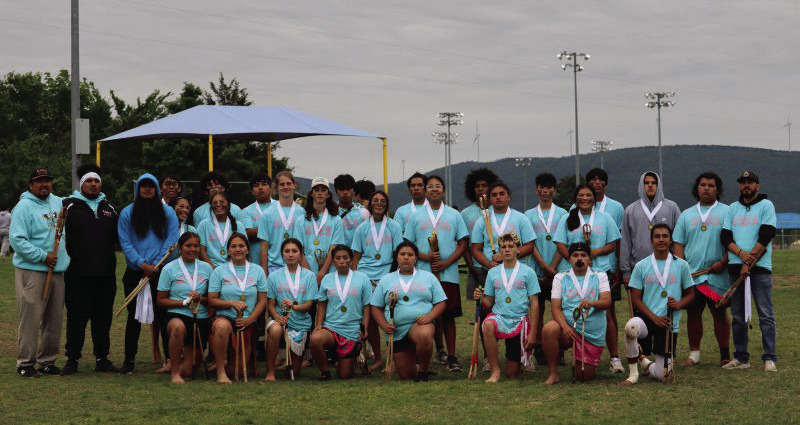
Coach Brandon White Eagle, coach Jake Wallace, coach Darnell Colbert, Jayse Battiest, Jerry Buck, Nokosi Harjo, Riley Alexander, Jathan Walls, Teegan Going, Jayden Jefferson, Bradley Harjo, Nate Read, Jacob Colley, Jake Walls, coach Matt MacDonald. Middle: Bryzen Templeman, Jayla Underwood, Asher Jordan, Matty Laurie, Lyla Standridge, Tushka Greenwood, Naomi Harjo, Brenlee Underwood. Anjali Bahe, Sophie Mater, Gabby Nucosee, Larissa Cruz, Maggie Stick, Jace Davis, Shane Fulsom, Brayden McGilbray. Courtesy photo In the last two years, the Chickasaw Youth Stickball teams have seen unprecedented growth, particularly in the 10 and under age group. Chikasha Bak Bak junior and senior teams were runners-up in the 2024 Choctaw Youth Stickball League. Courtesy photo
Chikasha Bak Bak (Chickasaw Woodpecker) is one of seven teams currently playing in the Choctaw Nation’s Stickball League. With a similar culture and intertwined histories, the Choctaw Nation invited Chickasaws to participate in their league in 2014. Numerous Southeastern First American tribes of North America are working to preserve the heritage of this traditional game.
“Stickball is shared amongstSoutheasterntribes. It brings different First Nation communities together,” saidChikashaBakBakHead Coach Brandon White Eagle. “The stickball community is growing but is still relatively small. Networking is a great factor in the growth (of the game).”
Stickball is experiencing a resurgence in popularity. Player population within the Chickasaw Nation’s youth stickball team is up nearly 70% from the previous year, growing from 36 players in 2023 to 52 in 2024. Adult players on the Chickasaw Nation’s team grew by two players in the same time frame, from 28 to 30 players.
With growth primarily within the 10 year old and under age group, family participation in the sport is essential. According to White Eagle, Bak Bak juniors have 30 players in this age group.
“Recruiting and retention is always a focus for the youth stickball program. We have a core group of 8-to-10-yearolds and 15-to-17-year-olds,” the coach said. “Each year, Chikasha Bak Bak ages out three to five players. This year is no different. We have three girls and two boys aging out. We hope to see them all playing with the adult teams and continue to grow as players.”
Stickball is a commitment for those involved. Practice takes place eight months out of the year, from February until the end of September. Chickasaw youth, as well as adults, are encouraged to attend practices and play league games. All experience levels are welcome.
The Chickasaw Nation youth stickball team, Chikasha Bak Bak, junior and senior teams were runners-up in the 2024 Choctaw Youth Stickball League finals that took place April 20 in Tuskahoma, Choctaw Nation.
Competing out of Talihina, Choctaw Nation team Tvshka Waya (Leaning Warriors) snatched the championship with a 6-1 win over the Chikasha Bak Bak junior team. Chikasha Bak Bak juniors went into the finals with a winning 4-2 regular season record.
“This is the first time Chikasha (Bak Bak) juniors have placed in the finals,” White Eagle said. “Chikasha Bak Bak juniors fought hard and played physically until the end.”
TheChikashaBakBakseniors entered the finals as the No.1seedwithanundefeated 6-0 regular season and backto- backchampionshipsunder their belt. Hiloha Osi (Little Thunder) from Broken Bow, Choctaw Nation, emerged as this year’s victors.
“The (championship) game started out fast with Chikasha Bak Bak (seniors) jumping out to a 2-0 lead by the end of the first quarter. Hiloha Osi countered with two scores in the second and third quarters,” White Eagle said. “The score was tied going into the fourth. Hiloha Osi would eventually get two more to put them ahead (for the win).”
The success of the youth teams would not be possible without a dedicated coaching staff. The Chickasaw Nation’s current coaching lineup includes White Eagle, assistant coaches Ashley Wallace, Ashley Stick, Darnell Colbert, Jake Wallace and Matt McDonald.
“This has been a historical run for Chikasha Bak Bak seniors. They have been in the finals 10 consecutive years.Itisnottheoutcomewe wanted, but it has fueled the players and coaches to work harder for next season. This was the first time that the Bak Bak juniors have placed runner-up in Choctaw Youth Stickball League,” White Eagle said.
As a growing sport, many tribes sponsor teams to play at the annual World Series of Stickball at the Mississippi Band of Choctaw Indians’ Reservation.
“Both teams showed great unity, no matter if we won or lost. They know they are cultural ambassadors and revitalizing the game of stickball,” White Eagle said.
In each of these tribes’ respective histories, ceremonial games of stickball were often used to settle disputes between themselves, neighboring villages and tribes with a shared culture. Considered the “little brother of war,” stickball players are among the warriors within a tribe, sharing the kinship broughtbyvictory,defeatand unexpected injuries.
Stickball players continue to be a tight community, experiencing the game’s renaissance in recent years together.
“Both Chikasha Bak Bak junior and senior teams played very well and represented themselves, their tribe and family in the most respectable way. Our ancestors would be proud of these youngwarriors,”WhiteEagle said.
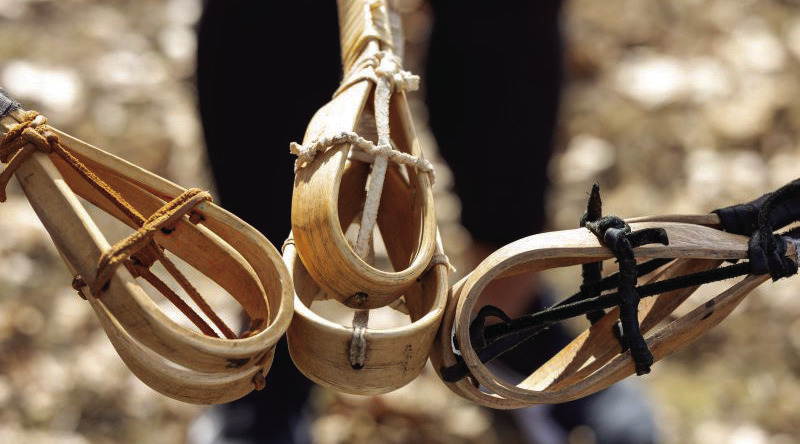
White Eagle said stickball provides players with more than physical activity. Stickball provides an avenue into Chickasaw culture that introduces players to the art of creating stickball sticks, traditional balls, incorporating the Chickasaw language and stomp dancing, among other tribal customs.
“The establishment of the adult and youth teams bring together other aspects of the Chickasawcultureintoplay,” White Eagle said. “Stickball gives people a connection to their heritage and the ancestors that came before us. It is a feeling like no other. Other tribes have expressed the same thoughts about stickball. It’s a ceremonial and healing game for our people.”