
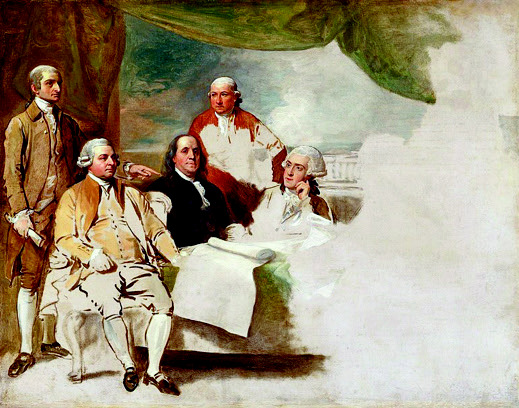
Image Note: The image accompanying this article is Benjamin West’s 1783 painting, American Commissioners of the Preliminary Peace Agreement with Great Britain, also known as Treaty of Paris. The unfinished painting shows the American commissioners who helped secure British recognition of the United States as “free sovereign and Independent States.” The British commissioners refused to sit for the painting, leaving the right side unfinished. The work is in the public domain.
Last weekend, Americans celebrated the 250th anniversary of our nation’s independence — or, perhaps more precisely, the 250th anniversary of our nation’s claim of independence.
That distinction matters. On July 4, 1776, the Continental Congress approved the Declaration of Independence. With that document, thirteen colonies announced to the world that they were no longer colonies at all, but free and independent states. It was a bold claim. It was a dangerous claim. It was a claim made in the face of the greatest empire on earth.
But it was still a claim. Great Britain had not yet accepted it. King George had not yet yielded it. Parliament had not yet recognized it. British armies had not yet been defeated. British ships still ruled the seas. American independence had been declared, but it had not yet been secured.
Last week, we looked back at the Declaration itself, the document in which 56 men pledged their lives, their fortunes, and their sacred honor to the birth of a nation. Those words have survived for 250 years because they were not decorative. They were not the closing flourish of a harmless political statement. They were a vow made in the face of war, empire, uncertainty, and death.
The Declaration did not end the matter.
It began it. On July 4, 1776, the Continental Congress declared that the thirteen colonies were free and independent states. The words were bold, the charges were severe, and the appeal was made to God, to history, and to what the Declaration called “a candid world.” The signers had accused their king of tyranny. They had accused Great Britain of repeated injuries and usurpations. They had declared that all political connection between the colonies andtheBritishCrown“isand ought to be totally dissolved.” No one in that room could honestly believe those words would be treated in London as mere political criticism.
Declaring independence and securing independence, however, are not the same thing.Apeoplemayannounce itself free, but another question quickly follows: can it remain free when the army comes, when the ports are blockaded, when the money fails, when men desert, when the enemy occupies cities, andwhenwintercomesdown on an army without food, shoes, or shelter?
That was the question after July 4, 1776. The words had been written. The signatures would be placed. The pledge had been made. Now the pledge had to be carried through war. The Revolution was not won on parchment. It was not won by eloquence alone. It was not won because the words of the Declaration were beautiful, though they were.Itwaswonbecausemen froze, marched, bled, starved, suffered, buried friends, left farms, endured defeat, and still did not quit.
The fighting had already begun before the Declaration was adopted. By the summer of 1776, the quarrel between the colonies and GreatBritainhadmovedwell beyond pamphlets, petitions, protests, tax disputes, and speeches. Blood had already been shed. Families had already begun to understand that the conflict with the Crown would not be settled by eloquence alone. The war did not begin in July of 1776. Blood had already stained the ground at Lexington and Concord. Men had already died at Bunker Hill. Boston had already known occupation and siege. But after the Declaration, the conflict changed in meaning. What had been resistance became open revolution. What had been protest became independence. What had been a quarrel over rights became a war over nationhood.
In April of 1775, British troops marched toward Concord, Massachusetts, to seize colonial military supplies. At Lexington, they encountered armed militiamen. No one can say with certainty who fired the first shot, but once it was fired, there was no returning to the old world. Men fell on Lexington Green. TheBritishcontinuedtoward Concord, where American militiamen confronted them at the North Bridge. Then came the long retreat back toward Boston, with colonial fighters firing from behind trees, fences, stone walls, barns, and houses. The British regulars, trained soldiers of the empire, found that the countryside itself had turned against them.
A month later, in May of 1775, Ethan Allen, Benedict Arnold, and their men captured Fort Ticonderoga in New York. That victory mattered because the fort held artillery the American cause badly needed. Those guns would later be dragged over difficult country in one of the great feats of the early Revolution and placed on Dorchester Heights overlooking Boston. But Fort Ticonderoga also mattered symbolically. It showed that the conflict was spreading beyond Massachusetts. This was not merely a local riot or a Boston disturbance. The resistance was becoming continental.
Then came Bunker Hill in June of 1775. Technically, much of the fighting occurred on Breed’s Hill, but history remembers the battle as Bunker Hill. The British took the ground, but they paid heavily for it. American forces eventually retreated, but they had stood against repeated British assaults and inflicted terrible losses. The lesson was unmistakable. The Americans could be beaten, but they would not simply run at the sight of British bayonets. The British learned that putting down the rebellion would not be quick, cheap, or easy.
Boston remained under siege until George Washington arrived to take command of the Continental Army. Washington did not inherit the polished army of later memory. He found a force that was brave but raw, committed but uneven, short of supplies, and uncertain in discipline. Many of the men werecitizen-soldiersmoreaccustomed tofarmsandtrades thanmilitaryorder.Theyhad courage, but courage alone does not feed an army, drill an army, or keep an army together when the first enthusiasm begins to fade.
ByMarchof1776,theguns from Fort Ticonderoga had been placed on Dorchester Heights. Their position made the British occupation of Boston untenable, and the British evacuatedthecity.Forthe patriot cause, that was a moment of great hope. Boston, one of the centers of colonial resistance, had been freed from British occupation. But no serious man mistook that victory for the end of the war. The British Empire had not been defeated. It had merely withdrawn from one position and would soon strike with far greater force elsewhere.
That is the setting in which the Declaration came. It was not written from a place of safety. It was not approved after victory had been secured. It was adopted while the American cause remained fragile, underfunded, divided, and militarily uncertain. The new nation had no secure borders, no stable national government, no reliable currency, and no professional army equal to Britain’s. What it had was a claim, a cause, a commander, and a willingness to put everything at hazard.
Almost immediately after the Declaration, the British struck New York with overwhelming force. The campaign for New York in 1776 was a disaster for the Americans. The British arrived with soldiers, ships, supplies, Hessian auxiliaries, and the confidence of an empire that expected rebellion to be crushed by force. Washington’s army was brave, but badly outmatched, poorly supplied, and fragile. At Long Island, the Americans were defeated and nearly trapped. Only a difficult night retreat across the East River saved the army from destruction.
New York City fell. The British took control of the city and would hold it for the remainder of the war. Washington’sarmyretreated north and then across New Jersey. The retreat became a grim test of survival. Men deserted. Enlistments expired. Supplies failed. The army shrank. The cause that had sounded so noble in July seemed by December to be staggering toward collapse. From a distance of 250 years, we see the Revolution as inevitable. To those living through it, nothing was inevitable except danger.
Bytheendof1776,thenew nation was in desperate condition. Washington’s army was cold, exhausted, poorly supplied, and badly reduced. The British believed they had nearly broken the rebellion. Many Americans feared the same thing. The Declaration hadbeenapprovedinJuly.By December, the dream of independence was not marching triumphantly toward victory. It was stumbling through mud, ice, and fear, trying not to disappear before the year ended.
That is when Washington crossed the Delaware. The crossing has become one of thegreatimagesinAmerican memory, but the painting cannot fully capture the desperation of the moment. It was Christmas night. The weatherwasbrutal.Theriver was dangerous. The army was worn down. Many men lacked proper clothing. Some had rags wrapped around their feet. The attack on Trenton was not a gesture of confidence. It was a desperate gamble by a commander who understood that if he did nothing, the Revolution might simply fade away.
At Trenton, the Americans surprised the Hessian garrison and won. Then, at Princeton, they won again. Those victories did not end the war, but they did something just as important. They kept the Revolution alive. They restored hope at the very moment hope was failing. They showed that Washington’s army, battered and diminished as it was, could still strike. In a revolution, hope can be as necessary as powder.
The next year brought more hardship and uncertainty. In 1777, the British captured Philadelphia, the very city where the Declaration had been approved. Congress fled. The symbolic heart of the Revolution fell into enemy hands. That fact alone should cure us of the notion that American independence unfolded in a neat and inevitable march toward victory. The nation’s capital, suchasitwas,hadbeentaken by the enemy.
Yet the same year brought one of the most important American victories of the war. At Saratoga, British General John Burgoyne surrendered his army after a failed campaign from Canada. Saratoga changed the way the world looked at the American cause. It demonstrated thattheAmericans could defeat a major British force. More importantly, it helped convince France that the American struggle was not hopeless. French support wouldbecomeessentialtothe final outcome.
TheRevolutionwasAmerican in its ideals, American initsDeclaration,andAmerican in its endurance. But it was not won by Americans alone. France provided money, arms, soldiers, naval power, and diplomatic support. Without French assistance, American independence would have been far harder tosecure.TheAmericanshad declared themselves free, but they needed allies to survive long enough to prove it.
After Philadelphia fell, Washington’s army endured the winter at Valley Forge. No honest telling of the Revolution can pass lightly over that name. Valley Forge was not a battlefield in the usual sense. There was no single clash of armies there that decided the war. It was instead a long trial of endurance. The army lacked food, clothing, blankets, shoes, and adequate shelter. Disease spread through the camp. Men suffered from hunger and cold. Some were sick beyond recovery. Others remained at their posts with little more than rags and resolve.
Valley Forge became a place where the Revolution was tested not by British cannon, but by misery. It is one thing to speak of liberty in a hall. It is another thing to keep faith with liberty when there is no bread, no shoes, and no certainty that the country you serve will survive. Yet Valley Forge also strengthened the army. Under the training of Baron von Steuben, discipline improved. The Continental Army emerged from that winter still burdened and still outmatched, but more organized, more professional, and more capable than before.
The war widened and deepened. It was fought in the North, the Middle Colonies, the South, along the frontier, and at sea. It entered farms, churches, barns, and family tables. It disrupted trade, emptied fields, separated husbands from wives and fathers from children, and forced ordinary people to make choices they had never expected to face. Some Americans remained loyal to the Crown. Some became patriots. Some tried to remain neutral and found that war has little patience for neutrality. In many communities, the Revolution became a civil war among neighbors.
The southern campaigns were especially brutal. The British believed that Loyalist support in the South might help them break the rebellion. Savannah fell. Charleston fell in 1780, one oftheworstAmericandefeats of the war, with thousands of soldiers captured. At Camden, American forces suffered disaster. For a time, it appeared that the British might roll up the South and strangle the Revolution from below.
But the southern backcountry did not quietly submit. Patriot and Loyalist militias foughtoneanotherwitha bitterness that made the war deeply personal. Men who had once traded, worshiped, and lived near each other becameenemies.Farmswere burned. Prisoners suffered. Families were divided. The war in the Carolinas and Georgia could be savage, local, and unforgiving. At Waxhaws, the war took on a particularly hard reputation. In the backcountry, violence was not always distant or formal. It could come to a man’s own road, his own field, his own doorway.
Out of that hard country came names still remembered in Revolutionary history: Francis Marion, the “Swamp Fox”; Thomas Sumter; Andrew Pickens; Daniel Morgan; and Nathanael Greene. They fought a war of movement, ambush, endurance, and attrition. They did not always hold ground, but they made British occupation costly. They struck where they could, withdrew when necessary, and refused to allow the British to turn military victories into lasting control.
At Kings Mountain in 1780, patriot militia defeated a Loyalist force in a battle that helped turn the tide in the South. At Cowpens in 1781, Daniel Morgan won a brilliant victory against Banastre Tarleton. At Guilford Courthouse, Nathanael Greene’sarmyretreatedfrom the field, but the British suffered losses they could ill afford. Greene understood that the British could win battles and still lose the war if every victory bled them white.
That is one of the great lessons of the Revolution. America did not win because it never lost. America won because it endured loss without surrendering the cause. The army retreated but did not vanish. Cities fell, but the Revolution continued. Men deserted, but others stayed. Congress faltered, but the cause survived. The country was not yet a country in the full sense, but it was becoming one through endurance.
By 1781, Lord Cornwallis moved into Virginia, and the war began to turn toward its decisive moment. Washington, with French assistance, recognized the opportunity. French forces under Rochambeaujoinedhim.The French fleet under Admiral de Grasse blocked British escape by sea. Cornwallis, who had marched through the South and into Virginia, found himself trapped at Yorktown.
The siege of Yorktown brought together the elements that had made American victory possible: Washington’s persistence, French military support, French naval power, American endurance, and British overextension. American and French artillery pounded the British defenses. Trenches moved closer. Redoubts were stormed. Cornwallis’s position became hopeless. In October of 1781, British forces surrendered.
Yorktown was the great military turning point of the Revolution, but even Yorktown didnotimmediatelyend the war. That is another part of the story often forgotten. Cornwallis surrendered in October of 1781. The Treaty of Paris was not signed until September 3, 1783. Nearly two more years passed before peace was formally secured. Armies still existed. British troops still occupied New York. Diplomacy still had to do its work. The United States still had to hold together long enough to turn battlefield success into international recognition.
The cost by then had been immense. Soldiers had died in battle. Far more had died from disease, exposure, and deprivation. Men had been wounded,maimed,captured, and imprisoned. Prisoners suffered in dreadful conditions, including aboard prison ships. Families had been displaced. Towns had been occupied. Farms had been stripped. Trade had been disrupted. Money had lost value. Public credit had been strained. Private fortunes had been sacrificed. The war took years of labor, youth, health, wealth, and peace from ordinary Americans whosenamesneverappeared on a famous parchment.
The Revolution was not only the story of Washington, Adams, Jefferson, Franklin, and the signers. It was also the story of the nameless soldier, the widow, the farmer, the sailor, the prisoner, the mother, the child, the preacher, the blacksmith, the wagon driver, the nurse, the merchant, and the town that watched another group of hungry men march through and leave little behind. A declaration may announce a nation, but only sacrifice can sustain one.
Here in Marshall County, wearefarremovedfromthose Revolutionary battlefields in distance, but not in inheritance. TherewasnoMarshall Countyin1776.Therewasno Madill, Kingston, Oakland, or county courthouse standing in the square. There was no Lake Texoma. There was no Oklahoma. There was no state line along the Red River as we know it today. This land was not part of the thirteen colonies. It was not part of the new United States recognized at the end of the war.TheTreatyofParisdrew the young nation’s western boundary at the Mississippi River. What would one day becomeOklahomalaybeyond that line, outside the new Republic’s reach.
That fact should humble us. When independence was declared, this place we call home was not yet within the nation being born. The American story had begun in the East, along the Atlantic coast, in colonial assemblies, port cities, farms, churches, and battlefields far from here. But history moves. The promise moved. The nation moved. In time, through expansion, treaties, removals, settlements, wars, railroads, statehood, and all the complicated chapters of American history, this region became part of the country first declared in 1776 and recognized in 1783.
Marshall County would not be created until Oklahoma statehood in 1907, from lands that had been part of the Chickasaw Nation. Long before there was a county government here, this was Chickasaw country. That truth belongs in our local history too. The American story reached this soil, but it did not arrive simply or painlessly. It came with promise and progress, but also with broken promises, hardship, displacement, and sorrow. Local history keeps us honest becauseitremindsusthatnational history does not stay in marble halls. It comes home tocourthousesquares,county roads, churches, schools, cemeteries, veterans’ memorials, family farms, small towns, and names carved in stone.
When we speak in Marshall County of the Declaration or the Treaty of Paris, we are not speaking of distant relics. We are speaking of the foundation beneath the public life we now take for granted: the right to vote, the right to worship freely, the right to speak, the right to assemble, the right to serve on juries, the right to hold governmentaccountable,and the right to live under laws made by consent rather than decrees imposed by distant rulers. Those rights did not begin here, but they reached here. Because they reached here, the Revolution is our story too.
Not because battles were fought here. They were not. Not because signers lived here. They did not. It is our story because the nation they declared and the independence they secured eventually carried its liberties, burdens, laws, blessings, and obligations to this place. From Philadelphia to Paris, from Paris to a continent, from a continent to Oklahoma, and from Oklahoma to Marshall County, that is the long road of the American promise.
The Treaty of Paris was signed on September 3, 1783. Benjamin Franklin, John Adams, and John Jay represented the United States. They were not appearing as subjects begging forgiveness. They were not asking to be restored to royal favor. They came as representatives of a nation that had survived the test of war.
The treaty was not as lyrical as the Declaration. Treaties rarely are. They are legal instruments. They settle claims, fix boundaries, define obligations, and close disputes. But the Treaty of Paris contains some of the most important words in American history, and its opening deserves attention: “IntheNameofthemostHoly & undivided Trinity.”
Those words should not be passed over quickly. The American founding was not godless. It was not an accident of secular paperwork. The generation that declared independence and secured peace spoke openly in the language of God, Providence, rights endowed by the Creator, the Supreme Judge of the world, and divine protection. That does not mean every founder held the same theology. They did not. It does not mean every public act perfectly matches Christian teaching. It did not. Human beings rarely live up to the ideals they proclaim. But the ideals were there. TheywereGod-consciousideals, rooted in a moral order higher than kings, higher thanparliaments,andhigher than government itself.
The Declaration said men are “endowed by their Creator with certain unalienable Rights.” It said governments derive their just powers from “the consent of the governed.” It appealed to “the Supreme Judge of the world” for the rectitude of American intentions. It closed with “a firm reliance on the protection of divine Providence.” Seven years later, the Treaty of Paris began “In the Name of the most Holy & undivided Trinity” and spoke of Divine Providence moving the hearts of nations toward peace. That is not incidental. It is the bookend of the Revolution.
Article 1 of the Treaty of Paris did what the Declaration alone could not do. It forced Great Britain to acknowledge the United States as “free sovereign and Independent States.” Those words were everything. Free meant Americans were no longer subjects of the British Crown. Sovereign meant the United States possessed lawful political authority in its own right. Independent meant the new nation stood separate from Great Britain, with power to act among the nations of the world.
The treaty acknowledged the United States by name: New Hampshire, Massachusetts Bay, Rhode Island and Providence Plantations, Connecticut, NewYork,NewJersey, Pennsylvania,Delaware, Maryland, Virginia, North Carolina, South Carolina, and Georgia. The thirteen colonies of the Declaration had become thirteen recognized states. The treaty also relinquished British claims to their government, property, and territorial rights. That was not charity. That was recognition of reality. The king had not generously givenAmericaindependence. America had taken its stand, fought the war, endured the suffering, and forced Britain to accept what had been declared in 1776. The treaty also drew the boundaries of the new nation. It recognized American territory extending west to the Mississippi River, north toward Canada, and south toward Spanish Florida. This was no small coastal republic barely clinging to the Atlantic edge. The treaty gave international recognition to a vast future. That future did not yet include Marshall County, but it opened the door to the continental nation that would one day include it.
Still, the American story was far from finished. The Treaty of Paris recognized American independence, but recognition alone could not make the new nation stable. The Constitution had not yet been written. The Bill of Rights had not yet been adopted. The Articles of Confederation would prove inadequate.Thestateswould quarrel. The country would struggle to define its powers, duties, and destiny. Winning independence was one thing. Building a durable Republic capable of preserving liberty was another.
That, too, is part of the miracle of the founding. The Declaration announced the principles. The Treaty of Paris secured recognition. The Constitution gave the new nation a durable frame of government. After independence was won, the Americansstillhadtoanswer a question almost as difficult as the war itself: could free people govern themselves without a king? Could thirteen jealous states become one Republic? Could liberty be ordered without being smothered? Could power be strong enough to govern, but restrained enough not to become the very tyranny the Revolution had resisted?
In1787,theframersmetin Philadelphia and drafted the Constitution of the United States. Its first words were not “We the States,” and not “We the Government,” but “We the People.” That was no small thing. It carried forward the Declaration’s great claim that government derives its just powers from the consent of the governed. The Revolution had not been fought so that one distant king could be replaced by a new domestic master. It had been fought so that the people, under law, could govern themselves.
The Constitution was not a sermon. It was a charter of government. It divided power, restrained power, checked power, and made government accountable to the people. It created a system strong enough to survive but limited enough to remain under law. And even there, in the closing attestation, the framers dated their work “in the Year of our Lord one thousand seven hundred and Eighty-seven.”
Then came the Bill of Rights, protecting liberties that Americans understood as older than government itself: speech, press, assembly, petition, trial by jury, due process, and the free exercise of religion. The First Amendment did not create the right to worship God. It recognized that the government had no rightful power to destroy it. Congress was forbidden to establish a national church, but it was also forbidden to prohibit the free exercise of religion. Thatdistinctionmatters.The founding generation did not build a godless Republic. It built a constitutional Republic in which government was limited because man’s rights came from a higher source than government.
The Treaty of Paris meant the first great question had been answered. The United States had survived the war for independence. Britain had recognized American independence. The Declaration would be remembered as a founding document, not a failed rebel manifesto. The Constitution then answered the next great question: whether that independence could be organized into a working government of laws, consent, and ordered liberty.
That is why these documents belong together in the memory of every American, including ours. Here in Marshall County, we live far from Independence Hall and far from the rooms in Paris where peace was made. But every time we enter a voting booth, every time a jury is summoned, every time a county officer takes an oath, every time citizens speak freely about their government, every time a veteran is honored on the courthouse lawn, we are living under the inheritance secured between 1776, 1783, and 1787.
The Declaration was the promise. The Treaty was the acknowledgment that the promise had survived. The Constitution became the frame by which that promise could endure. In 1776, the Declaration declared that the colonies “are, and of Right ought to be Free and Independent States.” In 1783, the TreatyofParisacknowledged them to be “free sovereign and Independent States.” In 1787, the Constitution began with “We the People” and gave that free people a government strong enough to act but limited enough to remain under law.
In 1776, the Declaration said the colonies were absolved from all allegiance to the British Crown. In 1783, the British Crown accepted that all political claims over them were relinquished. In 1787, the Constitution placed sovereignty not in a king, not in a crown, not in Parliament, but in the people themselves.
In 1776, the Declaration claimed the power of the United States to “levy War, conclude Peace, contract Alliances, establish Commerce, and to do all other Acts and Things which Independent States may of right do.” In 1783, the United States did exactly that. It concluded peace. It acted as an independent nation. It signed a treaty with the empire it had defied. And in 1787, it formed a constitutional government capable of carrying those powers forward.
That is the great line of the founding. The Declaration said what America had the right to be. The Treaty of Paris proved what America had become. The Constitution gave the free Republic a frame in which to live.
One was the claim. One was the recognition. One was the structure for endurance. One was signed in peril. One was signed in victory. One was written to form “a more perfect Union.” One appealed to the Supreme Judge of the world. One began in the name of the most Holy and undivided Trinity. One was dated in the Year of our Lord. Together, they tell us that the American founding was not an accident, not a mere rebellion of convenience, and not a godless political experiment cut loose from moral truth.
That is history worth remembering. Not myth. Not legend. Not shallow patriotic noise. History. A people, believing that their rights came from God and that government derives its just powers from the consent of the governed, declared themselves free. They laid their charges before the world. They pledged everything. Then they fought, suffered, buried their dead, endured hunger and defeat, found allies, won victories, negotiated peace, and compelled the king they had defied to acknowledge their independence. Then,havingwonthat independence, they framed a Constitution so liberty might not dissolve into chaos or harden into tyranny.
That is the American founding. It was built upon Godly principles: that man is created, not manufactured by the state; that rights are endowed by the Creator, not handed out by government; that earthly rulers are accountable to a higher moral law; that government exists to secure liberty, not to become master over it; and that a people may appeal to God when they stand against tyranny. Those were not small ideas. They still are not. They are pillars beneath the Republic, and we cannot honestly tell the American story without them.
Here at home, in Marshall County,weshouldremember that we are heirs to those ideas. We are not spectators to American history. We are participants in it. Our county mayhavebeenbornlongafter the Revolution, but the rights we exercise, the offices we fill, the laws we live under, and the liberties we claim all trace back to that founding struggle and to the constitutional order that followed it.
The United States did not emerge from ease. It did not come from comfort. It did not arrive wrapped in certainty. It was declared in danger, defended through sacrifice, recognized only after years of war, and then organized under a Constitution designed to preserve liberty through law. A nation born that way ought not be casually despised, carelessly divided, or lazily inherited. It ought to be known. It ought to be taught. It ought to be defended. It oughttobehandeddownwith reverence and with truth.
The men of 1776 signed knowing they might lose everything. The Americans whofoughtafterthemcarried that pledge through fire, and many did lose everything. In 1783, by the grace of God and the endurance of the American people, the world was forced to admit what had once seemed impossible. In 1787, the people began the work of giving that miracle a lasting constitutional home.
The pledge had held. The Republic had survived. The United States of America was free, sovereign, and independent.
And the king himself had to let it be written.
Author’s Note: Next week, we will return to the “Lion of the Courtroom” series to continue the story. I also wanttothankthosewhohave sent messages of support, concern, and encouragement during my recent medical issues. Your kindness has meant more than you know, and your prayers have been deeply appreciated. In times like these, one is reminded again that community is not an abstraction. It is found in the people who notice, care, reach out, and remember you before God. For that, I am sincerely grateful.