

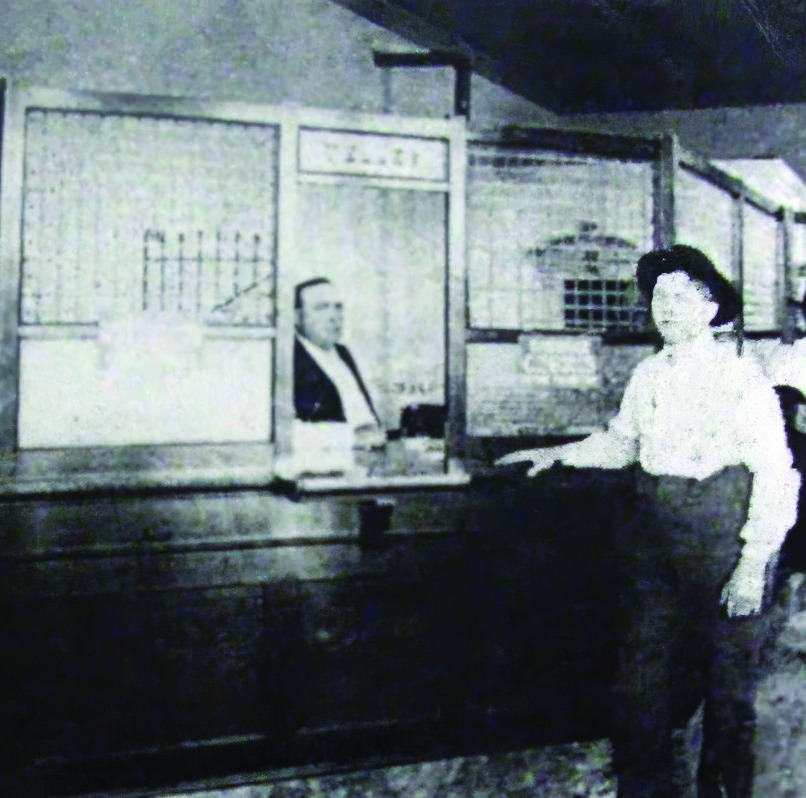
Two Lucky Man Crime is and always has been a sad but ever-present fact of life. Beginning with the first murder in human history, recorded in Genesis, Chapter 4, to the attempted murder of President Trump last week, crimes of every type occur in every city of every county across the globe. Try as we might, crime has, been and will always be part of the human experience. And Marshall County is not immune from crime.
However, despite the daily criminal activity in Marshall County, one type of crime has only occurred two or three times in the county's one-hundred-seventeen-year history. That crime is bank robbery, which is a relatively new type of crime in human history.
Bank robbery is the criminal act of stealing from a bank, specifically while bank employeesandcustomersare subjected to force, violence, or a threat of violence. This refers to the robbery of a bank branch or teller, as opposed to other bank-owned property, such as a train, armored car, or stagecoach. Bank robbery is a federal crime in the United States.
According to the Federal Bureau of Investigation's Uniform Crime Reporting Program, robbery is 'the taking or attempting to take anything of value from the care, custody, or control of a person or persons by force or threat of force or violence or by putting the victim in fear. By contrast, burglary is 'unlawful entry of a structure to commit a felony or theft.'
According to The New YorkTimesandtheSaturday Evening Post, the first bank robbery in the United States occurred in March 1831. Two men, James Honeyman and William J. Murray, entered the City Bank of New York using forged keys. This allowed them to empty the vault of over $245,000 in bankmoney.Accordingtothe Times, whether this was a robbery or a burglary cannot be confirmed so it is listed as the first bank robbery.
Bank robberies always occur in cities and towns. This concentration is often attributed to the presence of more branches in urban areas,butthenumberofbank robberies is higher than the number of branches. This has advantages both for bank robbers and for law enforcement. Transportation infrastructure in urban areas is highly developed, especially where banks cluster near retail shopping areas and commercial districts. Such banks are highly profitable targets for robbers, who are then afforded several potential escape routes. Law enforcement benefits by responding more quickly, and the odds of catching a bank robber on or near the scene are higher than other types of crime. This is because most bank robberies are reported very quickly while the crime is in progress; most bank robberies occur during daylight hours, have multiple witnesses and, with modern technology, often produce photographic images that can be distributed and used immediately to canvass the local area. Consequently, many bank robbers are caught on the same day. The clearance rate for bank robbery is among the highest of all crimes, at nearly sixty percent.
The first recorded bank robbery in Marshall County occurred in February 1912 in Woodville. A Texas man, who was labeled as “an allaround crook,” entered the First National Bank of Woodville and robbed the teller of what cash was on hand. The robber was quickly captured after he crossed back over the Red River. This robber was a sixty-year-old man who had just recently been released from serving a twenty-year prison.
After this robbery, the biggest and most famous bank robbery in Marshall County occurred on August 15, 1927, at the First National Bank of Kingston.
On that day, bank president Bruce May arrived at the bank at 8:00 a.m., which was the normal opening time. After arriving at the bank, May, who was also on the Kingston School Board, began working on a school report while seated near the cashier’s window at the front of the bank. He was the only person in the bank at the time.
While working on his report, May realized a man hadwalkedintothebankand was approaching the teller window. Believing the man was a customer, May got up from his desk and went to the window to assist the man.
It was as he finally got to the teller's window that May realized that the man was pointing a gun at May’s head. The man, later identified as Joe Leonard, then spoke his first words to May when he said, “Stick ’em up.” May told the police that he still had a pen in his hand, but he put hishandsabovehisheadwith the pen still in hand.
WhileLeonardwasthreatening May with his gun, Leonard’s accomplice, later identified as Charley Ross came through the back door of the bank and made his way to the vault to get it opened.
At that point, Leonard ordered May to slowly walk back to the vault in case Ross could not open the vault door. As they made their way to the back of the bank, May was walking backward, and Leonard was moving slowly forward, all the while pointing his gun at May.
As they made their way to the back of the bank, Leonard was looking out the bank windows to see if anyone was approaching,stumbledovera chair. As he tried to steady himself to prevent falling, Leonard accidentally pulled the trigger of the gun, and it discharged. The bullet narrowly missed May.
The gun's discharge caused a great deal of noise, and it caught the attention of several people near the bank. Upon realizing they had been discovered,LeonardandRoss grabbedasmuchcashasthey could hold, shoved May into the vault, closed and locked the door, and ran out the side door of the bank. Because of the rush, Leonard and Ross failed to put the cash in the briefcase they had brought for that purpose.
A stranger passing through town was standing across the street from the bank, visiting with Mr. Gray outside Gray’s store, when he heard the gunshot. Upon hearingthegunshot,theman turned and saw Leonard and Ross running out of the bank, dropping cash on the sidewalk as they ran toward a car. The visitor then began yelling at the robbers, shouting loudly enough that everyone on the south end of Main Street knew a robbery had just occurred.
Leonard and Ross made their way around Stroman's shoe shop and down the alley between Tinkle's garage and the shoe shop. Their car, a Ford coupe, was parked a block west of the bank near Hubbard's blacksmith shop. Because they failed to put the money in the briefcase, witnesses found several rolls of bills between the bank and where the car was parked. In all, the witnesses found about seven hundred thirty dollars.
Kingston Constable J.A. Byrd,whohadbeenwatching the car since about 3 A.M., that morning, quickly pursued the bandits. Justice I.L. LittleaccompaniedByrd,and the robbers held their guns on the two officers until they had the car started.
Mr. Byrd followed behind the car until R.A. Rea, Mr. Dobson, a salesman of Durant, Tom Daugherty and Young Massey passed them and neared the robbers’ car. Five shots were fired at the salesman's car from the Ford coupe to stop them. They failed to stop, however, but were soon passed by Fred Cooks's car, which followed the bandits to Madill.
The Marshall County Sheriff’s office was phoned immediately after the robbery, and Sheriff Edd Long met the robbers and their pursuers at Fred Herndon's filling station south of Madill. The robbers, however, after entering Madill, turned toward the freight depot, and the car accompanied by Rea, Dodson, Daugherty and Massey was the only car that followed directly behind them.
Long went around by the Madill depot and the car following behind the robbers drove up to their car almost before it stopped. Leonard and Ross had jumped from their car without shutting off the engine. The robbers then ran between the freight cars.
As Leonard and Ross ran between the train cars, Daugherty fired two shots at them, trying to stop them. Daughtry then passed the gun to Rea, who followed under the freight cars, and he got the drop on both men, who then stopped, realizing they might be shot. Sheriff Long then arrived and held his gun on the two robbers.
While Sheriff Long made the intruders hold their hands up, Rea, with the assistance of Daugherty, searched the two men. Eight hundred thirty-two dollars and eightynine cents were found, as well as more ammunition. Sheriff Long then took them to the county jail.
Once at the jail, Leonard and Ross told the Sheriff that there was a third accomplice who was supposed to drive the getaway car, but he apparently ran off when he heard the gunfire. Additionally, the men were driving a stolen car. They also had several Ford car keys, including a Ford Master Key that would fit any model of Ford vehicle. In their briefcase that they left at the bank, the Sheriff found the masks the men were wearing when they robbed the bank, as well astwonewredhandkerchiefs and a rope. All the money taken was recovered except about seventy dollars. The man also told the Sheriff thattheyhadparkedanother Ford Coupe near an unoccupied house on the Taliaferro Farm just south of Madill.
The next day, Leonard, from Oklahoma City and Ross, of Tulsa, entered their plea to the mercy of the court and were sentenced to twenty-five years in the state penitentiary at McAlester. Later that same day, the two were transported to the state penitentiary at McAlester by Sheriff Long.
As a token of their appreciation, the First National Bank of Madill presented SheriffLongwithtwotwentydollar gold coins and one tendollar gold coin. In addition to the bank’s gift, the State Banker’s Association gave theMarshallCountySheriff’s Office five hundred dollars, andtheGovernor’sOfficealso donated five hundred dollars to the Sheriff’s Office.
Now, I suppose you are asking who else, besides May, was lucky that day. I must confess, your humble scribe was also very lucky that Leonard missed May when his gun went off. For you see, May was my great grandfather. Had he been killed that day; I would have been robbed of the opportunity to know one of the finest men who ever lived.
So, August 15, 1927, was a lucky day for two men, May and Me.