
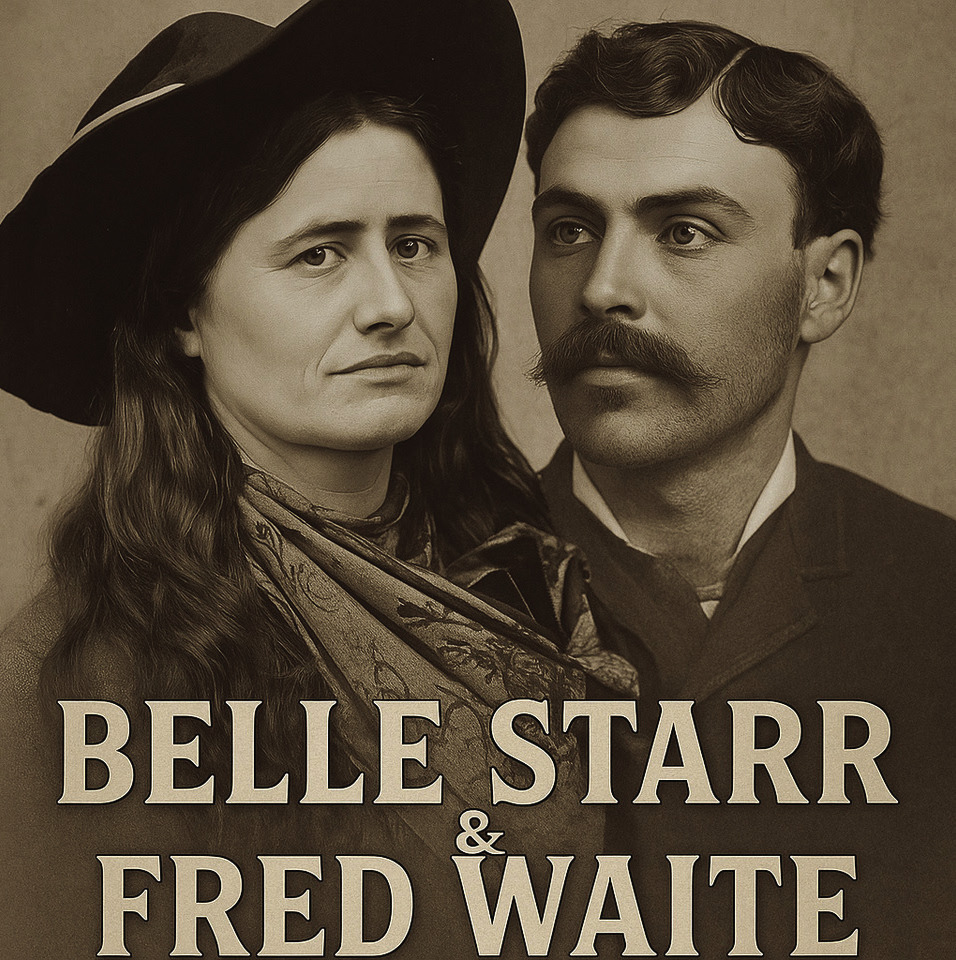
In the waning decades of the nineteenth century, Indian Territory, including the Chickasaw and Choctaw Nations stood as a great, rolling canvas of possibility, peril, and paradox. Indian Territory, as it was known to the federal government and the press back East, bore the weight of a fractured union, scattered tribes, and a law enforcement system that struggled to keep pace with the sheer magnitude of its wilderness. Amid its red clay hills, blackjack oak thickets, and winding creeks, stories were etched in blood and legend. Some of those stories became larger than life—the tales of men and women who defied the law, lived by their guns, and etched their names into the rawhide ledger of the American West.
Among them, three who terrorized Indian Territory andtheChickasawandChoctaw Nations, stood apart: Belle Starr, the infamous Bandit Queen who danced with outlaws and reveled in notoriety; Jim Webb, a ruthless killer whose vendetta against law and order met its match in the unrelenting U.S. Marshal Bass Reeves; and Fred Tecumseh Waite, a man who once rode beside Billy the Kid in the Lincoln County War and who, remarkably, later emerged as a statesman of the Chickasaw Nation. These figures did not just pass through Indian Territory— they were its pulse, its mythology, and its grim reminder that civilization came at a terrible cost.
It is against this backdrop thatwefirstencounterJames Wasson. His name does not burn as brightly in the pantheon of outlaw legends, but in many ways, his life was the distilled essence of the Territory itself—its lawlessness, its sorrow, its reckoning. And in other ways, Wasson was just as evil, if not more so, than Belle Starr, Jim Webb and Fred Waite.
The Bandit Queen of
Indian Territory
Myra Maybelle Shirley Reed Starr, known to the world as Belle Starr, was born on February 5, 1848, on her father's farm near Carthage, Missouri. Raised with refined tastes and educated in classical subjects, she studied piano at the Carthage Female Academy, a private institution her father helped establish. But the genteel trappings of her early life would stand in stark contrast to the dusty trails and gunpowder-ridden chapters that would later define her legacy.
The turbulence of the Civil War swept Belle's family into its maelstrom. Her older brother, Bud Shirley, became a Confederate bushwhacker, and Belle is rumored to have aided him as a courier and scout. When Bud was killed by Union troops in 1864, the Shirleys fled to Texas, eventually settling in Scyene near Dallas. Here began Belle's lifelong association with outlaws, many of whom were former Confederate soldiers who the war had displaced.
In 1866, she married James C. Reed, a fellow Missourian with whom she had two children. Their marriage started on traditional grounds but soon descended into a life of lawlessness. Reed joined various outlaw gangs, including the Starr clan, a Cherokee family known for whiskey running and horse thievery in the Indian Territory. The couple moved west, and Belle took to her new identity with flair: riding sidesaddle in black velvet, brandishing two pistols, and maintaining a dramatic, dark persona that captivated the imaginations of onlookers and journalists alike.
James Reed was killed in 1874 in Paris, Texas. Belle, now a widow with two children, continued to associate with criminals. She may have briefly married Charles Younger, a member of the notorious Younger family, thoughthemarriageremains undocumented. By 1880, she married Sam Starr, a Cherokee man deeply embedded in the Starr criminal enterprise. With Sam, Belle reached the height of her infamy.
Operating from their homesteadatYounger'sBend in the Indian Territory, the Starrs established a haven for outlaws, bootleggers, and horse thieves. Belle organized criminal activity and utilized her connections and bribes to secure the release of captured associates. Her most infamous arrest occurred in 1882, when she and Sam were apprehended for horsetheftandtriedbyJudge Isaac C. Parker, known as the 'Hanging Judge' of Fort Smith. Belle was sentenced to nine months in the Detroit House of Corrections, where her conduct earned her the favor of prison officials.
Sam Starr was killed in 1886 in a gunfight with law officer Frank West, ending the most stable and productive period of Belle's criminal career. She spiraled into a series of brief, often exploitative relationships with various outlaws, including Blue Duck, Jim French, and ultimately Jim July Starr, a relative of Sam's, much younger than she.
Belle's end came as violently asherlife.OnFebruary 3, 1889, she was shot in the back on a remote trail near Younger's Bend. The murder remains unsolved. Speculation ranged from familial betrayal to outlaw revenge. Herlifeanddeathbecamethe subject of newspapers, dime novels, and eventually films and television. Although largely mythologized, Belle Starr's career reflects the social upheaval, blurred legal boundaries, and violent charisma thatdefinedtheoutlaw era in Indian Territory.
Jim Webb — The Outlaw with No Mercy Jim Webb’s life remains less romanticized than Belle Starr’s, but no less fearsome. An unapologetic killer with ties to the Chickasaw Nation, Webb's tale is woven with blood, vengeance, and one of the most remarkable manhunts in Western history.
WebbarrivedintheChickasaw Nation from Texas around 1883, taking charge of the Washington-McLish ranchonSpringCreek.Hedeveloped a reputation not only for running the ranch with an iron grip but for his racist ideologyandviolenttemperament. His crimes came to a head with the murder of Rev. William Steward, a Black preacher and rancher.
A brush fire dispute sparked the fatal encounter. When Steward's controlled fire spread to Webb's ranch, the confrontation escalated. Webb drew his revolver and gunnedStewarddownincold blood. Judge Isaac Parker's federal court issued a warrant for murder, and Deputy U.S. Marshal Bass Reeves was assigned to bring Webb to justice.
Reeves, a formidable Black lawman renowned across the Indian Territory, partnered with posseman Floyd Wilson to arrest Webb. They approached the ranch in disguise and were invited to breakfast. Over the meal, Webb sat armed and suspicious. After eating, the men walked outside. In a flash, Reeves struck Webb's gun aside, seized him by the throat, and wrestled him into submission. Frank Smith, a cowboyattheranch,firedtwo shots at Reeves but missed. Reeves coolly returned fire, fatally wounding Smith. Webb was shackled and taken to jail.
After a year in confinement, Webb made bail—a staggering $17,000 posted by friends. When the trial came, he skipped. Once again, Bass Reeves was sent to find him.
In 1884, Reeves received a tip that Webb was hiding at Jim Bywater’s general store near Woodford, Oklahoma. Reeves and his new posseman, John Cantrell, approached the location. Cantrell spotted Webb inside and signaled Reeves. As Reeves charged, Webb bolted out a window with his Winchester and revolver, making a desperate sprint for his horse. Reeves cut him off. Webb fired four shots: one grazed Reeves’ saddle horn, another cut a button from his coat, one severed his bridle reins, and another clipped his hat brim. Calm as ever, Reeves fired two shots from his Winchester. Both struck Webb in the chest.
Asthelawmenapproached the dying man, Webb made his final confession: he had killed 11 men, four in Indian Territory, and believed Reeves would be his twelfth. He gave Reeves his revolver and belt as a sign of respect. Webb died with the acknowledgment of his defeat by the one man he could not outshoot.
In later recounting the story, Bass Reeves stated that Webb was “The bravest man I ever saw was Jim Webb, a Mexican that I killed in 1884 near Sacred Heart Mission. He was a murderer; I got in between him and his horse. He stepped out into the open 500 yards away and commencedshootingwithhis Winchester. Before I could drop off my horse, his first bullet cut a button off my coat, and the second cut my bridle rein in two. I shifted my six-shooter and grabbed my Winchester and shot twice. He dropped, and when I picked him up, I found that my two bullets had struck within a half-inch of each other. He shot four times, and every time he shot, he kept running closer to me. He was 500 yards away from me when I killed him.”
Webb's story underscores the harsh justice of Indian Territory, where even the mostdangerousmenwerenot beyond the reach of relentless lawmen like Reeves. Interestingly, the killing of Jim Webb by Bass Reeves was portrayedintheTaylorSheridan television show about the life of Bass Reeves titled “Lawman – Bass Reeves,” which aired on the Paramount+ streaming service in November 2023. While the show did deviate somewhat from actual historical facts, the killing of Webb was covered in the story, indicating the significance of the event.
Fred Tecumseh Waite — The Outlaw Statesman Fred Waite’s life is one of the most extraordinary transformationsinAmerican frontier history. Born on September 23, 1853, at Fort Arbuckle, he descended from a distinguished Chickasaw line through his mother, Catherine McClure, and from white settlers through his father, Thomas Waite. Educated and multilingual, Fred Waite attended institutions in Arkansas, Illinois, and Missouri, absorbing the tools of law and letters while retaining the grit of his frontier upbringing.
In 1876, Waite left Indian Territory and headed west, landing in Lincoln County, New Mexico. There he became embroiled in the Lincoln County War, one of the West’s most infamous feuds. He rode with Billy the Kid, John Middleton, Henry Brown,andotherRegulators, avenging the murder of John Tunstall and fighting against theDolan-Murphymonopoly known as 'The House.'
Waite was present during the murder of Sheriff William Brady and likely fired the fatal shot that killed Deputy George Hindemann. He took part in the prolonged gunfight at Blazer’s Mill and narrowly escaped the Five-Day Battle in Lincoln. Federal warrants for murder trailed him. Disillusioned and hunted, Waite returned to the Chickasaw Nation by 1879, leaving the gunfights behind.
But Waite did not fade into obscurity. He returned to the Rush Creek Valley, resumed family business affairs, and married Mary Thompson in 1881. Gradually, he re-entered public life. By the mid-1880s, he edited the Chickasaw Enterprise newspaper and emerged as a political voice.
In 1886, he was appointed a delegate to an intertribal council and later elected Speaker of the House in the Chickasaw legislature. His oratory, diplomacy, and understanding of both Indian and American legal structures earned him the title of Attorney General. He fought bitterly to delay allotment and preserve tribal sovereignty, authoring powerful letters to President Grover Cleveland.
He worked alongside tribal leaders like Sam Paul and Tecumseh McClure, guiding the Nation through one of its most politically precarious periods. Though eventually weakened by illness, he remained a stalwart figure until he died in 1895. His journey from fugitive to lawmaker encapsulates the tension and transformation of Indian Territory in the final decades of the 19th century.
Belle Starr, Jim Webb, and Fred Waite carved wildly different paths through the rugged expanses of the Chickasaw and Choctaw Nations. Starr embraced her legend. Webb died in defiance. Waite returned from violence to serve as a beacon of Chickasaw leadership.
Together, their stories reveal a frontier that was far more than myth. It was a living theater of contradiction— where civility and savagery danced, and where redemption, vengeance, and defiance defined a generation.
Their shadows still hang over Oklahoma's red hills, reminders of a time when law and outlaw walked side by side.
When James Wasson took up arms and rode into infamy in the early 1880s, he stepped into a land already carved by figures like Starr, Webb, and Waite. The territory was bloodied, its paths trodden by renegades and redeemers alike.TheChickasawNation, whereWassonwouldcommit his grisliest acts, had already witnessed the duel between federal jurisdiction and tribal justice. It had seen an outlaw become a statesman, a killer respect a marshal, and a woman rule the backwoods as queen.
Born in January of either 1848 or 1849, possibly in Hamilton County, Tennessee, James Wasson made his first documented appearance in the Indian Territory around 1874. His name surfaced in the County Court Records of Panola and Pickens Counties,ChickasawNation, listed as a witness to a bill of sale involving a sizable herd of cattle. That record alone might have cast him as just another ranch hand or frontier businessman, but it was only the faintest echo of what he would become.
Wasson had brothers— Demetrius (known as Met), Charles A., and possibly others—and a sister named Martha. His familial ties crisscrossed the territory like wagon tracks. The Wasson family were tied in varying degrees to other prominent names in the region, including the Colberts, Juzans, and Brooks. These were names written in the tribal rolls, in the permits of county courts, and in the whispered recollections of settlers who remembered the days when law rode on horseback and justice was measured by the length of a rope.
The early 1880s found Wasson and his cohort John DukeMcLaughlin—¾Chickasaw by blood, son of Ben and Amanda McLaughlin, and brother to diarist Lotte (McLaughlin) Durham— firmlyrootedintheWoodville and Harney area. Though both men kept company with local families and attended community functions, they were increasingly known for their drunkenness and short tempers.
Tensions simmered for months in this crucible of small-town rivalry and frontier pride. Old grudges festered. One such feud, between Wassonandaneighbor named Henry Martin, would erupt into the most notorious murder the region had yet seen.
In many ways, Wasson was one of the last of his kind—a desperado whose crimeswerenotjustpersonal, but emblematic of the dying days of frontier autonomy. He murdered a man over a whiskey-fueled grudge, fled across state lines, and killed again when defied.
Beforethegallowsclaimed James Wasson, others had already written the script. Belle Starr had ridden in velvet, Jim Webb had died with honor from a lawman, and Fred Waite had risen beyondtheblood.Andthough their stories diverge in violence and virtue, together they shaped the world James Wasson would enter—and ultimately, leave at the end of a rope.
The events that followed would eventually shock Indian Territory, stain the reputation of a once-quiet crossroads settlement of Harney/Woodville, begin a descent into multiple murders, including feuds involving some of Marshall County’s most well-known families, and push Judge Isaac C. Parker’s gallows into the national spotlight. James Wasson’s journey from obscure cattleman to infamous killer began with a keg of moonshine, an old resentment,andafatefulride across the Red River.
That story in Part IV.