
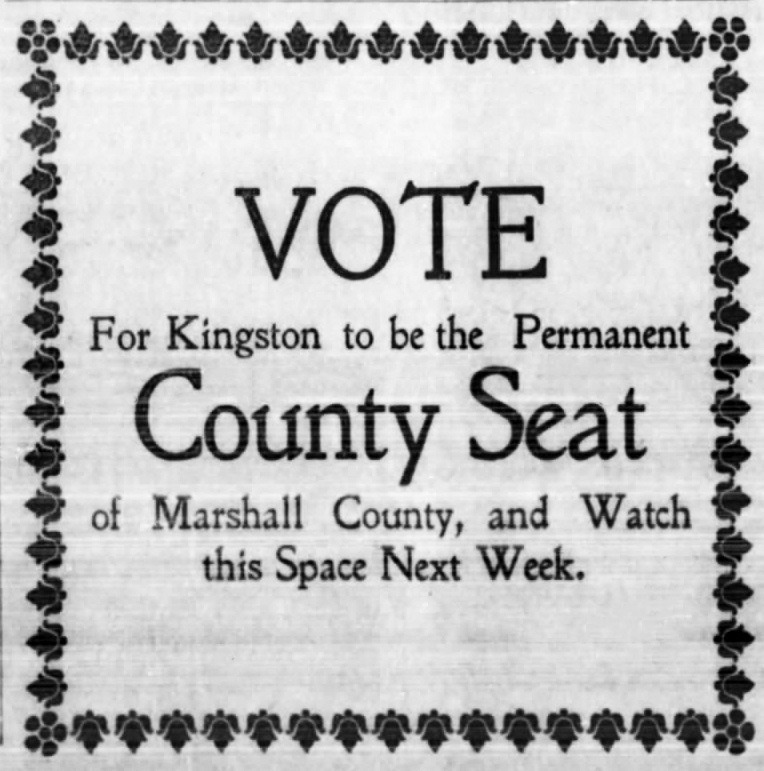
On May 1, 1908, Oklahoma Governor Charles Haskell issued a proclamation ordering an election on July 10, 1908, in Marshall County to determine whether Madill or Kingston should be declared the county seat. With that proclamation, a bitter fight began in Marshall County—a fight that divided the county, damaged relationships between various communities, drove a wedge between friends and led to a rivalry that still exists.
The two sides began pointing fingers at each other almost immediately after the proclamation was issued, trying to affix blame for the dispute. Madill blamed Kingston, and Kingston blamed Madill. Each townthentooktheirgrievances to the people of the county who werenotcitizensofeithertown.
As reported last week, a significant issue in dispute between Madill and Kingston was which town was closer to the county's geographic center. Thispointdeterminedwhether moving the county seat from Madill to Kingston would require a simple majority or a super-majority vote. Because Kingston was closer to the geographic center, a simple majority was all that was necessary for Kingston to prevail. This concerned those supporting Madill as the county seat. This concern brought about an effort on Madill's part to blame Kingston for the situation.
Following the Kingston Messenger report proving that Kingston was closer to the county's geographic center, both Madill newspapers, the Marshall County Democrat and the Madill News printed identical articles attempting to rebut the issue.
On May 22, 1908, both papers wrote: “WE, THE PEOPLE OF MADILL, take this occasion to present to the whole people of Marshall County, a county map, which has been compiled from the records of the United States survey, the Federal land offices at Ardmore and Tishomingo, and other reliable sources. We ask a careful study of this map and the statement of facts herewith, in connection with the contest for the relocation of the County Seat, brought on by some of the people of Kingston.
The geographical center of the county is situated in section 15, township 6 south range 5 east. It is 4 miles south of Madill, and 22-3 miles northwest of Kingston. According to the United States census taken in September, 1907, the center of population is in section 4, township 6 south range 5 east. It is about 1 1-4 miles south of Madill, and quite six miles northwest of Kingston. Madill has two railroads, one running east and west, the other running north and south through the entire length and breadth of our county.
Kingston has but one railroad. The railroads entering Madill serve efficiently a very large percentage of the 8000 people living north of a line drawn east and west through the geographical center of our county.”
“Owing to Kingston's isolated location, her railroad serves but a very small percentage of the 5300 people living in the south half of the county. Six railroad stations north of a line drawn east and west through the geographical center of the county, give the people of our county ample, easy and cheap transportation to and from Madill. There is but one railroad station (Woodville), from which people living in our county can reach Kingston unless they pass through Madill.
The U. S. census of 1907 shows 1587 people living in the town of Madill. Of this number, 425 are males over 21 years of age, and voters. The same census shows 2127 people living in Willis township, which embraces a large part of the south half of our county, including the town of Kingston. Of this number, 492 are males over 21 years, and voters. Thus, Madill town has within 67 as many voters as the whole of Willis township, includingthetownofKingston. Madill township comprises less than 1 square mile. Willis township comprises more than 100 square miles. When we add the 2685 people in Taliaferro township, of whom 618 are males over voting age to Madill's population we have 4272 people of whom 1043 are of voting age, living within a radius of 5 miles of Madill.” When we consider that this population and voting strength is within a fraction as large as the whole population of the south half of our county, the claimthatKingstonisthemore available place for our county seat becomes ridiculous.”
“The Constitutional Convention designated Madill as our county seat. Responding to that honor and responsibility, Madill has provided fairly good accommodations for our courts and county officials, at a very small rental cost to our county. To establish the necessary accommodation for our courts and county officials at Kingston would cost a large sum of moneythatwouldhavetocome out of the taxpayers, at a time when our county needs every dollar it can raise for the payment of current expenses and the providing of public schools, roads and bridges. Have the people of Kingston, who have forced upon our county the expense of a county seat election, in the present impoverished state of our county's finances, a due and proper regard for the interests of our taxpayers. Madill offers our county a desirable and healthful location for a county seat. She has a water system owned by her people. She has in contemplation sanitary sewerage in the near future. She has electric lights. An ice plant will soon be added to her industries. She has a cotton oil mill and grain elevators, thus affording a constant and reliable market for the products of the farm. Kingston has none of these.
The town of Madill is a town of homes. More than 80 per cent of her population are owners of their own homes. Civic pride is the distinguishing quality of her citizenship. This assures to the people of our county a constant growth and development in keeping with the growth and development ofourcounty.Thetaxable values of Madill outside of its land values, total more than $1,000,000. This great sum constitutes a large percent of the total taxable values of our county and is the county's chief asset in the furnishing of the necessary revenues to carry on its public affairs. Kingston suffers greatly, by comparison, in this regard.”
After printing the above, bothpapersuppedtheanteand ended their nearly half-page articles with the following.
“We the people of Madill deplore the fact that a county election has been forced upon the people of our county at this time. We believe the cost to the county, the cost to the individual taxpayer, in money, will be considerable. We know that the finances of our county are impoverished and can ill-afford costly proceedings of this kind. We feel that the turmoil and strife engendered by this contest will retard the growth and prosperity of our county, and in view thereof, we disclaim any responsibility for bringing on this election and point to the ambition of a small number of people of Kingston as the prime cause, if not the sole cause of this contest and its attendant train of expense and discord. Since the contest has been forced upon us, we appeal to the sober, unbiased and patriotic judgment of the people of our county and ask them to carefully weigh, and with open and unbiased minds consider Madill's claims on theirsupport,andfirmlyreposing confidence in the wisdom, good sense and sound judgment of the whole people, we feel we do not appeal in vain.”
This last paragraph caused quite a stir in the county. It provoked a strong response from the Kingston Messenger, and it opened up a fresh wound that had been made by Marshall County’s State Senator, William Franklin when he opposed and thus killed Marshall County State Representative Stump Ashby’s bill to provide for two court circuits with one in Madill and one in Kingston.
As previously reported, the State Constitution provided in Article Section 13 that “The County Court shall be held at the county seat, but the Legislature may provide for holding sessions of the County Court at not more than two additional places In the county...”
Because of this provision in Section 13 of the Constitution, Marshall County State Representative Stump Ashby proposed dividing Marshall County into two County Court Districts, designating Court Towns, terms of court and class of cases to be tried in each district. Ashby’s act created County Court District No. 1 and County Court District No. 2. County Court District No. 1 would be based in Madill and cover the north half of the county. County Court No. 2 would be based in Kingston and cover the south half of the county.
However, Marshall County State Senator William Franklin opposed Ashby’s bill, which was never introduced in the Legislature. In a letter to the Kingston Messenger, Franklin stated: “As ABOUT FIFTEEN HUNDRED PEOPLE in that county protested against the passage of the proposed bill and as the county seat can be reached from any part of the county within a few hours, could I not be recreant to my duty to support a bill that would place UNNECESSARY BURDENSUPONTHE PEOPLE?”
Franklin then stated: “You suggest that 'similar bills will be passed in almost all counties in the state.' THEY WILL NOT BY MY VOTE. The fact is (watch and see) not a dozen bills of the kind proposed will pass. NOT A SINGLECOUNTYASSMALL AS MARSHALL WILL HAVE SEPARATE PLACES FOR HOLDINGCOUNTYCOURT. NOT A SINGLE TOWN AS CLOSE TO THE COUNTY SEAT AS KINGSTON IS TO MADILL WILL BE GIVEN A TERM OF THE COUNTY COURT.”
In response to the joint articles in the Marshall County Democrat and the Madill News, the editor of the Kingston Messenger had the following response: “SHIFTING RESPONSIBILITY. We, the people of Madill, disclaim any responsibility for bringing on this election and point to the ambition of a small number of people of Kingston as the prime cause, if not the sole cause, of this contest and its attendant train of expense and discord. 'The above campaign argument appeared in the two papers of Madill and, as shown above, was published under the caption of 'we, the people of Madill.'
The 150 men of Kingston and the 850 men of Marshall County, outside of Kingston, will never shift the responsibility of assisting the whole people of this county in having an opportunity to vote on the question of a location for permanent county seat. Infact, the one thousand men who signed the petition, called by Madill as the 'Kington petition' believe the question of permanent location for county seat and all other important questions of public interest should be settled by a vote of the whole people and not by office holders. Therefore, these one thousand petitioners feel just a little proud of what they have done and will do for the entire citizenship of Marshall County on the 10th day of July. But the above campaign statement of the Madill papers is not true as hundreds of people in this county know, and as 'all the people in the county shall know. Long before the people of Marshall County or Kingston conceived the idea of asking for an election for locating the permanent county seat, and prior to March 7, 1908, a committee from Madill, either self-constituted or commissioned with authority of that town, went to Guthrie and consulted with the state senator from Madill for the purpose of ordering a county sent election and finally settling the question of permanent location as soon as possible. The senator informed this committee that, in his opinion, Madill being the temporary county seat, could not petition for the county seat election.”
“About the time Madill was making this investigation to ascertain whether she could petition for a county seat election, the people of Kingston and this part of the county made application to the legislature for a branch of the county court to be located at Kingston. At that time the people of the central and southern parts of the county, knowing they were entitled to a division of the court, did not dream of a protest by Madill, and had no intention of applying for the permanent location of the county seat. On hearing of this move for a division of the court, Madill rose up in arms protesting against Kingston or any other country town having a branch of the court; they sent acommitteetoGuthriebearing a petition signed by the people of Madill asking the legislature to oppose any bill giving Kingston or any other country town a division of the court.”
“The following is copy of the petition signed by people of Madill and presented by the Madill committee to the legislature: 'To the Honorable Senate and House of Representatives, Guthrie, Oklahoma: As notice has been given through the public press that a bill would be introduced looking to a division of the court in our county designating two or more towns for holding court; we, the undersigned, citizens and voters of Marshall County respectfully enter our solemn protest against the passage of such bill. We have one of the smallest counties in the state, and there is no point in the county from which our citizens cannot reach the county seat and return the same day. Look at the map' “AcommitteefromKingston wenttoGuthrieforthepurpose of asking the legislature to pass a bill giving one or more country towns divisions of the courts. This committee was informed that the proposed bill would pass the House with practically no opposition. The committee, waited on Senator Franklin, senator from Madill, for the purpose of ascertaining his views of the proposed bill. Senator Franklin finally informed this committee that he was opposed to any bill giving other towns, outside of Madill in Marshall County, divisions of the courts, and would refuse to support such a bill in the senate if ten thousand men in the County of Marshall should petition him to support it. This committee, decided that, if the proposed bill should pass the House, it would fail in the Senate, with Senator Franklin opposing it, and, for this reason, the proposed bill was never introduced in either the House or the Senate.
This protest on the part of Madill objecting to other towns of the county having divisions of the court, together with Senator Franklin's declaration that he would not support such a bill if petitioned by ten thousand voters of Marshall County, moved the people to take the only course open to them for protection against political machination and appeal to Governor Haskell for a county seat election in which the whole people could have a voice and vote in locating the permanent county seat.”
“When the people of Madill heard of the country people's appeal to Governor Haskell, they wrote a petition, signed it and circulated it in Madill and other parts of the county, expressing their wish and desire to join with other people of the county in asking the governor to call this very election which will take place on July 10th. The following is a copy of the Madill petition: To the Governor of the State of Oklahoma: We, the undersigned qualified electors of Marshall County, State of Oklahoma, hereby petition the GovernorofsaidStatetocallan election to relocate the county seat of said County under the provisions of Section 6, Article XVII of the Constitution.'
“Furthermore leading citizens of Madill, who will not deny the fact came to Kingston in person and requested that the petition from this town be held up and not presented to the governor until the petitionfrom Madillcouldbecompleted andbothpetitionsbepresented to the governor at the same time.
The above and foregoing statements are true and correct and are submitted to the consideration of the voters 'of MarshallCountythattheymay decide for themselves whether Madill can truthfully disclaim any responsibility for bringing on this election' and whether Madill can honestly 'point to the ambitions of a small number of people of Kingston as the prime cause, if not the sole cause, of this contest and its attendant train of expense and discord.”
The “blame game” was in full swing following these two articles. Representatives of Madill claimed that Kingston wanted the county seat for personal gain, even though Madill businesses and citizens would reap financial gain from the county seat remaining in Madill and suffer economic losses if the county seat was removed to Kingston. And Kingston representatives were blaming Madill for scuttling Stump Ashby’s Solomon-like compromise plan to “split the baby” by setting up two court circuits.
Interestingly, Senator Franklin was wrong in his prediction that none of the other twelve bills introduced to establish court divisions in other counties would pass. He had told the Kingston Messenger: “You suggest that ‘similar bills will be passed in almost all counties in the state.’ THEY WILLNOTBYMYVOTE.The fact is (watch and see) not a dozen bills of the kind proposed will pass.”
By the end of May, the legislature had passed all twelve bills by large margins in both the House and the Senate, and Governor Haskell had signed them into law. In Hughes County, besides the county seat of Holdenville, the legislature established courts in Dustin and Guertie. In Seminole County, a court was established in Konawa and Wewoka. Later, a court was established in the town of Seminole. Jefferson County was divided into two court districts in a bill almost identical to Stump Ashby’s bill. In Garvin County, a court was established in Stratford, in addition to the county seat of Pauls Valley.
In Rogers County, courts were established in the county seat of Claremore and the towns of Collinsworth and Chelsea. In Atoka County, a court was established in Caney and in the county seat of Atoka. In Johnston County, the county seat was designated as Tishomingo, but a law was passed establishing a court in Wapanuka. And even though Durant was declared the county seat of Bryan County by the State Constitution, two separate bills were passed in 1908 that established courts in both Bennington and Caddo.
The only bill to establish county court circuits or county court towns to fail was Stump Ashby’s bill to establish a court inKingstonandthecountyseat court in Madill. This fact was not lost on the people of Kingston. Whenwordspreadthatall twelve other bills establishing multiple courts were passed by the legislature and signed into law by Governor Haskell, the Kingston Messenger wrote the following on May 29, 1908: “GENEROUS DURANT. When Bennington and Caddo, two country towns of Bryan County, asked for branches of the county court, what did Durant the county seat of Bryan County, do? That generous town called a meeting of its commercial club and businessmen and passed resolutions andappointedcommittees.Did these resolutions declare that 'we enter our most solemn protest against two or more towns of the county having divisions of the court?' No.
Did the committees appointed go to Guthrie to oppose a bill that would give the two country towns their constitutional rights? No. Did the state senator from that county say he would not respect a petition signed by ten thousand voters of his county? No. The resolutions adopted by Durant, the county seat of Bryan County, favored the two country towns having branches of the court. The committee appointed by Durant went to Guthrie, not to fight a bill, but to support a bill giving the divisions of court to the country towns. What was the result? Caddo and Bennington have divisions of the court; Durant has the friendship of all the county towns and has no contest for county seat.
MORAL: if Madill had not entered her solemn protest against one or more!! county towns of Marshall County having divisions of the court, she could now have the friendship of all county towns and would not be engaged in a losing contest for the permanent county seat.”
After the passage of the twelve bills authorizing courts in towns other than the county seat, courts were established in each respective town. Over the next few years, more laws were passed, establishing dual courts in nearly every county in Oklahoma except for Marshall County. The courts in Bennington and Caddo ran from 1908 until 1919. In Johnston County, the court in Wapanucka operated for almost twenty years. InSeminoleCountyand KayCounty,courtsoperatedin two towns in each county until the last ten to fifteen years. And in Creek County, there are still two courts today—one in Sapulpa, the county seat, and one in Bristow. Senator Franklin was dead wrong in his prognostication and failed to block dual court systems in other Oklahoma counties. But he succeeded in Marshall County,whichhascausedalingering rivalry between Madill and Kingston that exists today.
It is understandable why the people of Kingston were disappointed and upset. And it is understandable why the people of Kingston decided to “go for the gold.” If Franklin had supported Stump Ashby’s proposal for Marshall County circuit courts, the fight between Madill and Kingston would have ended there. But Franklin’s stubbornness and unwillingness to compromise led to a bitter dispute that would rage on for another five years and then simmer for another one hundred and ten.