
On June 6, 1906, Congress passed the Oklahoma Enabling Act to provide for a single state to be formed from OklahomaandIndianterritories. On November 6 of that year, elections were held in both territories for delegates totheConstitutionalConvention. Each territory elected 55 delegates, and two additional delegates were elected from the Osage Nation. Of the 112 delegates,99wereDemocrats 12 were Republicans, and the remaining delegate was an independent. The delegates elected William H. 'Alfalfa Bill' Murray as president.
The Constitutional Convention began in Guthrie on November 20, 1906, and adjournedonMarch15,1907. Two additional week-long sessions were held to finish the document. The date set for placing the document before the people of Oklahoma and Indian Territories was September 17, 1907. That date was symbolically chosen because the drafters of the U.S. Constitution had adjourned their convention on September 17, 1787.
William Jennings Bryan did come to the state to encourage the adoption of the proposed constitution. Having earlier admonished the convention in a letter to rely on previous state constitutions to produce the best constitution ever written, he later proclaimed that he thought they had done just that.
The citizens of the two territories agreed, and 71 percent voted for its adoption. Then, on November 16, 1907, President Theodore Roosevelt signed the proper papers, proclaiming that 'Oklahoma is now a state.'
While the Oklahoma Constitution contained little new, the convention members followed Bryan's advice. They consulted numerous state constitutions, the proceedings of the Sequoyah Convention, the proposed State of Sequoyah Constitution, and the U.S. Constitution to produce an innovative document with many progressive provisions.
One of the major tasks of the writers of the Oklahoma Constitution was to designate counties and county seats. The process was contentious, and everyone on the county committee had opinions about boundary lines and principal cities.
While some of the most strident lobbying in the Constitutional Convention was over selecting county seats, the winners were often unpopular. While the delegates oversaw identifying where county governments would be located, there were, in some instances, strong disagreements and outright rebellion. Therefore, the committee declared that elections could be conducted in each county after statehood to satisfy these competing interests. However, at the final ceremony at Guthrie on November 16, 1907, officials designated the location of counties, their boundaries and the seat of each county government. Thus, Madill was designated as the county seat in the newly created Marshall County.
The designation of Madill as the new county seat almost immediately caused an uproar from the citizens of Kingston and a few other communities in Marshall County. Within hours of Oklahoma's admission as a state, the rivalry between Madill and Kingston heated up just as it had in 1905 when the citizens of Indian Territory adoptedtheConstitution for the proposed State of Sequoyah and declared Madill the county seat for Overton County. In the proposed State of Sequoyah, the area covering Madill, Kingston, Willis and the other communities makingupwhatisnow Marshall County was known as Overton County.
Becauseofdisputesduring theOklahomaConstitutional Convention regarding the designation of county seats, the framers of the Constitution provided in Article XVII, Section 6, that “The towns herein named as county seats shall be and remain the county seats of their respective countiesuntilchangedby vote of the qualified electors of such county, in the following manner: “Upon a petition or petitions in writing, signed by twenty-five per centum of the qualified electors of the county, such per centum to be determined by the total vote cast in such county for the head of the State ticket in the next preceding general election, said petition or petitions being verified by an affidavit showing that the petitioners are qualified electors of said county, and such petition or petitions having been filed with the Governor at any time after four months after the admission of the State into the Union, the Governor shall within thirty days issue his proclamation calling an election to be held in such county not less than sixty nor more than seventy days from the date of his proclamation.”
The Constitution went on to provide that: “If a majority of all the votes cast in the county at such county seat election shall be in favor of any town, such town shall thereafter be the county seat: Provided, however, that where the county seat named in this Constitution is within six miles of the geographical center of the county (said geographical center to be determined by certificate from the Secretary of State, and said distance to be determined by measurement from said geographical center to the nearest corporate limits of such county seat as they existed on the twenty-first day of January, Nineteen Hundred and Seven), it shall require sixty per centum of the total vote cast at such election by the competing town to effect the removal of such county seat, unless such competing town be more than one mile nearer the geographical center of said county, in which event a majority vote shall suffice…” Finally, the Constitution stated that: “after the first day of April, Nineteen Hundred and Nine, all county seats shall be subject to removal undertheabovenamed provisions; but, the town to which removal is sought must receive two-thirds of all votes cast in such county at the election held therefor, and such elections shall not occur at intervals of less than ten years: Provided further, that until after the first day of April, Nineteen Hundred and Nine, no public money shall be expended for court house or jail construction unless a vote of the people of such county shall have been taken on the relocation of the county seat.”
This provision in the Constitution set off a rivalry between Madill and Kingston that still exists today. Within weeks, articles began appearing in newspapers in the county. At that time, the Marshall County Democrat, the Madill News, the Kingston Messenger and the Woodville Star existed. These papers played out the warof words between the two towns for several months.
In fact, the first battle began before Oklahoma was granted statehood. On October 25, 1907, in the Marshall County Democrat issue, the editor, W. G. Draper, wrote, 'Teddy (President Theodore Roosevelt) has killed the bear and returned to the White House satisfied on that line. We feel sure he will take up the statehood question at once and issue his proclamation not later than the 10th of November. Then it will be Madill, county seat of Marshall County.”
Before the ink was dry on President Roosevelt’s signature on the Proclamation of Statehood, the people of Kingston began working on the drafting and circulation of a petition to move the county seat from Madill to Kingston. But before the petition was completed, a new development occurred.
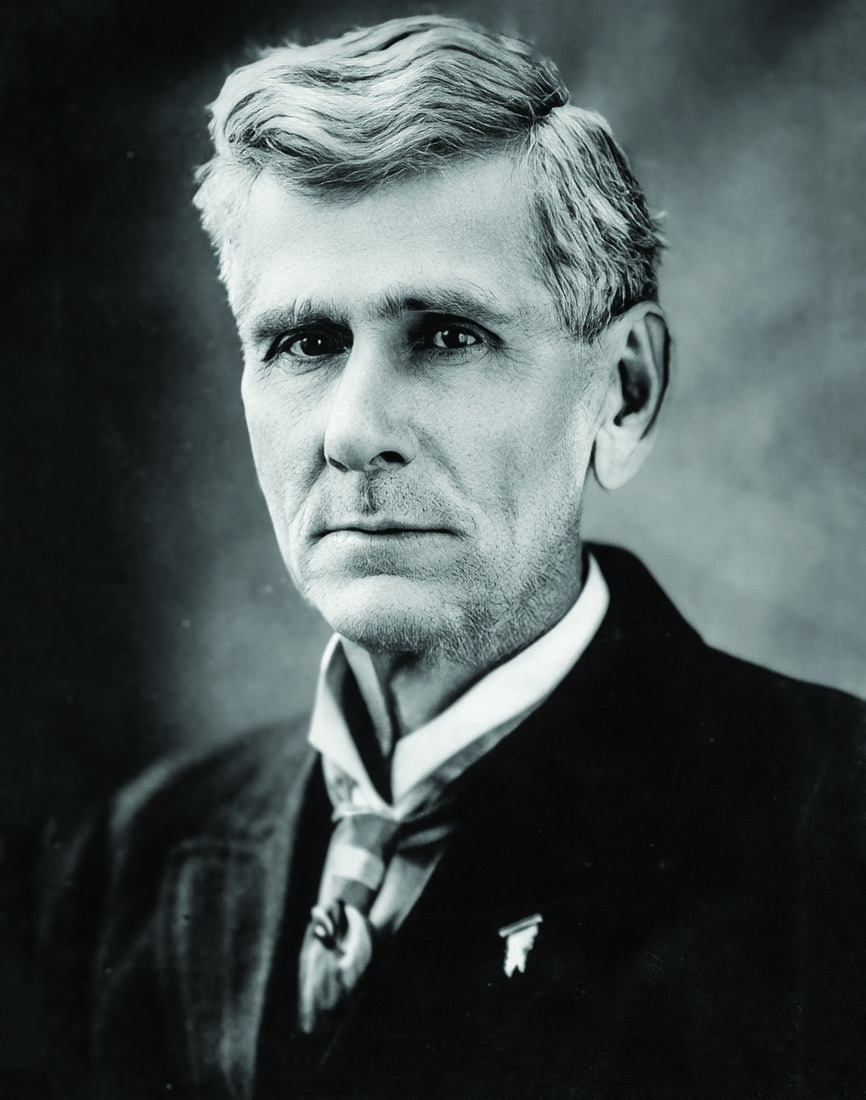
Because of the dispute, Marshall County’s first State Representative, Harrison Sterling Price “Stump” Ashby, proposed legislation he thought would calm the waters and give the people of Madill and Kingston what they wanted. It was a unique idea that would eventually occur in other counties across the state.
Stump Ashby was born to Benjamin F. and Martina Virginia (Walton) Ashby on May 18, 1848, in Chariton County, Missouri. At the beginning of the Civil War, Ashbywastooyoungtoenlist, so he often volunteered to be a midnight messenger for Confederate officers through dangerous territory. Later, he enlisted in the Confederate States Army and became a member of Shelby's Iron Brigade, also known as the Missouri Iron Brigade. Shelby’s Brigade was a Confederate cavalry brigade led by General Joseph O. Shelby in the Trans-Mississippi Theater of the war.
Shelby's Iron Brigade was originally formed in 1863, underordersfromMajorGeneral Thomas C. Hindman, following a successful recruiting expedition into Missouri by Joseph O. Shelby, Upton HaysandJohnT.Coffee,who each recruited a cavalry regiment. These new regiments Shelby's 5th, Hays's 11th and Coffee's 6th (redesignated as 12th), were brigaded under the command of Colonel Shelby. in Arkansas and participated in four major raids into Missouri during the war, earning a reputation as the most formidable brigade in the theater. The brigade remained in Shelby's Division in the Army of Missouri and fought in Maj. Gen. Sterling Price's Missouri Expedition in 1864—saving Price's army from destruction several times, including the retreat at the Battle of Marmiton River.
In the autumn of 1864, some 1,500 of Shelby’s Iron Brigade cavalry surrounded Sedalia, Missouri, and overpowered local Union militia defenders. Later, the Missouri Iron Brigade distinguished themselves at the 1864 Little Blue River and Westport battles and captured many towns from their Union garrisons, including Potosi, Boonville, Waverly, Stockton, Lexington, and California, Missouri. By the war's end, Ashby had achieved the rank of Colonel in the Confederate Army.
Following the war, Ashby movedtoTexas,wherehewas an actor, cattle driver, farmer, and schoolteacher. When he first moved to Texas, he worked as a clown in a traveling circus. One night, when the show was idle, Ashby attended a tent revival where he converted to Methodism. He was twenty when he left the circus to become a minister. Following his conversion, he quit show business and began preaching. He immediately began training in theology and became a licensed minister in 1872. Over the next fifteen years, he worked as a preacher in Belton, Lancaster, Weston, Stephenville, Rice and finally Grapevine, Texas. Ashby gained a reputation as a “revivalist” and a man who practiced what he preached. It is said that people would come a hundred miles to hear his “stirring” sermons.
In 1871, Ashby married Sara Sophia Wisdom in Cooke County, Texas. Before she died in 1876, they had four children. On January 12,1879,hemarriedAmanda Elizabeth Ray (Wray) in Belton, Texas. They had five children, two of whom died in infancy. Ben, one of his children, had achieved county political office in Oklahoma by the time of Ashby's death. How Ashby got the nickname “Stump” is one that has been a subject of debate for many years. One story is that he lost his leg, likely during the Civil War, and he used a wooden leg for the remainder of his life, and thus, folks called him “Stump.” The other story is that because Ashby was such agreatoratorandspeaker,he was very popular in political circles for his stirring and uplifting “stump” speeches, and because of his speaking prowess, he was given the name “Stump.” Regardless of which is true, Ashby was most commonly known and called “Stump.”
In 1888, he left the ministry for his political activities and for criticizing the church's failure to support reform. He is also reported to have left the church because of an alleged fondness for the bottle. Following his departure from the ministry, Ashby began a career in the newspaper business, where he published the Grapevine Telephone, the first local paper inTarrantCounty,Texas. It was while publishing the newspaper that he became interested in politics.
Ashby's interest in politics began through his acquaintance with Judge Thomas L. Nugent, a Stephenville congregation member who twice ran for governor on the Populist ticket. Ashby was one of Texas's first Farmers' Alliance speakers and organizers. He led the antimonopoly Greenback wing of the Texas Farmers' Alliance. As an early supporter of the alliance of independent political action, he helped lead an independent political movement in Fort Worth that succeeded in electing the city's mayor amid the Great Southwest Strike of 1886.
In May 1888, in Waco, he helped organize a convention of farmers, laborers, and stock raisers, which led directly to a state Union Labor party convention in July, the first statewide independent political effort in which large numbersofFarmers'Alliance men were involved. As one of the Texas alliance's first district lecturers, Ashby helped pioneer the radicals' tactics of using Democratic hostility to the Sub-Treasury plan of 1889 to split the Farmers' Alliance membership from their traditional Democratic loyalty.
Ashby's Populist career began officially when he helped organize the founding state People's Party convention, held August 17, 1891, in Dallas. This convention was coordinated with the state Farmers' Alliance meeting. As state party chairman in 1892 and 1894, Ashby organized the increasingly successful Populist state campaigns. During this time, he became a popular speaker in political circles, and his speaking program was embraced in twentyseven states.
Ashby was a delegate to the organizing convention of the National Populist Party in St. Louis in 1892. During his Populist career, he remained active in the Texas Farmers' Alliance, where he was a state lecturer from 1892 to 1894. He ran for Congress and was defeated by a very small margin. Then, in 1896, he ran unsuccessfully for lieutenant governor on the Populist ticket. He also ranafamousanti-prohibition campaign.
In 1900, Ashby moved to the Simpson, Mannsville, Indian Territory, where he farmedandbecamepresident of his local farmers' union. In 1906, he returned to politics, supporting Democrats William H. (Alfalfa Bill) Murray and Charles N. Haskell. In 1907, Ashby ran to be the first State Representative fromMarshallCounty. Inthe primary election, his main opponent was W.G. Draper, the owner and editor of the Marshall County Democrat newspaper.
In the primary, Ashby edged out Draper for the nomination of the Democrat party. The final vote was 553 to 490. Ashby’s victory over the newspaperman would eventually be a problem for Ashby. In the general election, Ashby beat the Republican candidate, A.V. Harris, by a vote of 1228 to 349. It was a win of landslide proportions. Ashby was elected to the Oklahoma House of Representatives as the first representative of Marshall County and in the First Legislature in 1907.
Once elected, Ashby delivered the nomination speech, which resulted in Alfalfa Bill Murray becoming the first Speaker of the Oklahoma House of Representatives. This earned him state-wide fame as an orator.
Ashby’s most famous speech likely occurred during the First Legislature. In that session, Catherine Ann,“Kate”Bernardsolicited Ashby’s help with one of her legislative goals. Bernard was the first Oklahoma Commissioner of Charities and Corrections. That office was the only position the Oklahoma Constitutionpermitted a woman to hold.
During the first Legislative session, Bernard lobbied for bills dealing with child labor, juvenile court, compulsory education for children, as well as legislation for adult probation, a state reformatory, treatment for the “insane” and people then called “feeble-minded and epileptics. She also pushed for an eight-hour workday for factories, state employment and mining. However, the one subject that was most important to Bernard was outlawing child labor.
Bernard worked to bring her child labor bill to a vote, and sixteen times, it was first on the legislative calendar, but each time, Alfalfa Bill Murray successfully pushed the bill to the bottom of the list via a filibuster.
Near the end of the first legislative session, Bernard desperately appealed to Governor Haskell for help, and he intervened on her behalf. Her bill finally came to the floor for debate. But again, Murray and his associates decimated her bill with multiple amendments and substitutions to kill it. The debate lasted for several hours with no success. All the labor organizations opposed the bill, but the most difficult group was the farmers association. While the farmers supported prohibitions on children working in factories and other industrial endeavors, they opposed the prohibition of children working in farming.
Bernard then appealed to Stump Ashby to lead the debate supporting her bill. When they learned that Ashby was supporting Bernard, Murray’s partners tried to derail his address by getting him drunk. Murray’s associates began feeding illegal liquor to Ashby, and he disappeared. Bernard then went searching for Ashby, and when she found him drunk and barely able to walk.
In her book, “A Life on Fire, Oklahoma’s Kate Bernard,” authorConnieCronley quoted Bernard’s retelling of the event. Bernard said, “I found Stump rather dizzy, told him I was depending upon his eloquence to save the children of the poor, and took him into a café for strong coffee.”
As Bernard led the feeble Ashbytohisseatonthehouse floor, Murray’s cohorts began yelling derogatory slurs at Ashby to dissuade him from speaking on Bernard’s behalf. But Ashby, “aged and poor but regal as a king,” struggled to stand. While he staggered and swayed, he collected himself and began to speak. As Cronley stated in her book, Ashby “took wings and soared.” She continued, “his arms were outstretched, his eyes aflame, and his voice blazed with holy fire. Word spread throughout the corridors and offices that Ashby was setting the house aflame. People poured into theassemblyroomtohearhis extemporaneous soliloquy. He spun a canopy of shining oration over the gathering, and when he finished, it floated softly over admirers and opposition alike to hold them in silence.” Cronley reported that Bernard said she “heard a clock tick,” and she then stated, “There won’t be another speech like it in the history of Oklahoma.”
Following Ashby’s speech, a vote was called, and the bill passed the House. As the House adjourned, the legislators stood to their feet and let Stump Ashby, the representative from Madill, quietly pass by them all as he left the House floor.
Bernard’s child labor bill was then passed by the Senate and was sent to Governor Haskell’s desk. But Alfalfa Bill Murray hurt and politi- cally weakened by Bernard’s solicitation of Ashby, convinced the Governor to veto the bill.
During the first session of the Oklahoma Legislature, Ashby played a pivotal role in the rivalry between Madill and Kingston as the county seat. During that first session, Ashby drafted legislation to split the county court between Madill and Kingston,grantingeachtown one-half of all court proceedings. His legislation also provided for the construction of courthouses in both Madill and Kingston. Ashby’s bill applied to Johnston County by creating courthouses in Tishomingo and Mannsville.
In the April 3, 1908, edition of the Kingston Messenger, Ashby issued a Public Notice. The notice stated the following: “Public Notice is hereby given that on the 20th day of April 1908, I will introduce in the House of Representatives the following bill: H.S.P. Ashby. AN ACT: To provide for the division of Marshall County into two County Court Districts and Designating Court Towns, terms of court and class of cases to be tried in each district.”
“Be it enacted by the people of the State of Oklahoma: Section 1. That Marshall County shall be divided into two county court districts to be known hereinafter as County Court District No. 1 and County Court District No. 2.”
“Section 2. County Court District No. 1 shall consist of all that portion of Marshall County, bounded as follows: Begin on the south boundary line and at the center point there of township No. 6 South, range No. 5 East, Indian Meridian, Indian Territory; thence north two miles; thence due east to the center of the Washita River; thence northward along the east boundary line of Marshall County to the north boundary line thereof; thence westward along the north boundary line of the county to the west boundary line thereof; thence southward to the south boundary line of township No. 6 south; thence eastward along said line to the place of beginning, and the county seat shall be the county court town therein.”
“Section 3. County Court District No. 2 shall contain all that part of Marshall County not contained in County Court District No. 1; and Kingston shall be the county court town in said district No. 2; provided, that all necessary office and court room shall be furnished free of cost to the county.”
“Section 4. After the county shall have been divided, by the county commissioners, into two county court districts, it shall be the duty of the county judge to hold each alternate session of the county court at court town designated in county court district No. 2, and the length of such term shall be determined by the county judge as in his judgment may be required to transact such business as is hereinafter provided.”
“Section 5. In cases where both plaintiff and defendant reside within county court district No. 2, it shall be the duty. Of the county court to docket for trial and to try all such cases at said court town hereinafter provided. Provided, however, that when either plaintiff or defendant resides in district No. 1 and the other in district No. 2, it shall be left to the court to decide in which district all such cases shall be tried.”
“Section 6. In county court district No. 2 all writs and process shall issue and be served as is provided by law for process of court courts of the state.”
“Section 7. In all cases appealed to the county court from the justice of the peace court, the same shall be tried in the same district wherein the justice of the peace resides.”
'Section 8. That all probate cases of appointing administrators, executors or guardiansmaybedonebythe court in either of said court districts, provided, that all controversies shall be determined or tried in the district where said guardian, executors or administrator reside. Provided, further, that in all cases where the guardian, administrator or executor is a non-resident, the hearings may be had in either district.”
“Section 9. Advertisement havingbeenmadeasrequired by law for the enactment of special laws, that all acts and parts of acts in conflict herewithareherebyrepealed; an emergency is declared immediately necessary for this act for the preservation of the public peace and safety, wherefore this act shall take effect and be in force from and after its passage and approval.”
While Ashby’s bill was well intended and would offer an olive branch to both factions in the Madill vs. Kingston rivalry, the bill's announcement made the dispute even worse. Friction between Madill and Kingston increased, and Ashby’s brilliant political career was in jeopardy.
Next week, we will discuss the fallout of Stump Ashby’s proposed legislation. Fallout for the rivalry and fallout for Ashby.