
In Marshall County, there are four Doctors of Medicine (MD), or one for every 3,960 people, according to the Oklahoma State Board of Medical Licensure and Supervision. If each of those doctors saw 10 patients each working day, each citizen could only see a doctor every year and a half if they didn’t leave the county.
One county, Atoka, in Oklahoma has one doctor for every 14,182 people and seven counties in Oklahoma — Coal, Cotton, Grant, Greer, Harper, Hughes and Pushmataha — have no doctors at all.
For people that need specialized medicine, medical care becomes even more complicated. Mattison Haydel and her twoyear-old son Stetson experience the lack of specialized medicine in rural Oklahoma on a regular basis.
Haydel’s son lives with Phelan-Mcdermid Syndrome, a genetic disorder that causes a mutation or deletion of a gene on the 22 chromosomes. Phelan-Mcdermid Syndrome results in a variety of symptoms, from intellectual disabilities to neurological symptoms to other miscellaneous health problems, which include gastrointestinal and breathing problems for young Stetson.
With all of his medical problems, Stetson and his mom visit doctors at least a few times a month. Both Haydels used to live in Marshall County, but now Mattison Haydel lives in Garvin County and Stetson lives parttime with his father in Marshall County.
Because Stetson has such complicated health issues, all his doctors are at OU Children’s Medical in Oklahoma City. The drive is around an hour and twenty minutes from where Mattison Haydel lives, or upwards of two hoursfrom MarshallCounty.
Haydel usually takes off a whole day of work for any medical visits because of the drive which often got her in trouble for at her old job.
Even for a pediatrician or emergency room visit Haydel says her son has to go to Oklahoma City. Two weekends ago, June 22, Hayden recounts taking her son to a local emergency room and being dismissed for a runny nose, just to take him to Oklahoma City Children’s Hospital where he needed to be hospitalized for three days.
“It’s really frustrating because even when he’s just sick and needs to go to the emergency room… none of the doctors around here take his case seriously so he ends up with pneumonia,” she said. “If I don’t take him straight to the city, he ends up very sick and he ends up in the hospital normally… [The doctors in the area] just don’t have the knowledge about it.”
Most of Oklahoma requires significant travel to get to any specialty doctor. One doctor that Stetson sees is a neurologist.
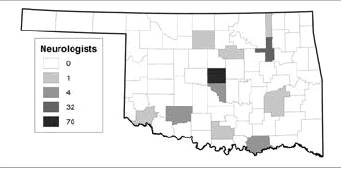
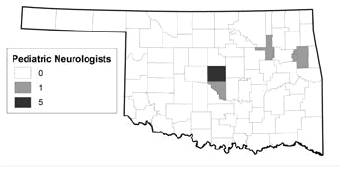
In the pink map compiled from data from the Oklahoma State Board of Medical Licensure and Supervision, a Marshall County adult seeking a neurologist would need to travel to Bryan or Carter County. For a neurologist that sees children, the nearest office is in Cleveland County, shown in the blue map.
Oklahoma has 120 neurologists that are licensed and practicing in Oklahoma and eight pediatric neurologists. This large divide between specialists that see adults and specialists that take pediatric cases is common among different specialties, such as 30 adult rheumatologist MDs (a doctor who treats musculoskeletal and autoimmune disorders) and one pediatric rheumatologist MD that are licensed and practicing in Oklahoma. Many adult specialists won’t see patients until they are legal adults at 18.
A few specialists do travel to Madill occasionally, however.
In a statement, Dr. Ely Gordon wrote, “In Madill we have a cardiologist that comes from Denison, Texas — he’s great. But [for] procedures they go to Denison. Adult specialties are more common than pediatric specialties. There is a pediatric cardiologist that comes to Denison/Sherman from Dallas… otherwise you go to [Oklahoma City] Children’s.”
To help the lack of specialized medicine in the area, Dr. Gordon suggests people try to be mindful of what harmful activities they participate in.
“Stop drinking alcohol, stop using drugs, lose weight, make responsible decisions that you know affect your health negatively (stop Spring Break Partying, don’t wrestle alligators),” he said. “We control very little, but we should control what little we can.”
Haydel said she hope medical training improves when it comes to children with disabilities.
“If a child does have a disability, it may be a little more than just a runny nose, it may be more than just a stomach virus, especially when a kid can’t tell you, ‘hey, I don’t feel right,” she said. “I hope they at least take the time out of the day to make sure these kids are okay, so that in the future we will feel more okay taking our kids rurally instead of having to take them to the city if he just needs to take him to the doctor quickly.”