
At 9:13 a.m. on Thursday, March 10, 1921, District Judge Thomas W. Champion took the bench on the third floor of the Carter County Courthouse in Ardmore. The bailiff called the court to order. Two minor felony matters were quickly disposed of, and then came the case that had dominated newspaper front pages across the country for nearly four months: The State of Oklahoma v. Clara Smith Hamon. The Daily Ardmoreite, covering events almost minute by minute, proclaimed that the “most sensational homicide trial known to criminal annals of Oklahoma” had begun. That description was characteristically breathless newspaperprose,butthecase had attracted extraordinary attention. Jake Hamon had been one of Oklahoma’s best-known oilmen, railroad promoters, and Republican political figures, and the circumstances of his death had transformed what began as a private tragedy in an Ardmore hotel into a national sensation.
For nearly four months, however, the case had largely been covered in newspapers. Reporters had followed Clara fromArdmorethroughTexas andintoMexico.Theyprinted what was presented as her private diary, published interviews with people who claimed to know what happened, and speculated about everything from Jake’s political ambitions to the nature of his relationship with Clara. Newspapers had reported Jake’s original claim that he accidentally shot himself, Clara’s disappearance, the nationwide search for her, her discovery in Mexico, her return to Oklahoma, and the maneuvering of lawyers on both sides. By March, there could have been few adults in Carter County who had not heard something about the case.
That changed on March 10. A newspaper did not have to prove what it printed beyond a reasonable doubt, but a witness in a courtroom did. Statements that had traveled across the country as gossip or sensational copy now had to withstand objections, the rules of evidence, and cross-examination. The prosecution could not convict Clara on headlines, and the defense could not acquit her on newspaper stories about Jake’s private life. Eventually, twelve jurors would be required to decide the case based on evidence admitted in Judge Champion’s courtroom.
The first task, therefore, was finding those twelve people.
The Courthouse Awakens Despite the national anticipation, the morning began with surprising quiet. Thirty minutes before court was scheduled to open, the Ardmoreite found fewer than fifty people in the courtroom, while the streets and hotel lobbiesofdowntownArdmore remained comparatively deserted. The newspaper could not resist noting that the celebrated murder trial appeared, at least momentarily, to be competing for local attention with oil wells being brought in west of town. In Ardmore in 1921, even a nationally followed murder trial apparently had difficulty competing with a new gusher.
The calm disappeared as nine o’clock approached. Clara entered accompanied by her mother and sister and took a seat immediately behind the lawyers who would defend her. The Ardmoreite carefully recorded her appearance: a blue serge tailored suit, matching hat, black stockings, patentleather slippers and a dark veil. Friends approached to shake her hand. She smiled, bowed and exchanged greetings. The newspaper placed a boxed item on its front page describing her as “selfpossessed” and reported that she had “a smile for all who greet her.” Whatever anxiety she felt privately, the Clara Smith Hamon presented to the public that morning appeared remarkably composed.
Within minutes, the atmosphere outside changed as well. By 9:10, according to the Ardmoreite, “a solid mass of humanity” filled the corridors on all three floors of the courthouse and spilled onto the lawn. The newspaperdescribedthearea as taking on a “metropolitan appearance.” Lawyers carrying papers and bags hurried throughthecrowd.Witnesses searched for places to wait. Local businessmen, oilmen, merchants, and farmers mingled with spectators who had come simply to see the woman whose photograph had appeared in newspapers from coast to coast.
Women were conspicuous among the spectators. The Ardmoreite noted that some of Ardmore’s leading society women attended and seemed intensely interested in the proceedings. That highlighted one of the trial’s striking contradictions. Women could crowd the courtroom, follow every question, testify as witnesses, and read about the case in newspapers. One woman sat at the defense table, facing the possibility of a murder conviction. Another, GeorgiaHamon,would soon sit across the courtroom, mourning the dead man. But no woman could become one of the twelve people who would decide Clara’s fate.
The press corps added another dimension. Newspaper correspondents had arrived from outside Oklahoma, and photographers jockeyed for position. The Ardmoreite noted something unheard of in the Carter County Courthouse: telegraphinstruments were “continuously ticking” in a room adjoining the courtroom as operators transmitted reports of the proceedings to newspapers elsewhere. The sound must have provided a peculiar backdrop to the day’s work—the clicking of keys carrying each significant development from a county courthouse in Ardmore to readers hundreds, and eventually thousands, of miles away.
The telegraph room itself was near the prisoners’ iron cage, part of the physical machinery by which criminal defendants ordinarily reached the courtroom. The Ardmoreite described an underground passage connecting the county jail and courthouse as the “tunnel of sighs.” Prisoners could be moved beneath the ground and brought up near the courtroom without walking openly through the streets. Clara, free on bond, didn't need the tunnel. She had entered through the public courthouse accompanied by her family and lawyers.
Photographers created their own problems. Court officials had initially restricted photography inside the courtroom, though they made arrangements to permit pictures at designated times. The cameras were so distracting that disputes arose over when and where photographers could work. This was a trial taking place at the moment when masscirculation newspapers, wire services, telegraphy and photography could turn a local murder prosecution into a national event almost as it happened.
Yet Judge Champion intended to run a court, not a theater. The Ardmoreite caption beneath his photograph reported that he intended the trial to proceed in the most expeditious manner consistent with justice and would not tolerate unnecessary delay. The speed with which the first day’s work unfolded suggests that he meant it.
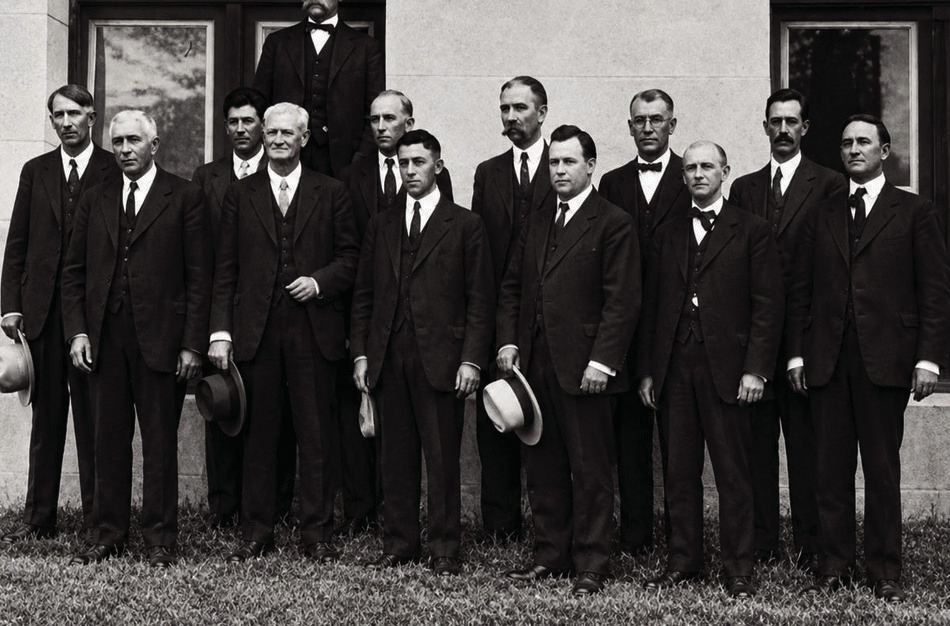
The Lawyers The collection of lawyers insideChampion’scourtroom was almost as interesting as the defendant. Oklahoma Attorney General S. P. Freeling had come personally to Ardmore to participate in the prosecution. H. H. Brown had been appointed special prosecutor because Carter County Attorney James H. Mathers could not prosecute Clara. As we saw last week, Mathers had represented her before assuming office. Judge Champion’s surviving order expressly found him disqualified for that reason and appointed Brown to take his place. The governor had separately directed Freeling to participate in the case.
The defense itself featured an unusual mix of local and outside talent. Texas lawyers joined the team; Mathers remained associated with Clara’s defense despite being unable to perform his usual prosecutorial role; and Charles Arthur Coakley held a prominent place among the attorneys surrounding her. Joe Ben Champion also participated in the defense. He was the twin brother of the judge presiding over them, a relationship contemporary newspapers openly reported without treating it as requiring the judge’s withdrawal.
For our story, the Ardmoreite’s introduction of Coakley on the morning of March 10 is particularly revealing. Beneath his photograph, the newspaper described him as “one of the most thorough lawyers in all Oklahoma,” and then reminded its readers that his reputation had been forged years earlier in Marshall County. “Before comingtoArdmore,heserved thepeopleofMarshallCounty as state’s attorney and made for himself, at that time, a most enviable reputation as a lawyer of deep learning.” The paper then turned to the qualityforwhichCoakleyhad become especially known in the courtroom, describing him as “possessed of that eloquence and personality which sway juries and wring tears from the eyes of the court’s idle spectators.” This was not a tribute written decades later, after memory and legend had enlarged Coakley’s reputation. It was a contemporary assessment of the forty-seven-year-old lawyer, published while he was still very much in the arena—and on the morning he entered the Carter County courtroom to help select the twelvemenwhowoulddecide Clara Smith Hamon’s fate.
The description was particularly appropriatebecause the first day’s work involved the very institution the newspaper saidCoakleyknewhow to influence: a jury. Before he could attempt to sway one, however, he and the other defense lawyers had to help choose it.
Twelve Men—And Only Men One qualification was sharedbyeveryonewhocould possibly become a juror that day: he was a man.
The Nineteenth Amendment was ratified in August 1920, only seven months before Clara’s trial, and women now possessed the federal constitutional right to vote. However, Oklahoma had not yet made women eligible for jury service. Thus, Clara could vote for public officials but could not be judged by a jury that included members of her own sex. Oklahoma women would not become eligible for jury service until decades later in 1951.
That fact has particular resonanceinthiscase,though weshouldbecarefulnottoimpose modern assumptions on the men ultimately selected. Clara’s defense would involve allegations of violence in a long, intimate relationship. Jurors would hear about marriage, adultery, sexual relationships, promises of divorce, jealousy, financial dependence, alleged beatings, fear, and the complicated emotional history of a woman whohadspentapproximately adecadewithamarriedman. Georgia Hamon and Clara Smith Hamon represented profoundly different relationships with Jake, and both women’s experiences would become part of the trial. Yet every person deciding what those relationships meant under Oklahoma law would be male.
The exclusion of women does not tell us what verdict a mixed jury would have returned, nor does it establish that male jurors could not fairly evaluate Clara’s testimony. What it tells us is something simpler and historically important: Clara’s claim that she had killed a man because she feared serious injury or death would be evaluated entirely by men. The contrast with a highly publicized murder trial more than a century later is striking. In 2026, Massachusetts mother Lindsay Clancy was tried for the deaths of her three young children. Like Clara, Clancy admitted the acts that caused the deaths, although the legal defenses were quite different: Clara claimed self-defense, while Clancy’s lawyers argued that postpartumpsychosislefther not criminally responsible. When the Clancy case went to the jury, nine of the twelve jurors were women.
The comparison is not offered to suggest that women would have viewed Clara more sympathetically, or that a mixed jury would have reached a different verdict. Wecannotknowthat.Rather, the two trials, separated by 105 years, illustrate how profoundly the American jury box has changed. In the Clancy trial, women made up three-fourths of the deliberating jury in a case that required jurors to examine extraordinarily intimate questions about a woman’s life and state of mind. In Clara Smith Hamon’s trial, women could fill the spectators’ seats, testify from the witness stand, report on the proceedings and even stand accused before the court— but they could not sit in the jury box. By law, the twelve people entrusted to judge Clara Smith Hamon were twelve men.
The Ardmoreite reported that 132 veniremen had been summoned. That large panel reflected the obvious difficulty. Jake had lived and conducted business in the area for years. Clara’s story had dominated local newspapers. Finding twelve Carter County men who had never heard about the case wasprobablyimpossible.The realistic objective was finding twelve who could honestly say that whatever they had heard would not control their verdict.
The Questions Begin The process began with men being called into the jury box and questioned about their qualifications. Some questions were routine: occupation, family, residence, prior jury service, and whether the prospective juror knew thepartiesorlawyers.Others quickly exposed the peculiar problems of the Hamon case. Had the man read about the shooting? Had he formed an opinion? Could he disregard that opinion and decide the case solely on the evidence? Would Clara’s sex influence him? Could he consider the penalties available for murder? Did he know Jake? Had he done business with him? Did he have connections with any of Hamon’s companies?
The newspaper audience apparently found the process unusually compelling. The Ardmoreite observed that spectators along the edge of the crowded courtroom leaned forward to hear questions and answers, showing an interest in jury examination that the reporter noted ordinarily did not attract such attention. Even before testimony began, the public understood that these exchanges offered clues to what each side intended to do.
Thatisonereasonvoirdire can be so revealing. Lawyers ostensibly ask questions to determine whether jurors can be fair, but the questions they ask often reveal what they fear. A lawyer expecting damaging publicity asks about newspapers. A lawyer expecting an unpopular defense asks whether jurors can follow a particular legal principle. A prosecutor who knows the victim’s character willbeattackedaskswhether evidence of bad conduct will distract jurors from the legal question before them.
All three happened in Ardmore.
AttorneyGeneralFreeling presented one prospective juror with a particularly revealing question. Suppose the evidence established that Jake Hamon was a man of “the gravest faults” and had been disloyal to his family. Would that affect the juror’s verdict? The question previewed a battle that would occupy much of the trial. Freeling knew Clara’s lawyers could attempt to make Jake’s conduct central to the case. The prosecution needed jurors capable of distinguishing between disapproval of Jake and legal justification for killing him.
It was an important distinction. Jake could have been unfaithful to Georgia. He could have deceived Clara, broken promises, behaved selfishly and treated both women badly without surrendering the protection of the homicide laws. The prosecution did not need the jury to approve of Jake’s life. It needed the jury to decide whether Clara had a legal justification for ending it.
The defense’s questioning exposed the other side of that argument. Prospective jurors were asked whether they recognized what the Ardmoreite called “the law of self-defense.” Other contemporary reports phrased the question even more directly: “Do you believe in the law of self-defense?”
Those few words represented a major development in the case.
From Accident to Self-Defense For nearly four months, the word 'accident' had been one of the most persistent terms in the Hamon story. Jake himself had introduced it. Immediately after he was wounded, he reportedly said the pistol had discharged accidentally while he was handling or cleaning it. Frank Ketch repeated that account. Early newspaper stories therefore presented the shooting as an accident, even as Clara’s sudden departure from Ardmore raised obvious questions about that explanation. Contemporary sources confirm that the accidental-shooting account circulated immediately after the November 21 incident.
But the questions asked during jury selection on March10showedthatClara’s lawyers were preparing something very different. The defense was not simply going to argue that the State could not prove Clara fired the weapon. Nor would it ultimately depend upon convincing the jury that Jake accidentally shot himself.
The surviving court documents remove any doubt about the defense that eventually went to the jury. Judge Champion would instruct the twelve men that Clara claimed she acted in selfdefense. More specifically, the instructions described her position as acknowledging that she killed Jake but claiming she did so because she believed it necessary to prevent him from killing her or inflicting serious bodily injury.
That meant the central question was changing. The jury would not merely ask, Who fired the gun? It would have to ask, Why did Clara fire it?
Whathappenedinthemoments before the shot? What did Jake say? What did he do? What did Clara believe he was about to do? Was that belief reasonable? How much could their history inform the jury’s understanding of her perception at that moment?
Those questions gave potential legal significance to material that had previously appeared primarily as scandal. The purported diary contained statements in which Clara described fearing violence and imagining being “stabbed or choked or beaten to death.” Sam Blair’s Mexico interview contained allegations of physical abuse. The truth and admissibility of those materials remained contested, and publication in a newspaper did not make them evidence. But once Clara claimed self-defense, allegations of prior violence could become relevant to explaining why she said she feared Jake on November 21.
At the same time, selfdefense limited the defense’s use of Jake’s past. Clara could not lawfully kill him simply because he had mistreated her previously. Past adultery, lies, broken promises, or cruelty did not themselves justify homicide. The legal question concerned danger at the time of the shooting, or danger that reasonably appeared imminent to Clara. The history mattered only insofar as the law allowed it to illuminate that perception.
The lawyers selecting the jury therefore were already laying the foundations for arguments they would make days later. Freeling wanted menwhowouldnottransform Jake’s moral faults into a license to kill. Clara’s attorneys wanted men capable of accepting that a killing could be intentional and nevertheless lawful.
The Attorney General in the Courtroom The defense wanted prospective jurors to confront another issue: the presence of Attorney General Freeling himself.
Freeling was not merely an attorney representing the Stateintheordinarycourseof a county prosecution. He was