
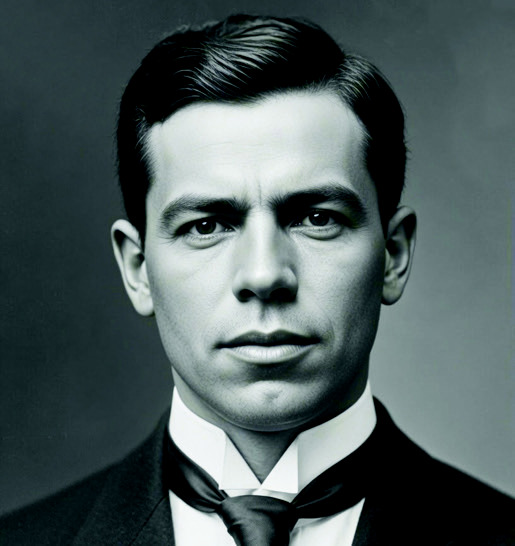
By the time John Wesley Honeysuckle’s first murder trial opened in May of 1915, the case had already become something larger than the killing of two women in a farmhouse east of Kingston. It had become the story Marshall County could not stop telling.
The courthouse was no longer merely a courthouse. It had become the stage upon which the county expected justice, vengeance, mercy, fear, grief, and old family history to collide. Men came in from farms and towns. Women came and filled the benches. Families connected by blood and marriage watched one another across the room. Lawyers moved through the crowd with the solemn purpose of men preparing for battle. Officers guarded the doors. Attendees were searched. The air itself must have felt charged.
This was not just another murder trial.
It was, by every measure available, one of the greatest criminal trials Marshall County had ever seen, before or since.
John Wesley Honeysuckle was not tried first for both deaths. The State separated the prosecutions. The first trial was for the killing of Mrs. George M. Mutz, Ida Hardwick Mutz, daughter of Creacy Merriman and sisterin- law to Minnie Honeysuckle. That decision mattered. The Red River Farmer later observed that the Mutz case was“consideredthestrongest case against him,” because Creacy Merriman was generally portrayed as the one who began the fight and the one alleged to have used the knife. If the State could not convict Honeysuckle for killing Ida Mutz, its path on the remaining charge would become harder.
But the State did not merely seek conviction.
It sought death. The case began on a Tuesday morning in District Court. Honeysuckle was charged by information with killing Mrs. G. M. Mutz on April 22, 1915, at about nine o’clock in the morning, in his home three miles east of Kingston, by “discharging leaden bullets” into her body from a loaded pistol. The trial consumed Tuesday and nearly all of Wednesday.
The Marshall County News-Democrat began its account by returning to the facts already known across the county. On April 22, Mrs. Creacy Merriman and Mrs. G. M. Mutz went to the Honeysuckle home. According to Honeysuckle and the evidence introduced at trial, they attempted to enter the home over the protest of Mr. and Mrs. Honeysuckle and against their will. The newspaper summarized the defense version plainly: the womenentereddespitewarnings; a controversy arose; and in the struggle that followed, both women lost their lives.
Under the heading “The Killing in Detail,” the paper laid out the facts as the jury heard them. Mrs. Merriman and Mrs. Mutz entered the home, knocked Mrs. Honeysuckle down,beganstamping her, and Honeysuckle interfered. He was then attacked. A general struggle followed. Honeysuckleclaimedhefired one shot at random, warning bothwomen,“Don’tmakeme hurt you.” He testified, and other witnesses supported him, that the deceased women were armed separately, one with a butcher knife and the other with a hammer. He believed he was in imminent danger of bodily harm.
The State, however, had evidence to work with. It was not enough for the defense to say there had been a fight. Two women were dead. Both had been shot. The physical facts were grim and final. Dr. M. L. Spangler, a practicing physician at Kingston, testified that he examined the bodies of Mrs. Merriman and Mrs. Mutz and found bullet wounds sufficient to cause death. He believed the woundsweremadebybullets from a .32 or .38 caliber gun. The clothing of Mrs. Mutz was placed into evidence, and the bullet holes tended to show two bullets had pierced herbody,onehighinthechest and one lower.
Then came Janie Benson. She was a difficult witness for both sides because she belonged, in one way or another, to nearly everyone in the case. She was the sister of Mrs. Mutz, the daughter of Mrs. Merriman, and the sister-in-law of Mrs. Honeysuckle. She testified that she wasattheHoneysucklehome when the killing occurred. She said that before the womenarrived,Honeysuckle remarked that “they needn’t think they could come over there and ‘chew the rag’ with him.” She also testified that she saw him with cartridges inhishandandsawhimwalk to the bed and raise the quilts before going out to meet the women.
That was dangerous testimony.
It suggested preparation.
It gave the prosecution a way to argue that Honeysuckle was not merely surprised by violence but was ready for it.
Still, Benson also testified that Mrs. Merriman entered the house, struggled with Minnie Honeysuckle, and appeared to be on top of her, striking or attempting to strike her. She said Honeysuckle intervened and pulled Mrs. Merriman off his wife. Then the struggle shifted between Mrs. Merriman and Honeysuckle. A shot was fired. At that point, Janie Benson left the house and ran to her own home about a quarter mile away.
That was the problem for the prosecution.
Even the State’s witness helped establish the defense’s centralclaim:Mrs.Merriman entered, Minnie went down, andHoneysuckleintervened.
Other State witnesses followed. John Nance testified that Honeysuckle came to his house on the morning of the tragedyandsaidhehadkilled Mrs. Merriman and George Mutz’s wife and asked him to telephone for an officer. J. W.Nance,John’sfather,gave testimony materially similar.
Guy Wenzel of Grady County testified that he had worked with Honeysuckle and that Honeysuckle had spoken of his correspondence with Mrs. Hardwick, later Mrs. Honeysuckle, saying he was coming to Marshall County to marry and feared trouble.
Court Clerk W. C. Campbell was called to identify probate records concerning guardianship, but the court sustained an objection that the records themselves were the best evidence. The State wanted the records to show theguardianshipdisputeand motive.
Then came the gun evidence.
Walter Kennedy testified that he had known Honeysuckle for about five years and that, a few days before the killing, he sold him a .38 caliber, Colt revolver. Perry Kirk of the Imperial Barber Shop in Madill testified that he saw Honeysuckle about two days before the tragedy and that Honeysuckle left a revolver in the barber shop for a short time.
The State also called O. S. Benson and N. F. Benson, whose testimony went directly to threats and intent. O. S. Benson testified that Honeysuckle came to his home on the day of the controversy, displayed a pistol, and said, referring to the deceased women, “they sent the word that they were coming to my house to see me and if they come they’ll go back a dead sight faster than they came.”
N. F. Benson testified that Honeysuckle visited him in his field a few days before the killing and said that if Mrs. Merriman and Mrs. Mutz gave him trouble, he would do violence. According to Benson, Honeysuckle used language to the effect that if theycamearoundhisplace,“I will eat them up,” though the newspaper softened or omitted thevulgarity.Bensonalso testified that on the morning of the tragedy, Honeysuckle said he had heard the women intendedtovisithishomeand again said, “if they get here they will go back a dead sight faster than they came.”
That was the State’s case in hard form.
Honeysuckle had purchased a revolver. He had cartridges. He had made threatening statements before the women arrived. He had expressed anger. He had expectedtrouble.Hehadshot both women.
Then the State rested. Thedefensebegancarefully. Mr. Roulaine was called concerning Honeysuckle’s character, though much of his testimony failed to come in cleanly. But he did testify that he and the two Bensons went to Kingston together on the morning of the killing and that, in their joint conversation with Honeysuckle before going to town, he heard Honeysuckle say nothing about intending to harm anyone.
Mrs. Roulaine followed, giving testimony of minor importance.
Then came Minnie Honeysuckle.
Her testimony was the heart of the defense.
Minnie told the jury she had married Honeysuckle only about a week before the tragedy, although they had corresponded and kept company for some time. She testified that Mrs. Merriman and Mrs. Mutz had warned her not to marry him and had declared that if she did, the couple would not live together. According to Minnie, Mrs. Mutz had once said she “wouldliketoseewhatkindof a looking corpse Honeysuckle would make.” Mrs. Merriman allegedly told Minnie, “If you and Honeysuckle get married, you will never live together; he is no account, and you know it, and everybody knows it.”
That testimony gave the defense motive in reverse. The State said Honeysuckle was after the children and property. Minnie said the dead women were determined to break up the marriage.
Minnie then described the morning of April 22. Honeysuckle went out to the gate and offered to hitch the horse. Mrs. Merriman refused, with profanity. Minnie testified that Mrs. Merriman said they intended to come in and would come in anyway: “you can’t keep us out.” As they approached, Minnie said, “Ma, I don’t want you to come in my house talking like that.” According to Minnie, Mrs. Merriman and Mrs. Mutz came on, knocked her down, and began stomping her. Honeysuckle intervened and pulled them off. Then, she said, the women attacked him with a butcher knife and hammer.
Honeysuckle fired a warning shot and cried out, “Don’t make me hurt you.” The assault continued. Two more shots were fired. Then, after a brief delay, two more shots. The struggle ended with both women dead.
Honeysuckle then took the stand in his own defense.
The News-Democrat described his testimony as “almost identical” to his wife’s on all material points. The paper noted that he testified “in a cool,deliberateandcomposed manner,” setting forth the facts “slowly and concisely.” The prosecutors pressed him with rapid questions, but, according to the paper, he met them with calm answers and “not a time did he cross or tangle his testimony on any material points.”
That mattered enormously.
Jurors watch defendants. They may listen to words, but they also weigh demeanor. A defendant who appears evasive can lose a case with his eyes. A defendant who remains steady can save himself. Honeysuckle was facing death, and the newspaper said he held together.
Officer H. H. Delay also testified for the defense. He visited the scene on the morning of the killing and found the bodies. He examined the room and observed a butcher knife and hammer on the floor. He located bullet holes in the wall and took detailed notes of the surroundings. In aremarkablemoment,Delay drew a profile of the room in Honeysuckle’s house on the courtroom floor in front of the jury box and explained his findings to the jury.
That must have been compelling. Before modern photographs, diagrams, forensic displays, and projected exhibits, the courtroom itself became the visual aid. Delay drew the room before the jurors. The farmhouse east of Kingston was recreated in the courthouse, line by line, markbymark,asthelawyers fought over where people stood, where weapons lay, and how the shots were fired.
The defense then rested, introducing no further material evidenceexceptcharacter evidence.
On rebuttal, the State called ten witnesses to prove the good character of the deceased women. Each testified that, so far as they knew, the reputations of Mrs. Merriman and Mrs. Mutz were good.
Thencamethearguments. County Attorney George L. Sneed opened for the State and argued for one hour and thirty minutes. The News-Democrat praised his fairness, stating that he argued only the evidence and the court’s instructions, staying strictly within the record. But his conclusion was severe. He told the jury: “I realize how precious life is and how hard it must be to give it up at the hands of justice; but gentlemen, Justice claims no favors, Justice demands no feelings of sympathy at your hands; even-handed justice appears before you and asks that you give her what is right and proper; what is really and honestly her own. And when you have fully considered all of the testimony in this case without fear or favor as under the law you are instructed to do, you are driven to the irresistible conclusion that this is one of those dastardly crimes for which death itself is insufficient punishment.”
There it was. The State was asking for death.
Modern readers should remember that every person who would decide John Honeysuckle’s fate in 1915 was a man. Women could not serve on Oklahoma juries at that time. In fact, women would not gain the right to vote nationally until the ratification of the Nineteenth Amendment in 1920, five years after the Honeysuckle trials. The jury box that heard George Sneed demand death and then heard Coakley invoke the ancient right to defend one’s home consisted entirely of male citizens drawn from a rural county where concepts such as self-defense, defense of family, defense of habitation, andhouseholdauthority carried powerful cultural weight. The case itself centered on issues that touched deeply upon the lives of both men and women—marriage, motherhood, children, guardianship, inheritance, and domestic conflict—yet the final judgment belonged exclusively to twelve men. Whether that fact helped or hurt either side can never be known with certainty. What is certain is that every witness, every lawyer, every argument, and every piece of evidence ultimately passed through the perspective of an all-male jury, because under Oklahoma law in 1915, no woman could sit in judgment in a criminal case.
Then Charles Arthur Coakley rose for the defense.
This was the moment toward which this whole series has been moving. The former county attorney was now standing before a Marshall County jury defending a man who admitted killing two women. There was no room for technical games. Coakley had to give the jury a human story and a legal foundation strong enough to overcome death.
TheNews-Democratwrote that Coakley argued the law and the testimony “in a manner that marked him as fair and unbiased,” seemingly with only one motive: “to wrest nothing but a fair and impartial verdict from the jury.”Thepapersaidhemade no misleading statements and abused no one connected with the case. It added that Coakley demonstrated his knowledge of law in a way that brought compliments from those who heard him.
Then the paper quoted him.
“The right which the law recognizes, to defend the home is a right which has descended to us from earliest times when every man’s house was his castle and he the defender of that castle against every unlawful assault; woe to the man who in those days, who in fear for his personal safety of the consequences to himself would hesitate to act in defense of his habitation.”
Coakley then reached deeper into the old law of self-defense: “Even in times and states when the law of self-defense was restricted by the cowardly principles that man must retreat and have his back to the wall before he could kill in self-defense, the right to act in defense of his home without the necessity of retreat was recognized.”
And then he gave the jury the moral core of the defense: “Defense of self is man’s God-given right. Defense of home and those under his protecting care is his Godgiven duty, which none but the poltroon and coward will shirk.”
That was Coakley at the beginning of his rise.
He did not merely argue evidence. He argued duty. He did not merely say Honeysuckle had a legal right to defend himself. He said he had a God-given duty to defend his home and those under his care. In a Marshall County courtroom in 1915, before jurors who understood home, family, violence, and duty in old and direct ways, that argument had force.
J. S. Ratliff of Tishomingo followed Coakley for the defense. The paper described his speech as forceful, noting that he went through technical flaws and focused in part on the testimony of a constablenamedHumes,who hadcrawledbeneaththefloor with a searchlight looking for evidence of a bullet hole. Some of Ratliff’s arguments were apparently humorous.
Then F. E. Kennamer closed for the defense. The News-Democrat called him “the powerful little legal wizard.” Kennamer analyzed the testimony of every witness from beginning to end, including the character witnesses. He appealed extensively to sympathy for Honeysuckle and those dependent onhim.Healsodrew upon history and Scripture.
His quoted passage was dramatic: “The book of all books, the Bible, in which is contained the wisdom and religion of the people of every Christian nation there is a sad story of how the death sentence was imposed upon the Immaculate Christ, that he go to his death on a Roman cross pronounced by a ruler of men who said after washing his hands, ‘I am innocent of the blood of this just person.’ But to please the wrath and tumult of a howling mob, the tender and mighty Christ, my Christ and yours, was deliveredintothehandsofhis murderers, which resulted in his crucifixion. That martyr rule has ceased to exist; now a man has the right to trial by jury, and you are the jury to sit in this defendant’s judgment, and he has unflinching confidence in your honor and integrity to discharge that sacred trust; he believes that in the final great test you will give a true finding in this cause, that your verdict will be according to the sworn testimony given before God and man, and has no fear of the final decision.”
Again, modern readers may find another aspect of the Honeysuckle trial striking. Both Franklin E. Kennamer and Charles A. Coakley repeatedly invoked God, Scripture, Christian duty, and biblical principles during their arguments to the jury. Kennamer concluded his argument by referencing the trial and crucifixion of Christ. Coakley spoke of self-defense and the defense of one's home as rights bestowed by God Himself. Neither lawyer appeared concerned that such arguments might be improper, and neither the court nor the prosecution objected.
That was a very different legal era. In 1915, lawyers commonly appealed not only to the law but also to religion, morality, patriotism, history, and shared community values. Oklahoma juries were drawn from a population in whichchurchattendancewas common and biblical literacy nearly universal. A lawyer who quoted Scripture was not viewed as introducing an outside influence into the courtroom. He was speaking a language that jurors already understood.References to God, Providence, divine justice, Christian duty, and biblical examples regularly appeared in jury arguments throughout Oklahoma and much of America during the late nineteenth and early twentieth centuries.
Today, the boundaries are far different. Modern courts generally prohibit lawyers from urging jurors to decide cases based upon religious authority rather than the evidence and the law. While attorneys may still make moral arguments and occasionally reference faith in limited contexts, courts have repeatedly condemned attempts to suggest that a verdict should be rendered because God commands it, because Scripture requires it, or because a juror's religious obligations demand a particular result. Modern appellate courts view such arguments as potentially diverting jurors from their sworn duty to decide the case solely upon the evidence and the law as instructed by the court.
As a result, portions of the Honeysuckleargumentsthat drew no objection in 1915 would likely prompt immediate objections today and could even serve as grounds for appellate review and reversal of a verdict. Yet to understand the trial fairly, it must be viewed through the lens of its own time. Kennamer and Coakley were not violating accepted courtroom practice. They were employing one of the most powerful forms of persuasion available to early twentieth-century trial lawyers—appealing simultaneously to the law, to conscience, and to the religious convictions of the men sitting in the jury box.
In the courtroom of Marshall County, in 1915, before twelve male jurors raised in churches, revivals, and Bible-reading households, an appeal to Scripture carried a force that is difficult for modern observers to fully appreciate. Kennamer and Coakleyknewtheiraudience. They were not merely arguing law; they were speaking to the moral framework through which many jurors understood justice itself.
Then, finally, Charles McPherren of Durant closed for the State. He spoke for one hour and twenty-eight minutes. The News-Democrat said he had “so much testimony to discuss and so much argument to answer” that he needed the time. The paper praised him highly, saying he made an argument “that would have done credit to Socrates of old,” and that his eloquence “swayed the feeling of the audience and challenged the admiration of the learned.”
But McPherren faced a hard road.
The jury had heard the castle doctrine. It had heard Minnie. It had heard Honeysuckle. It had heard that Creacy entered first and knocked Minnie down. It had seen the knife and hammer placed at the scene. It had heard the evidence of threats, but also the evidence of invasion. It had heard the State ask for death, and it had heard Coakley and Kennamer ask for justification.
When the jury retired, the room waited.
The trial had occupied Tuesday and practically all of Wednesday. The State had put on its proof. The defense had answered. The lawyers had argued with everything they had. The courtroom, already tense, became even more charged as everyone waited for twelve men to decide whether John Wesley Honeysuckle would be condemned for murder or spared under the law of self-defense and defense of the home.
When the jury returned, emotion filled the courtroom.
The News-Democrat reported that relatives of the deceased who had gone out returned with “eager anxiety.” Everyone entering was searched at the door by the bailiff, “as well as all others, even though not interested in the case.” Judge Jesse M. Hatchett ordered that there be no scene of any kind after the verdict was announced. If anyone wished to congratulate the attorneys or jurors, they were to wait until after leaving the courtroom.
That instruction tells us everything about the tension in that room.
Then the verdict was read. Not guilty. According to the News-Democrat, the jury was out only thirty-two minutes before returning to open court with a verdict of acquittal. The Red River Farmer reported the deliberation as about forty-five minutes. Either way, the meaning was the same. After all the tension, all the public talk, all the fear, all the preparation, all the testimony, and all the demand for the death penalty, the jury quickly found Honeysuckle not guilty of murdering Ida Mutz.
The speed of that verdict must have stunned the room.
The Marshall County News-Democratreportedthe result in sweeping language. Its headline declared: “Jury Vindicates John Honeysuckle.” Beneath that came the unmistakable result: “TwelveMenSaidByVerdict That Man Who Killed Mrs. Creacy Merriman and Mrs. G. M. Mutz Was ‘Not Guilty’ ofMurder.”Andthen,withall the drama early newspapers couldsummon,itannounced: “Greatest Victory Ever Met Crowned Efforts of Attorneys for Honeysuckle in This Case.”
The News-Democrat framedtheresultascomplete vindication. The jury had “vindicated” Honeysuckle. The greatest victory had crowned the efforts of his attorneys. The death penalty had been sought, but the defendant walked free from the Mutz murder charge.
Not everyone agreed. The Red River Farmer reported the acquittal in a far more skeptical tone. It stated that the verdict “does notseemtomeetwithgeneral approval.” Many believed the killing of the two women was “at least inexcusable,” and while there may have been aggravating circumstances, “the trouble could have been settled without the taking of the life of both the women,” particularly since the case involved “a strong and ablebodied man contending with women who were unarmed and not very strong physically.”
That paragraph shows how divided the county remained.
Tosome,Honeysucklehad defended his castle.
To others, he had shot two women who should not have died.
The Durant Daily Democrat carried the headline more bluntly: “Killed Two; Comes Free at Madill.” It reported that Honeysuckle had been acquitted of killing Mrs. Mutz and repeated the defense version of the killing. Importantly, it also noted why the Mutz case had been tried first and why it was thought important: “This was the first of the two cases to be tried. It was supposed to be the hardest of the two cases, for the reason that the other woman was recognized as the one starting the fight and using the knife.”
That is a crucial observation.
If Ida Mutz was not the primary aggressor, then her death was the harder killing for the defense to justify. If the jury acquitted Honeysuckle of killing her, then the defense had every reason to feel confident about the remainingMerrimancharge.
But the story did not end there. With the second trial coming in a few months, Honeysuckle was returned to the county jail, where he would be held until his next appearance before another Marshall County jury.
The case involving Creacy Merriman was continued until the September term. In the meantime, the family dispute over the children did not disappear. On June 4, the Red River Farmer reported that an application had been filed in county court for the appointment of Lee Lindsey as guardian of Mrs. Honeysuckle's children, formerly Mrs. Hardwick. Even after two deaths and one acquittal, the guardianship issue—the spark that lit the fire—remained alive in court.
In September 1915, the second trial began.
This time, Honeysuckle was tried for killing Creacy Merriman.
The record preserved in the newspapers is thinner, but the result is clear. The Marshall County News-Democrat later recounted the “History of the Famous Honeysuckle Murder Case.” It reminded readers that on April 22, at his home three miles east of Kingston, Honeysuckle shot and killed both Creacy Merriman and G. M. Mutz, two bullets entering each body. Honeysuckle gave himself up immediately to Sheriff John Glenn. His preliminary hearing had been held April 28 before Justice I. O. Lewis. The first trial, for themurderofMrs.Mutz,had taken two full days and part of two nights and ended in a verdict of not guilty.
Then came the second trial.
The News-Democrat reported that after Honeysuckle was acquitted in the Mutz case, he was not set free. He was returned to jail to await trial for the killing of Creacy Merriman.
That second trial was called in district court on a Monday morning in September. Again, the witnesses came. Again, the same terrible story was told. Again, thejuryheardaboutthefight, the shots, the dead women, the children, the home, and the old family feud that had finally reached blood.
But this time, the ending was different.
After nearly two days of testimony and several hours of argument, the case went to the jury. In the first trial, the jurors had needed only about thirty minutes to acquit him. In the second, they stayed out nearly forty-eight hours— longer than the evidence had taken in either trial.
Atlast,onThursdaymorning, they returned.
This time, John Wesley Honeysuckle was found guilty. Not of murder, but of a lesser offense of manslaughter. The jury fixed his punishment at four years in the state penitentiary at McAlester.
The Red River Farmer reported that Honeysuckle was “found guilty and given a sentence of four years in the penitentiary.” It added that the jury had been “tied up on the case for about 36 hours before they could agree on a verdict.”
The difference between the first and second verdicts is striking.
In May, the jury deliberated for less than an hour and acquitted him of killing Ida Mutz.
In September, the jury struggled for a day and a half, perhaps closer to two days, beforereachingacompromise verdict against him for killing Creacy Merriman.
That suggests a divided jury. It also suggests that the second case was not, after all, simple. The very woman whom the defense portrayed as the chief aggressor was also the grandmother, the guardian, the one who feared the children’s property would be taken. Jurors may have believed Honeysuckle was not guilty of murder, but still not wholly innocent. They may have believed he had some right to defend his home, but used more force than necessary. They may have believed the killing was not premeditated murder but still deserved punishment. The four-year sentence strongly suggests compromise.
The Tulsa World reported the outcome under the headline “Four Years for Killing Woman.” It stated that a jury in Madill returned a verdict ofguiltyagainstHoneysuckle for having murdered Mrs. Creacy Merriman on April 22 and sentenced him to four years. It noted that he had been acquitted in May of murdering Mrs. G. M. Mutz. The article summarized the whole case briefly: the two women were related to Honeysuckle; he shot them to death while they were in his house; the shooting grew out of a quarrel over children; and Honeysuckle pleaded self-defense, alleging that the women, armed with a butcher knife, attacked him in his own home. The Tulsa World also noted that F. E. Kennamer and C. A. Coakley defended him in both trials.
That final point matters. Both trials belonged to the same legal war. The first was a triumph. The second was a loss, but not the loss the State originally sought. Honeysuckle did not receive death. He did not receive life. He received four years. In a case where two women were dead, and the public had once talked of lynching, four years was, in practical courtroom terms, still a significant defense result. By1917,Honeysucklewas still incarcerated, serving as a cook at the Aylesworth Prison Farm. But his life did not end in prison. By 1920, he and Minnie were living in Willis, Oklahoma, along with Minnie’s Hardwick children—Dave, Agnes, Joe, and Bart—and their own children, Lewis Wesley, Lucille Evelyn, Minnie Louise, and Anna. By 1930, the family was living in Pauls Valley. By 1942, they were in Durant. Then, in the late 1940s or early 1950s, John and Minnie moved west to Brawley, California. John Wesley Honeysuckle died on January 5, 1959, in Imperial, California, at the age of seventy-two. Minnie died on February 4, 1962.
The old case faded, as all cases eventually do.
The courtroom emptied. The crowds went home. The newspapers turned to other tragedies, other elections, other trials, other scandals, other wars. The children grew older. The lawyers moved on. Kennamer would rise to the bench. Coakley would continue his long climb toward becoming one of Oklahoma’s most formidable criminal defense attorneys.
But the Honeysuckle case remained important because it marked the emergence of Charles Arthur Coakley in the role that would define him.
In the Mutz trial, Coakley stood before a packed and guarded courtroom, with the State seeking the death penalty, and argued not merely that his client had killed, but that the killing was justified under the oldest law of home and self-defense. He spoke of the castle, of the right to defend habitation, of the duty to protect those under one’s care. He took the facts of a terrible family tragedy and gave the jury a legal and moral framework through which acquittal became possible.
That is trial law at its highest and most dangerous level.
It is not clean work. It is not gentle work. It requires a lawyer to stand beside the accused when the crowd is angry, when the dead are mourned, when the facts are ugly, and when the easy thing would be to step aside. Coakley did not step aside. He stood there.
And in May of 1915, the jury listened.
The first verdict was not guilty.
The second verdict was four years.
The State had sought death.
JohnWesleyHoneysuckle lived.
This feels like the natural closingforPartVandabridge into Part VI: The Honeysuckle case would not be the end of Charles Arthur Coakley’s rise. In many ways, it was only the beginning.
The acquittal in the Mutz case and the partial victory in the Merriman case established Coakley as something morethanaformercountyattorney trying his hand at private practice. They marked his emergence as one of the most formidable criminal defense lawyers in Oklahoma. He had stood in the center of what many regarded as the most sensational criminal prosecutionMarshallCounty had yet seen. He had faced a death penalty prosecution fueled by public passion, family loyalties, newspaper scrutiny, and enormous community pressure. And he had survived it.
The careers of the two lawyers who defended Honeysuckle would soon move in very different directions.
Franklin Elmore Kennamer’s future would carry him upward into the highest levels of Oklahoma jurisprudence. Within a few years, he would be appointed to the Oklahoma Supreme Court, beginning a judicial career that would eventually lead him even farther, ultimately to the federal bench where he would become one of Oklahoma’s most respected jurists.
Coakley’s path remained in the courtroom.
After the Honeysuckle trials, he entered into partnership with a prominent law firm in Ardmore. There, in the oil-boom atmosphere of southern Oklahoma, he would find himself drawn into a case far larger than anything Marshall County had yet witnessed.
It would become the most famous case of his career.
The ingredients sounded less like a criminal prosecution andmoreliketheplotofa novel. There would be wealth beyond ordinary imagination. Oil fortunes. Political influence. Powerful families. Secret relationships. Allegations of infidelity. Questions ofmoneyandpower.National newspaper coverage. Hollywood interest. Courtroom drama on a scale rarely seen in Oklahoma.
The case would captivate the public not only because of the crime itself, but because it seemed to expose the hidden lives of the rich and powerful. Reporters followed every development.Crowdspacked the courtroom. Rumors traveled across state lines. The names involved became knownfarbeyondOklahoma.
For Coakley, it would be the ultimate test.
TheHoneysucklecasehad made him known.
The next case would make him famous.
And in the annals of Oklahoma courtroom history, it would stand beside some of the most celebrated and controversial trials ever conducted in America.
But in Marshall County, the roar began here.
That story begins next.