
Marshall County has always carried a quiet habit of renaming itself when circumstances change. Names here have never been fixed objects, carved once and left untouched. They have been working tools—adjusted, exchanged, and refined when the needs of travel, trade, communication,andsurvival demanded it. In this part of southernOklahoma,atown’s name has often revealed not sentiment,butnecessity:who needed to be reached, how goods moved, where mail arrived, and which place would endure.
In the 1880s, the town now known as Woodville first answered to the name Harney, a reflection of personal authority and early settlement patterns, when naming rights followed proximity, reputation, and land. It was namedforSissonHarney,ata timewhencommunitieswere small, fragile, and closely tied to individual figures. But Harney did not remain Harney.Asthetownmatured and permanence replaced improvisation, the name gave way—quietly but deliberately— to Woodville, after Chickasaw Judge, Labon Lipscomb Wood. This name change signaled a desire for stability and endurance rather than personality.
A similar—but more revealing— transformation unfolded at the turn of the century with the town now known as Kingston. What began as Helen, named for Helen Willis, the founder’s daughter, was a settlement shaped by family ambition and early optimism. The name itself was intimate, almost domestic, reflecting a place still small enough to be personal. But Helen faced a problemthatsentimentcould not solve.
Two miles away stood another settlement already called Kingston, named for its founder, Jeff King. That original Kingston possessed something Helen did not: a post office. Helen, despite its location on the St. Louis– San Francisco Railway, was denied one. Mail—lifeblood for commerce, law, and connection— flowed through Kingston instead.
Rather than compete, the two places merged their identities. The Kingston post office was moved to Helen, where the railroad already passed. To reduce confusion, improve travel, and centralize communication, the residents requested that the St. Louis–San Francisco Railway rename the Helen station as Kingston Station. The railroad agreed. With mail service secured and rail travel aligned, the town formally abandoned the name Helen and became Kingston.
It was not a romantic decision. It was a practical one—made to reduce confusion, improve contact, and anchor the town to the systems that mattered most in the modern world. Kingston did not replace Helen because it sounded grander; it replaced it because mail and rail demanded clarity. The town survived because it adapted.
The most recent Marshall County town to live under two names followed this same local tradition, though its origins were neither agricultural nor political, neither familial nor civic. They were industrial. This town was not bornofahomesteadoradepot or a county-seat contest. It was born of oil, of steel and timber and contracts drawn far from the Red River, and of decisions made in corporate offices as much as on the prairie itself.
It began as Pure City, a name chosen not for a family or a founder’s daughter, but for a company—an assertion of purpose as plain as it was modern. And it survives today as Little City, bearing the name of the men who laid it out, but carrying within it the memory of an industry that once dictated its rhythms.
To understand how such a place came into being—and whyitenduredwhensomany similartownsvanished—you mustbeginnotwithstreetsor houses, but beneath the prairie soil itself. Long before lots were platted, before roads were graded, before a single board was nailed into place, the story was already written in sandstone and shale, waiting for drill bits, speculation, and men willing to believe that the ground east of Madill still had something to give.
For generations, that groundhadbeenworkedonly from the surface. Fields were broken by plow and sweat, not by steel and rotary tables. The wealth of the land was measured in harvests and rainfall, not in depths and formations. What lay below remainedunseen,guessedat, and largely ignored—present, perhaps, but unproven.
And then, slowly, that changed.
Oil did not announce itself in Marshall County with the thunder and spectacle that made other parts of Oklahoma famous. There were no roaring gushers climbing skyward, no instant boomtowns thrown together in a matter of weeks. Instead, petroleum revealed itself here gradually, almost cautiously, as though testing whether the county—and the people who worked its land—were ready for what lay beneath its fields.
That quiet beginning would shape everything that followed.
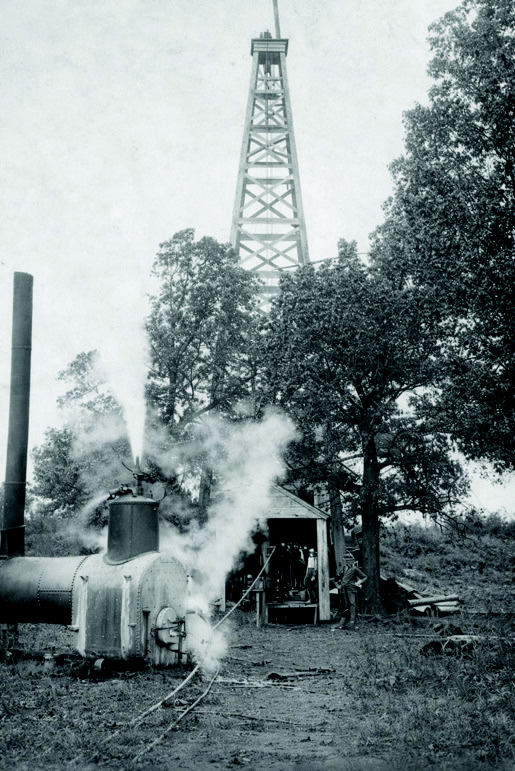
The first oil well in Marshall County was drilled in 1909, a modest beginning that nevertheless marked a permanent turning point. That early drilling initiated development in what became known as the Arbuckle field, later absorbed into the larger Madill field as production expanded and geological understanding improved. These early wells were shallow by the standards of later decades, limited by the technology of the time and by uncertainty about what deeper formations might hold. Yet they accomplished something far moreimportantthanvolume: they proved the presence of petroleum beneath Marshall County farmland.
That proof mattered. In an era when drilling was expensive, risky, and often speculative, confirmation of oil—even in small quantities— changed how land was viewed. Fields once valued solely for crops now carried a second, invisible worth. Farmers, speculators, and oil menbegantolookatthesame acreage through different lenses, each imagining a different future drawn upward from the same soil.
Natural gas soon followed oil, broadening the county’s resource base and deepening its industrial potential. In 1918, gas was discovered in the Enos field south of Kingston, a development that carried significance beyond the immediate area. By the late 1910s, natural gas was becoming increasingly important—not only for lighting and cooking, but for heating, manufacturing, and power generation. Cities and industries were hungry for fuel that burned cleaner and could be transported by pipeline rather than rail.
The Enos discovery signaled that Marshall County’s subsurface wealth extended beyond crude oil alone. Gas production introduced new players, new infrastructure, andnewformsofinvestment. Pipelines followed wells. Processing facilities followed pipelines. And slowly, the county’s relationship to the land began to change.
By the late 1920s, oil production had reached levels impossible to ignore. The Madill Pool, by itself, was producing more than 500 barrels of oil per day by 1929—a figure that anchored Marshall County within Oklahoma’s petroleum economy even as larger fields elsewhere captured headlines. Oil here was not spectacular, but it was steady, and steady production has a way of quietly reshaping communities.
This growing output coincided with broader economic shifts. While agriculture still dominated the visible landscape—fields of cotton, corn, peanuts, hay, and grain stretching across the county—oil began to introduce a parallel economy. Landowners leased mineral rights. Drilling crews arrived and departed. Service businesses emerged. Money circulated in new ways, sometimes unpredictably, sometimes unevenly.
For decades, Marshall County had been defined almost entirely by agriculture. When Indian Territory was opened to white settlement, newcomers rushed to claim fertile land long cultivated by Chickasaw citizens, who had already established farming operations raising cotton and corn. Agriculture remained the county’s backbone well into the early twentieth century, shaping daily rhythms, labor patterns, and community life. Farms were small, family-operated, and tied closely to the seasons.
Gradually, oil altered expectations. It offered an alternative to the uncertainties of weather and markets. It promised wages not tied to harvest cycles. It introduced outside capital and outside decision-making into a county long accustomed to self-reliance. Fields that had once been measured only in acres and yields were now measured in formations and depths.
What truly changed Marshall County was not the early shallow drilling of the 1910s or the steady production of the 1920s, but the arrival of deep drilling in the late 1930s. Advances in drilling technology and geological mapping made it possible to reach formations previously thought inaccessible or too risky to pursue. In 1939, deep exploration began in earnest, opening a new chapter in the county’s history.
Major fields followed in rapid succession: Cumberland, Aylesworth, Mannsville, and later North Madill, each discovery reinforcing the belief that Marshall County’s greatest petroleum potential lay not near the surface, but far below it. At IsomSprings,oilwasfoundin fractured Novaculite within the Ouachita trend, a geologically significant breakthrough that drew renewed attention from oilmen across southern Oklahoma. This was no longer a county dabbling in oil. It was a county being reshaped by it.
As drilling intensified, agriculture began to yield ground—not necessarily in acreage at first, but in economic dominance.Oilandgas production grew into a principal source of income, surpassing farming in its ability to generate cash and attract investment. Over time, farm sizes increased as smaller operations consolidated, and largeranchesemergedwhere fields had once been divided more finely.
Marshall County was no longer solely a place where crops were grown. It had become a place where energy was extracted, processed, and transported—where the future lay not only under the sun, but beneath the earth. That quiet beginning would shape everything that followed— but it would not last forever.
For nearly three decades after the first wells were drilled, oil in Marshall County remained something approached cautiously. Early production proved the presence of petroleum, but it did not yet justify sweeping commitment. Wells were shallow, formations imperfectly understood, and capital hesitant. Oil here was something youtested,notsomethingyou bet a future on. The land still belonged, in every practical sense, to the farmer. What changed was not luck, but knowledge.
By the late 1930s, the oil industry stood on the threshold of a technical revolution. Advances in rotary drilling, improved steel casing, more reliable cementing techniques, and increasingly sophisticated geological surveying transformed what operators believed was possible beneath the surface. The science of petroleum geologyhadmatured.Oilwas no longer hunted blindly; it was mapped, predicted, and pursued with intent.
Equally important was a growing understanding of subsurface formations—how layers folded, fractured, and trapped hydrocarbons over geological time. Shallow sands had told only part of the story. The real promise, oil men now believed, lay far below, locked in deeper horizons that earlier technology could not reach safely or economically. In 1939, deep drilling began in earnest in Marshall County.
This marked a decisive break with the past. Wells pushed beyond familiar depths, penetrating formations that had never been tested here before. These were not tentative experiments. They were serious, capital-intensive undertakings that assumed success was not only possible, but likely. Each new well drilled deep carried with it the weight of confidence—confidence in geology, in engineering, and in the belief that Marshall County’s quiet beginnings had masked a far greater potential. The results were immediate—and unmistakable.
Fields that had once produced modestly were redefined. Entirely new areas were opened. The Cumberland field, tested and developed in 1940, became one of themostsignificantoutcomes of this new era. Around it followed intensified activity at Aylesworth, Mannsville, and whatwouldlaterbeknownas North Madill. Each discovery reinforced the same conclusion: oil in Marshall County was not confined to shallow pockets. It existed in depth, structure, and continuity.
At Isom Springs, the story took on even greater geological significance. There, oil was discovered in fractured Novaculite within the Ouachita trend, a formation long considered complex and difficult. This was not merely another producing zone; it was a confirmation that hydrocarbons hadmigratedand accumulated in places once thought improbable. The find drew attention from oil men far beyond the county, marking Marshall County as a place worth serious, sustained exploration.
Additional drilling followed at Southeast Handy andSouthPowell,andexploratory workspreadoutwardas confidence grew. Not every well produced. Some fields would later be abandoned. Otherswouldbeconsolidated as production patterns clarified. But taken together, the pattern was undeniable. MarshallCountyhadcrossed a line.
It was no longer a speculative frontier where oil might be found if luck held. It had become a proven oil province, with multiple productive horizons, established fields, and geology that justified long-term investment. The conversation changed—from Is there oil here? to How much, how deep, and for how long? That change rippled outward in ways that went far beyond the derrick.
Oil and gas production began to surpass agriculture as the county’s principal source of income. Money arrived not seasonally, but steadily. Wages replaced crop yields as a measure of prosperity. Service businesses—machine shops, supply houses, transportation firms—found new purpose. Roads were improved. Infrastructure followed.
Agriculture did not disappear, but it adapted. Over time, smaller farms consolidated. The average farm size grew from 173 acres in 1936 to 428 acres by 1975, as land once worked intensively was converted back to grass and absorbed into larger ranching operations. Oil did not erase the rural character of Marshall County—but it rebalanced it, shifting the center of gravity beneath the feet of those who lived there.
Land itself took on new meaning. Acres were no longer valued solely for what they could grow, but for what they might contain far below theplowline.Leasingbecame common. Royalties entered family finances. Decisions once governed by weather and soil were now influenced by geology and depth charts.
This was not a boom in the old sense. It was a reordering.
And it was into this moment— when deep drilling had proven the county’s worth, when oil had demonstrated both staying power and scale, when the demands of production had outgrown what existing towns and scattered farmsteads could reasonably supply—that a national oil company stepped forward with purpose. Not to test the ground. But to commit to it.
This was not the arrival of a speculative outfit chasing rumor or luck. It was the entry of a company accustomed to weighing geology against capital, infrastructure against time, and communities against the long arc of production. The company that moved toward Marshall County in the late 1930s did so because the county had already spoken—through cores, logs, and flow tests—in a language it understood. That company was the Pure Oil Company.
Pure Oil did not originate in Oklahoma, nor was it born of frontier speculation or sudden fortune. It was formed far from the Red River, decades before Oklahoma achieved statehood, in a world where oil was already reshaping industry, transportation, and power—but where control of that transformation rested in the hands of very few.
Pure Oil was founded in 1895, at a moment when the American petroleum industry was nearing complete consolidation under the shadow of Standard Oil. By the closing years of the nineteenth century, Standard Oil’s reach extended into nearly every corner of the business: refining, pipelines, rail transportation, pricing, and distribution. Its influence was not merely dominant; it was decisive. Independent producers did not simply compete with Standard Oil—they survived at its discretion.
Railroad rebates favored Standard. Pipeline access was restricted. Refining capacity was controlled. Pricing could be raised or lowered strategically to break competitors. For many independents, the choice was simple: sell out, submit, or disappear. Pure Oil was formed by men unwilling to accept any of those outcomes.
The company emerged from a coalition of independent oil producers, refiners, and pipeline interests, many based in western Pennsylvania, the cradle of the American oil industry. These were not wildcatters chasing luck, but experienced operators who understood the mechanics— and the politics—of oil. Their objective was not merely to drill wells, but to create an integrated petroleum company capable of operating entirely outside the Standard Oil system. That ambition shaped everything Pure Oil became.
Even the company’s name was a declaration. Pure was not chosen casually. It signaled independence, reliability, and a moral stance against monopoly. At a time when public resentment toward trusts was growing but federal enforcement remained inconsistent, the name announced that this company intended to do business differently—andsurvive on its own terms.
From its earliest days, Pure Oil pursued vertical integration with uncommon discipline. Rather than rely on outside refiners, transporters, or distributors, Pure acquired and built its own infrastructure. It leased oil-producing land, drilled its own wells, constructed refineries, laid pipelines, and established distribution networks that carried its product from wellhead to consumer without passing through Standard Oil hands. This was not done quickly or recklessly.
Pure Oil expanded methodically, favoring proven geology over speculative frenzy. Where others chased headlines, Pure chased continuity. Its leadership believed that oil wealth was built not on gushers, but on long-lived fields, careful engineering, and infrastructure that justified its cost over decades rather than months. That philosophy distinguished Pure Oil from many of its contemporaries.
As the twentieth century progressed, the company broadened its reach beyond crude oil. Recognizing the growing importance of natural gas—particularly as cities expanded and industries modernized—Pure absorbed assets associated with the Ohio Cities Gas Company, integrating gas production, processing, and distribution into its portfolio. This positioned Pure not merely as an oil producer, but as an energy company at a time when diversification was becoming essential.
By the 1910s and 1920s, PureOil’soperationsspanned multiple states. Its refineries fed pipelines. Its pipelines fed markets. Its gas utilities supplied cities. Over time, the company’s corporate headquarters settled in Chicago, a deliberate choice that placed Pure at the crossroads of Midwestern rail networks, industrial demand, and financial capital. From Chicago, the company could manage production fields hundreds of miles away while remaining close to the markets that consumed its product.
To the American public, Pure Oil became increasingly visible through its retail gasoline stations,whichexpanded rapidly during the automobile age. These stations were intentionally designed to look different from the harsh industrial imagery often associated with oil. Many adopted a modest English cottage style, complete with pitched roofs and tidy facades. The design was deliberate. Pure understood that oil companies were guests in local communities, and it sought to present itself as orderly, respectable, and permanent rather than intrusive.
Advertising emphasized fuel quality, consistency, and cleanliness. Pure gasoline was marketed as dependable— tested, refined, and trustworthy. The stations were not just points of sale; theyweresymbolsofthecompany’s broader philosophy: control the process, respect the consumer, and avoid spectacle.
But while service stations made the brand visible, they were never the center of Pure Oil’s identity. The heart of the company remained the field.
It was in the field—where capital met geology, where decisionscarriedconsequences measured in decades— that Pure Oil revealed its true character. The company believed that oil production was not a transient gamble, but a managed system. Wells required skilled labor. Skilled labor required stability. Stability required housing, utilities, and order. Where oil was found in quantity and depth, Pure did not merely drill; it committed.
That commitment often took the form of oil camps— self-contained industrial communitiesdesignedtosupport production efficiently and safely. Pure built camps when geography demanded them, when existing towns could not absorb workers, or when long-term production justified the investment. Camps were not romantic places, but they were practical ones, reflecting Pure’s belief thatinfrastructurewasas important as the well itself.
Just as importantly, Pure Oil understood when not to commit. The company avoided reckless expansion. It waited for geological confirmation. It watched production curves. It invested where oil promised longevity, not where excitement burned brightest.
This approach meant that when Pure Oil arrived in a new region, it did so deliberately. It arrived with engineers, planners, and capital—not with hope alone. That philosophy explains what happened in Marshall County.
By the late 1930s, deep drilling had transformed the county from a place of quiet promise into a proven oil province. Fields had demonstrated depth and continuity. Infrastructure demands were growing. Labor needed housing. Production required order. Marshall County had crossed the threshold that Pure Oil watched for.
Pure Oil’s philosophy did not end at the wellhead. The company understood—perhaps better than most—that oil was not produced by machinery alone. It was produced by people. And people, especially those asked to worklonghoursindangerous conditions far from established towns, required more than wages. They required structure.
By the early twentieth century, companies like Pure Oil had learned this lesson the hard way. Oil fields that relied on transient labor, makeshift housing, or distant towns suffered from constant turnover, accidents, inefficiency, and disorder. Wells were left understaffed. Crews drifted. Production faltered. The romance of the boomtown proved incompatible with the realities of sustained oil production. What oil required—if it was to be produced steadily and profitably— was stability. That stability began with labor. Skilled drillers, rig hands,mechanics,andsupervisors could not be replaced easily. Their work demanded precision, endurance, and experience. But labor, once secured, demanded something else in return. Workers needed places to live. Families needed shelter. Shelter required water, electricity, sanitation, and predictable order. Without those things, even the best-paying oil field would eventually hollow itself out. The industry’s answer to this problem was not improvisation. It was design.
The oil camp emerged as a distinctly twentieth-century solution to an industrial challenge—a planned community built for production, not permanence. These camps were not accidents of growthorchaoticsettlements that sprang up overnight. They were engineered environments, laid out with intention and governed by necessity.
An oil camp was typically placed close enough to the producing field that workers could reach the rigs quickly, but far enough away to maintain safety and separation from industrial hazards. Within its bounds stoodrowsofcompany-owned houses for families, set in orderly fashion. Nearby were bunkhouses for single men, their interiors spare but functional. Central kitchens and mess halls provided meals on schedule, reinforcing routine and efficiency. Waterworks and sewer systems were installed because disease and downtime were too costly to ignore. Electricity followed, not as a luxury, but as an operational requirement.
Some camps included clinics, where injuries—inevitable in oil work—could be treated quickly. Others built recreation halls or small schools, recognizing that morale and family life mattered if workers were expected to stay. These were not places of leisure, but neither were they crude encampments. By rural standards, many oil camps were modern. By industrial standards, they were efficient. Order was the guiding principle.
Oil camps stabilized the workforce in ways no boomtown ever could. Workers knew where they lived, when they ate, and how their days were structured. Families had shelter. Children had continuity. Accidents could be addressed. Turnover slowed. Productivity increased. For companies like PureOil—committedtolongterm production rather than short-term spectacle—this model made sense. But oil camps were never meant to last.
They were built with the understanding that oil fields declined, shifted, or exhaustedthemselves.Many camp structures were designed to be dismantled and moved when production waned. Lumber was reused. Buildings were relocated. Entire camps vanished once their purpose was fulfilled. In this way, oil camps were both substantial and impermanent— solid enough to function, temporary enough to abandon. Yet wherever an oil camp appeared, something else almost always followed.
Beyond the edge of company control—just far enough away to escape regulation— independent towns began to form. These were places for merchants, barbers, café owners, doctors, preachers, and entrepreneurs whose livelihoods depended on the camp but were not governed by it. These towns were platted by private individuals, their lots sold to those willing to gamble on proximity to oil and people. They offered what the camp could not: ownership, autonomy, and opportunity.
Some of these towns flared brightly and disappeared as soon as the oil moved on. Others adapted, shifting their identities as industries changed. The difference often lay not in how loudly they arrived, but in how well they learned to exist without the company that gave them birth. Marshall County’s Pure City followed this pattern precisely.
In the spring of 1940, it rose beside a production camp. Within months, it shed its corporate name and claimed one of its own. Streets were laid out. Businesses opened. Families arrived. A town took shape— not because it was planned by a company, but because people believed it might endure.
In Part II, that belief will be tested—not by the slow decline of oil, but by the sudden violence of wind, steel, and sky—and by the question that every oil town must eventually face: What remains when the company leaves?