
I cannot write this week as though nothing has happened. My heart is too heavy for that. Last week’s events shook me to the core. The assassination of Charlie Kirk was not just another story in the news cycle. A man was killed because of his beliefs and for what he said.
Some of you may not be familiar with Charlie Kirk. Some may not have cared. Some may even have disagreed with him. But none of that changes this fact: words — his words, any words — should never lead to violence or murder. Never.
And Kirk was not the only recent victim of hatred. Just days before, in Charlotte, North Carolina, Iryna Zarutska, a 23-year-old Ukrainian refugee who had fled Kyiv after the Russian invasion, was stabbed to death on a light rail train at the East/West Boulevard station. She came to this country seeking peace and safety. Instead, she was murdered. Her killer was arrested immediately and charged with first-degree murder. Her story drew international attention because she had fled a war to find safety, only to meet violence here.
Andjustoverthreemonths ago, Minnesota State Representative Melissa Hortman and her husband were assassinated at their home in Brooklyn Park, Minnesota. Hortman’s killing was widely described as an act of politically motivated violence.
OntheverysamedayKirk was assassinated, America suffered another wound: another school shooting in Colorado, where students were critically injured and thepromiseofyouthwasonce again shattered by hatred.
And then, the very next day, we marked the 24th anniversary of September 11th — the day when hatred of difference, hatred of faith, hatred of America, took nearly three thousand lives in a morning.
How much violence must we endure before we admit that hatred is killing us?
Martin Luther King, Jr. once said: “Darkness cannot drive out darkness; only light can do that. Hate cannot drive out hate; only love can do that.”
That truth is not a suggestion. It is a mandate. If we do not stop hating and start loving, we will destroy ourselves.
At the top of this article, I placed the words of John Hume: “Difference is an accident of birth, and it should therefore never be the source of hatredorconflict.Theanswer to difference is to respect it. Therein lies a most fundamental principle of peace – respect...”
Hume lived those words through some of the darkest chapters of modern history. Born in 1937 in Derry, Northern Ireland, he was raised Catholic in a land divided between Catholics and Protestants. From the late 1960s through the 1990s, the Troublesleftscars:morethan 3,500 killed; 47,000 injured; entire communities locked in mistrust and fear. Bloody Sunday, hunger strikes, and bombings — all became part of daily life because of hatred based on differences.
Hume’s answer was not to respond to hatred with more hatred. Instead, he chose dialogue, compromise, and respect. He believed that difference was not destiny and that the accident of birth should never determine who lives and who dies. His unwavering hope played a crucial role in bringing about the Good Friday Agreement in 1998, for which he shared the Nobel Peace Prize.
His life is proof that peace is possible if we respect one another as fellow children of God.
And this is where I see God’s providence in our local history. Just last week, before tragedy struck, I submitted an article about the Powell prisoner-of-war camp. I turned it in on Monday night, unaware of what the week would bring. By Wednesday afternoon, the Madill Record published a story about enemies living peacefully among us. And that very day, Charlie Kirk was assassinated.
Sometimes God lays reminders before us. His timing is perfect, even when we cannot see it.
The Powell POW camp opened in 1943, housing 600 German prisoners. These were men who had fought under the Nazi flag — a regime that murdered six million Jews, along with millions of Romani, Slavs, disabled people, and political opponents. Nazi ideology decreed that difference itself was a crime.
And yet, here in Marshall County, those same men were treated with dignity. Theycookedtheirownmeals, organized their own routines, and volunteered for work. They cleared brush for the lakebed, helped prepare groundforDenisonDam,and even labored on local farms. When they cut timber, they carried saws and axes, not chains.
They played music. They sang songs. They bought small luxuries at the camp canteen. Families drove by to watch them at work. Children whispered about “Nazis,” but when they saw them up close, they realized these were young men not so different from farm boys at home.
And in nearly two years, only one escape attempt was recorded.
Enemiesonthebattlefield, but treated here with respect. That is a lesson we dare not forget.
Division is nothing new in Marshall County. And I’m not talking about the annual Madill vs. Kingston games on football fields, baseball and softball diamonds, or basketball courts; I mean real division. The county seat dispute betweenKingstonandMadill from 1908 to 1910 was long and bitter — and perhaps the most defining conflict in our county’s early history.
It started even before statehood. The 1907 Oklahoma Constitution named Madill as the county seat of the new Marshall County. Kingston was outraged, just as it had been when the proposed State of Sequoyah earlier declared Madill thecountyseatofOverton County. Within months of statehood, Kingston began organizing a petition to move the courthouse.
Representative Harrison “Stump” Ashby, a Confederate veteran of Shelby’s Iron Brigade, attempted to craft a compromise: two courts, one in Madill and one in Kingston. It was bold, even unique, but it only deepened the controversy.
The war of words erupted in the newspapers. The Marshall County Democrat in Madill and the Kingston Messenger sparred weekly. Draper of Madill and Johnston of Kingston hurled insults, accusations of fraud, and charges of bribery. Even the “Seen and Heard” columns turned into weapons, mocking each town’s social events and gossip.
Then came the editorial cartoons — the first in county history — lampooning leaders, exaggerating divisions, turning ink into knives.
Governor C.N. Haskell finally stepped in during 1908, calling an election to resolve the issue. Campaigns turned vicious. Petitions were circulated. Saloons and churches alike became venues of persuasion.
Even after Madill won the election, Kingston refused to give in. Courthouse bond elections dragged on for years, failing four times before finally passing in 1913. The Kingston Messenger published “The Courthouse Prayer,” mocking Madill’s efforts with sharp sarcasm.
For years, words flew like arrows. Yet, through it all, there was only one minor scuffle. No blood was shed. Neighbors who argued bitterly still traded in stores, still farmed side by side, still shook hands in church.
It was proof then, as it is now: words can cut, but they need not kill.
We have faced other storms.
Prohibition divided “wet” and “dry.” Courtrooms filled, newspapers seethed. Moonshine flowed from hidden stills. Bootleggers slipped along country roads by lantern light. Yet those same neighbors who quarreled in town still lent one another tools, helped with harvest, and gathered for barn raisings.
School consolidation cut at theheartofsmalltowns.Oneroom schoolhouses closed. Mascots disappeared. Children faced longer rides on dusty roads. Parents grieved the loss of identity. But in time, new gymnasiums rang with cheers, and rival towns cheered under a single banner.
Lake Texoma brought upheaval like none other. Cemeteries wereexhumed,bodies reburied, and churches dismantled. Wholecommunities — Aylesworth, Woodville, and Willis — vanished beneath the rising waters. Families grieved the loss of homesteads, churches, and sacred ground. But in shared sorrow, they leaned on one another, rebuilt lives, and found new roots on higher ground.
Division, yes. But hatred did not rule.
The 1920s brought the rise of the Ku Klux Klan. In Oklahoma, they claimed over 100,000 members. They burned crosses on hilltops and marched in towns. They targeted Blacks, Catholics, Jews, and immigrants. Even politicians bowed to them.
And yet, in places like Marshall County, many refused to let hate control their lives. Yes, the Klan was present in Marshall County, and prejudice lingered, but it never completely overwhelmed us. That, too, is part of our story.
From 1916 to 1925, the Aylesworth State Prison Farm housed nearly 100 prisoners, all Black men. Initially, the community opposed it. In 1919, a delegation visited Governor Robertson, demanding its closure.
But Superintendent Dave Wright opened the gates on Sundays for “community day.” The inmates cooked delicious meals — pork, potatoes, beans, pies, and iced tea. For many families, it was the best meal of their week. Afterward, there were skits, jokes, boxing matches, and singing, all led by the inmates.Blackmen,inmates, fed and entertained white residents. Not because they were forced, but because they also enjoyed the community. They ate together and sang together. They sang religious songs and spirituals. And those songs and spirituals lifted hearts.
The prison baseball team became so skilled that they traveled to Woodville and beyond, cheered by large crowds. Townsfolk who once feared the inmates came to laugh with them, clap for them, cheer them. Prejudice was not erased, but bridges were built.
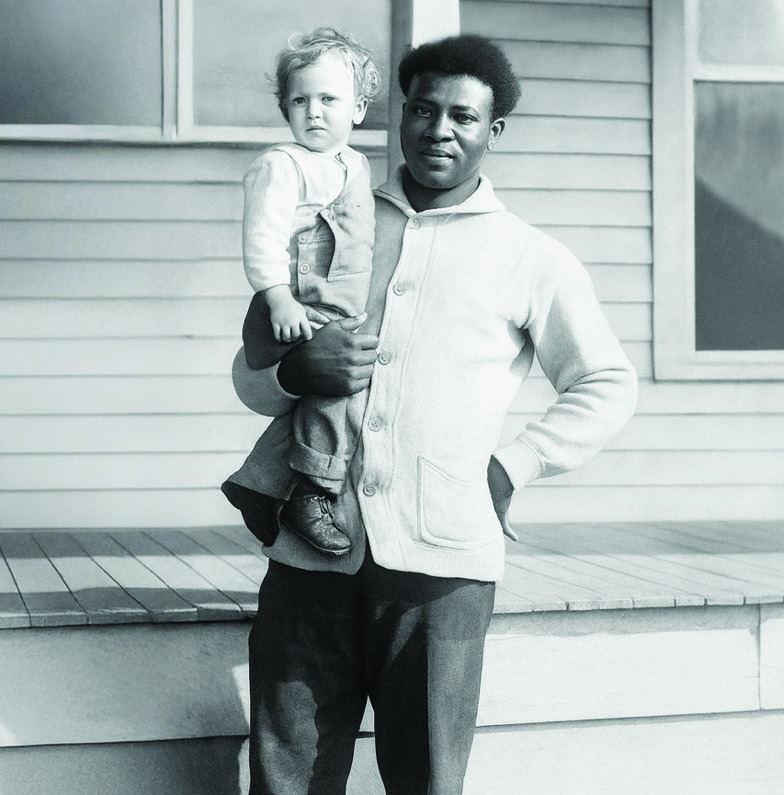
As I started writing this article, one image came to mind. A few years ago, an old family friend, Carolyn Hoggard King, daughter of guard William Jennings “Bill” Hoggard, and sister of William Jennings “Dugie” Hoggard Jr., shared with me aphotographfromthedaysof the Aylesworth Prison Farm.
That photo shows George, a Black inmate and cook at Aylesworth, gently holding little Dugie in his arms. Bill Hoggard and George became friends during their time in prison, and Bill trusted George to look after his son. Although society labeled George as inferior, he held, played with, and cared for that child with kindness.
Tome,thatpicturepreaches itsownsermon.Guardand prisoner. Black and white. Adult and child. Yet, none of that mattered. There was only humanity. There was only love.
We need to be more like George and Dugie.
Our Declaration of Independence says: “We hold these truths to be self-evident, that all men are created equal, that they are endowed by their Creator with certain unalienable Rights, that among these are Life, Liberty and the pursuit of Happiness.”
This echoes scripture: “So, God created man in his own image, in the image of God he created him; male and female he created them.” (Genesis 1:27, ESV) If we are all made in God’s image, then no one is lesser. If God endowed us with unalienable rights, then hatred has no place among us.
This all leads me to one of the biggest questions in life. Why are we here? Why did God create this world? Why did he place us on this orb hurtling through the universe? Whatdoeshewant from us?
One thing I know for sure, we are not here to hate. We are not here to kill. We are not here to let politics or prejudice tear us apart.
We are here to worship our Creator. To love and serve our neighbor. To plant trees and sit in the shade together. To raise children in hope. To lift one another when we stumble. To forgive, even when it is hard.
The Apostle Paul wrote: “There is neither Jew nor Greek, there is neither slave nor free, there is no male and female, for you are all one in Christ Jesus.” (Galatians 3:28, ESV) And again: “I, therefore, a prisoner for the Lord, urge you to walk in a manner worthy of the calling to which you have been called, with all humility and gentleness, with patience, bearing with one another in love, eager to maintain the unity of the Spirit in the bond of peace. There is one body and one Spirit—just as you were called to the one hope thatbelongstoyourcall—one Lord, one faith, one baptism, one God and Father of all, who is over all and through all and in all.” (Ephesians 4:1-6, ESV) Violence has become too common. A Ukrainian refugee slain in Charlotte. A state representativewasmurdered in her home. A political voice silenced by assassination. Students gunned down in a school. The memory of 9/11 where hatred took thousands.
If we let hatred take root, we will destroy ourselves.
But if we remember Powell, if we remember Kingston and Madill, if we remember prohibition, school fights, Lake Texoma, the Klan, Aylesworth,andifweremember GeorgeandDugie—then we will not forget this truth: We are not enemies. We are neighbors. We are brothers and sisters. We are children of God.
As Burt Bacharach’s song reminds us: “What the world needs now is love, sweet love. It’s the only thing that there’s just too little of.”
And as scripture reminds us: “Beloved, let us love one another, for love is from God, and whoever loves has been born of God and knows God.” (1 John 4:7, ESV) I will not sugarcoat it: I fear what could happen if we don'tchange.Ihavelivedlong enough to see a president assassinated. I have seen a civil rights leader assassinated. I have seen one presidential candidate murdered, and just a year ago, I almost saw another candidate gunned down. I saw a state representative murdered. I have witnessed riots, wars, and the breakdown of trust in our institutions. However, what has shaken me most recently is this: Charlie Kirk was neither a president nor a politician. He was a young man, a voice on college campuses, speaking his truth and trying to change hearts for the better. He was trying to share his love of God and his fellow man. Yes, some disagreed with his vision or his truth. But for that alone, he was slaughtered.
As Harvey Levin, the founder and managing editor of the entertainment and celebrity news site, stated this past weekend, this feels different—more dangerous. Because it indicates that violence is no longer reserved for the highest levels of power but is now directed at anyone whodaresopposethecultural tide. If that is where we are, then the very foundation of our democracy is trembling.
What frightens me most is that there are now some who see political violence not as an outrage, but as a legitimate solution. That is the darkest road a nation can walk. If we continue down it, I genuinely fear we may not be able to come back.
And yet, I say again: there is another road. A better one. A road our faith calls us to walk, the road of love, forgiveness, and unity.
As I reflect on these stories — from county seat wars to prohibition fights, from the upheaval of Lake Texoma to the tensions of the prison farm — one truth shines clearly: I am proud of the history of Marshall County and her people.
Time and again, storms havecome.Wordshaveflown sharply. Fears have risen. Yet throughout our history, Marshall County has never bowed to hate. Our people are people of love and kindness. Yes, there have been individuals who gave themselves to violence or prejudice, as in every community. But as a whole, this county has never been defined by that darkness.
Our quarrels have been about where to place a courthouse, how to educate our children, how to regulate liquor, and how to divide land or water. They were fierce, but they were not rooted in hatred of difference. They were not born of prejudice, nor were they excuses for bloodshed. Never in our history has violence here been justified because one man’s words were different from another’s.
That is something to cherish and something to preserve. Forifwecanremember that legacy — that Marshall County has always been stronger than hate — then we will have something solid to hand down to our children: not a story of division, but a testimony of endurance, kindness, and community.
And so I charge you, my neighbors: do not let this legacy slip away. Do not let bitterness become the seed of violence. Let our words be strong but not cruel. Let our debates be passionate but not poisoned. And let our differences sharpen us but never sever us.
The heritage of Marshall County is one of rising above hate. Now it is our turn to carry that forward — to show our children, and the watching world, that we are still a people of love, of kindness, of unity.
A Final Word Writing this article has been more than just putting words on a page. It has served as a form of therapy for me. I've written this weekly column for the Madill Record for over two years, but this week’s piece feels especially heavy on my heart. By putting these thoughts into words, I have found some healing, and I hope you find the same in reading them.
It has been a privilege to share the stories of Marshall County with you — stories of our past, our struggles, and our triumphs. But more than history, I have always hoped these words would serve as reminders of who we are and what we are called to be. My prayer is that this article, born out of grief, will also serve as a source of hope, a nudge toward unity, and a call to live up to the best of who we have always been.
God bless each of you. God bless Marshall County. God bless Oklahoma. And God bless the United States of America.