
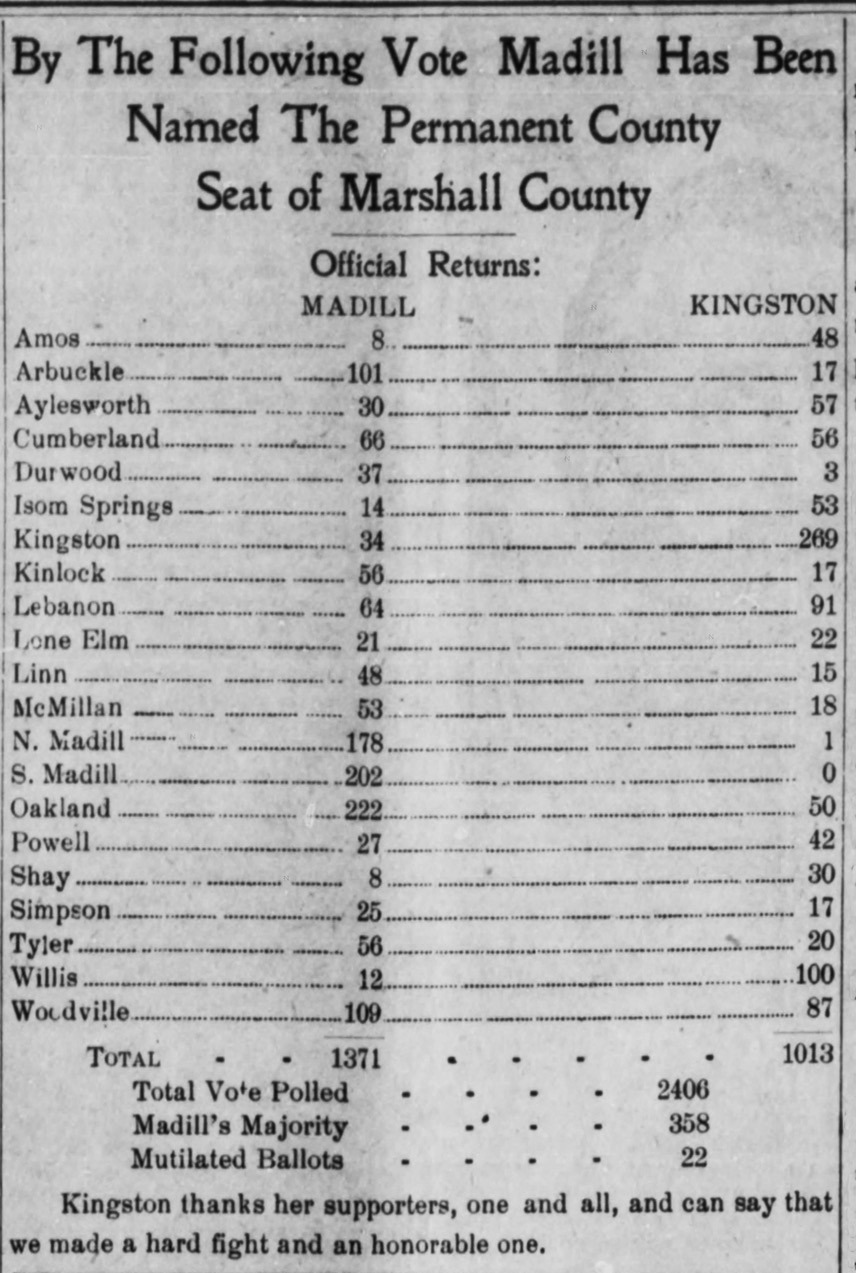
After months of an ugly and bitter campaign, election day arrived, and all that remained was for the people to vote. It was July 10, 1908. As of election day, Marshall Countyhadavoidedthesame fate as McIntosh County, Custer County, Creek County, and others, where the county seat disputes resulted in violence. Marshall County did experience a great deal of “tomfoolery,” but the worst thing that happened was the “poisoning” of Judge Hunt with “tarantula juice” whiskey. And while he was technically poisoned, he suffered no long-term ill effects, so it was viewed as a humorous matter and not some serious crime. However, on election day, Marshall County joined the list of counties where the dispute resulted in violence and gunplay, and a citizen was seriously injured.
On election day morning, Ben Burney and his brotherin- law, R. E. “Ed” McGaugh, got into a heated argument about which town should be the county seat, and the argument turned to violence, and Burney shot McGaugh with a shotgun. Thankfully, McGaugh survived.
Ben Burney was the oldest son of former Chickasaw Governor Benjamin Crooks Burney and Lucy James Davis Burney. Ben was born in Indian Territory near the future site of Aylesworth. He was born on May 7, 1881. He had two older sisters, a younger brother and a younger sister. His youngest sister, Arvilla Belle Burney, was the wife of the victim, R. E. McGaugh.
Burney went to school at the Harley Institute in Johnston County. The Chickasaw Nation operated the Harley Institute. The Harley Institute, originally known as the Chickasaw Manual Labor Academy, was established by the Chickasaw Nation in the mid-19th century. Located approximately two miles southeast of present-day Tishomingo, Oklahoma, the academy played a pivotal role intheeducationofChickasaw youth.
Theschoolwasestablished in 1844. The Chickasaw Nation, using funds from selling their Mississippi lands, initiated the construction of theChickasawManualLabor Academy. The Methodist Episcopal Church, South, oversaw the institution, aiming to provide comprehensive education to Chickasaw children. The academy began as a coeducational facility but transitioned to exclusively male students in 1852, following the establishment of a separate girls’ academy. It was later renamed the Chickasaw Manual Labor Academy for Boys.
In 1868, Joshua Harley and his wife, Lucretia, were contracted by the Chickasaw Nation to lead the academy. Under their guidance, the institution was renamed the Harley Institute. Both served as educators and during their tenure, the curriculum was expanded to include academic subjects comparable to those of junior colleges of the time. The academy faced several challenges, including fires between 1880 and 1885, which led to significant damage. Additionally, concerns about the healthiness of the location prompted tribal authorities to consider relocation. The institution continued to operate until the early 1900s, with its closure coinciding with Oklahoma’s statehood in 1907.
AfterattendingtheHarley Institute, Burney attended high school in Pottsboro, Texas, before returning to Marshall County where he operated at ranch near Cumberland for several years.
Little is known about R. E. McGaugh other than he was known as a “mean” and sometimes violent man himself. In May of 1908, McGaugh was indicted by the Marshall County Grand Jury of assault with intent to kill that had been committed a few months earlier. At the time of his dispute with Burney, McGaugh was out of jail after posting a $1,000 bond. Today, that bond would be about $35,000.
The dispute between Burney andMcGaughoccurredin Aylesworth after the two disagreed on which town should be the county seat. Just as Burney fired the shotgun, McGaugh was able to duck andturntoavoidthefullblast of the gun, but he was hit in the arm, causing a serious injury. Following the shooting, Burneywasarrestedand eventually indicted by the Grand Jury of assault and battery with intent to kill. And with that, the county seat fight in Marshall County had entered the books as one of the most bitter and violent campaigns in state history.
By the end of election day, 2406 Marshall County residents had made their choice. Whenthedustsettled,Madill was selected as the permanent county seat. The vote was 1371 for Madill and 1013 for Kingston, with 22 unreadable ballots. Madill won by 358 votes. Kingston won the Powell, Lebanon, Shay, Isom Springs, Amos, Willis, Lone Elm, and Aylesworth communities. Madill carried Simpson, Durwood, Tyler, McMillan, Linn, Cumberland, Woodville, Arbuckle, Kinlock and Oakland.
While the votes were counted the night of the election, people throughout town crowded the square to await the results. The following day, as word spread that Madill was the victor, people from throughout the county came to Madill via train, horseback, buggy and on foot. In all, over 2500 people took part in the celebration.
Kingston admitted defeat and, in a sign of goodwill, asked if their supporters could come to Madill to participate in the celebration. The Woodville band rode the train to Madill, and once a crowd assembled, a parade ensued. For the first time in months, the county seemed united. In addition to the parade, there were parties, speeches, and more music; It was a joyous atmosphere. It seemedasthoughthehatchet had been buried, and the wounds were healing.
In the Marshall County Democrat, the following was reported. “No sooner had the result of the election of Friday been made known that Madill had won the permanent location of the county seat shouts of joy were heard over the entire town. The glad anthem was soon taken up by Madill's supporters in all parts of the county, and the hurrahs were echoed and reached from almost every voting box.”
“All trains coming to Madill after the result of the election was known brought in ardent Madill supporters and from sections of country where they had no railroad transportation they came in on horse back and in vehicles of all kinds.”
“Saturdaymorning'searly train from the south brought theWoodvillebandwithquite a number of others from Woodville who were anxious to join in the celebration. Preparations were early put on foot for a street parade. While these plans plans were assuming a tangible form a phone message was received from Kingston stating that she realized her defeat and was willing to bow to the will of the people, and that her people wished to come up to Madill on the afternoon train and by so doing, express their willingness to submit to the majority and so far as they were concerned bury the ‘hatchet’ and all be friends and neighbors in Marshall county.”
“This was gladly accepted, and on the part of Madill they were given an invitation to come up and join the merry making. By this time a procession of some 500 enthusiasts was ready and it, headedbytheWoodvilleband proceeded to march over to Oakland. Dixie was the first piece played by the band after getting there, and as usual it brought forth a great round of cheers. Short speeches were made by Summers Hardy, Dave Wooten and W. G. Draper. A round of cheers was given for Woodville which was followed by three cheers for Oakland. Oakland surely felt good and was certainly proud of her vote for Madill.”
“Before time for the northbound train to arrived every inch of standing room on the depot platform was taken by the gladsome people of Madill to show to the incoming people of Kingston their readiness to meet them and extend to them a hearty welcome. This train not only brought a number from Kingston, but it also had several more Woodvilleites on it, who were anxious to share in the celebration.”
“Speaking was had on the square in the afternoon by Honorable George A. Henshaw, J. Hamp Willis and Uncle Buck Smith. A platform was built on the plaza in the square for the speakers in the evening. Around this stand by 8:30, 2500 men, women and children had gatheredtohearthespeaking and enjoy the music.”
“County Attorney J. O. Minter acted as master of ceremonies, and he performed his duties in a pleasant way. Those who addressed the people were Hardy, Milburn, Lewis, Kennamer, Draper and Henshaw. Between the speeches the band rendered some splendid music. At the close of the speaking the the crowd receded to some distance fromthestandandthat which the boys most enjoy was turned loose for the next 30 minutes, the fireworks.”
“But all seemed to enjoy it at this time, and the crowd did not finally disperse until the last skyrocket had gone heavenward, and the last Roman cannon had been shot. As these happy citizens of Marshall county retired for the night we are sure it was the sentiment of every one present, that it was good for us to have been there.”
The Madill News had this to say about the election outcome. “The election passed quietly over the county, with the exception of a shooting scrape at Aylesworth. A large crowd was assembled here Friday night, Saturday and Saturday night celebrating the result of the election.”
Speakers representing both sides of the contest expressed themselves as well satisfied with the fairness and result of the election, which seemed to be the sentiment oftheentirecrowd,coming from all over the county, every voting precinct being well represented.”
“After the speaking Saturday nighttherewasabrilliant displayoffireworks.Splendid music was furnished by the Woodville Band. An orderly crowd-perhaps the largest Madill has ever entertainedwith little or no drunkenness, made Madill well satisfied with the result of her efforts for the past, and she extends to Kingston and to everyone who was of the opposition, the glad hand of welcome to Madill to transact any official business, and assure them that they will be treated with courtesy at all times.”
Despite seemingly willing to accept the outcome of the election, the Kingston Messenger was silent about the outcome, other than a thank you note from the Kingston campaign committee. In that note, the committee wrote the following: “To The Friends of Kingston: We the undersigned members of the KingstonCampaignCommittee for county seat, take this method of expressing to you our thanks and appreciation for your confidence reposed in us by placing the management of your campaign in our charge.”
“We have discharged our duties to the best of our ability; we resorted to fair, legal and honorable means to win the county seat; we have devoted our time and exerted our best efforts for your deserved success.
What errors we have committed, if any, have not been serious we are sure, and are chargeable to judgment and not intent.”
“Expressing to you our regrets at failure of success, and again thanking you for your confidence and your valuable assistance in our campaign, we are, Sincerely, E. F. LEWIS, J. W. LITTLE,” “Then in another sign of unity, the editor of the Democrat offered another olive branch to Kingston. “It would be safe to say that of all the county seat contests which have been pulled off in the State, none has been morehotlycontestedthanthe one which closed in Marshall county last Friday.”
“Kingston not withstanding she is only about onethird the size of Madill made a valiant fight for the county seat. With nothing short of absolute unity of effort would Kingston have been able make the fight she did make. The fight she put up and the loyalty of her citizens must be admired by all citizens of MarshallCountywhobelieve in loyalty to one's home and to his hometown.”
“Kingston has a nice, high rolling location, just the place for a good trading point, and she is surrounded by a splendid trade territory such as but few towns of her size enjoys; and what is best for those who do their trading there, she ha wide awake businessmen at the head of her institutions who are ever alive to the interests of their town and community. She has businessmen of rare ability and as straightforward men as can be found anywhere.”
“Like all loyal American citizens, they know how to take defeat and with the true spirit of devotion to their country they bow to the will of the people, and wit perfect submission they acquiesce to the majority. With that feeling which is enviable of any man they say: while Madill has won the permanent location of the county seat yet it is as much our county seat as it isyours,andwehaveasmuch pride in our county as anyone and will do as much for her development and growth as the most ardent Madill supporters. We also have pride that Marshall county shall have a county seat second to none in the state. Who could help but to admire such a feeling, who could keep from appreciating such a spirit? Not us, we ca but say that now as the din of the fight has died out, the smoke of the battle has cleared away we will strike hands as neighbor and friends, and cultivate the tender chords of affection that unite us in one family; as citizens of one commonwealth.” “Madill extends to every citizen in Marshall County a hearty welcome within her gates. Nothing she has is too good for you and the best she has is for her friends. It is not our intention to stir up malice or hatred between neighbors and neighbors; but we had rather always be ready to pour oil on the troubled waters and to strive to beget within the people a more kindly feeling and a more genial disposition.”
The county appeared united, and both sides seemed willing to let bygones be bygones. Kingston declined to file a legal challenge to the election results, and there were no allegations of election fraud or vote buying by Kingston supporters.
The most vocal entity in Kingston, the Kingston Messenger newspaper, remained quiet and issued no further attacks on Madill. Based on reports in the Marshall County Democrat and the Madill News, most Kingston supporters traveled to Madill to participate in the celebration. It seemed that everyone was finally pulling on the same end of the rope. But were they? Time would tell. And what time was told was that the rivalry was far from over.
In truth, the unity of July 10th and 11th was fleeting, and the rivalry had only just begun. Kingston was not happy, and the townsfolk were not done fighting. The next fight would be over the county courthouse. And Kingston still had a few tricks up its sleeve.
In May of 1908, Ben Burney stood trial for the shooting of R. E. McGaugh. After all the evidence was presented, the jury acquitted Burney of assault with intent to kill. Undoubtedly, one of the reasons for the acquittal was McGaugh’s reputation for violence. McGaugh had already been convicted for the assault he committed months before Burney shot him, and Burney’s defense seized on that evidence to paint Burney as the victim who only shot McGaugh in self-defense.
In 1913, McGaugh was indicted a second time for the violent assault of E. C. Backenstoce, the local Indian Agent. Thisincidentoccurred near Aylesworth also. In that crime, McGaugh attacked Backenstoce, knocked him to the ground and then beat and kicked him until he was unconscious. McGaughstood trial for that assault and was convicted by a Marshall County jury and sentenced to 100 days in the county jail.
Burney would eventually be hired as the Deputy County Clerk of Marshall County, a position he held for several years until he was elected Marshall County Treasurer in 1924. In March of 1939, Burney was seriously injured inacaraccidentinOklahoma City. He never recovered and died in August of 1940 after spending over two years in a Shawnee sanitarium.