
This summer Oklahoma Watch hired two reporters to cover race and equity because the issues affecting communities of color — including housing, economic mobility, justice, health disparities and environmental inequality — are vital to Oklahoma’s future.
Rebecca Najera and Lionel Ramos came to us through Report for America, a GroundTruth initiative that places emerging journalists in newsrooms. “So here I am,” Rebecca says, “emerging.”
Both published their first in-depth story for Oklahoma Watch this month. Lionel used the perspective of the unemployed and employers to look at the impact of Gov. Kevin Stitt’s decision to end the extra federal unemployment benefits early.
Rebecca examined the impending end of a federal evictions moritorum through the experience of a Tulsa tenant rights advocate and those she serves. Below, Rebecca shares another dimension of that story.
— Mike Sherman, Executive Editor
We originally planned for a piece on what’s going to happen when the moratorium expires. Then I met Terra Atkins.
She’s a volunteer with Allied Communities of Tulsa Inspiring Our Neighborhoods, better known as ACTION, and spends her days knocking on doors in Tulsa County apartment complexes with high eviction rates to help tenants find rental assistance. Having faced eviction herself, Atkins wants others to avoid that experience.
Just a couple months into that work, she started getting sick and the pounds just seemed to fall off her. She thought it was the stress of the pandemic, her own fear of eviction and being out in the heat all day. But last fall she learned she had liver cancer.
After the diagnosis, Atkins started putting more effort into her advocacy.
“I’ve not always been the nicest person, or done the best of things like I should, so at first it was like, ‘God … I’m just trying to get into heaven,’” she told me. “Or leave something behind, some kind of legacy.”
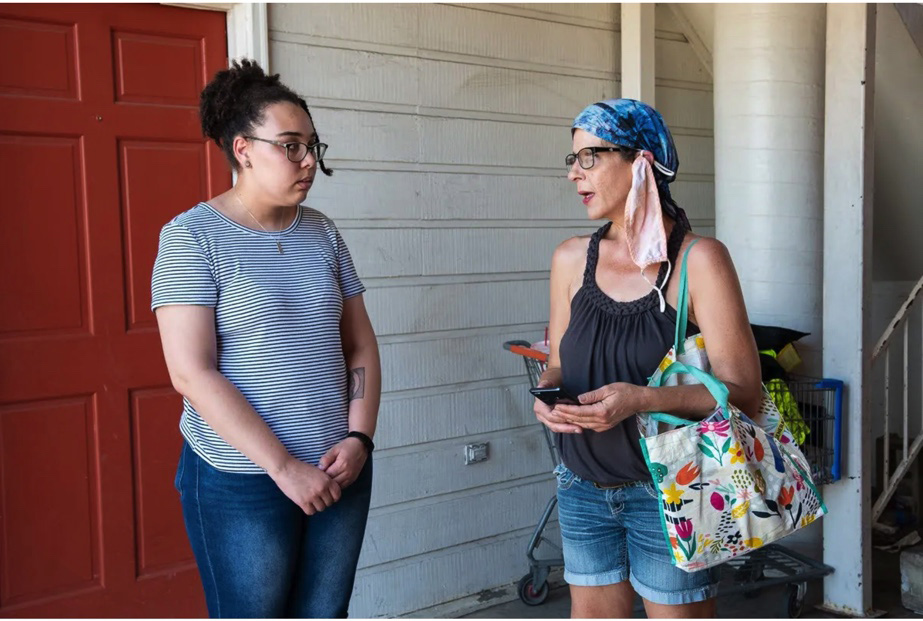
Whitney Bryen, our multimedia reporter, and I followed Atkins on one of her rescue missions. She carried a reusable shopping bag full of rental assistance flyers, pens, and paper and kept a roll of blue painters tape around her wrist. It was 93 degrees that day, so it didn’t take us long to start sweating. She occasionally would take breaks in the shade of entry ways to swap her wig for a head scarf before marching back into the sun.
The complex had many units in poor condition. We saw mold, holes in walls, shattered windows. I went home that night and cried after seeing some of the living conditions that Atkins said aren’t uncommon to some places she visits.
In one of our many chats over the last month, Atkins told me helping these people is much bigger than she is. Spending hours in the heat and watching her go back and forth between her wig and scarf showed me that. Watching her listen to tenants as they shared stories showed me that. Watching her help residents find help beyond rental assistance showed me that.
Dianna Arroyo, a tenant who lost part of her government assistance, was using a wheelchair a friend was about to throw it away. Atkins gave her contacts for people who could helper her get a chair that fits properly.
Atkins remains worried about her own housing when the federal evictions moratorium is scheduled to end Saturday. Her fiance’s return to work has allowed the couple to start catching up on rent, but Atkins’ work with ACTION is all volunteer.
It’s stories like hers that I want to tell, and I could use your help. Shoot me an email at rnajera@oklahomawatch.org with tips, suggestions or questions. You can follow me on Twitter here.
— Rebecca Najera
