
Following the Supreme Court’s ruling upholding the results of the fifth election to approvetheissuanceofbonds to pay for the construction of the county courthouse, the county commissioners acted almost immediately to issue the bonds and seek bids for the courthouse construction.
Following the county seat election, the county commissioners appointed a group of men from various communities to develop a plan for financing and building the courthouse. The committee members included David Russell from Madill, W. Y. Wiley from Woodville, James King from Aylesworth, Jeff Bishop from Powell, J. S. Jagers from Oakland, and F. E. Kennamer from Madill. Perhaps out of anger or spite over Kingston's fierce battle to have the county seat established there, the committee tasked with creating the courthouse plan did not include a representative from Kingston. Every major towninMarshallCountywas represented except Kingston. After the committee decided howtofinancethecourthouse construction through the sale of bonds, they focused on finding an architect for its design.
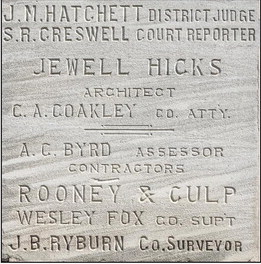
Before the fifth election, the committee, supported by the county commissioners, hired architect Jewell Hicks from Durant to design the courthouse. Hicks’ design was the third proposal made public and was notably more modest than the two earlier designs. Although no records indicate who was responsible for the first two designs, Hicks likely created both.
Jewell Hicks was born in Richmond, Arkansas, in 1882, to John T. and Frances Wiley Hicks. Little is known about Hicks’s early life; however, in 1900, at 18 years old, Hicks married Florence Mae Bradford in Texarkana, Texas.
JewellandFlorence’smarriage caused quite a stir and was considered scandalous in 1900. So scandalous that newspaperscoveredthestory of their marriage throughout the country. A large headline in “The St. Louis (Missouri) Republic” newspaper, on November 26, 1900, quoting a story from a Texarkana, Texasnewspaperread,“Stole His Bride From School” with a sub-headline “Clergyman Father Objected to Marriage, but Love Found a Way.”
The report of the marriage was, “Texarkana, Texas, November 25th, A romantic marriage occurred at this place last night the principles being Mr. Jewell Hicks and Miss Florence Bradford, both of Richmond, Arkansas.”
“The young lady’s father, who is a Methodist minister, objected to the suit and as an act of opposition placed his daughter a few days ago in Maddox’sSeminaryatMena, Arkansas” “Mr. Hicks left his home on Friday night on the plea of taking a duck hunt and went to Mena, where he stole the girl and brought her here and was married.” Following their marriage, Jewell and Florence moved to Durant.
It was in Durant that Hicks began training for and workingasanarchitect. Soon thereafter, Hicks opened the “Jewell Hicks and Company, Architects” firm in Durant. Over the next ten to twelve years, Hicks designed and oversaw the construction of numerous buildings, banks and houses in Durant and surrounding towns. He designed several area schools and other large buildings, including a five-story, 85room hotel in Hugo.
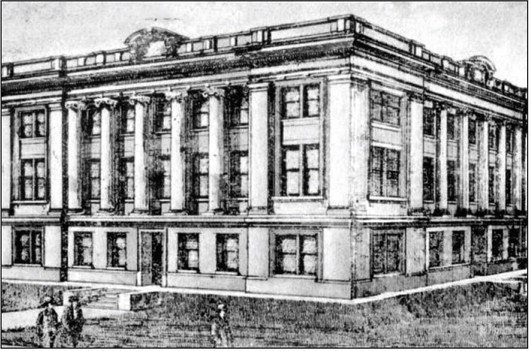
Hicks’s first major building design was the Marshall County Courthouse. Primarily constructed of faced stone, this building displays a solid and imposing appearance. Its rectangular, three-story structure exemplifies the Classical Revival style, characterized by balance, symmetry, and classical elements derived from ancient Greek and Roman architecture.
Key architectural features of the courthouse include entrances framed by large stonepilastersanddoorways, emphasizing the building’s importance as a center of justice and governance. The façade is meticulously balanced, with evenly spaced windows and decorative elements conveying order and stability. Vertical pilasters at the building’s corners and horizontal cornices along the roofline enhance its classical aesthetic.
The courthouse interior is organized around a central atrium, with offices, courtrooms, and meeting spaces symmetrically arranged on each floor. High ceilings and natural light enhance the sense of openness and grandeur.
These architectural choices were not just decorative; they held a symbolic purpose, reinforcing the authority and dignity of the county government. Simultaneously, the courthouse was designed to meet the community's practical needs, featuring spaces for judicial proceedings, administrative functions, and public gatherings.
After Hicks designed the courthouse, the City of Madill hired him to create the planned City Hall, and the Madill School District contracted himtodesignthenew “South Ward” school.
Due to Hicks’ design for the Marshall County Courthouse, he was hired by Solomon Andrew Layton, the principal architect at the Oklahoma City firm of Layton and Forsyth. Layton was one of Oklahoma’s most prolific and influential architects, earning the title of “The Master Architect of Oklahoma.” Throughout his career, Layton designed over 100 public, civic, and private buildings, many of which remain iconiclandmarksacross the state today. His work, often characterized by Classical Revival and Beaux-Arts styles, significantly shaped Oklahoma’s architectural identity.
In 1914, Solomon Layton hired Jewell Hicks to assist with the firm’s most significant project before and since. That project was the design and construction of the Capitol of the State of Oklahoma. LaytonandForsythhadbeen commissioned to design the Capitol. Still, due to the notoriety that Hicks earned for his design of the Marshall County Courthouse, Layton wanted Hicks to assist with the Capitol design.
While Layton is mainly credited with designing the Capitol, many documents indicate that Jewell Hicks ultimately led the building's design and inspired much of it. Due to Hicks’s collaboration withLaytonandForsyth on the design and construction of the state Capitol, the Layton and Forsyth firm was renamed Layton, Hicks, and Forsyth.
Hicks played a crucial role in designing the Oklahoma Governor’s Mansion. In 1927, the Oklahoma Legislature allocated funds for its construction, and the architectural firm Layton, Hicks & Forsyth was selected for the project, with Hicks serving as the lead architect. Although budget constraints necessitated changes to the original plans, the mansion was completed in 1928 and continues to stand as an important example of Hicks’s architectural legacy.
From that point on, Hicks was in high demand for designing and constructing numerous public buildings in Oklahoma. He later designed county courthouses in Bryan, Murray, Garvin, Pittsburg, Mayes, Stephens, and Oklahoma Counties, to name just a few. He also created the Masonic Temples in Muskogee and Oklahoma City, along with the Skirvin Hotel in Oklahoma City. Furthermore, Hicksdesignedthe Oklahoma Historical Society building, now the Oklahoma Judicial Center, which houses the Oklahoma Supreme Court, the Oklahoma Court of Criminal Appeals, and the Oklahoma Court of Civil Appeals. He designed many buildings across various state colleges and universities, such as the Bizzell Library at the University of Oklahoma, several at East Central State University, and facilities at the University of Oklahoma Medical School. For sports fans, Hicks also designed Oklahoma Memorial Stadium, now known as the “Palace on the Prairie.” In 1915, Hicks was named the “State Architect” by then-Governor Robert Williams. As the State Architect, Hicks received a commission of 5% on the construction of all state buildings. In 1925 and 1926, Hicks received more than $100,000 in commissions on state buildings. In today’s dollars, that commission would be approximately $1,775,000.
Hicks was deeply influenced by the Classical Revival and Beaux-Arts movements, whichemphasizedthe use of symmetry, proportion, and classical ornamentation. His architectural philosophy centered on the idea that public buildings should not only serve their practical purposesbutalsoinspirecivic pride and convey the stability of government institutions.
Key characteristics of Hicks' architectural style include symmetry and balance. Hicks believed that symmetry conveyed a sense of order and harmony, which are essential qualities for public buildings intended to accommodate government functions. Many of his buildings showcase prominent entrancesframedbycolumns or pilasters, emphasizing their significance as centers of civic life. He used materials such as stone and brick to ensure the durability of his structures, while decorative cornices, moldings, and friezes were standard features in Hicks’ designs, adding an element of refinement to his buildings.
Hicks also demonstrated versatility in his work, designing residences like the Barnes-Steverson House in Idabel, Oklahoma. This house, listed on the National Register of Historic Places, showcases Hicks’ ability to create both grand public structures and elegant private homes. Several other Hicks’s designs are listed on the National Register of Historic Places, including the Marshall County Courthouse and the courthouses in Bryan, Murray and Garvin Counties, as well as the Sulphur downtown historic district, much of which was designed by Hicks. In all, Hicks designed dozens of public buildings throughout Oklahoma.
Jewell Hicks’ contributions to Oklahoma’s architecture have had a lasting impact. His buildings remain in use today and are recognized for their historical and architectural significance. Throughout his career, he had to adapt to the evolving needs of his clients and communities. As Oklahoma grew and modernized, there was increasing demand for buildings accommodating larger populations and more complex administrative functions. Hicks met these demands by designing flexible and efficient interior spaces while maintaining the classical exterior elements that defined his work.
Hicks’ legacy is also reflected in the continued admiration of his architectural style. Preservation efforts have ensured that his buildings are maintained and restored, allowing future generations to appreciate their beauty and significance. His work has become an integral part of Oklahoma’s architectural heritage.
However, despite his popularity and notoriety, Hicks did not evade controversy. On February 17, 1926, Jewell Hicks was indicted by the OklahomaCountygrandjury on a charge of conspiracy to defraud the state of Oklahoma of $26,000. Representatives of the Humboldt Construction Company, the C. M Dunning Construction Company, the J. W. Mann Company, the A., C Kreipke Company, Campbell and Price, whose names are 'unknown,' and Frank Cableman, representative of the W. S. Bellows Construction company,werealsonamedin the alleged conspiracy.
The Grand Jury alleged that Hicks and the companies' representatives agreed among themselves that the cost of construction of a state building East Central State Teacher’s College (East Central State Unversity) would be approximately $96,000 but conspired to make the lowest bid submitted to be that of Campbell and Price at $123,000, which Hicks would approve.
Following the issuance of the indictment, Hicks was arrested. He pleaded not guilty and was released on a $5,000 bond. Hicks hired prominent attorneyCharlesMcPherren. At his arraignment, McPherren made no effort to quash the charge and informed the court that Hicks intended to go to trial. Hicks demanded an immediate trial, and the date set was the earliest possible. The trial was first scheduled for February 26, but Hicks objected, saying that would make the trial start on Friday. A different trial date was then set after a conference of attorneys.
McPherren said the indictment was not based on facts and that Hicks had no hesitancy in going to trial so that the truth could be known. McPherren stated there never has been any such transaction as alleged in the indictment.”
The trial was conducted on March 1, 1926, before Oklahoma County District Judge Lucian Babcock. Testifying for Hicks was former Oklahoma Governor Robert L. Willams. After Williams’ term as Governor ended, he was appointed as a United States District Judge for the Federal Court in the Eastern District of Oklahoma.
JudgeWilliamstestifiedto Hicks’s work and reputation when he was employed by the state during the judge's term as governor. Also, Sam MorleyofMcAlesterandC.O. Johnson of Durant, members of the state Board of Affairs under Judge Williams, testified Hicks, All swore to his good character.
Hicks’s defense argued that disgruntled contractors were blamed for the grand jury indictment. McPherren stated that 'There is no foundation for the Indictment.” Heargued,'Itissimplyacase of two or three disgruntled contractors going before the grand jury for revenge.”
McPherren also told the jury that Hicks “has made some enemies because of his position with the state, and it can, be seen readily how the (grand) jury got its information. On the other hand, Hicks never had anything to do with bids on state Jobs, which were all in the hands of the state board of affairs. He could not have, In any way, represented the state in letting contracts.” Then McPherren showed the jury that members of one of the firms with which Hicks was supposed to have had an agreement had not been the lowest bidders in two years.
Following three days of trial, Jewell Hicks was found not guilty of the charge, and he was acquitted of any wrongdoing.
Hicks and his wife Florence had two children, Jewell Hicks, Jr, and Mabel Hicks. In the early 1920s, the Hicks family moved to Oklahoma City following Hicks joining the Layton and Forsyth firm. Sadly, in 1932 Hicks was stricken with paralysis, and his days of designing buildings were essentially over. After almost 30 years of declining health, Hicks passed away on July 9, 1960.
Anobituarythatappeared in the Daily Oklahoman stated, “The architect who designed the state capitol and the governor's mansion, Jewell Hicks, 77, of 1223 N Central, died Saturday; services are pending at Street & Draper Funeral Home.”
“A Democrat, Hicks was active in state politics until he was stricken with paralysis 28 years ago. He served as state architect under Governor Robert Williams.”
Hicks also designed the University of Oklahoma football stadium, administration building and several other campus buildings. Other structures he designed include Crippled Children's Hospital, University Hospital, the state historical building and the Petroleum Building.”
“He lived in Durant during his early years. He was a member of the Methodist church. Survivors include a son, Jewell Jr. from Los Angeles, and two sisters: Mrs. Laura Thomson from Fort Worth and Mrs. Post from Wichita, Kansas.” Hicks was buried in the Forest Park Cemetery in Shreveport, Louisiana, where he lived for many years as his health declined. Despite his notoriety and fame, Jewell Hicks was a very private man, and sadly, nophotographsofhimexistin the available public records.
Jewell Hicks was a visionary architect whose work helped define the architectural identity of Oklahoma during a period of rapid growth and change. His designs for public buildings, including courthouses, government offices, and residences, reflected a commitment to classical principles and civic pride. Through his enduring works, Hicks has secured his place as one of the most important architects in Oklahoma’s history. His buildings continue to inspire and symbolize the state’s rich cultural and architectural heritage.
It should be a source of great pride to the people of Marshall County that their courthouse was the launch pad for the career of the State Architect of Oklahoma. A man who would be instrumental in the design and construction of the State Capitol, numerous other county courthouses, other government and college buildings and the Palace on the Prairie. It all began with the Marshall County Courthouse.
After a long, contentious fight between Madill and Kingston, the end was an opportunity for Marshall County to put its stamp on so many other majestic buildings in Oklahoma. Is it not unfair to ask, had Hicks not been hired by Marshall County, would his career reach the heights it achieved? It is safe to say that had he not designed the courthouse, he likely would not have been hired to help design the capitol, and he may have remained a local architect in Durant.
It is safe to say, once again, that Marshall County set the standard. That greatness wasborninMarshallCounty. Next time you pass the Marshall County Courthouse, remember Jewell Hicks and be proud of all the wonderful buildings and houses that were born out of the association between Marshall County and Jewell Hicks.