

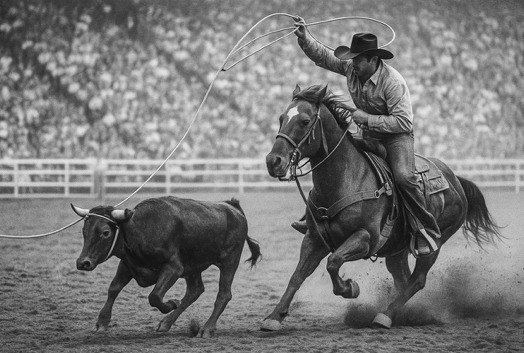
The dust will fly and the grandstands will rumble as the Madill Round-Up Club celebrates its 79th annual rodeo — a tradition nearly eight decades strong — on Friday and Saturday, August 22 and 23, 2025, with performances starting nightly at 8:00 p.m. Gates openat6:00p.m.,andparking is $20 per vehicle. The action takes place at the Madill Round-Up Club Arena, located between Madill and Kingston on Highway 70 — the same arena where generations have come to cheer, compete, and keep the spirit of the West alive.
When it comes to rodeo, the quality of the competition starts with the quality of the stock — and that’s where the UPRA Stock Contractor of the Year title carries its weight. Awarded annually by the United Professional Rodeo Association, the honor isn’t handed out lightly. It’s voted on by the contestants themselves — the men and women who strap into the chutes, nod their heads, and face down bucking bulls and broncs. These athletes know exactly which contractors deliver strong, athletic, and fair animals that give every rider a shot at glory. Being named Stock Contractor of the Year is a statement of trust, respect, and excellence within the sport.
For the Madill Round-Up Rodeo, the partnership with FlyingCRodeoCompany—a remarkable 17-time winner of that title — is more than a point of pride; it’s a seal of quality. Flying C’s animals are known for their power, agility and consistency, making them a favorite among top-tier contestants and a thrill for spectators. Their reputation draws competitors from across the region, raises the stakes for every event, and ensures that fans will see rodeo action at its very best. In short, Flying C’s presence guarantees that the Madill Round-Up Rodeo isn’t just another stop on the circuit — it’s a destination.
The Madill Fire Department will once again operate the concession stand, a tradition that ties the excitement of the arena directly to the safety of the community. Every dollar raised from concession sales will go toward supporting the department’s ongoing mission to protect the citizens of Madill—whether through maintaining vital equipment, funding training, or ensuring a rapid response when emergencies strike. It’s a reminder that the Round-Up Club is more than just bucking broncs and barrel racing—it’s about neighbors helping neighbors, and a community coming together to preserve its heritage while looking after its own.
Special events include County Team Roping on Wednesday, August 20th, a paradeonSaturdaymorning, August 23 at 10:00 a.m., and the crowning of this year’s Rodeo Royalty on Saturday night during the main performance.
Families will find plenty for the kids to enjoy, with sheep riding (mutton bustin’) and stick horse races each night of the rodeo. For the latest updates and sign-up details, fans are encouraged tochecktheMadillRound-Up Club Facebook page.
It’s more than a rodeo — it’s a living link to a proud western heritage, where the community gathers under the summer sky to celebrate skill, courage, and tradition. A rodeo is more than an event; it is a heartbeat — a steady, rhythmic reminder of the days when the American West was not a romantic notion, but a daily reality. Beneath the dust and the spectacle, it is a story of work, pride, and survival, told in the language of grit and grace.
Its origins lie in the vast, open ranges of the 19th century,whencattleranching was the engine of the frontier. Twice a year, cowhands would gather herds scattered across miles of grassland for branding, sorting, and driving to market. These “round-ups” were both grueling labor and a rare chance for camaraderie. Once the day’s work was done, the men would pit their skills against one another in impromptu contests: who could rope a steer fastest, who could stay on a bucking horse the longest, who could handle the roughest stock with the most finesse.
What began as a few minutes of sport after a long day’s work became, over time, a tradition. By the late 1800s, towns across the West were holding organized competitions, blending cowboy skill with community celebration. The Wild West shows of Buffalo Bill Cody carried the cowboy image eastward, marrying truth and legend in a spectacle that made bronc riders and sharpshooters into folk heroes.
A rodeo arena is a crucible. Inside its rails, a rider faces not just an animal, but the test of every hour they have spent in the saddle. The bucking horse or the spinning bull is an echo of the challenges the frontier threw at those who dared to tame it: unpredictable, dangerous, and utterly unforgiving. Rodeos symbolize selfreliance, toughness, and honor. They celebrate the idea that your word is your bond, that courage is not the absence of fear but the mastery of it, and that skill — honed through repetition and hardship-is something to be respected.
The Old West endures in the American imagination because it speaks to a yearning for freedom — the vast horizon, the open trail, the life lived close to the land. Rodeos are a living museum, where the smell of leather and livestock, the shimmer of heat rising from the arena dirt, and the cries of the announcer bring history within arm’s reach.
There is a romance to the rodeo, but it is not a softness; it is a beauty that knows hardship. The gleam of a silver bit, the braid in a horse’s mane, the crisp shirt and white piping on a competitor’s blouse — these are not just decorations but badges of pride, telling the world that this is serious business. Each event is a conversation with history: calf roping recalling the necessity of catching and doctoring livestock; barrel racing showcasing the precision and trust between rider and horse; bull riding proving the raw mettle that once kept a man alive on the range.
For all its tests of skill, the rodeo is a communal affair. The grandstands are filled with neighbors, families, and friends, gathering as their forebears once gathered on branding day. The arena becomes a place where generations meet — grandparents remembering the contests of their youth, parents cheering their children’s first run, and young riders dreaming of making the eight-second whistle.
In small towns like Madill, the rodeo is a yearly marker, as dependable as the turning of the seasons. It is a time when the community’s shared heritage is on full display, when the old songs of theWestarenotjustsungbut lived. The grand entry, flags flying and riders circling in formation, is both pageantry and pledge — a promise that the traditions of the past will ride forward into the future.
Even in a world of instant entertainment, the rodeo holds its place. It is not a sport you can genuinely understand from a distance. You must be there — to hear the gate clang open, to feel the vibration of hooves through the ground, to see dust curl in the late sun. It is a reminder that skill, courage, and heritage still have a place in modern life.
Therodeoenduresbecause it is not merely performance — it is preservation. It preserves the lessons of the Old West, the artistry of horsemanship, the courage of facing down the untamed, and the unspoken code of honor that has bound cowhands together for more than a century. Every bronc ride, every barrel turn, every rope thrown is a line in the living story of the West — a tale the rodeo keeps telling, one ride at a time.
The true roots of rodeo lie south of the Rio Grande. Spanish colonists in Mexico brought horses, cattle, and a ranching culture to the New World in the 1500s. The vaqueros—skilledhorsemen whosenamecomesfromvaca (cow)—developedtechniques for roping, branding, and managing wild cattle in open country. They created much of the gear and style still seen in rodeo today: the lariat, spurs, wide-brimmed hats, and heavy leather saddles designed for long hours in the saddle.
When Anglo-American settlersmovedintoTexasand the Southwest in the early 1800s, they absorbed the vaquero methods wholesale. The “cowboy” was born, and with him, the contests of skill that would eventually become rodeo events.
On the cattle drives of the mid-19th century — from Texas to Kansas railheads like Abilene and Dodge City — cowboys worked hard for low pay. Days might pass in dusty monotony, but when the cattle were bedded down and the coffee boiled, competitions sprang up around the campfire. Who could rope the fastest? Who could stay on the meanest bronc? Who had the steadiest hand with a branding iron? These were not idle games — they mirrored the actual work needed to survive and succeed in the trade.
By the 1860s and 1870s, such impromptu contests spilled over into towns on payday weekends or during fairs. Cowboys would bet wages on who could ride the longest, rope the quickest, or throw a steer with the most style.
While it’s hard to pinpoint the exact “first” rodeo, several claim the honor. Deer Trail, Colorado, hosted adocumentedcowboycontest in 1869, awarding a fancy suit of clothes to the best hand. Pecos, Texas, points to 1883 as its inaugural event. Prescott, Arizona, held what it called the first “organized” rodeo in 1888, complete with admission fees, advertised programs, and prizes.
These early rodeos were often tied to Fourth of July celebrations, county fairs, and stock shows. The events — bronco riding, steer roping, bull riding — mirrored ranch work but were adapted for spectators. The spectacle began to matter as much as the skill.
Buffalo Bill Cody changed everything. His Wild West shows, starting in 1883, brought the cowboy’s image to the world. Although not rodeos in the competitive sense, these traveling spectacles featured trick roping, bronc busting, and staged battles with Native Americans. They glamorized the cowboy and drew international audiences. Cowboys who honed their skills on ranches now had a stage — and a paycheck.
Many early rodeo stars, like Tom Mix, Yakima Canutt, and Lucille Mulhall, gained fame through these shows, blurring the line betweenworkingcowboyand entertainer.
By the early 1900s, rodeos were moving from dusty fairgrounds to larger, more organized arenas. The Cheyenne Frontier Days (first held in 1897) became a model — blending genuine competition with showmanship. Events like calf roping, steer wrestling (bulldogging), and saddle bronc riding were formalized.
In 1936, cowboys at the Boston Garden rodeo went on strike over unfair pay and treatment. Their walkout succeeded in winning better conditions, and they formed the Cowboy Turtles’ Association — so named because they had been slow to organize but eventually “stuck their necks out.” This organization evolved into today’s Professional Rodeo Cowboys Association (PRCA), which standardizes rules, events, and pay scales.
From this point on, rodeo became not just a pastime but a professional sport. Prize money grew, sponsorships emerged, and stars traveled a national circuit.
Women were part of rodeo from the start, excelling in trick riding, roping, and bronc busting. In the early 1900s, figures like Tad Lucas andBonnieMcCarrollgained national fame. However, after McCarroll’s death in a bronc-riding accident in 1929, women’s rough stock events declined. Today, women dominate barrel racing, which entered the PRCA as an official event in the 1940s, and they remain leaders in breakaway roping.
The mid-20th century saw rodeo grow alongside television. Colorful personalities like Jim Shoulders, Larry Mahan, and Ty Murray brought bull riding and bronc riding into living rooms across America.TheNationalFinals Rodeo (NFR), first held in 1959, became the sport’s championshipstage,drawing top talent from across the country.
Modern rodeos blend tradition with entertainment — pyrotechnics, music, and corporatesponsorships—but the core remains: man (or woman) against beast, skill against chance.
The first rodeo to be held in Marshall County occurred in the summer of 1920, just a year after the signing of the Treaty of Versailles in June of 1919, which ended World War I. That first rodeo was sponsored by the Charles B. Burke Post of the American Legion, located in Madill. The post had been formed in November of 1919, just a few months after the Treaty of Versailles had been signed.
For the next eleven years, the American Legion sponsored a rodeo in Madill. Then, in 1931, various other groups began sponsoring rodeo events. From the Rotary Club, the Madill Business Association, to the Madill 4-H Club and other groups, rodeos were held multipletimesayear. During those days, it was reported that these events would draw crowds numbering between 2,000 and 4,000 spectators. Then, about 1935, the rodeos ended. And for the next few years, there is no record of any rodeo being held in Marshall County. While rodeos were conducted in all of the surrounding counties, thespectacleofbroncbusting, cattle wrestling and calf roping seems to ride off into the sunset.
Then, in September of 1941, the Madill Record asked the following in the September4thedition. “ARE WE ASLEEP? Rodeos, fairs, cavalcades, and celebrations of various sorts are being held intownsandcitiesalloverthe country. Nearly every town of any size in this entire section has held or is planning some sort of community entertainment. Except Madill! Is it worthwhile to hold these events?
Are we asleep to our opportunities?”
The Madill Record's appeal likely stemmed from the formation of a new organization in Madill called theMadillSaddleClub.Inthe spring of 1941, rumors about starting a riding club began to spread across Madill. The idea wasn’t driven by dreams of big rodeos or producing champion bronc riders—it wasmorebasic.AstheMadill Record observed, the goal wasn’t a “big rodeo” at all, but to “create more interest in horses and horseback riding” in a region naturally suited for it.
Southern Oklahoma already had its share of fine saddle horses, and the club’s organizersbelievedhorseback riding was more than just a pastime. It was exercise, fresh air, and freedom—the perfect antidote to the deskbound life of the modern businessperson. More than that, it was fun. The Record rallied the community with a simpleencouragement:“Let’s assist in every way those who are organizing the club.”
By late May 1941, the movement had gained momentum. On May 29, an open invitation was published, urging “everyone interested in horseback riding, whether he has a horse or not,” to attend an organizational meeting at the Farm Security office. The note even reassured newcomers—there was no need to bring your horse that night.
The meeting, held on Monday, May 5, 1941, brought the club officially into being. The men who first formulated the idea of the Saddle Club were Harold Jones, his brother Wreno“Pedo”Jones,General Fitzhugh Lee Lewis, Viley Johnson and Bill Cochran. Theyweretheguidingfigures in the formation of the Madill Saddle Club, which later became the Madill Round-Up Club. These early guiding figures behind the Madill Round-Up Club had reputations that extended well beyond the rodeo arena.
HaroldJones,remembered by many generations of Madill residents, was one of Madill’smostwell-knownand reliable mailmen. He served in that role for 39 years, faithfully delivering letters, bills, and long-awaited news in all kinds of weather. But when his postal work was done each day, Harold traded his mailbag for reins. A skilled horseman with a relaxed seat and a natural rapport with animals, he was just as comfortable in the saddle as he was walking the streets of Madill carrying his mail pouch. His deep understanding of horses and steady, friendly demeanor made him a clear choice for the Round-Up Club’s leadership in its early days.
Wreno Jones—known to friends and neighbors simply as “Pedo”—brought his own brand of energy and community spirit to the club. Out past J&I Manufacturing, on his family farm, Pedo established Jones Meat Market, a small-scale operation that became a trusted source of quality cuts for locals. The market reflected his practical knowhow, strong work ethic, and personal investment in the peopleofMarshallCounty.In the arena, Pedo’s leadership was marked by a willingness to pitch in wherever needed, whether it was organizing events, wrangling livestock, orsimplymakingsurevisiting cowboys felt welcome.
General Fitzhugh Lee Lewis carried one of the most distinctive names in Marshall County history — and with good reason. His father, Judge Isaac Overton Lewis, was not only one of the founders of Madill but also a respected judge whose work often took him to Washington, D.C., lobbying on behalf of the Chickasaw Nation. During those trips, he became acquainted with the celebrated former Confederat e general Fitzhugh Lee, who had later served as a general in the Spanish-American War and as governor of Virginia. Admiring the man’s career and character, Judge Lewis decided to name his newborn son in his honor. When he instructed the clerk of Pickens County, Chickasaw Nation, to name the boy “after General Fitzhugh Lee,” the clerk took him at his literal word — and so the birth record officially read “General Fitzhugh Lee Lewis.”Thoughthejudgehad only intended “Fitzhugh Lee Lewis,” the title stuck for life. In time, “General” Fitzhugh Lee Lewis carved his own path as both a respected lawyer and a successful businessman, operating the Farm and Ranch International Harvester dealership in Madill. In both law and commerce, he became as much a fixture in the community as the family name itself.
Viley Johnson, remembered in Marshall County for his years as a rancher and his deep ties to Oklahoma agriculture, was a man whose life bridged the traditions of rural heritage and modern education. A graduate of McAlester High School and Oklahoma State University, Johnson was active in 4-H programs as a youth, fostering a love for livestock and land stewardship that would guide his career. For several years, he operated a ranch in Marshall County, contributing tothelocal cattle industry before returning to McAlester.
Bill Cochran was a wellknown figure in Madill, remembered both for his business acumen and his deep love of horses. At one time the manager of the Corner Drug Store, Cochran also channeled his craftsmanship into making and selling saddles and tack, earning the respect of local horsemen. Beyond his work, he and his wife devoted themselves to mission efforts through the Madill United MethodistChurch,extending their service far beyond the county line. His life reflected the values of hard work, horsemanship, and faith that are central to the community’s character.
When the Saddle Club was first formed, Fitzhugh Lewis was elected president, with Viley Johnson as vicepresident and Bill Cochran as secretary-treasurer. Their first order of business was ambitious: the construction of stables at the City Park. A committee—Johnson,Harold Jones, and Cochran—was appointed to begin work on ten stalls immediately. The dues were yet to be set, and the long-term plans still undefined, but the group had taken the first real step toward something locals had talked about for years. Even in these earliest discussions, the possibility of hosting a rodeo in Madill was mentioned.
The club wasted no time building camaraderie. On June 19, 1941, they saddled up for a picnic supper at the City Lake, with Mrs. Zula Morris bringing food for the riders who arrived on horseback. These informal gatherings—equal parts riding and fellowship— quickly became a signature of the club.
By late July, the Madill Saddle Club was setting its sights on something more coordinated. Under the guidance of Mrs. Hinton Bell, members began practicing the quadrille—a precise, choreographed riding formation akin to a square dance on horseback. The fact that they met three nights a week for practice speaks to the dedication and enthusiasm the riders brought to their work. Their weekly outings continued, with rides to Carter Lake and other destinations, blending recreation with skill-building.
Public appearances soon followed.OnAugust14,1941, the Saddle Club joined forces with the Madill High School band to lead the parade at the Ada Rodeo. It was the club’s first taste of public parade performance, a tradition that would define much of their public life in the years ahead.
Through the remainder of 1941 and into 1942, the club continued its regular rides, picnics, and social gatherings. October 30, 1941, saw members riding to the City Lake for a meeting hosted by Mrs. Basil Adamson and Mrs. Don Welch. In August 1941, they accepted an invitation to join Tishomingo’s first annual LaborDayRound-Upparade. These excursions connected the club to a broader network of riding groups, fostering friendly competition and shared tradition.
They held outdoor suppers, roasted hot dogs, and participated in rodeo parades, including the July 4 Gene Autry Rodeo in ArdmoreandtheannualAda Rodeo. The most spectacular event of that year came on September 10, when rancher Frank Bounds hosted what began as an entertainment for the Saddle Club but turned into one of the largest gatherings in county history. At least 300 guests attended a barbecue and old-fashioned square dance at the Bounds ranch, with guests from all oversouthernOklahomaand north Texas.
Behind the scenes, the Saddle Club was building something lasting. Their facilities—including barns, a modern rodeo arena with lights, grandstands, fences, andchutes—werecompletely paid for. It was an impressive accomplishment for a group thathadstartedwithnothing more than an idea in 1941 From those first casual meetings in the Farm Security office to winning parade honors and building a debt-free arena, the Madill Saddle Club became more than a gathering of horse enthusiasts—it became a symbol of community spirit. Its history is a testament to the enduring appeal of horseback riding, the value of fellowship, and the power of a shared vision to shape local culture.
But history intervened. When World War II erupted, many of the club’s members were called into the armed forces. Without its core of riders, the Saddle Club faded, its activities suspended for nearly a decade.
Following the war, the Madill Round-Up Club was formed. The Round-Up club is a story of persistence, grit, and community spirit—a legacy that reaches back before the name “Round-Up” ever appeared on a banner. The roots of the organization trace back to 1941, when the original Madill Saddle Club was formed. This early group of horsemen and enthusiasts gathered for fellowship and horsemanship, staging events that brought together the town’s ranching and riding community.
The rebirth of the Saddle Club came in 1949. Meeting in Jack Blalock’s riding stables,agroupofdetermined citizens—ledbyW.E.Jonesas president, Jim Davis as vicepresident, and C. A. Hardee as secretary-treasurer—and Harold Jones, reorganized underanewname:theMadill Round-Up Club. They had no arena,nostock,andnosteady income, but they had vision.
That first year, Sunday afternoon “free rodeos” became the club’s lifeline. Borrowing calves and horses from local stockmen like Frank Vinson, members staged small competitions thatdrewcuriouscrowdsand gave local cowboys a place to hone their skills. The events not only built enthusiasm but also began filling the club’s treasury, penny by penny.
By 1950, the Round-Up Club was ready for bigger things. A $250 donation from members and careful savings allowed them to construct an arena. Old barns, corrals, and fencing from the defunct Saddle Club were moved into place, and floodlights were installed. The sandy arena floor—washed clean from its past life over a football field—quickly turned to muck in wet weather, but the community’s willingness to help was unshakable. Local businesses donated materials and labor, and by rodeo season, the arena was ready.
The first official rodeo in the new facility faced heavy rains that washed out all three nights. Despite the setback, the event cemented the club’s role as a hub of local rodeo culture. Beardon Brothers provided the stock that year, and in the crowd weremanywhowouldbecome lifelong supporters.
Fromthoseearlystruggles, the Madill Round-Up Club began to hit its stride. In 1951,underPresidentHarold Jones, the rodeo not only enjoyedgoodweatherbutalso cleared its debts. The stock, provided by W. N. Whitten of Idabel, was a highlight, as were the bustling concession stands overseen by Mrs. Mariah Carter.
By mid-1952, the club had 140 paying families—more than 500 individuals in total. They had won prizes in three straight parades, established official uniforms, and crowned Round-Up Queens like Jo Ann Ewing in 1949 and Margaret Carter in 1951. Their annual rodeo had become a regional event, attracting top contestants and spectators from across southern Oklahoma and north Texas.
From a wartime pause to postwar revival, from makeshift Sunday ropings to an arena that echoed with the cheers of hundreds, the Madill Round-Up Club had secured its place as one of the community’s proudest traditions. The story was far from over, but by 1952, the foundation was solid, and the future promised bigger and better shows under the summer lights.
The August 21–23, 1952, rodeo marked a high point in the Madill Round-Up Club’s young life. The arena, now polished from three years of constant improvements, shone under the electric lights as competitors from across Oklahoma, Texas, and beyond converged on Marshall County. “Goat” Mayo’s stock proved a formidable test for the riders, withbuckingbroncsandagile calves ensuring that no event was won without grit and skill. The grandstands were filled each night, the scent of fresh popcorn and barbecue drifting through the warm summer air, while Margaret Carter, still serving her final weeksasqueen,ledthegrand entry with poise.
TheelectionofanewRound-Up Queen before the 1952 showwasacommunityaffair. Local merchants donated prizes, photographers lined up to take publicity shots, and young horsewomen from across the county vied for the honor. The queen was not only the rodeo’s figurehead but also the club’s ambassador, representing Madill in neighboring towns andensuringtheRound-Up’s name was known across the southern plains.
By 1953, the Round-Up Club’s annual rodeo was firmly established as one of the premier summer events in southern Oklahoma. The club began introducing more family-friendly activities — sack races for children, musical chairs on horseback, andevena“wildcowmilking” contest that became a crowd favorite. Rodeo weekend was no longer just about competition; it was a fullscale community festival.
The uniform tradition continued, with club members riding in parades andperforminggrandentries in their distinctive shirts and trousers.Theclub’sdrillteam, withpreciselychoreographed maneuvers under the arena lights, became a signature feature of every show. By now, other towns had begun modeling their own rodeos on Madill’s example, further solidifying the Round-Up Club’s influence in the region.
In 1954 and 1955, the club embarked on a series of improvements to the arena facilities. The wooden bleachers were extended to accommodate the evergrowing crowds. Better corrals and chutes were installed, making stock handling more efficient and safer for both animals and cowboys. The club also invested in better lighting and sound systems, ensuring that the announcer’s voice carried clearly to the farthest seats and that the night performances retained their atmosphere even under overcast skies.
It was during this period that the club also began working with nationally recognized rodeo contractors, bringing in some of the best rough stock available in the Southwest. The caliber of competition rose accordingly, and Madill became known as a proving ground for up-andcoming professional rodeo hands.
The 1956 rodeo was remembered as one of the best in the club’s history to that point. The weather cooperated perfectly — warm, dry evenings with just enough breeze to keep the dust down. Recordbreaking attendance filled the stands, and for the first time, the club had to arrange overflow parking in nearby fields. A special section of the bleachers was set aside for veterans, in recognition of the large number of local servicemenwhohadreturned from the Korean War.
The queen contest that year drew unprecedented participation, with young womenfromMadill,Kingston, Oakland,andseveralsmaller communities entering. The winner not only received a saddle and crown but also a trip to represent the club at the Fort Worth Stock Show.
Throughout the late 1950s, the Round-Up Club was powered almost entirely by volunteers. Members repaired fences, sold tickets, ran concessions, and worked the chutes. The club was a reflection of Marshall County’s rural heritage — neighbors helping neighbors, everyone lending a hand to make the rodeo happen. Profits from the shows often went back into community projects, including youth programs and local fair improvements.
The Madill Record regularly covered these eventswithamixofprideand familiarity, often featuring photographs of the queen and her court, action shots of the bronc riding, and candid images of the crowd. Year after year, the rodeo was referred to as one of the “outstanding community achievements” of southern Oklahoma.
By the decade’s end, the Madill Round-Up Club was more than just a rodeo organization; it was a cornerstone of community identity, a place where generations gathered each summer to celebrate their shared heritage under the bright lights of the arena.
When the 1960s dawned, the Madill Round-Up Club’s annual rodeo was no longer just a highlight of the summer — it was the event that marked the turning of the season. By now, three generations of families had stood at the rail or sat in the grandstands, cheering bronc riders and barrel racers, listening for the sharp pop of the calf rope, and watching the familiar colors of the Round-Up Club drill team sweep into the arena.
The queen contests remained a major draw, with entrants now coming from across southern Oklahoma and northern Texas. Winning the title of Round-Up Club Queen had become a badge of honor that carried prestige well beyond Marshall County. The crown was not just a token of beauty or horsemanship; it meant leadership, public speaking, parade appearances, and representing Madill at other major rodeos. Many young women who took their first confident ride as a queen candidate in Madill went on to lifelong involvement in the rodeo world.
As the decade progressed, the club invested heavily in keeping the facilities up to modern rodeo standards. By the early 1960s, new metal chutes replaced some of the older wooden structures, making stock handling safer. The lighting system was upgraded again, allowing the night shows to be run with thekindofbright,shadowless illumination that television networks preferred. This consideration would soon matter more.
The club also made a push to improve spectator amenities. The bleachers were reinforced and expanded yet again, more restrooms were added, and the concession stands began offering a wider range of food, from hamburgers and chili dogs to cold drinks that were almostasmuch apartof the experience as the events themselves.
Attendance regularly hit record highs, with cars parked in every available spaceforblocksaround.Local businesses, from feed stores to cafés, saw the rodeo week as one of their busiest of the year. For some shop owners, the Round-Up was second only to Christmas in terms of revenue.
Bythemid-1960s,Madill’s rodeo was a recognized stop for top-level competitors chasing the national circuit. PRCA sanctioning helped standardize the events and ensured that cowboys could earn points toward the National Finals. Names thatappearedintheprogram were often the same you’d see in Fort Worth, Cheyenne, or Calgary. This prestige made the Round-Up a proving ground for local riders, who now had the chance to match skills with some of the best in the business without leaving home.
In this era, the Round-Up Club began bringing in nationally known rodeo announcers whose voices became as much a part of the show as the events themselves. Their colorful descriptions, jokes, and crowd-rousing style turned each performance into a shared experience that felt larger than life.
Beyond the competition, the Round-Up Club arena became a year-round community hub. Parades, trail rides, and holiday events are often centered around the facility. In the mid-1960s, the club organized benefit rides to raise funds for local causes, and they sometimes opened the arena for youth rodeos to encourage the next generation of cowboys and cowgirls.
For many in Madill, the rodeo was the year’s largest reunion. Families scheduled visits to coincide with the show, knowing they’d see cousins, old classmates, and friends in the stands. The announcer’s booth often became a platform for public greetings, from “Happy 50th Anniversary” to “Good luck to our servicemen overseas.”
The1970sbroughtchange to the rodeo world as a whole — rising costs, shifting entertainment trends, and growing public discussion about animal welfare. Through it all, the Madill Round-Up Club kept its footing by holding tight to the values that had built it: volunteer work, community involvement, and respect for the sport’s heritage.
The queen contests of the ’70s became even more polished, with contestants appearingintailoredwestern suits,carefullytooledsaddles, and coordinated grand entry routines. The club’s drill team expanded its repertoire, performingintricatepatterns to recorded music, and often bringing the crowd to its feet.
Stock contractors now brought in some of the most famous bucking bulls and broncs of the time, names known to rodeo fans across the country. The eightsecond horn for bull riding, introduced nationally in the late ’60s, became part of Madill’s soundscape, adding tension and drama to every ride.
The club continued to maintain and improve its arena,weatheringOklahoma storms and the wear and tear of constant use. The lighting towers stood tall over the fairgrounds, visible from the highway, serving as a reminder that Madill was not just another small town — it was a rodeo town.
By the end of the 1970s, the Madill Round-Up Club had firmly established itself as one of the longest-running, most respected small-town rodeos in the Southwest. Its reputation rested not on size alone, but on heart — the heart of a community that turned out year after year to work the gates, ride in the parades, cheer from the stands, and keep alive a tradition that began with little more than a dusty arena and a handful of cowhands willing to test their skill.
Throughoutthe1970s,the Round-Up Club continued to lean on volunteer efforts and community spirit. Though detailed newspaper accounts from the period are sparse, the traditions of rodeo queens, parade drill teams, concession stands, and local sponsorships remained central to each event. The rodeo was firmly entrenched as a highlight of Madill’s cultural and social calendar. The legacy endures. The Madill Round-Up Club continues to host its annual rodeo, now part of a longstanding tradition stretching into the 2020s. According to Rodeos USA, the event attracts a full slate of rodeo action — from bull and bronc riding to calf roping, barrel racing, breakaway roping, team roping, and more — under UPRA, CRRA, and ACRA sanctioning. Flying C Rodeo Company, a respected contractor in the region, runs modern performances.
Today, the event is still going strong —with added attractions like Mutton Bustin’, and with free admission on both nights, a $10 parking fee per vehicle, and a program likely rooted in that long tradition of community-first entertainment. This year’s Rodeo Royalty candidates includethefollowingbeautiful young ladies: Paisley Dean, Checotah Blood, Bri Harkins and Reece Gay.
The Madill Round-Up Club’s legacy has never been just about the arena dirt, the chutes, or the eight-second rides — it has always been about community. From its earliest days in borrowed barns to the modern, well-lit arena on Highway 70, the club has been a gathering place where neighbors cheer, families laugh, and the Old Weststillbreathesinthedust and the roar of the crowd.
Today, the Madill Round-Up Club remains a non-profit organization dedicated to keeping western heritage alive while giving back locally. Its efforts extend beyond the flagship August rodeo, supporting related events. One of them is the Madill FFA Rodeo — a celebrated youth competition that draws contestants from across the state and is believed to be the oldest FFA rodeo in Oklahoma. These events ensure that the values of sportsmanship, skill, and community pride are passed down to the next generation.
That sense of belonging remains as vital as the sport itself. Membership is still open to anyone with a love for rodeo and community tradition, with annual dues set at just $20 per family — a small price to be part of something that has endured for generations. Whether you ride, rope, volunteer, or simply come to watch, your presence helps keep the Round-Up spirit alive.
Asthe79thRound-UpClub Rodeo takes center stage, it is more than an event; it is the living heartbeat of Marshall County’s heritage, carried forward one ride, one cheer, and one family at a time.