

When the St. Louis–San Francisco Railroad first cut through the Chickasaw Nation in 1901, it brought more than commerce. It brought the hum of modern life. The depot became Madill’s heartbeat. Every train’s whistle was both promise and punctuation: promise of goods, people, and letters from afar; punctuation in the rhythm of small-town life. To a prairie town still roughedged and barely out of its frontier infancy, the shriek of the Frisco’s iron horse was a reminder that it was now tied into something larger, faster, and more consequential than itself.
The depot was not just a building.Itwasastagewhere life unfolded in daily scenes repeated with slight variations, a ritual as familiar as church on Sunday. Every morning and evening, the town gathered there—not just those boarding or disembarking, but the curious, the idle, and the hopeful. Mothers brought children to watch the smoke plumes rise. Merchants came to meet shipments. Young men came to size up arrivals, and arrivals sized up Madill. The depot wastheplacewheretheworld arrived and where the local met the global.
When the Frisco came, it didn’t just give Madill a timetable; it gave the town a center of gravity. Depots across Indian Territory and the new state worked like magnets: they pulled freight, news, mail, itinerant trades, and people into a tight daily orbit — and hotels clustered exactly where that orbit was strongest. The hotel and the depot were conjoined twins. The depot brought the flow; the hotel caught it, housed it, and gave it form.
Hotels in this era were not luxuriesbutnecessities.They were as essential as the depot itself. Without them, a town could not host drummers or dignitaries, salesmen or surgeons. Without them, there was nowhere for farmers to wait out a storm, no place for civic clubs to gather, no stage for banquets that proved the town was modern and worthy. The hotel was the civic parlor, the traveler’s refuge, the merchant’s showroom, the doctor’s office, and the salesman’s headquarters. The Frisco delivered people, and the hotel absorbed them.
You could hear this life before you saw it. The high, lonely whistle echoing across the prairie; the pulsing exhaust as locomotives idled at the platform; the squeal as flanges bit the curve; the porter’s sing-song call urging passengers to step lively; the slap of mailbags hitting the platform; trunks grating against the iron lip of a twowheeled hand truck; a drummer’s sample case clicking open like a cash drawer in a general store. Each sound becamepartofthevocabulary of progress.
You could smell it too. Hot oil and cinders hung in the air. Coal smoke drifted across town, acrid and pungent, searing throats but quickening pulses.Dampcanvasfrom tents or tarpaulins carried a tang of wet rope. Crates of oranges unloaded from freight cars split open, mingling with the dusty sweetness of harness leather. Coffee, always coffee, drifted from a hotel lunch counter that never really closed, its pots simmering day and night. For the traveler, that aroma meant warmth, food, and rest. For the town, it meant proof that Madill was connected to a wider world.
This pattern wasn’t unique to Madill. It was the way progress worked in the first decades of the twentieth century: railroad first, depot second, hotel third. Ardmore rode the rails to prominence andcontinuedtobuildbigger, prouder hostelries as proof. The Whittington, rebuilt after a fire and explosion, was widely touted as “the finest hotel between Kansas City and Fort Worth,” its marble lobby and electric lights symbols of a city that refused to be provincial. Ardmore’s Whittingtonevenboastedthe region’s first Otis elevator, clattering guests upstairs in a way that made smaller towns envious.
Durant grew in the same depot-first way. By 1902, chroniclers noted “five hotels” already open, clustering near the Katy and Frisco depots. Bythe1910s,theHotelBryan had become a four-story social and political clubhouse, hosting rallies, society weddings, and touring performers. Its very height signaled ambition. If you wanted to know how far Durant had come, you looked at the Hotel Bryan.
Across the Red, Denison wore its hotels like regalia. Its location as a gateway from Texas into Indian Territory made it an early boomtown, and its hotels reflected that wealth. The Denison House came first, a frontier palace by 1870s standards. By the turn of the century, others had followed, culminating in the seven-story Hotel Denison in 1924—a skyscraper by local standards, which dwarfed the courthouse and stood as an icon of civic pride.
Even in smaller places, the formula remained the same. Little whistle-stop towns along the Frisco line often had one or two hotels, their modest wooden frames serving as gathering points for travelers and locals alike. Some were only two stories with a dozen rooms, their dining halls doubling as the only public meeting spaces. Yet even there, the hotel gave the town stature. The logic was simple: no hotel, no town.
Seenfromawiderlens,the Rock Hotel is not an outlier but the local flower of a regional system. The Frisco’s schedule set the tempo; the depot marked the stage; the hotel made the stage habitable. Madill’s Rock was cut from Bromide stone, built not merely to accommodate guests but to declare that this young town had staying power. To walk past its heavy walls, to see its bold painted sign from the depot platform, was to know that Madill was no temporary settlement but aplacereadyforpermanence.
A Building of Stone When the Frisco Railroad arrived in Madill in 1901, it put its stamp on the town in timber. The depot was a large and broad wooden structure two blocks east of where the Rock Hotel would soon rise, a plain but vital hub where mailbags slapped the platform, porters called out, and travelers came and went. Right across the street from that depot sat the Frisco Hotel, a two-story wooden hostelry owned by the railroad. For a time, it was the first and only place on East Mainwherepassengerscould find a bed near the trains. Convenient, yes, but like the depot itself, it was built of wood — serviceable, temporary, and vulnerable to fire.
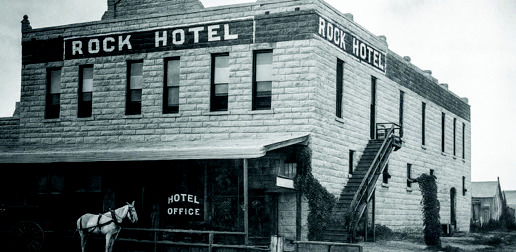
Two blocks west, at East Main and 3rd Street, something far more ambitious began to take shape. Where most of Madill’s early hotels were hastily built frame structures that could vanish in a blaze, the Rock Hotel rose from blocks of native stone. Its walls came from the quarries at Bromide in Johnston County, a town whose very nameevokedmineralsprings but which supplied the dense limestone that would give Madill its first monument to permanence. The work of bringing that stone to Madill was punishing; blocks had to be pried from the earth, cut into shape, and loaded onto wagons. Wagon teams leaned into harness, axles groaned under impossible weight, and drivers trudged alongside with reins in one hand and whip in the other. The roads were little more than rutted tracks, dusty in summer and nearly impassable in winter. Every load of stone that rattled into town was a victory of endurance and faith in the future.
Once in Madill, masons took over. In the glare of Indian Territory heat, they set to work with hammer and chisel, trimming blocks to fit, spreading mortar, and stacking stone into walls that would stand for decades. What they built was more than a hotel; it was an act of civic will. Where wood warped, weathered, and burned, stone endured. In a settlement still carving permanence out of prairie, the Rock became both a literal and a symbolic foundation.
That permanence was striking to every visitor who stepped off the train. To see the Frisco Depot and Hotel of timber on one end of the street, then to walk two blocks west and encounter the Rock’s limestone walls, was to confront two different visions of a town’s future: one temporary, one enduring. Stone buildings were still newintheChickasawNation at the turn of the century. They were expensive, laborintensive, and difficult to erect. That was precisely why they carried such weight. The Rock was not just a place to sleep; it was a proclamation: this town will last; this town deserves stone.
The newspapers wasted no time in celebrating it. The Madill News in April 1905 praised the Rock as “a handsome two-story stone building” that was already doing “an enormous business.” By September of that same year, demand had grown so great that the owners announced an expansion: “an additional hall and ten more rooms… to better equip this hotel for its growing trade.” In less than twelve months, the Rock was bursting at its seams, proof of both its popularity and Madill’s rising vitality.
Evensmalldetailsbecame part of its legend. That same year, the News reported, almost with a wink, “The Rock Hotel has one of the finest milch cows in the world. She gives four gallons of milk without moving the bucket.” For travelers, that meant cream in their coffee and fresh butter at their tables — luxuries that separated the Rock from rougher hostelries where canned goods were the rule. What reads like a rustic boast was, in fact, clever marketing: this was a hotel that promised quality fare even in the midst of a frontier town.
Photographs tell the rest. The Rock’s architecture was rooted in the vernacular commercial block tradition, the standard form of American small-town buildings between 1880 and 1920. Still, it carriedtheunmistakableheft of the Romanesque Revival. The squared stone blocks, laid in regular courses, gave it the fortress-like presence of Romanesque fashion, pared down for frontier reality. Modest finials capped its corners, and a central arched pediment broke the parapet line,drawingtheeyeupward.
Its signage was architecture in itself. “ROCK HOTEL” was painted in massive white letters across both façades, so bold it could be read from the depot two blocks away. At street level, the office door carried a painted glass sign, gleaming beneath the shade of a broad wooden awning. Along the side wall, an exterior stairway clung to the stone, plain yet practical, serving as both a secondary entrance and a fire escape.
Other details softened the mass. Ivy crept along the stone in seasonal green. Wagons rattled past on unpaved ruts, sometimes splashing through shallow puddles, while overhead the Rock squared itself proudly against the prairie sky.
This was not luxury in the sense of Oklahoma City’s Skirvin, built in 1911, or Ardmore’s Whittington, but it was frontier grandeur. To the early 20th-century eye, its very style conveyed trust. The Romanesque cues — heavy masonry, parapet silhouette, and fortress-like weight — were architectural shorthand for strength and safety. Guests crossing its threshold could believe they were stepping into a place meant to withstand wind, fire, and the passage of time.
In a wooden town that could burn in a night, the Rock’sstonewallsproclaimed stability. They told every passerby, whether farmer waiting on supplies, drummer hauling a sample case, or Frisco conductor resting between runs, that Madill had crossed a threshold. It wasnolongertemporary.The Rock gave the town a spine of stone, a visible anchor for commerce, hospitality, and civic pride.
Modern Comfort: Plumbing and Dining The Rock was among the first Madill hotels to install indoor plumbing. Plumber Charles A. Zorn “completed for the Rock Hotel the installation of sanitary sewerage, baths and a complete hot and cold water system.” The News-Democrat declared this “adds a great deal to the comfort and adequateness of theRockandmakesthishotel much nearer the ideal of the traveling public.”
The dining room matched its plumbing in reputation. TheNews-Democratin1915: “The dining room is second to none and the meals cannot be excelled by any hotel… Businessmen and commercial travelers appreciate the extremely moderate prices… The cooking and the serving here is above reproach.”
In 1916, Bob Jones added a 24-hour lunch counter, promising:“DayandNight… Always what you want to eat at any time you want it. All the delicacies of the season.” The paper called him “the best hotel and lunch roomman in this part of state.”
Trains didn’t keep banker’s hours.TheRock’scounter meant a meal was always waiting.
By the mid-1910s, the Rock Hotel had not only built its reputation in stone but had begun to compete in service with the very railroad hotel that stood across from the depot. Two blocks might not seem far, but in the dust of summer or the mud of winter, with a sample case in hand or a family in tow, it could feel like a journey. The Rock’s owners understood that convenience was part of competition, and so they added a new feature that the Marshall County News-Democrat noted with approval: “The Rock Hotel has recently put on a bus to meet all Frisco trains. Guests may now be conveyed from the depot to the Rock, and to other points in town, without inconvenience.”
It was a small detail, but one large with meaning. Hotels across the state had begun to advertise not just their rooms and tables but their amenities. A bus — at first a horse-drawn hack and, in time, a motorized jitney — transformed the Rock from a building two blocks away into a direct competitor with the Frisco Hotel itself. Travelers could step off a train, hand their luggage to the porter, and ride in comfort to the Rock’s stone threshold. For drummers lugging sample trunks, for weary families with children, for elderly passengers unaccustomed to walking rutted streets, that ride mattered.
The service went beyond depot transfers. As the News-Democrat noted, the Rock’s buswould“conveyguests…to other points in town,” meaning shops, restaurants, and even other hotels. In effect, the Rock offered its patrons a private shuttle service in an era when automobiles were still rare and livery rigs were still costly. A guest at the Rock could not only sleep and dine in comfort but move through town with ease, a convenience that spoke volumes about the hotel’s ambition to be more than a lodging house.
Such services placed Madill in step with larger towns. In Ardmore, the Whittington had long sent hacks to meet the Santa Fe. In Durant, the Hotel Bryan boasted its own conveyances for guests. The Rock, by adopting the same practice, signaled that it belonged to this fraternity of modern hostelries. It was no longer merely Madill’s stone hotel; it was part of a regional trend in which hotels became extensions of transportation itself.
Symbolically, the bus did what the Rock had always intended to do: narrow the gap between depot and town, between transience and permanence. The Frisco Hotel might sit across the street from the trains, but the Rock could reach out and bring the trains to its door. That small hack or jitney rumbling down East Main, dust trailing behind it, was more than a convenience — it was a rolling advertisement that Madill’s finest hotel was also its most forward-looking.
Banquets at the Rock: Civic Ritual in Stone In the early twentieth century,whenatownwanted to prove it belonged to the modern world, it threw a banquet. AndinMadill,banquets meant the Rock Hotel.
Hotels were uniquely suited for such occasions. They were the only buildings in most small towns with dining rooms large enough to seat dozens, sometimes hundreds, of guests. They had kitchens equipped for mass preparation, pantries stocked with flour, sugar, coffee, and beef, and cooks accustomed to feeding both travelers and townsfolk. Their dining rooms doubled as civic stages, and the Rock’s was no exception.
WhentheChickasawMedical Association convened in Madill, they adjourned not to a church basement or schoolroom but to the Rock, where, as the Marshall County News-Democrat reported, “a most delightful banquet was given, consisting of a menu delicious and refreshing in every detail, several courses being served, which were prepared by the genial host, W. W. Carter, who revived on the markets of Denison, Dallas, and Ft. Worth for contributions to the same.” The Ardmore Orchestra provided music, and speeches carried long into the evening. The paper called it “one never to be forgotten.”
Similarly, when Madill celebrated the opening of the new stone Frisco Depot in 1913, it was the Rock’s dining room that hosted the railroad officials, not the Frisco Hotel. No other building in town could match the combination of food, elegance, and prestige. These meals were not simply sustenance—they were statements. The linens, the polished silver, the carefully chosen music—all broadcast a message: Madill is modern, cultured, and worthy of investment.
Across Oklahoma, the same pattern held. In Ardmore, banquets at the Whittington Hotel honored visiting governors. In Durant, the Hotel Bryan’s dining hall became the setting for political conventions. In Denison, the Mulligan Hotel’s banquets were described in the papers as “glittering affairs.” In that lineage, the Rock was Madill’s equivalent—a smaller town’s proud but equally ambitious civic parlor.
Hotels as Clinics: Traveling Medicine in the Rock Doctors were scarce in small prairie towns. In the early days of Indian Territory, many communities had no permanent physicians. Forthosewhocouldnotafford a trip to Ardmore, Denison or Dallas, medical care often meant waiting—sometimes too long.
Hotels like the Rock filled that gap. Traveling physicians, dentists, and optometrists rented rooms, turning them into temporary clinics. Lobbies became waiting rooms; upstairs chambers became exam rooms. An entire group of doctors could descend on a hotel, taking half a floor, and see dozens of patients in a single day. If they lingered a week, they could treat hundreds.
Advertisements in the Madill papers told the story. The Marshall County News-Democrat in June 1912 promised: “Visiting Specialists from the Cleveland Institute of Medicine and Surgery… will be at the Rock Hotel Wednesday,June12…These specialists will diagnose your case and give you the benefit of their skill and medical knowledge.”
Another ad declared: “According to their system, no more operations for appendicitis, gallstones, tumors, goiter or certain forms of cancer. They were among the first in America to earn the name of ‘Bloodless Surgeons’bydoingawaywith the knife, with blood and with all pain.”
Dentists worked the same way, setting up chairs and extracting teeth by lamplight. Optometrists arrived with cases of spectacles, testing eyes and fitting frames in borrowed rooms.
For many years, these traveling physicians, dentists and optometrists converged on the Rock Hotel every sixty to ninety days to treat and heal the citizens of Madill and Marshall County. To the people of Madill, this wasn’t charlatanry but salvation. In a world where infection or a bad tooth could kill, these hotel-based doctors offeredachance—sometimes the only chance—at care.
Traveling Salesmen: The Drummer’s World If the Rock was a clinic by day, it was also an office for traveling salesmen—the drummers who carried the commerce of the frontier in sample trunks.
Traveling salesmen of the era were universally known as “drummers,” a nickname that captured both their method and their manner. The term came from the way these men “drummed up” business in every town they visited, moving from store to store with sample cases, knocking on doors, and making their pitch with a rhythm as steady as a parade cadence. Some carried trunks so large they looked like they were hauling instruments, and the constant sound of their chatter, their sample cases snapping open and shut, and their very persistence seemed to echo like drumbeats in the life of small towns. To be a drum- mer was to embody motion and noise — always arriving, always calling attention, always pressing the beat of commerce forward.
A drummer’s life was built around hotels. They arrived bytrain,checkedtheirtrunks at the desk, and set up shop in the lobby or a rented room. Their “sample cases” opened like wardrobes, displaying bolts of cloth, bottles of patent medicine, hardware, tools, or the newest kitchen gadgets. Local merchants came to them. Without salesmen, small-town stores would have remained bare of variety. With them, Madill could stock items otherwise unavailable.
The Rock offered them everything they needed: a bed, three meals a day, a parlor in which to meet customers, and proximity to the depot for theirnextjumpdowntheline.
The News-Democrat in 1915 made it plain why the Rockthrivedwithdrummers: “Businessmen and commercial travelers appreciate the extremely moderate prices that are asked, and the service is better here.”
Hotels across the state echoed this. The Whittington in Ardmore prided itself on “rooms for drummers.” In Durant, the Hotel Bryan was praised for its sample rooms. Madill’s Rock filled the same role—a home office for the men who kept frontier commerce alive. Motion Pictures Come to Madill The Rock was also the unlikely birthplace of cinema in Madill.
As the Madill Record later recalled: “Majestic Was First Picture House Here — Movies Once Held Next to Rock Hotel.”
In 1912, George Sharpe opened the Majestic Theater in the adjoining building owned by the Rock. Hand-cranked reels flickered against a white sheet or wall, accompanied by the sound of piano music. Programs included fairy tales like The ThreeBears,dramaslikeThe Vagabonds, and comic shorts advertised in the papers as “toothache stories.”
The Record announced in March 1912: “Mr. Morris tells us that he will take the moving picture show to the old opera house next door to Rock Hotel… The pictures for tonight and tomorrow night will be, ‘The Three Bears,’ a fairy story, ‘The Vagabonds,’ a drama of real life, and ‘Brave and Bold,’ a toothache story.”
For many Madill residents, these flickering images were their first glimpse of motion pictures. To see them, they came to the Rock.
By 1918 or 1919, the Rock Hotel underwent a change in name, reemerging as the LamontHotel.Thenewname reflected fresh management and the fashions of the postwar years, when many hostelries sought more modern or cosmopolitan titles. Yet while the sign above the door changed, the service and prestige did not. The Lamont carried forward the reputation the Rock had built — as Madill’s finest hostelry, the natural gathering place for salesmen, banquets, and visiting physicians. Guests still found clean rooms, hearty meals, and a standard of hospitality that set the Lamont apart from its rivals. In spirit, it remained the same stone hotel that had proclaimedpermanenceadecade earlier, now continuing its role as the town’s anchor of commerce and comfort under a new name.
Changing Hands: The Rock’s Many Proprietors TheRockHotel’sstorywas not just about stone and mortar; it was about the men and women who steered it. Each owner left a mark, shaping its reputation as Madill’s finest hostelry.
Initially, the Rock thrived under the genial management of W. W. Carter, a man whose energy and hospitality made him one of the most renowned hoteliers in the region. Carter modernized the Rock, staged grand banquets, and gave the hotel the reputation it would carry for years. Yet ambition led him in a new direction. In 1911, Carter joined forces with Samuel Isaac Lazarus, a wealthy Frisco Railroad director who believed Madill needed a hotel nearer the depot. Lazarus acquired land adjacent to the Frisco tracks, and together they built the Royal Hotel, which was completed in April 1912. Carter left the Rock behind to run the new property, praised in the Marshall County News-Democratas“ahotelmanpar excellence” with “one of the most complete and up to date small houses in Southern Oklahoma… destined to become one of the most popular places in the country with the traveling public and those who desire splendid service and something good to eat.” With that, Carter’s chapter at the Rock closed, and the hotel passed into new hands.
In 1912 the Rock was taken over by A. F. Coghill of Kentucky,theNewsassuring readers that he would “maintain the standard fixed by Mr. Carter.” The transition suggested how vital consistency was: townspeople and travelers alike expected the Rock’s reputation to endure. A few years later, R. J. Byrd of Texas assumed control, praised in the press as “enterprising,” determined to keep the hotel “modern and up-to-date.” Byrd’s improvements gave way to the tenure ofBobJones,rememberedfor his knack with both hotel and café. He added the 24-hour lunch counter that became a trademark, earning him the title “the best hotel and lunch room man in this part of state.”
In 1917, the hotel entered a new phase under Mrs. Albert Tippit, who advertised proudly that it had been “remodeled and under new management”andthatitnow offered a “stand for service cars.” Her tenure marked the Rock’s adjustment to the automobile age, when motorcars began to displace horsedrawn hacks. Finally, around 1918–1919,GeorgeW.Harris rechristened the Rock as the Lamont Hotel, giving the venerable stone building a new identity for the postwar decade. Though the name changed, the reputation did not:theLamontremainedthe town’s standard for prestige, service, and civic pride.
The Fire of 1923: The (Rock) Lamont Hotel’s Last Night The Lamont Hotel, once Madill’s proud Rock, met its tragic end in the still hours of January 30, 1923. At about 3:30 a.m., fire broke out in the kitchen, and within minutes the twostory landmark was ablaze. The Madill Record splashed the story across page one under a banner head, “FIRE DESTROYED LAMONT HOTEL TUESDAY MORNING — LOSS ESTIMATED $40,000; GUEST FATALLY BURNED,” and its reporters said plainly that “the entire building was a mass of flames before the fire department arrived” and that “many guests leaped from the windows in their night clothes to save their lives.”
Inside, fifteen guests were asleep when the blaze took hold. Among them was Alec Chastain, who woke to find smoke curling through the halls. Realizing the danger, he rushed downstairs and roused George Harris, his wife, and their children, asleep in the southwest corner of the lower floor; his quick action let the Harris family escape just as fire swept toward their rooms.
Upstairs, panic spread fast. Guests coughed in the thickening smoke and found the stairwell already cut off. Windows became their only hope. One by one they smashed panes and clambered outside, crawling to the adjoining roof of William Richardson’s café; as the Record summed it, all of the guests escaped to the roof above Richardson’s café—all but one.
M. B. Jackson, a traveling salesman for the American Tobacco Company, was known as a heavy sleeper. By the time he awoke, the building was already, as the paper put it, “a smoke and a blaze.” He managed to stumble from his room, but the fumes overwhelmed him, and he collapsed on the east side of the second floor, lying unconscious on his stomach.
Jackson’s fate might have been sealed had it not been for a man on the roof of the adjoining building who was breaking out windows with a stick and searching rooms with a flashlight. When his beam cut through the smoke, he spotted Jackson sprawled on the floor; crawling inside, he dragged the salesman out through the flames.
The rescue revealed the cost. The Record reported that “with the skin completely burned off his feet, [he] insisted and did walk to the home of Mr. Coates.” His hands and most of his head were also burned, yet somehow Jackson staggered through the freezing night to Coates’snearbyhouse,where townspeople tried to comfort him until he could be moved.
He was taken to Ardmore and admitted to the Hardy Sanitarium, where the Daily Ardmoreite at first tried to reassure readers that “Jackson was brought to an Ardmore sanitarium, where it is said he will recover.” That hope quickly faded; burns about theeyes,head,andscalpwere toosevere,andonWednesday morning, January 31, the Record carried the grim truth: “Victim of Lamont Hotel BlazeDiedWednesdayMorn. Was Found Partially Suffocated And Dragged From Hotel Fire; Was Rushed To Ardmore Hospital.”
Meanwhile the fire had spread beyond the Lamont. Flames consumed Harris’s warehouse, filled with poolhall fixtures, and swept into Richardson’s café and grocery. The Ponca City News explained why the fight was so hard: “the three buildings were built of native stone and difficulty was experienced in fighting the flames,” and “it was not until 6 o’clock… that the firemen had the situation in control.” By daylight, three gutted shells stood on East Main. Estimates of loss ran from $40,000 to $75,000, with Harris’s personal losses pegged around $20,000 and Richardson’s at $7,000, only partly covered by insurance. Fire Chief J. H. Creekmore and his men had fought to exhaustion, but Madill’s finest hostelry was gone.
As flames lit the sky, the town itself bore witness. Neighbors spilled into the streets in their nightclothes, huddling against the cold as they watched the building burn; farmers on the outskirts later said they could see the glow from miles away, and the sound of bells, shouts, and collapsing timbers carried across the prairie. For hours the blaze dominated every sense—the acrid smoke, the roar of falling beams, the frantic neighing of horses tethered nearby, the cries of families who had escaped with nothing but their lives. At sunrise, people stood silently before the blackened walls, speaking inhushedtones,theshock of loss etched on every face.
In the days that followed, the ruins were dismantled. As the Marshall County Enterprise noted, “Workmen are busily engaged in tearing downtheruinsoftheoldRock Hotel… It is understood that the stone… will be used in part in the construction of the new Nazarene church.” Thus ended the Lamont— born as the Rock in optimism, destroyed in fire, and resurrected in faith.
Legacy The Rock Hotel’s legacy was never measured only in stone and mortar, though those stones told a powerful storyoftheirown.Hewnfrom the quarries near Bromide, carted across the prairie at great effort, and set into walls that stood long after flames hollowed the building, they came to embody the grit and permanence of a young town. When the fire of 1923 left nothing but charred timbers and blackened walls, those same stones were salvaged and stacked anew into Madill’s Nazarene Church. What had once housed traveling salesmen, banquets, and moving pictures now resounded with hymns and prayers. In that transformation, the Rock’s story took on a deeper symbolic weight: commerce gave way to worship, and civic pride was transfigured into spiritual anchoring.
Yet the Rock and its later incarnation as the Lamont lived on in more than just repurposed stone. For the people of Madill, the hotel represented a golden era of the town’s life. Citizens who remembered its heyday did not speak of it merely as a place to sleep, but as the very heart of the community. They recalled banquets in its dining hall, where white clothscoveredlongtablesand speeches toasted the future. They remembered doctors and optometrists renting rooms and turning them into examining parlors, where frontier families who rarely saw a physician could line up in the lobby and receive care. Theyrememberedthesteady flow of traveling salesmen, or “drummers,”whowouldopen their sample trunks in the lobby and turn the hotel itself into a marketplace, bringing to Madill the goods and fashions that might otherwise have never reached such a small prairie town.
The Rock was also where modern entertainment first arrived. In its adjoining hall, the first moving pictures flickered to life for Madill and Marshall County audiences, bringing the magic of silent reels to a community that had only just grown used to the whistle of the Frisco. The hotel gave residents not just a roofandameal,butawindow into the larger world, a place where commerce, medicine, culture, and civic identity all converged.
Its fiery destruction in 1923 only deepened the sense of what had been lost. The Madill Record told the story in bold type, lamenting the $40,000 loss and the death of a well-known salesman, and the townspeople carried that memory for generations. Long after newer motels rose along the highways, locals continued to say that the Rock had been “the finest hotel Madill ever had.” That phrasewasnotjustnostalgia. It carried a recognition that the Rock had been built to stand out, to make a statement, to tell every visitor stepping off the Frisco that Madill was a town of permanence, ambition, and pride.
Even in memory, the Rock gave the town a kind of spine. It was the place where Madill measured itself against the widerworld,wherecivicpride took visible form in stone. It was not merely a hotel; it was a gathering place, a stage, a symbol. Its walls may have burned, but its story endured — in the church that rose from its stones, in the tales passed down through families, and in the enduring conviction that for one shining generation, Madill’s Rock was more than a building. It was the town’s very heart.