

Part III ended at a milestone that most boom settlements never reach. In less than a year, Little City had moved from open pasture to a plotted community with streets and utilities, then stepped across the courthouse threshold into incorporation, and—by January 13, 1941—was declared a voting district by the election board, no longer folded into Cumberland on the county’s paperwork. By March 14, 1941, the Madill Record could report, in the plain language of procedure, that Little City residents voted for the first time as their own separate district. Only six people voted—four “yes” for all amendments and two “no”—but the fact was larger than the number. It meant the state now had to count Little City as Little City. The name had entered the machinery of government, and the town had begun to feel, behave, and function
Insurance Processing Available like a place that expected to be there tomorrow.
And that is where Part IV begins—atthemomentwhen a newborn town stops being only a headline and starts becoming a community in the old-fashioned way: by repeating the same human routines that make every town recognizable.
The March and April 1941 “Dear Editor” letters show Little City still busy, still growing, still living between Madill, Durant, Ardmore, Seminole, and Texas. On March 20, 1941, Andy Massingill returned after a long absence and found the town doing what young towns do—absorbing newcomers, hammering boards, stretching family ties, and keeping score of who is sick, who is traveling, who is building, who is laughing. He reported O. J. Baker and baby moving from Cumberland; Roy Curran and Earl Creekmore building a garage; Ancel James and daughter Delnah moving from Chowning; and Mrs.JamesassistingAndyat thePalaceGrocery.Thesame entry carried that characteristic braid of small-town life: social notes, illnesses, trips, humor—and the hard edge that reminds you this wasn’t a storybook set. It included the car wreck injury to Sharon Louise Northip, and a tenth-birthday party that involved guests and refreshments at McCoy’s Tavern after a show at Madill. That is the texture of normal life arriving: play and pain in the same paragraph, the kind of mingled reality that only towns have because towns keep living even when life is uneven.
A week later, on March 27, 1941, the rhythm continued. Massingill recorded plantings— because people who believe a place will last begin putting things in the ground. He noted attendance at a Madill High School play, and he recordedReverendCoxfilling hisappointmentSundayevening— one of those quiet lines that signals a community is beginning to form around regular worship and regular schedules, not just around paydays and drilling reports.
ByApril10,1941,thetown sounded even more settled. Massingill welcomed home A. W. Dixon and Dorothy Ann, after a month away, and he recorded something that deserves to be lingered overbecauseitshowsayoung settlement learning the civic art of belonging. There was a Potluck supper where C. O. Davis gave an after-dinner talk and read a poem on “Getting Acquainted.” Everyone introduced the person on their left and told where they were from. It is almost impossibly simple—and that simplicity is the point. Little City was stitching itself together with ritual. Names, origins, neighbor-to-neighbor recognition: the human infrastructure that matters as much as roads and wires. A town can have a grocery and still be only a stop. A town becomes a town when people begin doing the slow work of knowing one another in public.
On April 17, 1941, Massingill recorded illnesses and Easter trips, and then he recorded a detail that shows Little City’s civic-spiritual life maturing into organized effort: an invitation to a sack supper in the community building Friday night, each sack having food to be sold to thehighestbidder,themoney to buy a piano for the church. That is not merely fundraising. That is a town defining what it wants to sound like. It is a community saying that worship will not be bare and borrowed forever—that beauty, music, and permanence belong even in a place that began as a boom.
On April 21, 1941, he recorded that Sunday school changed from 2 p.m. to 10 a.m., with Mrs. M. A. Finney appointed as adult teacher. He recorded sickness lists again, because the old newspapers never let you forget that in those days, sickness was a community matter, not a private inconvenience. And he recorded “two new chauffeurs” in Little City— Miss Ruth Splawn and Miss Juanita Wilcox—an almost throwaway line, but one that only makes sense in a town that has enough “ordinary” to joke about youth, movement, and who’s driving whom.
The May 16, 1941, entry kept the same steady pulse: Sunday school at 10 a.m.; visits; illnesses; a picnic for Mrs. Posey’s Sunday school class; Charley James Wilcox Jr. home from Camp Bowie, Texas; and the kind of ordinary errands that become history precisely because someone bothered to print them. This is where Little City’s real story lives—not just in the founding, but in the repetition of routine until routine becomes identity.
And commerce did not stand still as the town grew.
On May 10, 1941, the Madill Record printed an announcement that shows the grocery landscape shifting in a way that only “real towns” experience—ownership changes, competition, and the normal churn of enterprise. The ad read, in substance: the speaker had sold his interest in Palace Grocery to Oldham Woods and had purchased the Little City Grocery from Henry Luker, Lee Phillips, and Bud White. He would operate Little City Grocery, offering “the very best of good groceries,” fresh fruits and vegetables, and fresh meats; it had been a pleasure to serve at Palace Grocery, and he invited friends to trade at LittleCityGrocery.Thename at the bottom was Homer L. Huff. That single advertisement proves two things at once: Little City had enough trade to sustain grocery competition and transitions, and it had matured quickly into the familiar economy of a town where the store is not merely a supply point but a public institution.
By September 4, 1941, the paper was still running Little City notes—fishing trips, travel to Galveston and Carlsbad Cavern, business trips to Wichita Falls, Dallas visits, Murray Lake fishing, people attending church at Cumberland,andevenafamily vacation to Washington, D.C. by way of West Virginia and returning through Illinois. You provided this entry twice (one labeled “Last Week”), and that repetition is its own small artifact of newspaper production—how columns were reprinted, repeated, or carried forward. Even the mechanics of the paper reflect a town’s ongoing presence: Little City was worth printing again.
Then the record turns, as it always does, and reminds us that even established routines are vulnerable to sudden loss. On January 21, 1943, the Madill Record carried a stark headline: “LITTLE CITY GROCERY IS DESTROYED BY FIRE.” It reported that the B. and B. Grocery of Mr. and Mrs. W. H. Boatwright at Little City was completely destroyed by fire early that morning, with building and stock a total loss. That fire belongs in the larger arc because it foreshadows difficulties ahead and the truth that communities born beside industrial operations can become genuine towns, but they remain exposed—sometimes to wind, sometimes to flame,sometimestothewider forces of history that do not ask permission.
And still—Little City kept taking on the shape and normalcy of bigger places.
By May 20, 1943, even the county’s “first school bus accident” reached into Little City’s orbit. The Madill Record reported charges of reckless driving filed in the justice court of H. F. Keller against Beverly Webb, driver of the Madill school bus that overturned on Highway 199 about three miles east of Madill. Eighteen school children from the Little City–Pure Camp district were passengers. The most serious injury was to Robert Wilcox, 13, who suffered a fractured collarbone. He was treated at MadillHospital,aswereDonald King, Billie Blakemore, and Beverly Webb, who had arm and head cuts. Others received only minor cuts and bruises. The story captured the wartime strain on ordinary systems as able-bodied men went off to war: Beverly Webb, a high school student, hadbeenemployedtemporarily as a bus driver when an additional bus was put on to take care of the 60 children comingtoMadillschoolsfrom the territory east of Madill. Because of the war effort, the Oklahoma legislature allowed school bus drivers as young as 16 to be employed. The overturned bus, like all Madill school buses, was of all-steel construction, “protecting the safety of children in every way possible,” and only about $15 damage was done to the bus even though it rolled onto its top in the crash. But Superintendent M. C. Collum made clear the limits and the intent: “Other arrangements will be made for drivers next year… We will have older drivers. If there are not draft-exempt men to drive, we will make some other arrangement,” even indicating faculty might have to make the daily trips. That is World War II already pressing into local life—draft exemptions, shortages, teenagers taking on grown duties, and a town’s children riding the gravel roads of a county pulled taut by war.
Alongside that civic normalcy came spiritual normalcy, and the paper shows it in plain, recurring notices—exactly the way “bigger towns” look in print.
On October 21, 1943, the MadillRecordreported:“LITTLE CITYCHURCHGROWING EACH SUNDAY.” Rev. Andy Underhill, the pastor, said the church at Little City wasgrowingeachweek.Over 70 were present for services on Sunday, and one member was added. The Baptists and Methodists held services on alternateSundays.Underhill wastheBaptistminister,and Dr. C. L. Holman was the Methodist minister. Even that alternating schedule tells you something important: Little City had enough worshipers, enough organization, and enough sense of itself to support multiple congregations—cooperating, rotating, and still expanding.
By May 11, 1944, the town’s Baptist life had become even more formal. The Madill Record reported that the Rev. James M. Bryant was the new full-time pastor of the Baptist church at Little City. He and Mrs. Bryant movedtoanapartmentatthe JoeWilliamsonresidenceand made their home in Madill until they could obtain living quarters in Little City. Revival services were announced for May 21 through June 4, with the Rev. Ross Hughes of Ardmore to lead the singing. Bryant had attended Baylor University at Waco and was then a student at the Baptist Seminary in Fort Worth. That is the kind of notice any established town would recognize: pastor arrival, housing logistics, revival dates, visiting song leader, educational pedigree. Little City was behaving like a place with institutions.
Within a short time, there were three churches in Little City. The first to begin holding services was the Baptist church, then the Methodists and finally the Church of Christ established a congregation in Little City.
And it wasn’t only churches.
On April 11, 1946, the Madill Record described a Boy Scout court of honor held at the Little City Methodist church on Monday night, with many in attendance. The court of honor was for Troop 121, sponsored by the Kingston Methodist church, Troop 122, sponsored by the Kingston Baptist church, Troop 123, sponsored by the Camrose P.-T.A., and Troop 124 of Little City. The awards were listed with the careful pride of a community that knows these things matter. In Troop 121, G. W. Golden, JoeWoods,HoytBlevins,and Harold Dean Woods received first class awards; Oren Lee Wilkins, Jimmy Joe Cunningham, Hulen Gorrell, W. C. Cissell, Wesley Sherrod, Carl Mack Cook, and Billy Patton received tenderfoot awards. Troop 122 had five second-class awards to Charles May, Bob May, Ted Harris, Richard Gentis, and MarionSmith.Troop123saw Wayne Weldon, Carl Pickle, James Borcherding, and Leroy Young receive secondclass awards. And Troop 124—Little City’s own—had the most attendance, with Harry Thomas awarded a merit badge for safety, and Mack Schafer receiving an award in Morse code. That is not “camp life.” That is a civic ladder being built, boys learning public responsibility, families gathering at a church, awards read aloud, community pride anchored in discipline.
And then there was the women’s work—the kind of work that rarely earns a monument, but without which towns and nations do not endure.
During World War II, the Madill Record was calmly reporting what, on its face, sounded like the ordinary rhythm of Little City’s Women’s Society of Christian Service. The WSCS met Monday at the home of Mrs. Jess Green with twelve members present. The program included Mrs. George Lambert giving the devotional, and Mrs. J. E. Mansfield serving as program chairman. The previous week’s meeting had been at Mrs. Ed Erickson’s, where Mrs. S. D. Lewis led the devotional and fifteen members attended. The paper listed,withoutdrama,the installation of officers for the new year.
But those names and titles tell you something far larger than a church calendar.
Mrs. W. F. Schafer, president. Mrs. Festa Watson, vice-president. Mrs. L. D. Lewis, second vice-president. Mrs.GeorgeLambert,recording secretary and treasurer. Mrs. J. S. Dennis, secretary of spiritual life. Mrs. Ed Erickson, secretary of organization and promotion. Mrs. E. W. Strelow, secretary of missionaryeducation.Mrs.L. D. Parker, secretary of Christian social relations. Mrs. A. M. Mansfield, secretary of supplies. Mrs. J. M. Harper, secretary of children, youth, and student work. Mrs. A. E. Staton, secretary of literature and publications. Mrs. J. E. Mansfield, secretary of publicity and printing. Mrs. C. M. Downing, chairman of the fellowship committee. Mrs. Ed Boren, chairman of the membership committee.
Those were not ornamental titles. They describe a structure—defined responsibilities, clear purpose, continuity from year to year.
To understand what happened inside the church rooms of Little City during thewaryears,youhavetounderstand what the Women’s Society of Christian Service actually was.
The WSCS was not a local invention. It was a nationwide organization created in 1940 when the Methodist Episcopal Church, the Methodist Episcopal Church South, and the Methodist Protestant Church unified into what became simply The Methodist Church. As part of that unification, the various women’s missionary societies and church aid circles that had existed for decades were formally consolidated into a single, structured body: the Women’s Society of Christian Service.
That mattered because it meant that even in a brand-new oil camp town in Marshall County, the women meeting on a weekday afternoon were part of a disciplined, hierarchical, national system. The WSCS had a constitution, elected officers, reporting duties, assigned areas of responsibility, and a direct connection to the Methodist district and national leadership. It was, in effect, the Methodist Church’s organized arm for missions, education, relief, social welfare, and community service.
Thatiswhythetitleslisted in the Madill Record are so revealing. Each position corresponded to a defined duty in the Methodist structure. The secretary of supplies was responsible for coordinating material relief efforts. The secretary of Christian social relations addressed welfare and community needs. The secretary of missionary education kept the group tied to national and international Methodist mission work. The secretary of children and youth work coordinated withSundayschoolandScout activities. The secretary of literature and publications distributed Methodist materials. The secretary of publicity and printing communicated the society’s activities to the community.
In other words, this was not a ladies’ social hour dressed up in church language. It was an organized body, fitted into the national Methodist system at precisely the moment the nation itself was being fitted into a wartime posture. The WSCS was designed long before the war to mobilize women for organized service.
That is where World War II begins to fall on Little City, not as distant headlines, but as personal weight.
The war did not announce itself in Little City the way it did in the cities. There were no factory whistles summoning riveters. No blackout curtains on storefronts. No long lines outside recruiting stations. In places like Little City, the war entered quietly. It entered the calendar first—through ration dates, scrap drives, and the steady subtraction of familiar faces from pews and classrooms. It enteredthehouseholdnext— through letters, through the saving of string and tin, through the new habit of watching the mailbox with a vigilance that had nothing to do with ordinary life.
Before the war ever arrived in Little City as a Navy letter, it arrived as work.
It arrived in the same rooms where sack suppers had once raised money for a piano, where children had practiced Christmas recitations, where devotionals had been read, and missionary programs planned. The Women’s Society of Christian Service already knew how to organize a room, assign responsibility, and turn fellowship into something practical. Long before anyone imagined a global war, they had practiced the discipline that war would require.
By the early 1940s, the minutes of their meetings began to change. Where once the record noted hymn selections and program chairmen, itnownotedquantities—rolls of gauze, strips of muslin, stacks of finished bandages readyforshipment.Thesame tables that had held potluck dishes and Sunday school materials now held cutting boards, folded cloth, and neat rows of sterile wrappings.
They did not have to be taught how to do this. Organization was already their habit.Theyknewhowtomeet at Mrs. Erickson’s house with fifteen members present, and the next week at Mrs. Jess Green’s with twelve. They knew how to appoint chairmen, keep minutes, and follow through. When the call came from the Red Cross and Methodist district leadership for church societies to assist in wartime production, Little City’s women did what they had always done when the town required something: they turned routine into response.
They cut, rolled, tied, stacked, and boxed bandages that would never return to Little City. Those strips of cloth would travel farther than most of the people who made them ever would. They would end up in aid stations in North Africa, in field hospitals in Italy, in tents on Pacific islands heavy with humidity and the smell of iodine and salt. The women could not see that, but they understoodit.Theirworkwas a quiet, repetitive liturgy of usefulness. Every roll finished meant one less wound left uncovered somewhere in the world.
And this did not go unnoticed.
At the height of the war, the Madill Record printed an editorial that stung. It sharply criticized the women of Madill for failing to organize comparable wartime participation, specifically holding up the women of Little City, Kingston, and Oakland as examples of what church women ought to be doing. In the county seat newspaper, the smallest oil-camp town was being used as the model of civic and Christian responsibility. That tells you how visible this work had become.
Thechurchroomschanged in subtle ways. Conversation still moved easily, but it had new subjects. Names of boys from Little City, Madill, Kingston and throughout the county were spoken more often because letters from them were read aloud. Newspapers were passed around the table. Headlines about campaigns in places difficult to pronounce were weighed against the simpler question always beneath it: Where is he now? The war was still distant enough to be described in print, but close enough to be measured in the number of local families with sons in uniform.
Week after week, while grocery ads and grocery fires still made the social column, while Boy Scouts met at the Methodist church and school buses bounced along loose gravel roads, the Women’s Society of Christian Service gathered and worked, turning fellowship into usefulness, proving that Little City had the full anatomy of a community—threechurches, a Boy Scout troop, school buses, potlucks, poems, devotionals, officers, minutes, and purpose.
They did not know that while they were rolling bandages, the war was already moving toward them in another form. And it would arrive not as cloth, but as paper. And then, finally, it arrived in its hardest form.
It came as official language on thin paper.
On March 23, 1944, the Madill Record printed a report that carried a sentence heavy enough to bend a town. There was, it said, “no hope” that Mrs. Nettie Moore of Little City would learn that her son, John Ales Scott, had survived. The words were not written by the newspaper as mere opinion; they were rooted in what a Navy Department letter had communicated to her—an official dispatch signed by A. C. Jacobs, Commander, U.S.N.R., head of the casualties and allotments section. The newspaper’s item did what local papers always did in wartime: it gave the public the facts, but it also didsomethingmoreintimate, whether it meant to or not. It put a name to the loss. It fixed the grief to a place. It madethetragedygeographic.
The paper recited the bare biographical anchors that every readerwouldunderstand. John Ales Scott had enlisted in the Navy in March of 1942 when he was eighteen years old. He was a graduate of Aylesworth High School, class of 1941, but his family moved to Little City before he enlisted in the United States Navy. His mother, Nettie, was active in the community. Those details seem simple on the page, almost too ordinary for the violence they imply. But in a small community, they do not sit lightly. They are identifiers as much as facts: the boy you saw at school programs, the young man whose graduation was recent enough to feel like it still belonged to the present, the same eighteen-year-old age that had been walking out the door from towns all over Oklahoma.
And beneath those lines— beneath what the paper had room to print—your family record carries the deeper history that makes the loss strike even harder. John Ales Scott was born April 7, 1925, to William Scott and Nettie Irvin in Wichita Falls, Texas. Soon after his birth, the family moved again—first to Aylesworth and then to Little City. That sequence changes everything. It means the war did not take a distant figure known only by surname. It took a young man whose childhood had unfolded along the same roadways, fences, and church rooms that were now learning how to be a town. It means Little City was not only the place where his mother received the letter. It was the place that had watched him head off to war.
The Navy’s letter began by grounding Mrs. Moore in the painful timeline she already knew. On December 6, 1943, she had been informed that her son—John Ales Scott, Seaman Second Class, U.S. Naval Reserve—was missing in action. He was still listed as missing, the letter explained, because no information had been received that would allow the Navy to change that status. That phrase—no information has beenreceived—wasoneofthe cruel necessities of wartime bureaucracy. It sounded neutral. It was not. It meant the machinery of war had swallowed a man so thoroughly that even certainty had become unavailable.
But then the letter pivoted from status to story. A message had been received describing the final action of the ship in which he had been serving. That ship was the USS Liscome Bay, and the Navy told Mrs. Moore something that made the event distinct even within a war full of sinkings and losses: the Liscome Bay was the only ship sunk when the United States captured the Gilbert Islands in the Central Pacific campaign then being waged. That fact, placed in an official letter, had a double edge. It marked the ship’s loss as singular in that operation, and it also suggested—without saying so directly—that the event had been examined, remembered, and counted.
The letter gave a precise moment. The Liscome Bay was struck by one or more torpedoes from an enemy submarine about dawn—at 5:13 o’clock—on November 24, 1943. The ship went down in flames fifteen minutes later. The phrasing was spare; the reality behind it was anything but. A ship does not simply “go down in flames” in fifteen minutes without a chain of devastation— withoutcompartments filling, machinery failing, men trapped, and every second becoming the difference between escape and entombment.
The letter did not stop at the sinking. It described the rescue, and even in the rescue, the official voice could not help but tally the elements that might give a mother something to hold onto. Escort vessels saved the lives of a few hundred men. Their motor lifeboats and life rafts picked up everyone found in the morning sunlight. A moderate breeze and a gentle sea helped. That last line—a moderate breeze and agentleseaalsohelped—was the kind of detail that feels almost unbearable, because it implies conditions that should have allowed hope to bloom, if hope were a thing physics could guarantee.
Then the letter did something that changed it from a mere notification to testimony. It quoted the commanding officer of one rescue vesseldescribingwhathesaw in the water after the explosion. “Inspiring is no word,” he wrote, for the conduct displayed by the men picked up. Every time their motor boat approached a man in the sea, the man would “invariably say,” Never mind me, there are others who need the boat because of their injuries. The officer described the water as heavy with oil andwreckagethroughoutthe rescue area. And yet, despite that blackened, choking chaos, he called the courage of those men “electrifying.” He reported that when a sailor was pulled aboard, he turned back and assisted in getting other shipmates out of difficulties. He emphasized the discipline of it, the quiet industry of men who had seconds earlier been living on a ship now gone: “There was no visible confusion,” he wrote, “for everyone was just plain busy with the job at hand.”
Those lines were not merely descriptive. They were moral portraiture. They were the Navy’s way—whether intended or not—of telling a motherwhatkindofmenhad surroundedhersoninthelast minutesofhisyounglife:men who, even in oil and fire and wreckage, defaulted to a kind of self-forgetfulness. And yet those same lines also served as a prelude to the sentence that carried the full weight of finality.
It is with deep regret, the letter said, that Mrs. Moore was advised the circumstances of the sinking of the Liscome Bay did not furnish hope that those who were missing from the ship would be found to have survived.
That phrase—did not furnish hope—was another bureaucratic necessity, but it was also the Navy’s way of saying what it could not say as an absolute. The letter then explained the governing rule that turned grief into a legal status. Under Public Law 490, as amended, a person in the naval service could be carried in the status of missing for a period of one year, in the absence of a report that he was a survivor, or an official report of death, or confirmation that he was a prisoner of war. At the end of that time, if his fate had been determined, the Secretary of the Navy would give consideration to his status based on the facts then available. The letter closed with a sentence that wouldhavebeenbothcomfort and torment: Mrs. Moore’s anxiety was understood, and she could rest assured that if additional information were received, she would be promptly notified.
As if the official letter were not enough, the Madill Record item printed a second piece of wartime correspondence: a letter from the ship’s chaplain, Robert H. Carley, Chaplain, USNR. He wrote that it had long been his desire to communicate with the next of kin of the many friends who were his shipmates. A chaplain’s letter did not carry legal language; it carried something else—an attempt at meaning, offered into a place where meaning had been shattered.
He told Mrs. Moore that the last Protestant Sunday service aboard the Liscome Bay had been held on November 7, and that the last Roman Catholic Mass with confession and communion had also been administered at that time. He wrote that he had conducted daily morning prayers for the Protestant men up to the time the ship wassunk.Andthenheadmitted what chaplains so often admit when they write to the newly bereaved: there was so little he could say to compensate for such a loss. But he offered her a sentence shapedlikeacreed:itmatters little where and when we live or die, but how we live and how we die. In that case, he wrote, he knew her son was doing what he believed to be right in his own heart—serving God and country.
At some later point, the status changed, as the law required. The story darkened from “missing” into official finality. John Ales Scott, missing in action since November 24, 1943, was declared dead by the Navy Department. His mother received a letter from the Secretary of the Navy explaining that her son had been listed as missing in action in the official records as of November 1943. He had been serving aboard the USS Liscome Bay when that vessel was torpedoed while participating in the capture of the Gilbert Islands. Favorable weather conditions, the letter said, enabled nearby United States vessels to make a prompt and complete search for survivors. But in view of the length of time that had elapsed without any indication that he survived, and because of the strong presumption that he lost his life at the time of the explosion or shortly thereafter, the Secretary wrote that he was reluctantly forced to conclude that he was deceased.
And then came the cold arithmetic of statute. Pursuant to Section 5 of Public Law 490, 77th Congress, as amended, his death was presumed to have occurred in November 1944—the day following the expiration of twelve months in the missing status. The letter extended sympathy and framed the loss in the language that sought to bind private grief to public meaning: her son gave his life for his country, upholding the highest traditions of the Navy, and the Navy shared in her bereavement and felt the loss of his service.
Still another letter arrived— this one from Carl F. Yaeger, Chaplain, USNR, at the U.S. Naval Ammunition Depot in McAlester. It opened with regret and sympathy, acknowledging in plain language that words were little comfort in the midst of such sorrow. In such times, the chaplain wrote, we instinctively lean on the One who asks us to come to Him so that He may bear our burdens. He told her that as days went by, the gratitude of a grateful nation would take on added meaning. He wrote that her son had found the peace that passes all human understanding. He spoke of eternal life and of oppressed men everywhere making more abundant life—language that carried the moral ambitions of the war into the quiet loneliness of a mother’s grief. He also added a detail that was itself a kind of miniature history of wartimeAmerica:forreasons of national security, routine must be followed; this was not a lack of sympathy or understanding. The Navy Department was eager to be helpful, he wrote, but it could not bypass the machinery of procedure. And he closed by offering her the most personal thing he could offer: that she could call upon him at any time if he were able to help, and that his sincere prayer was that God would strengthen and comfort her and her family.
All of that—the dates, the letters, the legal provisions, the chaplain’s attempt at meaning—was the war as Little City experienced it. Not as maps. Not as a strategy. As mail.
But the wider story, the one Little City did not see with its own eyes, unfolded across an ocean half a world away aboard a ship that had lived fast and died faster.
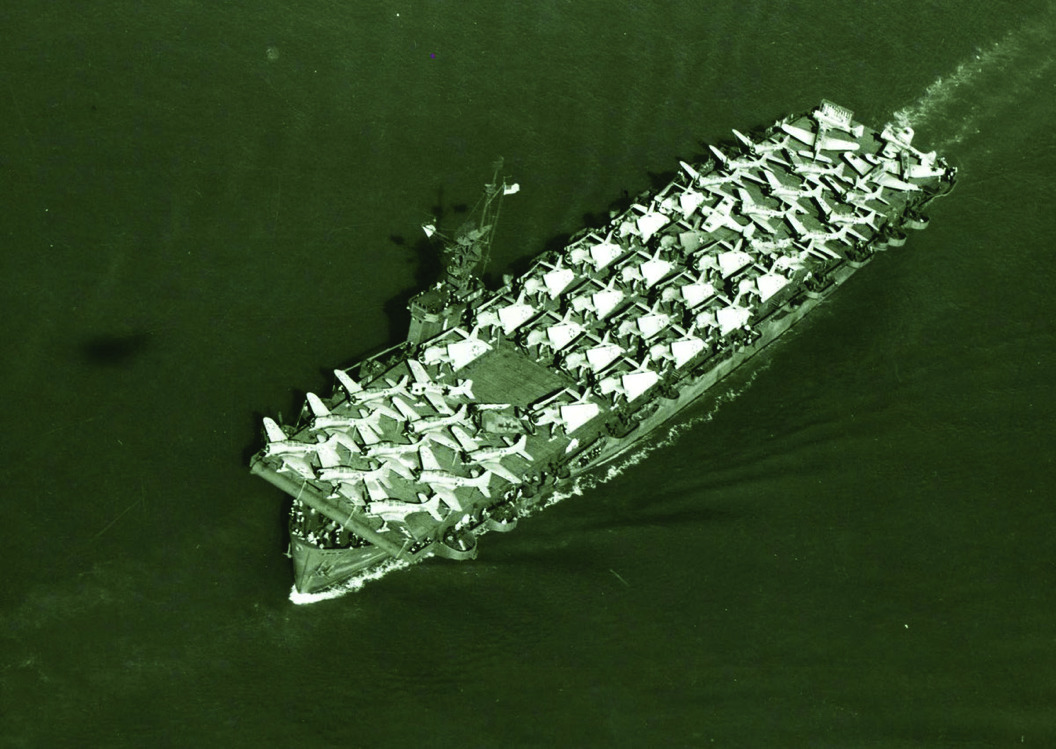
TheUSSLiscomeBaywas a Casablanca-class escort carrier, one of the massproduced “baby flattops” built quickly to meet the war’s appetite for steel and flight decks. She was launched in April1943andcommissioned four months later in August. She was named for Liscome Bay on Dall Island in the Alexander Archipelago of Alaska. She measured 512 feet 3 inches long overall, withabeamof65feet2inches and a draft of 20 feet 9 inches. She displaced 8,188 long tons standard and 10,902 with a full load. She carried a 257-foot hangar deck and a 477-foot flight deck. She was driven by two Uniflow reciprocating steam engines turningtwoshafts,producing 9,000 horsepower and making nineteen knots. She had a cruising range of 10,240 nautical miles at fifteen knots. She was armed with a five-inchdual-purposegunon the stern, with anti-aircraft defenses that included Bofors forty-millimeter guns and Oerlikon twenty-millimeter cannons around the deck perimeter. She was designed to carry twenty-seven aircraft butcouldaccommodatemore. On her only combat deployment, she carried a total of twenty-eight.
Her construction was itself a snapshot of wartime industry. She was laid down on December 12, 1942, under a Maritime Commission contract by Kaiser Shipbuilding in Vancouver, Washington. She was launched on April 19, 1943, sponsored by Mrs. Clara Klinksick, wife of Rear Admiral Ben Moreell. She was originally intended to be transferred to the British Royal Navy as HMS Ameer, but plans changed. She was named Liscome Bay on June 28, 1943, assigned the hull classification symbol CVE-56 onJuly15,andcommissioned on August 7 under Captain Irving D. Wiltsie.
Once commissioned, she proceeded toward San Diego, ferrying aircraft along the way. For weeks, she trained in Southern California. On October 11, she became the flagship of Carrier Division 24 under Rear Admiral Henry M. Mullinnix. On October 14, she received her aircraft contingent. On October 21, she departed for Pearl Harbor, arriving on October 27, then continued training off Hawaii until early November.
Then, on November 10, she departed Pearl Harbor as part of Task Force 52, bound for the Gilbert Islands. The invasion bombardment began on November 20 at 5 a.m., and within seventy-six hours, Tarawa and Makin werecaptured.LiscomeBay’s aircraft played a vital role around Makin. The carrier task group conducted 2,278 sorties in support of operations— bombingJapanese positions, providing close air support, intercepting enemy aircraft, and backing the landings and ground operations. With the islands secured,navalforcesbeganto withdraw, but Liscome Bay remained with her task force while resistance on Makin was still being addressed.
Japanese command, caught by surprise, ordered submarines to converge on the Gilberts. The submarine I-175, commanded by Lieutenant Commander Sunao Tabata, arrived off Makin on November 23. The American task group was steaming twenty miles southwest of Butaritari Island at fifteen knots in a circular formation. Liscome Bay, as the guide, sat dead center between other ships, surrounded by destroyers and larger vessels. Because a collision was considered a greater risk than a submarine attack, the group was not zig-zagging.
In the pre-dawn hours of November24,theshipmoved into the rhythm of war at sea. At 4:30 a.m., reveille sounded. At 4:34, the destroyer Franks left to investigate a signal beacon, creating a gap in the screen. At 4:36, radar operators on the New Mexico spotted a short-lived blip that may have been I-175 diving into position. At 4:50, flight quarters sounded. At 5:05, the crew went to routine general quarters as flight crews prepared planes for dawn launching. Thirteen aircraft were readied on the flightdeck,fueledandarmed, with one forward on the catapult. There were seven more aircraft in the hangar not yet fueled or armed. The shipcarriedalargeamountof munitions below decks. The task group executed a turn to the northeast, presenting the ship’s side to the attacking submarine. I-175 fired a spread of torpedoes.
At about 5:10 a.m., a lookout on Liscome Bay’s starboard side reported a torpedo headed for the ship. It struck behind the aft engine room and detonated the ship’s bomb magazine. The resulting explosion engulfed the carrier and sent shrapnel flying thousands of yards. Debris fell on neighboring ships. The task force was rocked. A mushroom cloud rose above the wreck. The detonation sheared off much of the stern. Seawater rushed in, mixing with oil. The hangar and flight decks were heavily damaged. Superstructure collapsed. The forward hangar became an inferno, igniting aircraft and ammunition. Steam and compressed air were lost. Fire-main pressure failed. Gasoline spread on the surrounding water and ignited, turning the sea into a burning ground.
Liscome Bay lasted only minutes.
At 5:33, only twenty-three minutes after the explosion, she listed to starboard and sank. Aircraft went down with her. Rescue began quickly. Destroyers converged on the oil slick and the survivors. But many of the men hauled from the water were dead or dying. Others were grievously burned. Survivors were moved to larger transports. Two men died afterward and were buried atseaonThanksgivingnight. In total, 272 were rescued, but many later succumbed to wounds; the final toll reached 702 dead. The Navy later announced the ship’s loss in early December. John Ales Scott is most likely still entombed in the wreckage of the ship at the bottom of the South Pacific, along with hundreds of his shipmates.
This is the event behind the letter Mrs. Moore received. This is what “went down in flames fifteen minutes later” truly means: a ship reduced to fire and oil, and men compelled to choose between the burning deck and burning water.
When that story traveled back to Marshall County, it did not arrive in cinematic form. It came in the clipped cadence of military correspondence and the public language of a newspaper column, printed among other items of local life. But its effect was not clipped. It was total. It became a fixed point in Little City’s memory, the kind of event that divides time into before and after.
And the war did not leave when the legal status changed.Itremained,carried forward through the long years that followed. The papers did what papers always do: they returned, later, to the mother. On June 7, 1951, the Madill Record reported that Mrs. Nettie Moore, formerly of Madill, had died at Wynnewood. She had lived in Marshall County for many years, moving to Dodd City, Texas, four years earlier. Her body was brought to Madill and then taken to Dodd City for services. The obituary listed survivors: three children— Otho Grubbs of Pauls Valley, M. C. Grubbs of New Orleans, Louisiana, and Mrs. W. R. Brown of Midland, Texas—five grandchildren, two brothers, and two sisters.
The war story, in other words, did not end with the sinking, and it did not end with the presumed date of death written into federal law. It carried forward into the structure of a family, into moves and remarriages and new names, into the quiet bookkeeping of survivorship that an obituary performs.
That is what World War II didtoLittleCitywhenitcame in its hardest form. It did not merely pass over the town as national news. It entered the town’s institutions and routines. It turned churches into service centers and ordinary gatheringsintowartime labor. It pressed teenagers into adult roles and made every household attentive to the language of officialdom. It took a boy born in Wichita Falls, raised through Aylesworth and Little City, and placed him on a ship built in haste for a desperate war. It returned him not as a body, not as a grave close enough to touch, but as a name in a Navy letter: missing, still missing, and then—by law and by sorrow—dead.
And so, when the larger history of Little City is told, it is not enough to say the war reached even the smallest places. In Little City, the war reached the smallest places because it reached the smallest unit of all: one mother at a table, opening a letter, reading words designed to be formal, and finding beneath them the unbearable truth that her son’s ship went down in flames, and that hope itself had been officially withdrawn. That is the real conclusion of Part IV, and it sets the stage for everything that follows: Little City’s astonishing speed of maturation, and the way the war tested whether that maturity was real.
In Part V—arriving in two weeks—we will step forward into the years when Little City’s routines had finally settled into the shape of a real town, only to be struck by the single greatest tragedy ever to touch the area, an event that would alter the place and its people in ways no one then living would ever forget.
But before we reach that chapter, next week we will pause our walk through Little City’s story to mark the eighty-first anniversary of Iwo Jima—and how that distant island battle, fought in black sand half a world away, found its way home to Marshall County.