
This year, America celebrated her 250th birthday.
For two and a half centuries, ours has been a nation that has dreamed boldly, built fearlessly, and accomplished what many believed impossible. We crossed a continent, bridged mighty rivers, tunneled through mountains, electrified cities, harnessed the atom, and eventually placed men on the moon. Along the way, America produced machines that becamemorethantools.They became symbols of what free people, armed with ingenuity and determination, could accomplish.
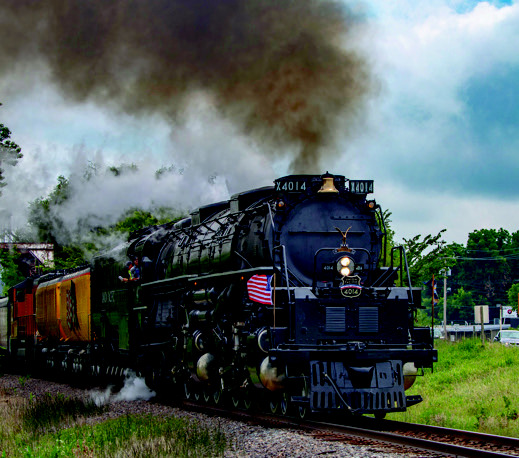
Few machines embody that spirit more completely than Union Pacific’s Big Boy No. 4014.
Aspartofthenation’s250th anniversary celebration, the world’s largest operating steam locomotive embarked on an extraordinary journey. Leaving its home in Cheyenne, Wyoming, Big Boy traveled thousands of miles across America, reaching the East Coast before beginning the long trip home. Along the way, it crossed the Mississippi River for the first time since December 1941, when it left the American Locomotive Company’s factory in Schenectady, New York, as a brand-new locomotive destined for Union Pacific service.
Pause for a moment and consider that.
The last time Big Boy had been east of the Mississippi, Franklin Delano Roosevelt was president. Pearl Harbor had not yet been attacked. America had not yet entered World War II. The Interstate Highway System did not exist. Television was still a novelty. More than eighty years later, that same locomotive returned—not on the back of a flatcar or tucked awayinamuseum,butunder its own steam, doing exactly what its builders intended.
My wife and I knew we had to see it.
Thiswasthefourthtimein seven years that we had set out to chase Big Boy. Every trip has been memorable, but this one carried a special significance. It was America’s 250th birthday, and one of the greatest engineering achievements our nation has ever produced was retracing part of the journey it first made as a newborn locomotive in 1941.
On Wednesday afternoon, we pointed the car north toward Kansas. Thursday, we followed Big Boy from Topeka to Salina. Friday, we chased it again from Salina west to Hays, where it would spend the weekend before beginning the final leg of its journey home to Cheyenne. Saturday morning, we returned to see the locomotive resting while its crew prepared it for Sunday’s departure.
Watching the crew work was fascinating.
Steam locomotives are unlike modern machines. Today’s locomotives hide their complexity beneath computers, sensors, and sealed compartments. When something goes wrong, technicians connect diagnostic equipment and read electronic codes.
A steam locomotive demandssomethingdifferent. It demands craftsmen.
The crew moved deliberately around the locomotive, inspecting bearings, lubricating rods, checking valves, tightening fittings, wiping away grease, and preparing the great machine for another day on the rails. They knew every sound it made, every vibration, every moving part. They understood not merely how the locomotive worked, but how this locomotive worked. Watching them was like watching master violin makers tune a priceless Stradivarius before a concert. They were preserving more than machinery. They were preserving an art that has nearly disappeared from the world.
As fascinating as that was, it wasn’t my favorite part. Not even close. My favorite part is seeing Big Boy alive. Not sitting still beneath the Kansas sky.
Alive.Breathing.Working. Living.
There is a moment before every departure when the locomotive begins to awaken. Steam curls gently from valves. The air pumps settle into their familiar rhythm. The injector hisses as water enters the boiler. The fire burns hotter. Then, somewhere deep within the giant machine, the first movement begins. Massive pistons slowly push forward. Connecting rods longer than many automobiles begin their graceful dance. The exhaust grows louder, the rhythm steadier, until the entire locomotive seems to awaken from a long sleep.
Then comes the whistle. It is impossible to describe adequately.
It is not merely loud. It is deep, haunting, almost mournful. It carries for miles across the prairie, echoing over fields and through small towns. Long before anyone sees the locomotive, they hear that unmistakable voice calling across the countryside.
People stop talking. Children point toward the horizon.Camerasarelowered for just a moment. The rails begin to sing. The ground beneath your boots starts to tremble.
Then you feel it—not simply with your ears, but in your chest—as more than a million pounds of iron and steel come rumbling into view, breathing steam, throwing sunlight from polished rods, and speaking with the same voice that echoed across the American West during World War II.
No photograph can capture that feeling. No video truly reproduces the sound. No recording conveys the vibration that rises through the earth beneath your feet.
It must be experienced. That is why people chase the Big Boy.
The locomotive itself is an engineering marvel.
When Union Pacific approached the American Locomotive Company— better known simply as ALCO—in 1940, the railroad faced a formidable challenge. Freight traffic over the WasatchMountainsbetween Ogden, Utah, and Green River, Wyoming, had grown dramatically. Existing locomotives often required helper engines to push heavy trains over the steep grades. Union Pacific wanted one locomotive powerful enough todothejobwithfewerdelays and greater efficiency.
ALCO answered with a masterpiece.
The Big Boy stretched approximately 133 feet from coupler to coupler and weighed nearly 1.25 million pounds with its tender. Its articulated 4-8-8-4 wheel arrangement consisted of four leading wheels, two sets of eight massive driving wheels, and four trailing wheels beneath an enormous firebox. Steam generated at approximately 300 pounds of boiler pressure drove four massive cylinders capable of producing well over 6,000 horsepower and approximately 135,000 pounds of tractive effort. Every inch of the locomotive wasdesignedforonepurpose: hauling enormous freight trains over some of the most difficult railroad grades in North America.
Yet numbers alone fail to explain it.
Only twenty-five Big Boys were ever built. They were numbered consecutively from 4000 through 4024, and together they represented the absolute pinnacle of American steam locomotive engineering.Theywerenever intended to become famous. They were built to work, and worktheydid,haulingfreight acrosstheWestduringWorld War II and throughout the final years of the steam era.
As diesel-electric locomotives replaced steam during the 1950s, the Big Boys gradually disappeared from service. Most were cut apart for scrap, victims not of failure but of progress.
Eight escaped the torch. Seven now rest quietly on static display in museums and public parks around the country, preserved as monuments to an extraordinary chapter in American history.
Only one still runs. No. 4014 was retired in 1961 and donated to the Rail Giants Train Museum in Pomona, California. There it sat silently for more than half a century, admired by generations of visitors who assumeditwouldnevermove again.
They were wrong. In 2013, Union Pacific accomplished what many considered impossible. The railroad brought 4014 home to Cheyenne and undertook one of the most ambitious locomotive restoration projectsinhistory.Thousands of hours of labor, engineering, machining, fabrication, and craftsmanship followed. WhenBigBoysteamedagain in 2019, history quite literally came back to life.
That resurrection may be every bit as remarkable as the locomotive itself.
Watching Big Boy work inevitably raises a question.
Why are we drawn to it? Modern locomotives are unquestionably more efficient. Today’s dieselelectric engines produce tremendous power while requiring far less maintenance. Computercontrolled traction systems maximize efficiency. Electronics monitor virtually every operating condition.
So why do tens of thousands of people line railroad crossings to watch a machine designed before America entered World War II?
The answer, I believe, lies deep within human nature.
Psychologists have spent decades studying an emotion known as awe. Unlike happiness or excitement, awe occurs when we encounter something so vast, powerful, or extraordinary that our ordinary way of understanding the world momentarily becomes inadequate. Standing on the rim of the Grand Canyon can produceawe.Gazingthrough a telescope at Saturn does the same. Watching a Saturn V rocket towering overhead evokes a similar response.
So does standing ten feet from the Big Boy.
Researchers have discovered something remarkable about awe. It quiets the part of our minds that constantly focuses on ourselves. Our daily worries shrink. Our anxieties seem less important. We become aware that we are part of something larger. For a few moments, our attention shifts away from ourselves and toward something magnificent.
Perhaps that explains what we experienced in Kansas.
Over three days, I spoke with countless people.
One couple I met had traveled from Florida.
Others came from Virginia, Texas, Oklahoma, Colorado, Missouri, Kansas, and countless places in between.
There were railroad historians and first-time visitors. Farmers, engineers, mechanics, teachers, physicians, business owners, veterans, attorneys, photographers, retirees, and children perched on their parents’shoulders.Somehad chased steam locomotives for decades. Others had never seen one move before.
There were Republicans. Democrats. Christians. Muslims. Hindus. People with no religious affiliation. Youngandold.Richandpoor.
But for three days, none of those distinctions mattered.
No one asked how anyone voted. No one argued politics. No one cared about occupation, race, religion, or income.
We all had one purpose. We had come to witness greatness.
There is another reason the Big Boy captivates us.
Modern technology hides itself. Our smartphones perform billions of calculations every second, yet we cannot see a single one. Modern automobiles concealtheirenginesbeneath hoods. Jet engines disappear inside sleek nacelles. Their complexity is invisible.
TheBigBoyhidesnothing. You see the fire become steam.
Youwatchthesteammove pistons.
The pistons drive rods. The rods turn wheels.
Every ounce of energy is visible.
Every movement makes sense.
It is engineering laid bare. There is an honesty about it that appeals to something deep within us.
Perhaps the deepest reason of all is that our minds instinctively assign life to things that move in familiar ways. Psychologists call this anthropomorphism. We see faces in clouds, personalities in automobiles, and loyalty in ships. Steam locomotives invite that response more than almost any other machine ever built.
The Big Boy breathes. It sighs while standing still. It pants as it climbs a grade. It spits water. It exhales steam. It speaks through its whistle. Its rhythmicexhaustsoundsalmost like a heartbeat.
Although we know intellectually that it is nothing more than iron, steel, brass, copper, fire, and water, our minds cannot help but see something alive. Railroaders have understood this for generations. They rarely speak of great steam locomotives as though they were lifeless equipment. They speak of them with affection, respect, and sometimes even love.
Throughout history, human beings have always gathered to witness greatness. The pyramids, the great cathedrals of Europe, the launching of mighty ships, the Wright brothers’ first flight, the Saturn V, the Space Shuttle—all remind us of what ordinary people can accomplish when imagination, craftsmanship, determination, and courage come together.
The Big Boy belongs in that company.
Not because it is merely large. Not because it is merely old.
But because it represents the very best of those who conceived it, designed it, built it, restored it, and continue to care for it today.
As Big Boy approached each crossing, something remarkable happened. Conversations stopped. Heads turned toward the distant whistle. Smiles spread across faces. Complete strangers stood shoulder to shoulder waiting for history to arrive.
Then it came. Breathing. Hissing.
Rumbling.
Alive. For perhaps sixty glorious seconds, thousands of strangers sharedexactlythesamethought.
This is magnificent. How often does that happen anymore?
As my wife and I drove home, I realized we had not really spent three days chasing a steam locomotive across Kansas.
We had spent three days chasing wonder.
We had spent three days watching history come alive.
More importantly, we had spent three days watching Americansremembersomething that is easy to forget. For one weekend, people from every background, every political belief, every faith, every occupation,andeverygeneration stood together without suspicion or anger. They laughed together. Shared stories. Held places for oneanotheratrailroadcrossings. Recommended better vantage points. Waved at strangers. Waited patiently for the same whistle. Felt the same rumble beneath their feet.
In a year celebrating America’s 250th birthday, perhaps there could have been no better reminder of what still binds us together.
Sometimes it takes a million pounds of living history, breathing steam beneath a blue Kansas sky, to remind us that before we are divided by politics, religion, geography, or circumstance, we are simply people.
People who still stop in awe when greatness comes rumbling down the tracks.