
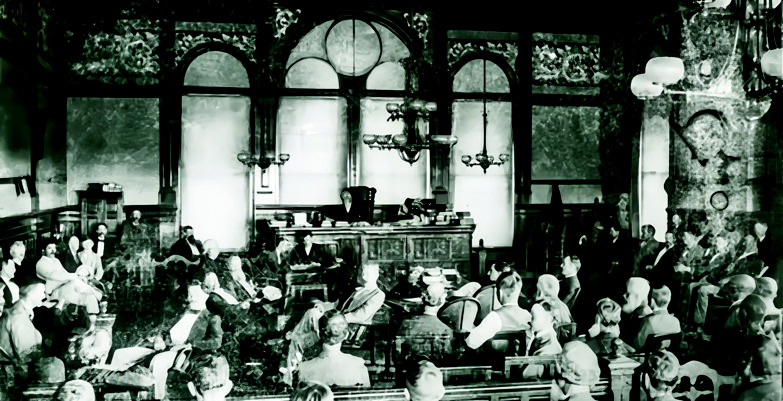
As the sweltering Arkansas heat pressed through the courthouse windows in July 1885, the first echoes of testimony in the United States v. James Wasson resonated throughJudgeIsaacParker’s austere courtroom with the weight of death and remembrance. The trial—already stirring talk across Indian Territory and northward into the Arkansas River Valley— centered on the killing of HenryMartin,amangunned downintheshadowedtimber nearWoodvilleintheChickasaw Nation.
To build its case, the prosecution opened not with lawmen or ballistics experts, but with those who had shared fencelinesandSundaymeals with the victim. These were not hired guns or professional witnesses, but rather neighbors, ordinary folk now burdenedwithextraordinary memories.
First to take the stand was John Merriman, a farmer of no great renown but of considerable local respect. His voice, though steady, carried the tremor of a man still haunted by what he had seen—orrather,heard—that fall evening three years ago. Merriman lived just a mile from Wasson, a neighbor to both the victim and the accused. He recounted how he and Martin rode together from Woodville late in the day, with Martin having just helped Mrs. Elizabeth Brooks move across the road from the Merriman place. Merriman remembered that Martin was in good spirits and expressed plans to visit Alex Juzan’s home a short distance northeast.
It was the last time John Merriman would see his friend alive.
What followed, Merriman testified, was a series of events that unraveled quickly and left a lasting scar. Not long after Martin rode off, Merriman saw two riders approach—one on a brown horse, the other on an iron-gray. Though he couldn’t be certain in the fading dusk, he believed the riders were Jim Wasson and John McLaughlin. He watched them dismount, tie their horses to his fence, and walk in the direction of Mrs. Brooks’s house.
Then came the gunfire. A quick, violent volley— too rapid to count—sliced through the still evening. Merriman testified that it came from the direction of Birdsong’s land, not far from whereMartinhadgone.Then silence, and after a pause, a single final shot. Merriman described the moment with chilling clarity, his voice hushed as he relived the sequence.
Fifteen minutes later, Martin’s horse returned, riderless. Saddled, bridled, but empty. Merriman called uponanotherneighbor,Steve Bussell, and together they summonedEastmanHarney. Lantern in hand, the men followed the trail.
They found Martin facedown in the brush, his pistol still beneath his coat—holstered, unused. He had been shot multiple times, the wounds savage and closerange. Merriman would later return to the scene with Marshal Jack Relerford, who retrieved Martin’s revolver. Only one of the six chambers had been fired.
Horse tracks near the body led back toward Alex Juzan’sland.Birdsongwould later find a dozen spent cartridges scattered in the brush—evidenceofaplanned and prolonged assault. And Martin’s wounds told the rest: two shots to the side, one to the neck, and one through the base of the skull, the slug passing through his face and embedding in the earth beneath.
Under cross-examination, the defense sought to minimize the significance. Merriman admitted that earlier that day, Martin, Wasson, and McLaughlin had been seen laughing together in town. It had seemed an ordinary day. Gunshots, after all, were common in the territory. But Merriman was unshaken. The timing. The direction.Theevidenceonthe ground. They all led back to the same conclusion.
Next came Clara Merriman, John’s wife, who corroborated her husband’s account withsteadycomposure. She remembered the sound of gunfire—sharp, close, and ominous.Fromherporch,she saw the return of Martin’s horse, saddled but alone, confirmingwhatherhusband already feared. She testified that Martin had passed their home just minutes before the shooting began, heading toward the northeast corner of the property.
Though Clara could not speak to motives or faces, her presence added weight to the narrative. She confirmed that John Merriman’s recollections were not imagined or solitary—they were shared. And they were rooted in the familiar rhythms of domestic life, suddenly torn by violence.
The third witness, Elizabeth Brooks, brought the tragedy to a more personal level. She was Martin’s landladyandhadknownhim as both tenant and friend. That day, she said, Martin had spent much of his time helping her move household goods across the road. He had shown no sign of anger or conflict, no indication that he was in danger.
When she was told of Martin’s death, she joined the others in retrieving his body. Her voice broke when recalling how they laid him across the saddle and led his lifeless form home.
Brooks stated that Martin had no known enemies and, to her knowledge, carried no weapon that day aside from his pistol, which remained holstered. She had not seen Wasson or McLaughlin that day, but she was certain of one thing: Martin had left her home alive and untroubled. He returned in silence, his body cold and riddled with bullets.
Together, these three early witnesses—John Merriman, Clara Merriman, and Elizabeth Brooks—did not claim to have seen the hand that pulled the trigger. But their words, consistent and interwoven, built the structure of a chilling story. A neighbor departs on horseback. Gunfire rings out from the woods. A riderless horse returns. A body is found. And the suspected men were seen nearby, just minutes before.
Their testimony gave the jury its first glimpse of what the government contended was a calculated murder, committed not in self-defense, but in ambush.
And for Jim Wasson, who watched in silence from behind his attorneys, it was the first of many damning portraits drawn by those who once called him neighbor.
The fourth government witness called to the stand was a young man named Stephen Bussell—Elizabeth Brooks' stepson and a quiet observer of the fateful events that occurred three years earlier in November.
Bussell, residing with his mother in the Chickasaw Nation, livednearthecrossroads where lives were shattered and legends began. His testimony, rendered with plainspoken honesty and youthful clarity, drew a haunting map ofthedayMartinmethisend.
He remembered living at his mother’s place, which was located near John Merriman's home, just seventy-five yards away. On that day, as Mrs. Brooks and Merriman exchanged houses, Bussell kept himself busy near the eastern branch below their homes. From this vantage point, he first noticed Wasson and John McLaughlin emerging from Merriman’s house and walking toward thefence.McLaughlinshouted— Bussell responded back. “They were both laughing,” he said. “John asked if I wanted a dram. I told him yes.” In the American South and Indian Territory, offering “a dram” usually meant a shot of whiskey, typically served in rough frontier taverns or even from a flask.
They went to the fence where their horses were tied. There, in the fading light, all three drank. The pair asked Bussell about the whereabouts of Henry Martin, whom they claimed they hadn't seen since the morning. They also inquired about Eastman Harney and Alex Juzan. Bussell noted the men were already “tight”—drunk enough to blur their judgment but not their purpose.
Bussell described Wasson astride a brown horse, formerlyMcLaughlin’s,while McLaughlin rode a blue pony belonging to a fellow named Richardson. After finishing their drinks, the pair mounted and rode slowly eastward, toward the fork where one path led to Birdsong’s place and another turned toward the mouth of the Washita River. Bussell admitted he could not tell which direction theyultimatelychose,though the last he saw, they had not passed the fork.
Ten minutes after they disappeared from view, gunshots echoed. Five or six, possibly more, Bussell testified. The final shot, he pointed out, came about half a minute after the others—distinct in its delay, as if intended to finish what the others had not.
Shortly after, a pony came running up to their yard—a familiar animal, belonging to Henry Martin. It bore a saddle and bridle, but no rider. Bussell, alarmed, called out to Merriman, who declined to investigate. Bussell sent for Eastman Hamey, and soonthethreemen—Bussell, Hamey,andMerriman—rode outtowardBirdsong’s.There, beside the road between the two homes, they found Martin’s body.
“He was lying on his face,” Bussell recalled. “One leg crossed over the other.”
He bore a single, fatal wound—entering the back of his head, exiting his cheek. A pistol was still sheathed in the scabbard on Martin’s back, with five cartridges untouched. Blood pooled beneath him, and a bullet hole markedtheearthnearwhere his head lay.
Wasson and McLaughlin were gone.
In the months that followed, their absence loomed over the community like a storm cloud. Bussell wouldn’t see either man again for over a year and a half. But before their departure, he had seen them often—every week, he said. They lived just over a mile and a half away. Familiar, friendly, even jovial that day—yet beneath their laughter, perhaps, lingered something darker.
Bussell’s account stood unshaken under cross-examination. He admitted he had been squirrel hunting that day, armed with a pistol. He hadtakentwodrinkswiththe accused, and though the men made no threats, they asked questions about Martin, Harney, and Alex Juzan. Bussell had no reason to lie. His voice was steady. His story, tragic.
He had hollowed first. Then they hollowed back. That echo, like the last breath of Henry Martin, still lingered in the courtroom air.
In Fort Smith’s chambers of justice, it was not merely guilt or innocence on trial—it was memory, motive, and the echoingstepsofmurderalong a Chickasaw trail.
In the long, steady march of testimony that unfolded before Judge Isaac Parker in the federal courtroom at Fort Smith, the voice of Joseph C. Edwards, the fifth witness, entered like a soft drum in a distant storm—quiet, tentative, but echoing with the weight of fatal memory. Though not a central figure in the tangled lives of James Wasson, John McLaughlin, or the murdered Henry Martin, Edwards had the ill fortune to be present in Mrs. Brooks’ house on the very day Martin met his end.
Edwards, a resident of Savanna and a man long afflicted with poor health, testified that he and his wife had taken up temporary residence at the Brooks home— seeking rest and recovery in thestillnessoftheChickasaw Nation’s fields. That stillness, however, shattered one November afternoon.
“IsawHenryMartinabout 3 o’clock,” he said plainly. “It was the last time. He was at Mrs. Brooks’ house. After that, they said he went up towards Birdsong’s.”
Later that same day, shortly before sundown, Edwards observed James Wasson and John McLaughlin enter the Brooks home. The two men, he said, stepped into the west room—where he lay sick—and engaged in only brief conversation. McLaughlininquiredpolitely about Edwards’ health. That was all. No threats. No commotion. But they carried pistols, Edwards noted. Both men were armed.
From where they came, he could not say. Nor did he see them after they exited the house. “I believe they stepped out Mrs. Brooks’ door,” he testified, “but I did not see them again.”
Whatfollowedwasasharp and grim series of sounds— gunfire, rapid and deadly.
“They left the road, and about three minutes later, I heard shots,” Edwards said. “Two first, then a volley—two or three in quick succession— then another single shot afterward.”
The shots came from the direction north of the Brooks home,betweenthehouseand Birdsong’s. Edwards, though sick and confined mostly indoors, was alert enough to distinguish six shots in total. The pace of fire, he said, was quicker than a single man could manage. In that observation lay the grim implication oftwoshooters—Wasson and McLaughlin—working in concert.
In the stillness that followed the gunfire, time bled slowly. It may have been thirty minutes, perhaps less, when a horse arrived riderless. Edwards did not see it come, but he heard of its approach. Later, he joined others and accompanied them with a lantern to recover the body of Henry Martin.
“He was lying partially on his face,” Edwards recalled. “There were four wounds through his body, and one through the head and jaw.”
It was a brutal end. The body, he said, bore the cruel markings of overkill. One wound, he was told, had driven the bullet through the cheek and into the earth beneathMartin’shead.Blood soaked the soil—silent testimony more eloquent than any man.
“I carried a light when they brought the body in,” Edwards said softly.
He remained in the neighborhood for about a week after the killing, but never again laid eyes on Wasson or McLaughlin—until this trial.
Under cross-examination, Edwards remained calm and consistent. He estimated that about three minutes passed between the men leaving the road and the sound of shots. He would not swear to the exact direction they took—he did not follow them. His health at the time had dulled his movements but sharpened his awareness.
The defense tried to pin down inconsistencies, particularly regarding the time lapse between the men’s departure and the shots. Was it really just three minutes? Wasn’t it longer before the horse appeared riderless? Edwards stuck by his best recollections.
“I don’t think it was an hour,” he said. “Might have been half an hour. But the shots—I swear—came about three minutes after they left.”
And so, another voice joined the chorus—quiet, hesitant, but unwavering. Joseph Edwards, by accident more than intention, became a chronicler of the fatal moments that sealed Henry Martin’s fate. In that west room, lying sick beside his wife, he bore witness to the prelude of murder and the echoes that followed.
The sixth witness, Jack Birdsong—farmer, neighbor, and silent witness to a murder’s aftermath—stepped into the box and gave his solemn account of what he saw, and what he did not.
Birdsong, who then resided on the Widow Brooks’ farm in the Chickasaw Nation, lived just a quarter mile northofherhome.Atthetime of Henry Martin’s death in November 1881, Jack was at home, having returned from Harney’s Post Office, where a man named Darling kept store. Martin, whom Birdsong knew, had passed by that afternoon riding a black mare. Birdsong admitted he wasn’t sure of Martin’s purpose or destination—only that he saw the man turning the corner of his field fence before disappearingsouthward.
Within mere minutes, Birdsong heard a volley of shots ring out to the south— five or six, perhaps more. He couldn’t see the shooters, but he saw the smoke, hanging faint in the air in the same direction Martin had gone. “It seemed to be right where the body was lying,” he testified. While he hadn’t seen the murder take place, the rapid burst of gunfire and the column of smoke marked a grim certainty.
Moments later, young Stephen Bussell and John MerrimancametoBirdsong’s home with dreadful news. Henry Martin was dead.
Birdsong joined the group that included the local marshal and assisted in retrieving the body, which they found face down along the road. “I saw one wound in his head—it went in the back part and came out of his face.” The body was then taken down to the home of Mrs. Brooks.
In recounting the subsequent time, Birdsong provided a sobering timeline. He indicated that it was likely a full year or more before he saw either of the accused men again, James Wasson or John McLaughlin. Wasson returned first; McLaughlin came back some time later. Both lived nearby—Wasson just two miles away, residing on McLaughlin’s property. McLaughlin himself spent the summer after the murder driving cattle for a local man named Weittel.
Birdsong confirmed that noefforthadbeenmadetoapprehend the men that night. When asked if McLaughlin wasrelatedtoMrs.Brooks,he replied that he did not know. However, he acknowledged that the marshals could have easily taken McLaughlin if they had chosen to.
He also confirmed being a witness in Sherman the prior fall, after Wasson had been arrested for the killing of Almarine Watkins, a separate slaying. The Henry Martin case was reawakened in the course of that prosecution.
Cross-examination brought more local details into light. Birdsong said he had lived near Mrs. Lucy Watkins, Martin’s host and the sister of Mrs. Brooks. At the time of Almarine Watkins’ death, Birdsong resided roughly eight miles away from her. When asked about the cattle ranch McLaughlin hadworkedon,Birdsongsaid it was located about twelve miles from the site of Martin’s murder.
The gunfire that claimed Henry Martin’s life, Birdsong repeated, occurred around dusk.
Birdsong’s testimony, though limited in what he directly observed, painted a vivid image of place and time. He described the geography of murder as clearly as the court outlined the law. He heard no threats and saw no guns drawn. However, the smoke he saw rising from the brush road hinted at a sudden,brutalviolence—and his memory, steadfast after years, lent weight to the tale of death and desertion now revealed in Judge Parker’s court.
Theseventhwitnesscalled by the prosecution was Jesse Birdsong. His measured words provided the jury with another key perspective on thefinalmovementsofHenry Martin and the mystery that ensued.AsthebrotherofJack Birdsong and a resident of the same modest homestead in the Chickasaw Nation, Jesse was among the last to see Martin alive—and one of the first to hear the shots that sealed his fate.
“I saw Henry Martin that evening,” Jesse stated plainly. “He came to our house after some clean clothes.” That errand, domestic and straightforward,wouldmark the final hour of Martin’s life. Jesse couldn’t say for sure if Martin had changed clothes before leaving, only that he left their home about sundown, mounted and headed off, direction unknown.
Just minutes later—five or six, perhaps—Jesse heard the gunfire. “Some five or six shots,” he recalled, noting that the last one came a minute or two after the initial volley. “The first shots fired, then in a minute or so, the last shot fired.” He didn’t see the shooters. He didn’t go out to investigate. But in that calm twilight, the thunder of violence broke the stillness with a shattering clarity.
Though Jesse hadn’t seen Wasson or McLaughlin that day, he remembered spotting them a day or so later, riding across the prairie toward Woodville. “I don’t recollect what they were riding,” he admitted, and he couldn’t say whether they were armed. Months passed before he saw either man again—five or six months by his count—first one, then the other, near the Christian family property. He wasn’t sure exactly when they returned to stay, as he had gone north to work along the Washita River.
In cross-examination, Jesse’s memory was tested. His recollections, while honest, wavered under scrutiny. He admitted that he had been sick off and on since the events, and that time blurred around the facts. He guessed that the killing had occurred between sundown and dusk, conceding, when pressed, that it might have been too dark to tell a white man from a Black one at that hour. “It was getting dark,” he offered. “You may be right.”
Counsel prodded Jesse on inconsistencies—his prior statement that Martin was seldom seen, and his vague timeline about when the accused returned to the area. “I don’t go down into that neighborhood very often,” Jesse admitted. “Sometimes I saw him passing around, but not even once a month.”
The defense suggested there had been talk of Martin intending to marry. Jesse confirmed this, though without elaboration. As for whether Martin had received his clothes or where he had gone afterward, Jesse could not say.
The testimony closed with questions about community knowledge and associations. Jesse acknowledged the region was a “pretty thickly settled” area and admitted that he left for the Washita country not long after the killing, perhaps out of caution, perhapssimplyforwork. Jesse Birdsong’s testimony added another measured voice to the chorus of witnesses attempting to reconstruct the fading echoes of gunfire from a November evening in 1881. While his account was incomplete and at times uncertain, it confirmed the tight timeline andrepeatedhallmarkofthis trial: Henry Martin was seen alive at sundown, and within minutes—without warning or a chance to speak—he was dead in the dust of a lonely road.
As the trial of James Wasson pressed on under the stern and unsparing gaze of Judge Isaac Parker, the socalled Hanging Judge of the Western District of Arkansas, the prosecution’s case deepened—layer by layer, witness by witness—into a dirge of grim recollection and measured accusation. In this second phase of testimony, five additional voices took the stand, each one drawn from the quiet homesteads and dusty crossroads of the Chickasaw Nation. These were not eyewitnesses to the exact moment Henry Martin fell. Still, their testimonies rang with an eerie harmony of footsteps fading, gunshots cracking through dusk, and the silence that settled over the brush like a burial shroud.
Throughout their accounts, a pattern emerged— steady as a funeral toll. A drink was offered. A question was asked. Then, as twilight gave way to darkness, a volley of gunfire shattered the stillness. The murder of Henry Martin was not the result of sudden rage or reckless chance. It was, if these voices spoke true, a calculatedkilling—astalking ambushwroughtbymenwho laughed in the afternoon and vanished by sundown.
Each witness—Stephen Bussell with his quiet candor, Joseph Edwards from his sickbed, Jack and Jesse Birdsong from their lonely cabins, and others—added shape to the bloody outline of a crime that tore through their community like a lightning strike. What they described was not just the death of one man, but the death of trust, of safety, of neighborly innocence along a Red River trail. This was no ordinary courtroom, and no ordinary crowd of onlookers.
Above the foul stench and despair of the jail below, Parker’s courtroom became, during those sweltering days of July 1885, a crucible of vengeance and judgment. The galleries overflowed with citizens, officers, and settlers—many from Woodville itself—who had known Henry Martin, Jim Wasson, and the complex lives intertwined with theirs. Among them sat a woman whose presence was both a wound and a warning: Lucy Juzan Watkins.
The widow of Almarine Watkins—who was gunned down months after Martin— Lucyhadstakedherlasthope on justice. It was she who placed a $1,000 bounty on Wasson’s head, a staggering sum for that time and place. She had paid it from her own means, driven not by cold retribution but by a burning need to see the law avenge two murders she believed were committed by the same man. In court, she sat unflinching, her dark eyes fixed on Wasson like twin blades. Some whispered she prayed daily for a hanging, while others said she already had themourningclotheslaidout. Her presence cast a silent but unrelenting shadow across the proceedings. She was not merely a spectator— she was the embodiment of the grief and fury that had festered in Woodville since Martin fell. Her neighbors watched with her, not out of curiosity, but out of yearning for justice, for peace, for an end to the long night that had fallen on their part of the Nation.
As these mid-trial testimonies drew to a close, it was evident: this case would not conclude quietly. The outcome would send ripples throughout every cabin and cotton row in the Red River country. It would not only determinethefateofoneman but also confirm whether the federal court at Fort Smith could establish order in the wild borderlands or if the Chickasaw hills would continue to be a place where murder roamed freely and justice arrived too late.
Next week, in Part VII, the government will bring forward its final three witnesses: Alex Juzan, whose family ties to both the victim and the accused shadow his role in the night’s events; George O. Reeves, whose recollections help piece together the fugitives’ flight; and Deputy U.S. Marshal John G. Farr, whose official testimony may finally close the circle between suspicion and proof. Only then will the defenserise—andthegallows draw near.