

Territory quite like the riseandfallofJamesWasson. Once a familiar figure across southernChickasawcountry, Wasson's name would come to be etched not into stone for glory or honor, but as a number 203. That was the cold, impersonal designation on the grave marker placed above his unclaimed body in Fort Smith’s Oak Cemetery. It remains the only physical trace of a man who once rode freely through the Territories, who murdered in bloodfeud and whiskey rage, and who, on April 23, 1886, paid the ultimate price beneath Judge Isaac C. Parker’s gallows.
James Wasson was no stranger to violence when his name reached the docket of the United States District Court for the Western District of Arkansas. Born into a modest white family and raised in the cultural maelstrom of the Indian Territory, Wasson moved easily among Chickasaw and Choctaw families. He was, by all accounts, physically imposing, charismatic, and restless. By the early 1880s, he had aligned himself with John McLaughlin, a wellconnected young man of Chickasawheritagewhobore the advantages of wealth and a name that opened doors.
The crime that ultimately sealedWasson’sfateoccurred inOctober1881,thoughsome records place it in 1882. The victim was Henry Martin, a man with whom Wasson and McLaughlin had a longstanding feud. It began, as many frontier disputes did, with alcohol. The two men acquired a keg of whiskey and began drinking heavily. Fueled by resentment and drink, they set off to confront Martin, who was believed to be traveling to a neighbor’s home.
The story, pieced together from court testimony and contemporary newspaper reports, tells us that Wasson and McLaughlin intercepted Martin on a wooded road outside Woodville. Without issuing a word, they raised their rifles and shot him multiple times. Martin fell where he stood. But Wasson, perhaps suspecting his victim might yet survive, returned to the body and fired a single bullet into Martin’s head, killing him instantly.
The two men fled, vanishing across the Texas border. For about two years, they remained fugitives.
In the spring of 1884, James Wasson returned to Chickasaw country. By then, his co-defendant, McLaughlin, had not yet been arrested, and Wasson seemed to believe he could reintegrate into society. He even attended a religious revival and expressed interest in reforming his life. According to a neighbor’s testimony, Wasson reportedly told members of the congregation that he was beyond salvation because of the way he had “killed Henry Martin.”
It wasn’t long before his violent streak returned. Later that year, Wasson and another outlaw, Jerry Lewis,encounteredAlmarine Watkins, a prominent and wealthy cattleman, who was overseeing the transport of a prisoner under federal arrest. Wasson and Lewis tried to take the prisoner by force. Watkins refused. A scuffle followed, and Almarine Watkins was shot and killed.
The murder enraged the community.LucyJuzanWatkins, Almarine’swidowanda woman of formidable resolve, offered a $1,000 bounty for the arrest of James Wasson. She also pledged $500 for Jerry Lewis. Her money would prove persuasive.
Wasson was captured by a federal detective and returned to Fort Smith under heavyguard.Hewascharged not with the murder of Watkins— though that remained pending—but with the earlier killing of Henry Martin.
The trial of James Wasson was held in the U.S. District Court at Fort Smith, under the watch of the ironwilled Judge Isaac C. Parker. Known as the 'Hanging Judge,' Parker presided over one of the largest jurisdictions in the nation, encompassing IndianTerritory,and his courtroom was the last hope for justice in a lawless expanse.
The district attorney who was assigned to try the case was William Henry Harrison Clayton. (In a previous article, I mistakenly listed Clayton’s brother, Powell Clayton, also a lawyer, as one of the prosecutors.) Born on October 13, 1840, in Delaware County, Pennsylvania, William Henry Harrison Clayton was one half of a pair of politically named twins—he and his brother John Middleton Clayton bore the names of the 1840 Whig presidential ticket. Raised on a family farm and educated locally, Clayton left school at the outbreak of the Civil War to raise a volunteer company. Commissioned as a second lieutenant in the 124th Pennsylvania Infantry, he fought atAntietam,Fredericksburg, and Chancellorsville before mustering out in 1863.
After a short period of teaching, Clayton traveled to Arkansas to join his brother, Powell, where they invested in plantation land near Pine Bluff. William later sold his share and studied law in Huntsville, Arkansas. Influenced by his brother, Powell Clayton, who was then Governor of Arkansas, he was appointed superintendent of public instruction. He also served as a trustee of Arkansas Industrial University (now the University of Arkansas).
After passing the bar in 1871, Clayton quickly advanced through the legal ranks, serving as a district attorney and judge before receiving a federal appointment in 1874 from President Ulysses S. Grant. As United States Attorney for the Western District of Arkansas and Indian Territory, Clayton became the chief federal prosecutor alongside the legendary Judge Isaac C. Parker. He held the position from 1875 to 1885, and again from1889to1893,overseeing numerous high-profile criminal trials in a region troubled by lawlessness. His work brought order to the frontier and left a lasting impact on the federal judiciary’s presence in the Indian Territory.
However,inastrangeturn of events, it was revealed after the trial that the second prosecutor in the case, Jordan Edgar Cravens, was a non-government attorney practicing in Clarksville, Arkansas. HewashiredbyLucy Juzan Watkins, the widow of Almarine Watkins, to assist the prosecution. During those early days of justice in the region, the law permitted family members to hire special prosecutors to help with trials. After the trial, it was reported that, in addition to the $1,000 ransom that Lucy Watkins posted for the capture of Wasson, she spent an additional $6,000 on James Wasson’s trial. This covered the cost of Jordan Cravens, as well as travel and expenses for witnesses.
Jordon Edgar Cravens, born November 7, 1830, in Missouri and raised in Arkansas, was a central figure in the postwar legal and political fabric of western Arkansas.AgraduateofCane Hill Academy and a licensed attorney by 1854, Cravens practiced law in Clarksville before entering politics. He served in both the Arkansas House and Senate before the Civil War and entered Confederate service as a private in 1861. He swiftly rose through the ranks, ultimately commanding the 21st Arkansas Infantry, which surrendered at Vicksburg in 1863. After being exchanged, he led the 1st Arkansas Consolidated Infantry Regiment in the Trans-Mississippi Department.
Following the war, Cravens resumed legal practice and held several public offices, including prosecuting attorney of Johnson County and state senator. His most prominent public role came in 1876 when he was elected to the U.S. House of Representatives asanIndependent Democrat. He served three terms in Congress (1877– 1883), winning tough elections against rivals like John McClure and Thomas Boles. In 1882, he was defeated in the Democratic primary by Judge John H. Rogers and returned to private practice.
Cravens continued to shape Arkansas law and politics, serving as a circuit court judge from 1890 to 1894. He died in Fort Smith on April 8, 1914, and was buried in Oakland Cemetery in Clarksville. A cousin of Congressman WilliamBenCravens,Jordan E. Cravens, remains remembered as a soldier, statesman, and judge during one of the most transformative periods in Arkansas history.
The case presented by the government was strong. Although no one saw the exact moment Martin was shot, several key witnesses testified that Wasson and McLaughlin were near the victimandmentionedthreats and confessions made by the defendants. Among the prosecution’s witnesses were John Merriman, Elizabeth Brooks, and Alex Juzan.
Juzan testified that Wasson and McLaughlin came to his house shortly after the murder and admitted they had killed Martin. Juzan said. “McLaughlin called me over. He stepped down from his horse by the fence corner and said, ‘We have got into trouble.’ He was crying. Juzan testified that McLaughlin said they “had killed Henry Martin.” As Juzan pressed for details, asking if Martin might still be alive, Wasson admitted, “Yes, I know he is dead—I went back and shot him in the head.”
Other witnesses testified to the court about Wasson's confession at the religious revival and the long-standing hostility between the parties. There was testimony, too, about Wasson’s behavior after the murder—his flight, his return, and his subsequent criminal associations.
The defense called several witnesses and sought to shift blame toward McLaughlin or to imply that the entire case rested on prejudice and assumption. Wasson himself took the stand, denying he had fired the fatal shot. His attorneys, William Moore Mellette and James Kent Barnes, delivered impassioned arguments, pointing to the lack of direct evidence and the circumstantial nature of the accusations.
But it was not enough. After closing arguments concluded, the jury withdrew for deliberations. It did not take them long. On July 30, 1885, after days of trial, the jury returned to the courtroom with a verdict within just a few hours. The foreman stood and delivered the words that sealed Wasson’s fate: “Guilty of murder in the first degree.” Wasson’s sentencing was then set for January 30, 1886.
On October 19, 1895, in a last-ditch effort to save his client, who now stood on the precipice of the gallows, Wasson’s attorney filed a formal motion for a new trial. In that motion, Attorney James Kent Barnes argued that Judge Parker had erred in his instructions to the jury and that the verdict was not supported by sufficient evidence. The motion stated: “Comesthedefendantand moves the Court to grant him a new trial herein. 1, “Because the Court erred in its instructions to the jury herein,” and 2, “Because the verdict is contrary to law and not sustained by the evidence.”
JudgeParker,neveroneto bend easily under pressure, reviewed the motion but rejected it outright. “The trial was fair,” he declared from the bench, “and the verdict just.”
From the time James Wasson was arrested in November 1884untilSeptember 1885, his accomplice, John McLaughlin, stayed at large. While Wasson was confined in the deplorable Fort Smith federal jail, McLaughlin enjoyed days riding the range, sunshine on his face, and wind in his hair. While Wasson fought for his innocence during his lengthy trial in July 1885, McLaughlin stayed one step ahead of the United States Marshals. As Wasson’s attorney prepared to file a motion for a new trial, hoping to free him from the gallows, John McLaughlin enjoyed his freedom.
But about the time Wasson filed his motion for a new trial, the road of freedom ended for John McLaughlin. On September 4, 1885, John McLaughlin was arrested in Denison, Texas.
As reported in the Denison Daily Herald on September 4, 1885, “Today about 3 p.m., Marshal Cutler, assisted by thepoliceforceandConstable Nixon and Deputy Sheriff Boles, arrested a party of rowdies who were firing off pistols near the Post Office. After the arrest, it was discovered thatoneoftheparties was the desperado named JohnMcLaughlin,forwhoma reward of $1,000 was offered. He is charged with having killed one of the Colberts and a man named Martin in the Indian Territory. He was full of whisky when captured.”
McLaughlin was taken to the federal jail in Sherman, Texas, where he remained until September 18th, when he was transferred to the federal jail in Dallas. The Dallas Herald reported that McLaughlin, “…was brought here from the Sherman Jail todayforsafekeepingandwill have a preliminary examination here within the next few days.JimWasson,hisalleged confederate in the killing, has been tried at Fort Smith and sentenced to be “hanged” for the crime. McLaughlin is a desperate man, and the officers fear that he will make a break that will force them to kill him.”
Followinghis“preliminary examination,” McLaughlin was then transported to the Fort Smith federal jail to await his murder trial. On October 9, 1885, the Fort Smith Daily Tribune reported, “John McLaughlin, one of the murderers of Henry Martin, was brought in today and placed in the United States jail. James Wasson, who was with McLaughlin and participated in the killing, was tried and convicted of this murder about six weeks ago andisnowawaitingthedeath sentence. McLaughlin will be convicted,andheandWasson will be hanged together. The murder of which these men are accused was committed in the Indian territory five years ago.”
On Saturday, January 30, 1886, Wasson stood once more before Judge Isaac Parker. He was one of six men sentenced to hang that spring. Judge Parker read from the bench: “On motion of M.H. Sandels, Esquire, Attorney for the Western District of Arkansas, the said James Wasson was brought to the bar of the Court in custody of the marshal of said district, and it being demanded of him what he has to or can say why the sentence of the law upon the verdict of Guilty heretofore returned against him by the jury in this cause on the 30th day of July 1885 shall not be pronounced against him, he says that he has nothing further, or other to say than he has heretofore said.”
“Whereupon the premises being seen and by the Court well and sufficiently understood it is considered by the Court that the said marshal of the District aforesaid, cause the said James Wasson to be taken hence and him the said James Wasson safely and securely keep from the date hereof until Friday the 23rd day of April, A.D. 1886 and on that day and between the hours at which time, between the hours of 9 nine o’clock in the forenoon and five o’clock in the afternoon of the said day the said marshalcausethesaidJames Wasson to be taken to some convenient place within the District to be appointed by said marshal, and then and there between the said hours of nine o’clock in the forenoon and five o’clock in the afternoon on Friday the said 23rd day of April in the year of our Lord, One thousand eight hundred and eighty six cause the said James Wasson to be hanged by the neck until his is dead.”
“And it is further considered by the Court that the United States of America do have and recover all the costs in and about this prosecution laid out and expended and that they have execution therefore.”
“And the Clerk of this Court is hereby required to furnish the marshal of this District with a duly certified copy of this Judgment, sentence and order, which shall be returned by said marshal with a full and true account of the execution of the same.” Judge Isaac Charles Parker.
The courtroom was still. Wasson said nothing. His mother and brothers, seated behind him, wept quietly.
Over the next few weeks, four of the men sentenced to be hanged with Wasson received reprieves from the President of the United States. Each of those four men had their sentences commuted to life in prison. Wasson did not receive a reprieve, and neither did Joseph Jackson, a black man convicted of killing his wife.
The sun rose slowly on April 23. The scaffold had beencleaned.Tworopeswere measured. The witnesses assembled. The execution was scheduled for 9:00 a.m., and Wasson was prepared.
But the execution was delayed.
Wasson’s friends and family had sent urgent telegrams to Washington, D.C., appealing directly to President Grover Cleveland, requesting a stay of execution. The argument was simple: John McLaughlin, his alleged accomplice, had not yet been tried. If McLaughlin were found innocent, could Wasson’s conviction be trusted?
Because of this, U.S. Marshal Carroll held off the execution to wait for word from President Cleveland. The condemned were told of thedelay,andaflickerofhope returned to Wasson’s eyes.
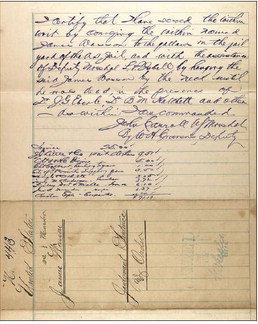
As was customary for executions in Fort Smith, the federal government paid for burial clothing for the men who were to be hanged. For Wasson,thegovernmentpaid $9.51 for his trousers, shirt, and boots. In addition to the clothing, the government paid $6.37 for a new rope for Wasson. Each condemned man was hanged with a new rope to prevent breakage that could cause a botched execution. The government also paid each deputy who assisted with the execution a stipend of $2.50. The executioner received $2.05.
As the guards made final preparations, Joseph Jackson, themanwhowastohang besideWassonforthemurder of his wife, attempted to kill himself. He had smuggled a piece of broken glass into his cell and slashed his throat. The wound was deep, but not fatal. Marshals intervened quickly and dragged the bleeding man to the scaffold, binding the injury with a cloth.
Then, around 3:30 p.m., a telegraph boy arrived at the garrison.
Wassonwasalreadyonthe scaffold. The crowd fell silent, awaiting what the telegraph would say. A slip of paper was handed to the marshal and read aloud. There would be no reprieve. The President had denied the stay.
Even as the final preparations were made, another delay occurred: Wasson’s minister was late. The condemned man, rope around his neck, waited in grim silence for the arrival of the clergyman who would offer the last prayer. And as he waited, James Wasson looked out over the crowd and saw a familiar face near the back, the face of Lucy Juzan Watkins. The widow of Almarine Watkins, whospentoverfouryearsand over $7,000 pursuing justice for her husband, who died at the hands of Wasson. And whileWassonwasnevertried for the murder of Watkins, his widow was satisfied by the outcome. In her heart and mind, she believed that her late husband was about to receive the justice he deserved. His killer would pay with his life and soon meet his maker.
The minister finally arrived, and a short prayer was offered. The deputies made the final adjustments ontheropesaroundthenecks of both Wasson and Jackson. Then the executioner grabbed the lever, and at 3:46 P.M., at the command oftheUnitedStatesMarshal, he pulled the lever; and the trapdoor sprang open. Both men fell until they reached the end of their ropes, and at that moment, their necks were snapped. Death came instantaneously.
They died without a struggle.
That afternoon, United States Marshal John Carroll filled out a return notice to Judge Parker. The Marshal wrote: “I certify that I have served the within writ by conveying the within named James Wasson to the gallows in the jail yard of the United States jail, and with the assistance of Deputy Marshal, L P Isbell, by hanging the said James Wasson by the neck until he was dead in the presence of Deputy J G Eberle, Deputy D M Hatchell and others as within I am commanded.” John Carroll, U.S. Marshal.
After the bodies were cut down, they were placed into simple pine coffins. Jackson’s body was claimed by a local congregation of black residents and buried with dignity.
But no one claimed James Wasson. His family, poor and burdened, could not afford to transport the body home to Woodville. Nor could they afford a burial plot. Therefore, the government provided a pine box, a service and a grave. The coffin cost $2.72 for lumber and $6.10 for iron to build a coffin for Wasson’s remains. The carpenter who built the coffin was paid $10.00, and another man received $1.00 to transport Wasson’s remains to the cemetery. The City of Fort Smith was paid $3.50 to dig the grave, and a minister was paid $25 to attend the execution and perform the funeral service. Such was the fate of paupers.
Wasson was laid to rest in the Potter’s Field section of Oak Cemetery in Fort Smith. There was no fancy gravestone. No formal ceremony. There was just a minister paid by the government who did not know Wasson, who conducted a brief service. No hymns and no sermons.
And in the end, James Wasson was just a number.
203. That was the only mark left to commemorate a man whose life had shaken the Territory.
Today, the stone still stands—a flat, worn marker amid overgrown grass. Children play nearby. Locals pass by, unaware. The man who once lit up headlines across the nation, who haunted the frontier with pistol and whiskey, is now no more than a numerical ghost.
The saga of James Wasson may have reached its grim conclusion at the end of a rope, but the chaos that gripped Indian Territory was far from over. No Man’s Law still reigned, claiming more blood and more breath before its waning. And for Lucy Juzan Watkins, the road to justice had not yet come to its end. Now it was John McLaughlin who stood in the shadow of the gallows, awaiting his day in court—and perhaps his own reckoning by the noose.
In Part X: The strange tale of the prosecution of John McLaughlin begins.