
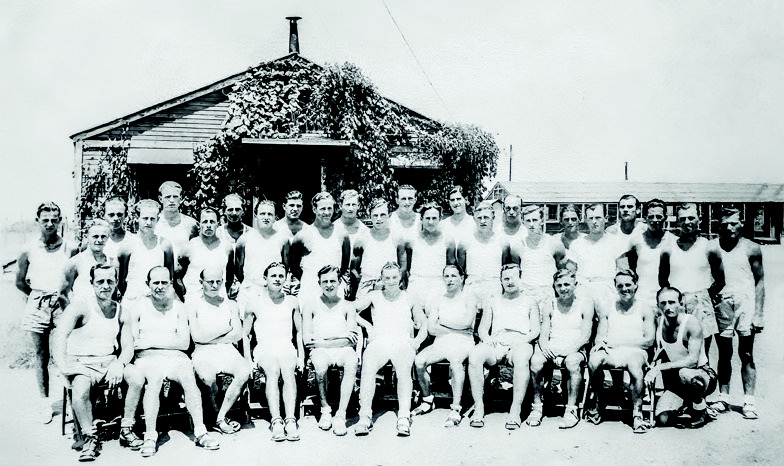
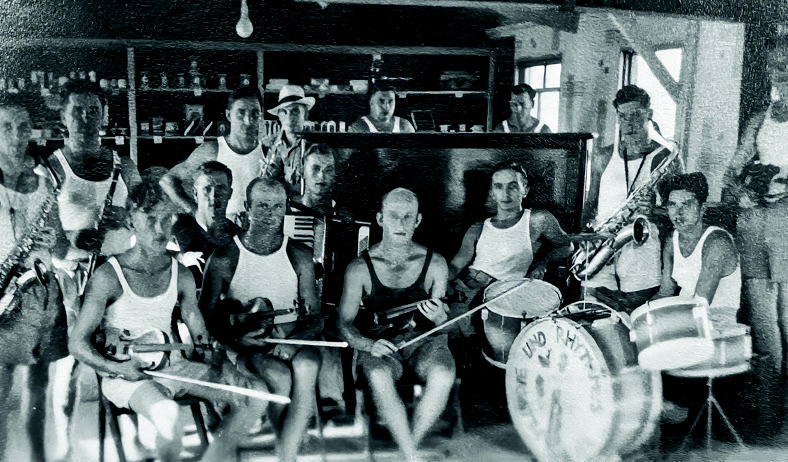
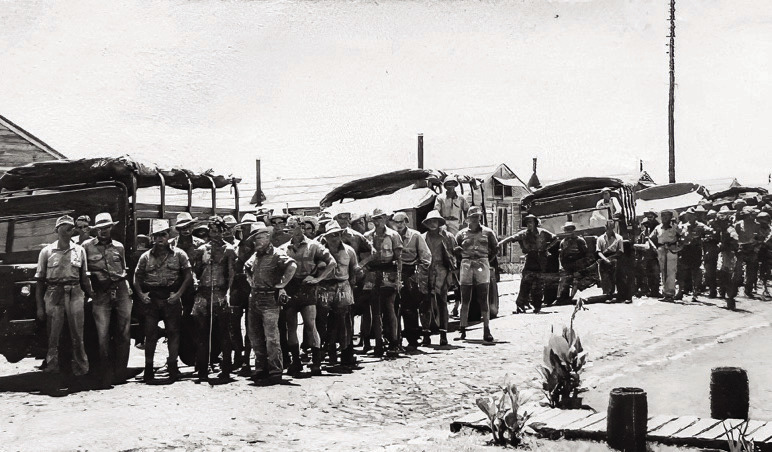
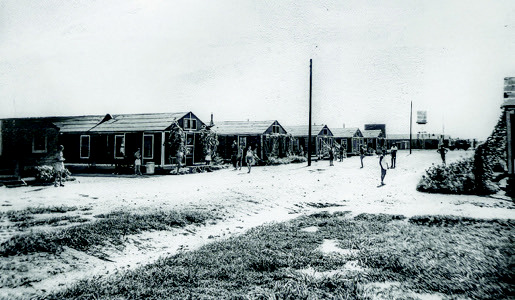
In August 2023, when I was still finding my footing as a columnist for the Madill Record, my fifth article focused on the World War II German prisoner-of-war camp located in Powell, Oklahoma. I was inexperienced back then, still learning how to craft a story so that it wasn’t just a recitation of facts, but a vivid narrative. That first piece wassimplecomparedtowhat I try to produce now—less layered, less filled with the voices of history. And yet, to my surprise, it struck a nerve.
That article drew an outpouring of interest unlike anything I had written before or since. Readers called, wrote letters, and sent emails. Some remembered their fathers talking about German prisoners felling timber for the Denison Dam. Others shared family stories of long convoys of trucks rattling downMarshallCounty’s backroads, loaded with foreign faces in dark blue denim uniforms. The men wore the same cut as U.S. Army work clothes, with leggings or boots, but with one difference: every garment was stenciled in stark white with the letters “P.W.” for “Prisoner of War.”
The article awakened memories that had been sitting just beneath the surface, waiting to be called forth. It made me realize something important: sometimes the most ordinary-looking places—fields we drive past, patches of woods we hunt in, stretches of shoreline we fish from—carry extraordinary stories beneath them. South of Powell, there is such a place. Most who travel past it today would never guess that the ground once held a prisoner-of-war camp that housed six hundred men plucked from Rommel’s Afrika Korps and shipped halfwayacrosstheworld.Nor wouldtheyimaginethatLake Texoma itself bears the mark of their labor, thousands of trees cleared by captive hands.
For me, the story is not just abstract history. It is also personal memory, stitched into the fabric of my own family. I remember my mother and father speaking of it when I was a boy, telling of how they would stand and watchastruckloadsandeven trainloads of German prisoners passed through Kingston on their way toward the dam site. They recalled the strange sight of enemy soldiers, notingrayWehrmacht tunics but in those plain blue work clothes, rolling past the familiar streets of Marshall County.
Since writing that first article, I have uncovered more—more documents, more photographs, more eyewitness accounts. Each new scrap of evidence has deepened the story and made me realize that what I published back then was only the beginning. What follows is not a simple retelling of what I wrote in 2023, but a fuller excavation. Two years later, I want to revisit the Powell camp not only to correct the thinnessofmyearlyeffortbut to bring forward the material I did not yet have—records, testimony, and, for the first time, photographs of the camp itself.
This is Marshall County’s hidden chapter in the global war. It is the story of how men who had marched beneath the desert sun of North Africa ended up behind barbed wire in Powell, Oklahoma. It is the story of how the farthest edges of the world conflict touched our county roads and town squares, our timberlands and lake shores. And it is, I think, a story worthtellingagain—withthe richness it deserves.
Field Marshal Erwin Johannes Eugen Rommel (1891–1944) was one of Germany’s most celebrated commanders of the Second World War. Born in Württemberg, heenteredtheGermanArmy in 1910 and first proved his mettle during World War I, earning a reputation for boldness and tactical brilliance. By the outbreak of the next global conflict, he had risen swiftly through the ranks. After leading armored divisions with distinction in France, he was dispatched to North Africa in early 1941, where his name would become legendary.
In the deserts of Libya and Egypt, Rommel won enduring fame. At the head of the Deutsches Afrikakorps, he earned the sobriquet Wüstenfuchs—the Desert Fox—for his uncanny ability to outmaneuver larger Allied armies. His tanks captured Tobruk in 1942, drove deep into Egypt, and for a time seemed all but unstoppable. His reputation carried such weight that even his enemies respected him. Winston Churchill himself praised Rommel in Parliament—a rare tribute to an opponent.
But fortune shifted with the Battle of El Alamein in the autumn of 1942, when British General Bernard Montgomery broke the Afrika Korps’ advance. Soon after, American forces under Dwight D. Eisenhower landed in Morocco and Algeria. Rommel’s army was trapped between two great Allied offensives. In May 1943, surrounded in Tunisia, more than 250,000 German and Italian soldiers laid down their arms. It was one of the largest mass surrenders in history.
Those captives were shipped across the Atlantic in vast convoys, scattered among camps across the United States to keep them far from the battlefields of Europe. Some of the very men who had once fought underRommel’scommandin the blistering sands of North Africa found themselves in the Chickasaw Nation of southern Oklahoma. There, under armed guard, they labored not as warriors but as work crews—clearing timber for Denison Dam and living behind the barbed wire of the Powellprisoner-of-warcamp.
Rommel himself never set foot in Oklahoma, but his shadow loomed over the menwhodid.BackinEurope, he remained one of Hitler’s most trusted generals until 1944, when his name became entangled—rightly or wrongly—in the July 20th conspiracy to assassinate Hitler.
The July 20 Plot, also knownasOperationValkyrie was a conspiracy led by German military officers, including Claus von Stauffenberg, to assassinate Adolf Hitler and seize control of the government to negotiate peace with the Allies. The bomb Stauffenberg planted exploded at Hitler’s Wolf’s Lair headquarters in East Prussia, but Hitler survived with only minor injuries.
Rommel’s name became tied to the conspiracy— though historians debate whether he was actively involved, sympathetic, or merely aware of it. After the plot failed, Hitler forced Rommel to take his own life to protect his family from retaliation. Offered the choice between a humiliating trial that would imperil his family or suicide, Rommel took poison on October 14, 1944. He was buried with full military honors, his death falsely announced as the result of war wounds.
His soldiers, however, carried his legacy with them— even into captivity. To the people of Marshall County, the sight was jarring: men who had once served under the Desert Fox himself, now reducedtoclearingbrushand felling trees in Oklahoma. Until then, the war had been something distant, read aboutinnewspapersorheard through crackling radio broadcasts with names that seemed foreign—Tobruk, El Alamein, Kasserine Pass. Now the war had arrived at their doorstep.
By 1943, truckloads of German prisoners rumbled down dusty county roads. They were dressed in the same distinctive dark blue denim uniforms stenciled with the white letters “P.W.” For locals, it was a surreal sight—enemy soldiers in the heart of southern Oklahoma, confined inside stockades a few miles south of Powell.
The men had been handpicked, seasoned in earlier fighting, and hardened by desert warfare. They had endured scorching heat by day, freezing cold by night, sandstorms, fuel shortages, and battles that tested them to the limit. Captured in Tunisia and shipped across an ocean, they ended up in the last place they could have imagined—MarshallCounty, Oklahoma. Behind barbed wire near Powell, under the watchful eyes of U.S. guards, they worked to prepare the Red River valley for the great reservoir that would become Lake Texoma.
In early 1943, the U.S. Army, under direction of the federal government, began the hurried construction of prisoner-of-war camps across the southern United States. The War Department had set clear requirements: the camps had to be located far from major ports and manufacturing centers, to minimize both the risk of espionage and the possibility of rescue or escape by sea. They were to be built in rural, agricultural regions where prisoner labor could be put to use in the fields, and in temperate climates where the Army would not have to divert precious supplies toward cold-weather gear.
These criteria made the South a natural choice. Oklahoma, Texas, Arkansas, Louisiana, and their neighboring states offered precisely what theArmyneeded—openland, rural economies in need of labor, and mild winters that reduced logistical strain. At the time, planners estimated that facilities would be required to house roughly 275,000 captured Axis soldiers.
By every measure, Oklahoma fit the bill. Its expansive farmland, sparse population, and central location made it an ideal setting for prisoner-of-war camps.
World War II was vast, stretching across continents and oceans. But its reach extended even here, to quiet farmland and backroads where locals watched, astonished, as the war’s prisoners marched past.
Captured soldiers were gathered in makeshift camps in North Africa, then moved to ports like Oran and Algiers. They were loaded aboard Liberty ships for the long voyage to America. Conditionswerecrampedbut orderly. Most were relieved to have survived.
When they landed in New York, captured soldiers were processed, registered, and given medical exams. Many of them experienced a shock. They had been told repeatedly byNazipropagandathat New York was a ruined city, bombed into rubble by the Luftwaffe. They expected to see smoking ruins, collapsed skyscrapers, and starving people. Instead, as they disembarked, they saw the skyline of Manhattan gleaming intact, with skyscrapers stretching into the sky and bustling streets full of life.
One prisoner later confessed thatitwasthemoment he realized how thoroughly they had been lied to. The propaganda that America was on its knees collapsed instantly.
From New York, the men were loaded onto trains bound for the interior. They traveled under guard for five days, crossing the vast American continent.
They saw farms green with crops, towns with full stores, families going about their lives as if there were no war. The contrast with Europe—where cities were reduced to rubble and food was scarce—was striking. For many young Germans, this was the first glimpse of a land untouched by war.
They marveled at the sheer size of the country. Mile after mile of farmland rolled past. Rivers, forests, mountains— all passed outside the train windows. For them, it was an education. America was not weak or starving. It was strong, fertile, and thriving.
Even after they arrived in America, many prisoners clung to Nazi ideology. Reports from Oklahoma camps describe how they continued to rise at 4:30 a.m. to perform exercises and calisthenics. They said they wanted to remain fit “for the day when the Führer arrives in America.”
United States soldier, Private First-Class Clement Greenberg, in his controversial 1943 article printed in The Nation magazine, wrote about the camps at Tishomingo and Powell. In reference to the German soldiers’ daily drills: “Nevertheless, the prisoners continued to roll out at 4:30 a.m. to exercise, saying they wanted to keep themselves fit for the day when the Fuehrer would arrive in America.”
For the guards, it was a mixofcomicalandunsettling. These were men defeated in battle, shipped halfway across the world, and yet still clinging to dreams of Hitler marching triumphantly into New York.
For local residents, this was a novelty. Madill was a town of shops, churches, and county government. Now it was also a command post for a war on the other side of the globe. From April 1943 to the summer of 1945, Madill was on the Army’s map in a way it had never been before.
The camps themselves followed a uniform blueprint. Each compound had both guard and prisoner barracks, a canteen, recreation areas, a fire station, and other support buildings. The layouts were identical from site to site, reflecting the Army’s effort at efficiency and order. American military police served as the official guards, but within the wire, German officers maintained authority over their own men—always under U.S. supervision. Prisoners prepared their own meals, organized daily routines, and managed internal matters through their designated chain of command. Meanwhile, the Army provided educational programs to introduce them to democracy, civil liberties, and the principles Americans believed they were fighting to defend.
Work was a constant question. Non-commissioned Germanscouldrefuseoutside labor if they chose, since it was seen as aiding the Allied war effort. Many did refuse— butmanyothersvolunteered, grateful for the chance to escape the monotony of camp life. Prisoners were used on farms near their camps and in light industrial work such as ice plants, cotton picking and ginning, alfalfa drying, and other agricultural tasks. They were paid $1.80 per day for their labor, with wages held until the war’s end.
Madill found itself the unlikely hub of military operations. Though no prisoners were housed there, the town served as the administrative headquarters for the U.S. Army’s southern Oklahoma POW system. The Provisional Internment Headquarters was established in the Little Building, just off the square. Across Lillie Boulevard, the First National Bank building (ThecurrentSouthernCoach Works building) became quarters for officers and guards. Soldiers in uniform could be seen marching across the square, clerks carrying papers under their arms, and Army families renting homes on residential streets Two or three miles south of Powell, on open land surrounded by farms and pastures, the Army built one of its many branch camps. It opened on April 29, 1943. Its purpose was clear: to house600Germanprisoners, mainlyfromRommel’sAfrika Korps, and to put them to work clearing the Red River basin for the soon-to-be Denison Dam and Lake Texoma.
The camp was built according to standard Army blueprints. Rows of barracks stretched across the compound. A mess hall, kitchens, and latrines served the prisoners. A post exchange allowed them to spend their coupons. Four tall towers, manned by guards with rifles, stood at the corners. Floodlights illuminated the grounds at night.
For the people of Powell, the most significant change was the introduction of electricity. TheArmystrungpower lines to run the camp, and for the first time, the town itself enjoyed the benefits of electric light. A world war had brought modernity to a rural Oklahoma settlement.
Inside the wire, discipline was enforced not only by American guards but by German sergeants.Theprisoners rose early, marched to their duties, and returned at night. They cooked their meals in Germanstyle—frankfurters, sauerkraut, boiled potatoes, bread and butter. One local memory stands out: a redhaired German baker, who sometimespassedwarmrolls to children through the wire.
“At Work Under the Wire” (Robert E. Hicks, Fort Worth Star-Telegram, July 8, 1943) OnJuly8,1943,theMadill Record reprinted a feature by Robert E. Hicks, staff writer for the Fort Worth Star-Telegram. Hicks visited the camps at Powell and Tishomingo and described what he saw. His words provide one of the most detailed surviving accounts of life in the Powell camp: “German prisoners of war under the jurisdiction of the Madill Provisional Internment Camp are now at work at the base of the big Denison Dam. Several hundred of them, brawny blond and grizzled, are engaged in land clearing operations on the lowlands which are to be backed up as Lake Texoma, extending far into Oklahoma andTexas,whentheDenison Dam project is completed.”
“TheGermansmarchfrom stockade to work grounds underarmedguard,shoulder their tools and proceed with the cutting and burning operations with a minimum of conversation. Army officers in charge of the prisoners say they are good workers and fill any need as a dependable crew of American laborers.”
“They crush brush in their hands with an expression akintosadness.Germansare said to feel that the cutting and burning of so much timber is wasteful. To Germans, a tree is food and clothing, as well as fuel and shelter; to them, there is a criminal offenseinwantondestruction of government domain, and when a tree is cut, every sprig of it is saved and utilized in some manner.”
“Despite this natural aversion to wholesale timbering, they go about it as a routine job with apparent interest, joy or zeal. After a signal of the forest crashers to the ground, the prisoners strike with fire to the brush, leaving nothing but ashes.”
“The prisoners’ quarters are set up in barracks-type frame buildings on the order of the American Army’s cantonments. The Germans live two to a room. The quarters are lighted with electricity and heated with steam heat. Each building has a bathhouse with hot water. The mess halls are similar in design to American mess halls. The prisoners use American food, the same as American soldiers.”
“The first ones into the barracks were assigned to cook the food and did a good job. The Germans prefer frankfurters, sauerkraut, boiled potatoes, bread and butter.”
“After refreshing themselves and taking a bath, the prisoners line up and wait for the final count by guards, and then to their bunks and to be counted by the guards. When the last man has been accounted for, a signal is turned on, and they scramble into their bunks. Back at camp, the prisoners line up outside each evening to sing their homeland songs. They are deeply musical and sing with expression that appeals greatly to the guards.”
This musical note—the soundofGermansongsrising into the Oklahoma night— left an impression on locals. Even in captivity, far from home, the prisoners found solace in song.
Hicks also observed the role of the Red Cross and the quality of supplies when he wrote: “American captors are holding prisoners in quarters more luxurious than many European homes. Red Cross parcels include large cans of butter. The Red Cross maintains permanent offices at the camps and delivers supplies. Prisoners are supplied with the best available food, including potatoes, butter, bread and meat.”
This generosity was by design. The United States adhered to the 1929 Geneva Convention,whichmandated humane treatment of prisoners. The Army went further, often providing food and medical care that exceeded what American civilians received under rationing.
A month before Hicks’ article, theGreenbergpiecehad causedoutrageinOklahoma. On June 10, 1943, The Madill Record published a sharp editorial under the headline “ARTICLE ON PRISON CAMPS AROUSES OKLAHOMANS’ IRE.” It referred to the piece by Greenberg, printed in The Nation.
Greenberg wrote of seeing German prisoners at Tishomingo and described them as young, fit, and still devoted to Nazi ideals: “Some of them had been through 12 days of continuous action before being captured. Some had seen service before on the Russian front. I was told that one of the prisoners was only 14 years old. Two I saw could not have been more than 15.”
In addition to Greenberg’s comments that “one prisoner was shocked to see New York’s skyscrapers still standing, having been told they were bombed to ruins,” and “the prisoners continued to roll out at 4:30 a.m. to exercise, saying they wantedtokeepthemselvesfit for the day when the Fuehrer would arrive in America,” what angered Oklahomans most was Greenberg’s insult to their culture: “God help the fugitive who tries to hide himself in the unsubstantial foliage of its gullies or stop in boredom at the town of the Biblepounding natives.”
For southern Oklahomans, this was a slap in the face. They took pride in their faith and their community. To be mocked in a national magazine stung deeply.
Greenberg also noted the prisoners’ discipline: “The prisoners maintain their own army discipline under two sergeants, who seem to be the only men among them who do not do work. The guards admit that the Germans are willing and capable workers, eager to be helpful and lending a hand with any work they see being donearoundthemevenwhen they are not ordered to do so.”
He added that their stoicism was unsettling: “One of them who had gashedhisfootwithanaxand was brought to the medical officer…satinthedispensary and stolidly watched the wound being sewn together without making a sound.”
Greenberg’s article painted the prisoners as efficient, disciplined, and ideologically committed. For locals, it seemed to glorify the enemy while sneering at the people of Oklahoma.
The Germans carried propaganda leaflets printed with swastikas, designed to undermineAmericanmorale. One, translated into broken English, declared: “U.S.A. People-Nation! Have you would this war? Would you sacrifice your liefe for the Judaism and the capital?
Your man father brother son and fiance fall now and know not for what.
Dead man return never back, cripple rest without love.
Therefore recollect you return before it is too late.
Germany rest victorious. Hitler come!”
To locals, these were laughable. The crude language and wild claims had no effect. But they reminded Americans that the prisoners were still soldiers of a dangerous regime.
The juxtaposition of Hicks’ and Greenberg’s reporting is striking. Hicks portrayed the Germans as orderly workers, well-fed, housed in decent quarters, singing songs in the evening. His tone was observational, even sympathetic. Greenberg, by contrast, saw them as unnervingly committed to Hitler, fit and disciplined, their zeal undimmed by captivity. Together,thetwopiecesshow the complexity of the story.
In August 1943, two German prisoners working in the Denison Dam clearing district slipped away from their guards near Powell. Hidden briefly by brush piles, they vanished before anyone realized it. Within two hours, Camp Tishomingo bloodhounds, led by Sgt. Vance L. Skocdopie, a former track star, were on their trail. By 8:00 that evening, the men—Rudolph Arens, 21, and Jacob Braun, 22—were surrounded in the river bottoms and marched back to camp for punishment under international law.
The episode underscored both the vigilance and the futility of escape. The POWs’ dark blue denim uniforms, stenciled with the white letters “P.W.,” made them instantly recognizable. FBI agents, state police, and even local citizens were alerted, butthehoundsnearlyalways made such pursuits short.
One of the most remarkable episodes at Powell came in1943,whentwobrothers— bothborninGermany—were briefly reunited. One had emigrated to America fourteen years earlier and now wore the uniform of the U.S. Army at Camp Fannin, Texas. Through correspondence with relatives overseas, he discovered that his younger brother had been captured with the Afrika Korps and was being held as a prisoner of war at Camp Powell.
After arrangements were made, the two men met face-to-face inside the camp stockade. For a few hours, uniforms and loyalties fell away, and the war shrank to a family bond. One brother served the United States; the other was confined as its enemy.
With so many Marshall County men overseas in Europe and the South Pacific, farms at home were left short of hands. In the summer of 1943, the shortage was so severe that German prisoners from the Powell camp were pressed into service as farm laborers. County agent Dale Ozment, working with Lt. Col. H. E. Fischer of the Madill provisional internment camp, arranged the program.
Theresponsefromfarmers was immediate. More than forty showed up at a Monday morning meeting before the doorsevenopened,alldesperate for help. That same week, fifteenprisonerswenttowork chopping cotton and corn on the farm of Calvin Orr, who reported they did good work. Thirty more were sent to Pete Biggers’ farm south of Powell, and another fifteen to the fields of Boge Lynn. All expressed satisfaction with the results.
The prisoners, most of them only nineteen to twenty- five years old, were strong, quick to learn, and—by all accounts—steady workers. Theylaboredunderthewatch of armed guards, were paid $1.50 a day (including a meal allowance), and the money was held until the end of the war. The only real problem, Ozment noted, was finding enough hoes to put in their hands; the Madill Chamber ofCommerceevenpurchased thirty to keep the work going.
Some of the Germans had farm backgrounds, but many had grown up in cities or youth camps. Still, they swung into the work willingly, often laughing as they chopped cotton rows under the Oklahoma sun. For the farmers, their presence was a lifeline—an unexpected way the war overseas had come home to Marshall County fields.
Sadly, the relief was shortlived. Just as Marshall County farmers began to see German prisoners as the answer to their labor shortage, Washington shut the door. Orders came down that POWs were to be used only for land clearing at Denison Dam, not on private farms.
The decision baffled locals. County agent Ozment and others had praised the Germans’ work, noting that they were strong, steady, and had quickly taken to the fields of Orr, Biggers, and Lynn.TheChamberhadeven furnished hoes so the work could continue. However, the DepartmentofLaborinsisted on contracts, approvals, and proof that no local labor was available—something residentsfoundabsurd,given that every able-bodied man was already in the service, at the dam, or in defense jobs.
U.S. Army engineers at Denisonwerefirm:thecamps at Powell and Tishomingo existed for one purpose only - clearing the bottomlands that would soon be flooded by Lake Texoma. Col. W. W. Wanamaker, the Denison Dam project chief, said he was helpless to do otherwise.
For the farmers, it meant going back to their original problem. With their sons overseas and their fields already behind schedule due to spring rains, they faced the harvest with too few hands and rising wages for the few laborers left at home. What had seemed, for a brief moment, like a solution disappeared in a wave of bureaucratic red tape.
The Powell branch camp was one among dozens that dotted Oklahoma. In total, the state hosted nearly 20,000 German prisoners during the war, a staggering number when you stop to consider it. Six base camps anchored the system:
• Alva — housing up to 5,000 prisoners, it was the largest in the state. This camp became infamous for holding hardened Nazi Party members, the only one in the U.S. where such men were concentrated. The prisoners there formed Nazi cells, held rallies, and intimidated others.
• Tonkawa — a branch camp that became notoriousforthe1943murder of Johannes Kunze, beaten to death by fellow Germans for being suspected of informing. The crime horrified Americans,provingthateven behind barbed wire, Nazi discipline and terror could reach.
• Fort Reno — with 2,500 prisoners, this camp in Canadian County became a hub of farm labor. Today, the cemetery still contains the graves of 62 German and Italian prisoners who died in captivity.
• Fort Sill — a longestablished Army post, it housed 2,000 prisoners and put many to work in agriculture and construction.
• McAlester — tied to the ammunition depot, it held about 1,500 prisoners who labored in non-sensitive capacities to support the war effort.
•CampGruber—in eastern Oklahoma, housing up to 3,000, serving as both a training ground and a holding camp.
From these bases, branch camps radiated out, including Powell, Tishomingo, Chickasha, Seminole, Ardmore, and Stringtown. Each was smaller, often housing 300 to 600 men, and usually tied to a specific labor project: farm harvests, road building, or, in Powell’s case, clearing timber for Lake Texoma.
By late 1944, the Denison Dam was nearing completion. The need for prisoner labor diminished. In 1945, the Powell camp closed. The Army dismantled the barracks, auctioned the pumps and motors, sold the water tanksandelectricequipment. Farmers bought what they could. The land reverted to private use.
Today, only fragments remain; concrete foundations, a well, rusting pipes hidden in the grass. Without a guide, no one would know that hundreds ofGermansoldiersonce lived there.
When the war ended, the prisoners were sent back to Europe. None were allowed to remain in America. Many returned to a Germany devastated by bombing, divided by occupation, and starving. Yet the memory of their time in Oklahoma stayed with them. Decades later, some returned as visitors—old men, once young soldiers of Rommel—comingbacktosee the land where they had been held. They walked the fields south of Powell, stood by the remnants of the camp, and recalled their youth behind barbed wire. For locals, it was astonishing: the enemy returned, not as captives, but as tourists seeking memory. The story of Powell cannot be told in isolation. It was part of a larger tapestry of prisoner-of-war camps across Oklahoma and the United States. At Alva, prisoners staged Nazi rallies and intimidated others. At Tonkawa, they murdered Johannes Kunze. At Fort Reno, their graves remain. At McAlester, they labored near an ammunition depot. At Camp Gruber, they lived in the shadow of training fields.
Powell was smaller, quieter. But its impact was no less real. It brought the enemy to Marshall County. It gave locals memories that linger still. And it tied the county to the global war forever.
The German invasion of Marshall County was not fought with rifles or artillery. Itcameinquieterways—hidden in the rhythm of axes striking timber, in the smell of burning brush, in the haunting sound of foreign voices rising in song beneath the Oklahoma stars. It arrived not with fire and blood, but with work crews in blue denim, with watchtowers at the edge of pastures, with barbedwirefencingoffapiece of Marshall County soil.
It changed things. It brought electricity to Powell. It left stone ditches cut by captive hands, foundations that still linger in the grass. It gave children the memory of a red-haired baker slipping warm rolls through the wire, amomentofhumankindness inside a landscape of war.
Lake Texoma is their monument. Beneath its waters lies the land they cleared, the timber they felled, the brush they burned. Every ripple against its shore carries the echo of their labor, every wave laps against the hidden bones of history.
The towers are gone. The wire has rusted. The men themselves are long since buried, scattered across two continents. But for a brief, extraordinarytimefrom1943 to 1945, Marshall County stood inside the great storm of the twentieth century. The enemy lived here. They worked here. They sang here. Andthentheyvanished,leaving only memory.
Their story reminds us that even in the quietest corners ofOklahoma,theworld’s greatest war reached out its hand. It is a reminder that history does not just happen in far-off capitals and famous battlefields—it can leave its mark in our own fields, on our own roads, and in the voices of our own people. And it did.