
In the years following the Civil War, Indian Territory became a Mecca for former Confederate soldiers. Between the early 1870s and 1900, the Indian nations welcomed former Confederate soldiers with open arms. Their acceptance of former Confederate soldiers is certainly understandable.
First, the Native Americans were still angry with the federal government because the government seized their homelands in the Southeastern part of the United States, followed by their forced removal to reservations in Indian Territory.
Second, of Indian Territory's approximately one hundred thousand inhabitants, fourteen percent were African American slaves. Many of the tribal members were slaveholders themselves. In fact, Cherokee Confederate General Stand Watie owned approximately one hundred slaves. This also explained the willingness of many Indians to side with the Confederate States of America.
And lastly, Indian slaveholders were apprehensive about Abraham Lincoln’s victory in 1860 and the Republican party's ultimate designs for Native Americans. Many Indian Territory residents were upset by Secretary of State William H. Seward's remarks when he urged the U.S. government to extinguish tribal land titles and open the West to settlement.
Because of these factors, the Native American tribes supported the Confederacy, and many Native Americans fought for the Confederate States of America. For these reasons, former Confederate soldiers were welcome in Indian Territory.
In the years after the Civil War, the area now known as Marshall County became the home to several Marshall County founding fathers. Men like Walter Alley Holford, the first white man to establish a ranch in the Chickasaw Nation. ConfederateCaptainRichard Catesby Wiggs, who founded Oakland. AndColonelThomas Dorsey Taliaferro, who, along with his sons, founded Madill. In the early to late 1880s, two more former Confederate soldiers, who played large roles in the early days of Marshall County, settled in Oakland. They were Dr. Calvin Polk Kelly and Henry C. Hampton.
Dr. Calvin Polk (C.P.) Kelly was born in 1842 in Fincastle, Botetourt County, Virginia. In 1861, he enlisted in Company K of the 28th Virginia Regiment as part of Robert E. Lee’s Army of Northern Virginia. The 28th Virginia participated in most of the major eastern battles during the war. The regiment was part of Longstreet's corps, Pickett's division, and they fought at 1stand2ndBattlesofManassas, the Seven Day's battles, at Sharpsburg, Gettysburg, the Siege of Richmond and Petersburg and the retreat to Appomattox. Kelly was seriously injured during the battle of Gettysburg but remained in the 28th Virginia until 1864.
Following the war, Kelly attended the University of PennsylvaniaMedicalSchool and received his medical degree. He then moved to Russellville, Arkansas, where he met and married Josephine Shinn in February 1869. During their marriage, Calvin and Josephine had twelve children. In the mid-1880s, they moved to Indian Territory, where Dr. Kelly practiced medicine in Tishomingo and Oakland.
Henry C. Hampton was born in 1846 in Washington County,Arkansas. Hampton served in Sherman’s Brooks Brigade of the 26th Arkansas Infantry and Cavalry. After the war, he married Cordelia Heraford. During their marriage, they had two children. In the late 1880s, theHamptonsmovedtoOakland, Indian Territory.
The first hotel to open in what is now Marshall County was the Wiggs Hotel inOakland. RichardCatesby Wiggs opened his hotel in 1882. It was reported that Wiggs operated a “first class” hotel, which was popular with travelers and people of “distinguished character.
Not to be outdone, Dr. Calvin Polk Kelly opened the second hotel in Oakland. Its name is lost to history, but it was reportedly a first-class hotel for its day. The hotel wasusedastheheadquarters for the two political factions of the Chickasaw Nation. Both parties regularly held their conventions for the nomination of candidates for county offices in old Pickens County, Chickasaw Nation, at the hotel.
In addition to operating the hotel, Kelly continued to practice medicine and later became a minister for the Christian Church, later known as the Church of Christ. By the mid-1890s, Kelly had moved to the Newcastle area of the Chickasaw Nation, where he practiced medicine and preached at areachurches.Uponhismove from Oakland, Kelly sold the hotel to Henry C. Hampton, whorenamedittheHampton House. Hampton operated the Hampton House in Oakland until 1900.
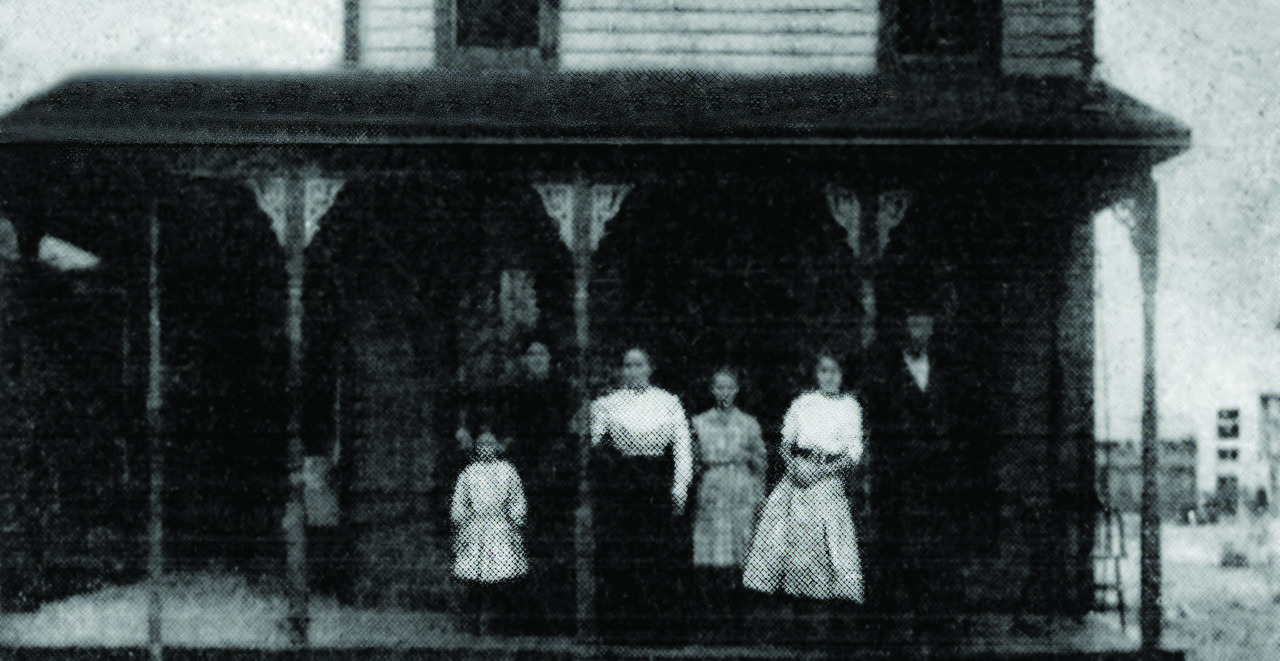
Shortly after Madill was founded in 1900, Hampton moved the hotel to Madill. Following the move, the former Hampton House was the first hotel in Madill. It was moved by horse-drawn wagons from Oakland to Madill. The hotel was located and re-established on the northwest corner of Second and Taliaferro streets. The hotel sat on the now vacant lot just south of the McMillan Building. At the time of the move,Mr.Hamptonrenamed the hotel the Commercial Hotel.
After relocation, the hotel was enlarged multiple times with a new wing holding additional rooms, a kitchen and a large dining hall. The hotel was unique for its day in that all the rooms opened to the outside instead of opening to interior hallways, as was the norm in those days.
Upon its move to Madill, the hotel became the setting of several different businesses. By 1904, Dr. Wilson, an eye, ear and throat doctor, had used the hotel as his office. He came once a month and stayed for two to three days, seeing patients in a room in the hotel.
Miss Myrtle Evelyn Mc-Clintock's business also made its home in the hotel. She operated an “Artistic Gown Builder and Ladies’ Tailor” business and was a permanent resident in the early days.
Several prominent businessmen, including Dr. Isaac Decker, also made their homes in the Commercial Hotel. Dr. Decker had an office on the second floor of the Madill National Bank building on the corner of Lillie and Hwy 70 (First Street), but he lived in the hotel.
In 1908, Mr. Hampton sold the hotel to J.H. Bounds. Bounds owned a large ranch south of Madill, and the hotel was just one of his business ventures. After he purchased the hotel, Bounds hired Mr. and Mrs. J.H. Cooper to run the hotel. Mr. Cooper was from Mississippi and had originally come to the Lebanon area to farm. He eventuallybeganrunningthe hotelanddidsoformostofthe remainder of the hotel’s life.
An article in the Marshall County News-Democrat in December of 1910 had this to say about the Commercial Hotel.
“One of the neatest and most attractive, and home like hotels which has come under the observation of the writer is the Commercial Hotel so ably conducted by Mr. J.H. Cooper.” Mr. Cooper “thoroughly understand the conducting of a first class hotel, and he also possesses the happy knack of making his guest feel perfectly at home. The rooms of this popular hotel are all outside rooms, are well lighted and ventilated and are furnished and kept in a neat, clean and substantial manner. The table always contains all the substantial as well as the delicacies of the season, he also employs a good chef and the dishes served have a homelike, appetizing appearance and taste, the dining room service is also neat and intelligent as everyone is waited on in a prompt and courteous manner.” “Mr. Cooper numbers among his regular boarders, business men and professional men, who have been with him a long while. This is undoubtedly one of the most homelike hotels in this section and is highly appreciated by the traveling public as well as the citizens of Madill.” “Only the best of trade is solicited and therefore the hotel is conducted as a good hotel should be. Mr. Cooper is ably assisted by his cultured and estimablewifeanddaughters who take a delight in offering information to the stranger and in other ways making his stay a pleasure as well as a comfort.”
The hotel continued to operate until Saturday, January 22, 1927, when it was destroyed by a fire. Oddly enough, the lot just westoftheCommercialHotel became the home to the City Wagon Yard in 1913, and it, too, was destroyed by a fire in 1941. The site of the hotel later became the used car lot of Raborn Auto.
After Hampton sold the hotel to J. H. Bounds, the Hampton family moved to Ardmore. Just months after they sold the hotel, Cordelia Hamptonpassedaway. After a few years, Henry Hampton thenmovedtoSulphur,Oklahoma, where he lived until 1922, when he was killed by a tornado on March 13, 1922. The Sulphur tornado was part of a larger tornado outbreak across southern and eastern Oklahoma that claimed the lives of approximately twenty Oklahomans. In Sulphur, three lost their lives, and dozens were injured, several severely.
While the Commercial Hotel was the first hotel in Madill, by 1904, there were five hotels in the town. In addition to the Commercial, the town boasted the Lewis Hotel, located on the lot now occupied by the Nazarene Church. The Central Hotel, which was located where T. H. Rogers Lumber Company is now located. The Alamo Hotel located at 2nd and Drew, and the Rock Hotel located at 3rd and East Main.
In later years, the Royal Hotel and the Frisco Hotel were constructed at East Main and the railroad tracks, and in 1928, the Hollingsworth Building was converted intotheHollingsworth Hotel. The last of these fine hotels was the Hollingsworth Hotel, which became the Dowdy Hotel in 1949, and it operated until 1975.
It is hard to imagine now, but in the early days of Madill, the hotels in town were the centers of civic and public life. Each had a restaurant, and some had coffee shops. They housed doctors and other professionals, and travelers and locals patronized the restaurants and businesses. It is truly a shame that only two of the old hotel buildings still exist today. It should be the goal of every citizen of Madill to see that both are preserved as reminders of the early, golden days of Madill.
.