
In 1908, just a few months after Oklahoma achieved statehood, the state became embroiled in a series of intense and sometimes violent conflicts known as the “County Seat Fights.” Thesebattles,whichoccurred across multiple counties, were centered on selecting county seats—the administrative capitals of local government.
Securing the county seat was a significant matter in newly formed counties, as it promised economic growth, political influence, and status for the winning town. Towns vied to become the center of county government, resulting in fierce competition, political maneuvering, and even violent confrontations.
Oklahoma was undergoing rapid development, and county seats were seen as vital hubs of activity and influence. The county seat was where government offices were established, courts were held, and local business and social life thrived. Being chosen as a county seat often guaranteed a town’s survival and prosperity. Conversely, missing out on this designation could mean economic decline or, in some cases, extinction. This decision on where to locate the county seat is a highly contentious issue.
For many towns, winning the county seat was more than just a civic pride issue— it was a financial windfall. With the county government headquartered in the town, businesses such as hotels, restaurants, and law offices flourished. Additionally, constructing a courthouse and jail would draw workers and contracts, further stimulating the local economy.
The State of Oklahoma was formed by joining the Indian Territory and Oklahoma Territory, resulting in a patchwork of communities with different ethnic backgrounds, economic interests, and historical ties. In some cases, former territorial capitals or significant towns felt entitled to become county seats, while newer or neighboring towns, often located closer to railroads, sought to challenge their claims. The result was a charged atmosphere ripe for political infighting.
Tensions between rival towns often escalated due to differing political affiliations or cultural backgrounds. Many county seat disputes reflected the broader power struggles between rural agricultural interests and more urban, industrialized communities. The battles were as much about asserting dominance over local governance as they were about securing the economic future.
With such fierce competition and frequent allegations of fraud, many of these disputes were taken to the courts. In several cases, the Oklahoma Supreme Court was called upon to resolve the county seat fights, issuing rulings based on technicalities such as voter turnout or election procedure violations.
Thestategovernmentalso played a role, often acting as an intermediary to prevent violence. Oklahoma’s governor at the time, Charles N. Haskell, was keenly aware of the potential for these disputes to destabilize the new state’s fragile political system. Haskell and other state officials frequently had to intervene to mediate between warring towns or authorize the deployment of state militia units to maintain orderduringparticularly contentious elections.
Though some of the disputes were resolved through legalorpoliticalmeans,many county seat battles left deep scars in the affected communities. Rivalries between towns often persisted for decades, and the economic consequences of losing the county seat were felt long after the conflict ended.
For Oklahoma, the 1908 county seat fights were a defining moment in its early history. The contests reflected the growing pains of a state still finding its footing, grappling with regional divisions and local governance challenges. The battles also highlightedtheimportanceof civic infrastructure in shaping communities' economic fortunes.
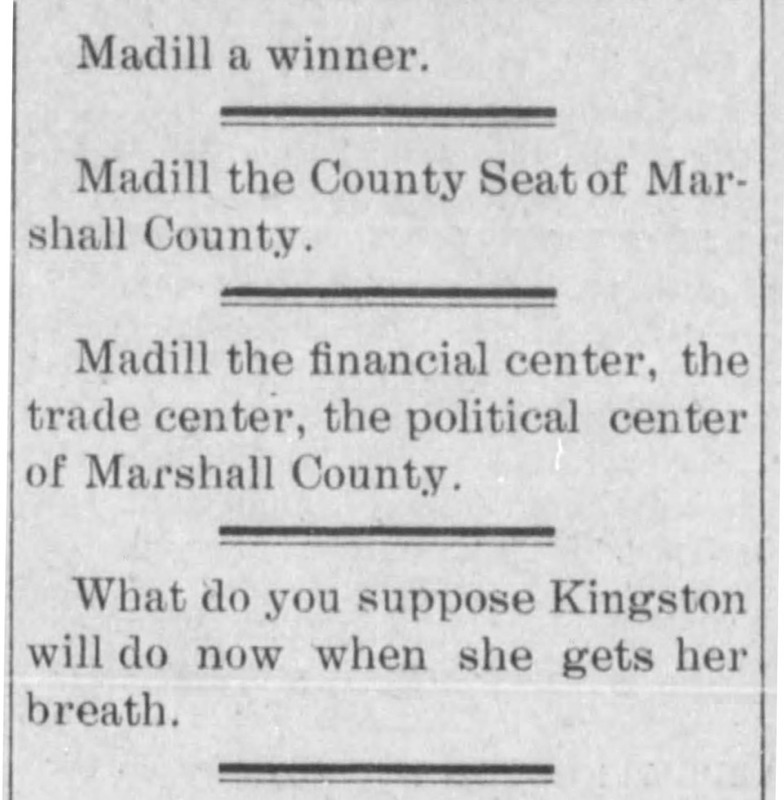
In Marshall County, the fight between Madill and Kingston was primarily waged in the local newspapers, mainly the Marshall County Democrat and the Kingston Messenger. However, the Madill News and the Woodville Star also occasionally waded into the fray. But the real war of words was between the editors of the two primary papers—W. G. Draper of the Marshall County Democrat and D. R. Johnston of the Kingston Messenger.
Many of you likely remember the weekly “Seen” and “Heard” sections of the Madill Record. A bygone section of the paper that mostly amounted to light gossip but was a place where readers couldcatchuponthecomings and goings of their friends and neighbors. Interestingly, that format was a part of newspapers before and after statehood. Theywereregular fixtures in every paper in the county, covering every community. And even those sections were not immune to the county seat fight.
Shortly after statehood, the Marshall County Democrat began adding a line to nearly every blurb about someone from Kingston, Aylesworth, Woodville or any other community being seen in Madill. And the line added to each was usually something to the effect of, “Walter Henry was in the County Seat today, conducting business.” But not to be outdone, the Kingston Messenger began responding by adding a line to their “seen and heard” section. It was usually something like, “Will Lasiter was in the temporary county seat this week.” Then, the next week, there was usually a response, mainly from the Editor of the Marshall County Democrat, who always seemed perturbed by the comments. They usually were just mild rebukes, but one week, the response was, “G-e-e-e W-h-i-z??!!!,” which resulted in Kingston's reply the next week, saying, “The Truth Hurts!” And while these seemed to be lighthearted, they weren’t. The fight was real. And the anonymitywasgrowingweek by week.
The fight was also waged between Marshall County State Representative Stump Ashby, who seemed to favor Kingston, and Marshall County State Senator William Franklin. Following an article in the Kingston Messenger claiming that Senator Franklin supported Ashby’s proposed legislation calling for a dual court system in the county, Franklin responded.
In the April 24, 1908 edition of the Marshall County Democrat, editor Draper published a letter written by Senator Franklin to D. R. Johnston, the editor of the Kingston Messenger. The letter stated: “Dear Sir A short time ago I received a letter from one of your most respected citizens, stating that the people there felt proud of me, and he further said, 'Hope at some future time we will have you in our midst that we may grasp the hand of our faithful representative.'
At different times you have commended my work. Just a short time ago you wrote me 'We are proud of you and the work you are doing and when I can be of help to you I want you to call on me.' I felt glad that I had the friendship of your people and hoped to maintain their good will.”
“I am sorry to note in the last issue of your paper the spirit in which you assail me. You are the only person in Kingston that I have, at any time, written to in regard to the separate court proposition. My letters and your responses there the best evidence as to what was said.
On March 26th, among other things, I wrote you as follows: 'I have not had time to examine the bill that you left with Mr. Ashby as thoroughly as I desire and, too, I have been bothered as to the effect the same, in its present form, would have upon the entire citizenship of Marshall county. I doubt, as I have expressed myself to you before, the legality of certain features of the bill. Also, I desire to add that since it has been understood that such bill is in contemplation, I have received various protests against the passage of the same.
As a representative of the interests of all the people of the county, I will not do anything that will harm them. I would not do anything for Madill that would discriminate against or hurt other sections of that county and I do not believe that you or any one who is a friend of mine would demand such. I shall act fair and impartially with all sections of that county and, also, the other county in my district. I do not want to do anything that will hurt Woodville or any other part of that county.”
“There is no intention (referring in the constitution) that a county could be divided into 'districts.'
In this letter I stated that I would favor the proposed bill if amended to a CERTAIN EXTENT, but did not say, as you state in your paper, that I would favor it with 'a few amendments.' See my letter for proof. As you must be aware, a bill can be amended by substituting entirely new matter after the enacting clause. I doubt whether you would want to agree to such an amendment as I would propose.
I had no way of telling just what shape the bill would be in, provided that it could pass the House in any form, so it would have been absurd for me to have passed upon the bill before it reached me. Nearly all bills are amended before they leave the House in which they originate. In answer to my first letter, among other things, you said, 'If Woodville wants a term of this court let them come forward like men and ask for it. YES YOUR POSITION ON THIS MATTER IS FAIR AND HONEST.”
“On the 7th of April, in a letter to you, among other things, I stated to you, 'I believe that if I should never open my mouth, the Senate would not pass the bill to be introduced by Mr. Ashby. I certainly do not want to do anything that will prejudice the interest of other parts of that county. I will do all I can for Kingston and the Kingston people when others are not injuriously effected. You suggest that Woodville shouldhavemanhoodenough to look after her own interest, but I desire to say that, as a representative of that district, it is my duty to guard the interest of all parts of the same.
In your paper, you state that 'We believe it (bill) will pass the House of Representatives.' I do not believe that it could have passed the House, and a little later I will submit some proof to sustain this position. No one in Madill had anything to do in shaping my attitude in this matter. At no time did I get instructions from Madill or advise anyone there that I would kill your bill. I have been studying the matter in the light of the interest of all the people in that county and not from the commercial advantage sought by any particular town.”
“As ABOUT FIFTEEN HUNDREDPEOPLEinthat county protested against the passage of the proposed bill and as the county seat can be reached from any part of the county within a few hours, could I not be recreant to my duty to support a bill that would place UNNECESSARY BURDENS UPON THE PEOPLE? You must remember that Marshall County is one of the smallest counties in the State. You suggest that 'similar bills will be passed in almost all counties in the state.' THEY WILL NOT BY MY VOTE. The fact is (watch and see) not a dozen bills of the kind proposed will pass. NOT A SINGLE COUNTY AS SMALL AS MARSHALL WILL HAVE SEPARATE PLACES FOR HOLDING COUNTY COURT. NOT A SINGLE TOWN AS CLOSE TOTHECOUNTYSEATAS KINGSTON IS TO MADILL WILL BE GIVEN A TERM OF THE COUNTY COURT.
The counties you cite in your paper are not a parallel. PLEASE NOTE THESE FACTS AND THEN ASK YOURSELF IF I AM UNJUST.”
I presume that there will be a permanent location of the county, seat and I trust that it will be conducted in all fairness and that no bitterness will be engendered. I will pay no attention to any ungracious filing that may be made against me, but if you have occasion to refer to my letters again, please do me the justice of quoting my letters of March 26th. April 7th. and April 18th. in full, so that my position will not be misrepresented.
I trust that I may still retain the friendship of the good people of Kingston who believe in justice towards all.
Very respectfully. WM. M. FRANKLIN.” Interestingly, Franklin’s comments would be proven right and wrong in the coming months. First, the State Constitution did provide for multiple courts in each county, and second, bills similar to Ashby’s would pass the legislature. Until the past few years, there were multiple courts in at least three counties. During most of my career in law, there were two courts in Seminole County. One in Wewoka and one in Seminole. In Creek County, there was a court in Sapulpa and one in Bristow. AndinKayCounty,therewas a court in Blackwell and one in Ponca City. So, the idea wasn’t outlandish. However, Franklin was opposed to Ashby regarding Marshall County.
The same day the Marshall County Democrat published Senator Franklin’s lettertoKingstonMessenger, the editor of the Messenger, D. R. Johnston wrote in his paper: “IN THE FIGHT TO A FINISH Madill has hung her hook and Kingston is in the fight to a finish. It is our intention not to use any dirty, vile means to gain this fight, but we shall do everything honorable and possible to gain the majority of the votes and thereby secure the county seat. We fully realize that we have the majority with us and that they will walk up to the ballot box and cast their honest ballot for the center of the county to be the county seat. With the majority of the voters demanding the division of the county court, MADILL'S SENATOR makes the statement that he would not favor it if there were 10,000 on the petition asking for such. Representing the people! Not much, But, Madill first, last and only. Down with such cliques and clans. KINGSTON IS THE CENTER OF MARSHALL COUNTYANDTHE FUTURE COUNTY SEAT THEREOF.”
Then quoting from the Marshall County Democrat, Johnston wrote: “The Kingston Messenger has had the temerity to speak of Madill as the temporary county site. Just now we guess that as Kingston is having day dreams and that a little later she will see visions of altogether a different character. Then she will want time to turn backward in its fight, and many of her business men will be sad that they did not discover the looked-for opportunity to ship themselves and they're all from the despised place. We invite you to Madill, the place that has felt no uneasiness as to her ability to be always the county site of Marshall county.”
“The above is the limit. DESPISED TOWN!
Readers what the do you think of that?
Surely you must be mistaken. Your town is not with you. You are off! Madill is uneasy. The truth has began to appear above the surface. Madill's Senator, who speaks after attorney Hardy, is against us.
He is an easy mark. A cat's paw who dances like a monkey when the string is pulled. Don't fret Madill, we are camping on your trail and stepping on your tail. We will give the majority a chance to speak.”
And you thought ugly and dirty politics was a recent thing. You thought politicians being rude and makingmeancommentswas something unheard of until Donald Trump ran for election. Think of how ugly the Madill-Kingston fight would have been if W. G. Draper, D. R. Johnston, William Franklin and Stump Ashby had Facebook, X (Twitter) and TikTok? Today’s politics pales in comparison to the fights of yesteryear.
In several counties, the 1908 county seat fights resulted in citizens being shot and killed. In Custer County,thetownsofArapaho and Clinton were locked in a bitter struggle. Arapaho, the county seat since the territorial days, was the incumbent town, while Clinton, a booming railroad town, sought to wrest control. The 1908 election for county seat saw rampant voter fraud accusations, with both towns accusing the other of bribing voters and tampering with ballots.
A particularly dramatic event occurred when pro-Clinton supporters attempted to steal the county records from the courthouse in Arapaho, hoping to force the county government to move. According to local accounts, armed citizens from Arapaho formed a vigilante group and pursued the thieves, eventually recovering the documents. The attempted theft only heightened the animosity between the two towns, and while Clinton ultimately lost, the incident leftalastingmarkonthelocal political landscape.
The county seat fights of 1908 were more than just local skirmishes—they were emblematic of the broader social, political, and economic changes occurring in Oklahoma. These contests, often involving fraud, political intrigue, and even threats of violence, illustrate the high stakes of community identity and economic opportunity in the early days of statehood. Today, many of these battles are remembered as key moments in the history of Oklahoma’s counties, shaping the state’s development and serving as a reminder of the fierce localism that characterized its formative years. But for others, the legacy of the 1908 conflicts lives on in local lore, a testament to the fierce determination of the townsthatfoughtforsurvival in the early days of statehood.
Marshall County was no different.