
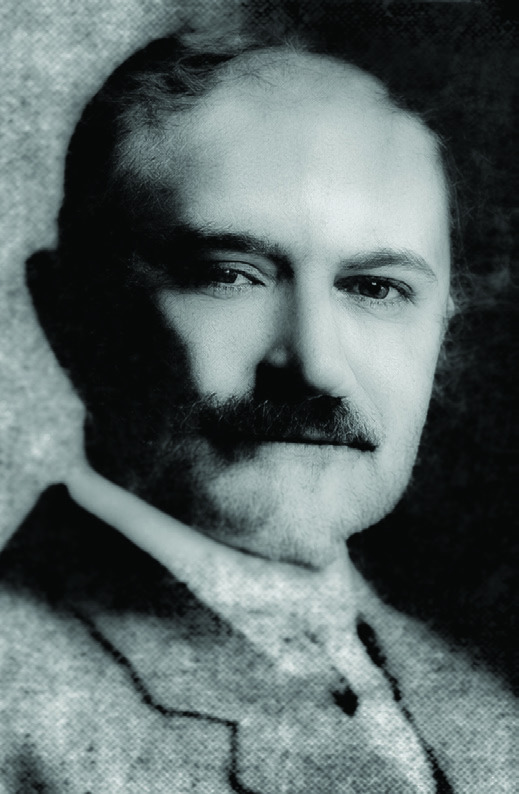
In the early days of Madill, a man wielded a significant influence on the town's development despite never residing in Madill or Marshall County. He was instrumental in shaping the town, owning several important and historic properties, yet he never had an office or official presence here. His substantial investments in Madill yielded a small fortune, yet his contributions arelargelyunknownandlong forgotten. He was the man behind the curtain, his influence shrouded in secrecy, and his story is still a source of intrigue today.
This phrase ‘behind the curtain’ is a colloquialism that means “to give away the elementsthatusuallyremain secret.” In other words, it signifies aspects of a business thatnobodyknowsaboutand is guarded secretly. This is the story of Sam Lazarus.
Samuel Isaac Lazarus was born in Syracuse, New York, on February 4, 1855, to Henry Lawrence Lazarus and Anna Isaacs. Henry and Anna Lazarus immigrated to the United States from England around 1850. Samual, who went by “Sam” for most of his life, was the middle child with two older brothers and two younger sisters. The family comprised devout Jews, and Sam was raised in the Jewish faith.
While Sam was born in Syracuse, he later said he did not like the surroundings and his home life, so shortly after the Civil War, at the age of thirteen years, he ran away from home. The year was 1868.
After leaving Syracuse, Sam made his way to New Orleans,Louisiana. Hemade the months-long trek from northern New York to the Gulf of Mexico alone, with little to his name. Upon arriving in New Orleans, Sam was taken in by Benjamin andAnnaJacobs. TheJacobs were also Jews, and they had five children of their own. After a few months, Sam found employment with Wallace & Company, a wholesale dry goods company in New Orleans. By this time, Sam was about fifteen years old, and the year was 1870. The Jacobs family treated Sam like a son and a brother.
But after just a year or two, Sam wanted more than to work in a warehouse. He had heard stories of the “cowboy life” of the Texas plains, so he left New Orleans with his friend, T.W. Waggoner, headed to Texas. Between them, they only had $25. Along the way, they stopped in Hot Springs, Arkansas, rented a room from a widow woman, and paid for two weeks in advance. By the end of the second week, they only had $4.85 left. To raise more money, Lazarus went to a gambling hall and bet all they had on a faro game. As would be the story of Lazarus’s life in the future, luck and good fortune shone down on him, and he turned their $4.85 into $19, which would be about $500 today. Lazarus and Waggoner headed to Texas with their winnings in hand, eventually landing in Sherman.
Upon arrival in Sherman, Sam found a job working in a mercantile store. The experience and knowledge he gained by working for Wallace & Company in New Orleans made him a natural for the dry goods mercantile business, and he was very successful in his new job. After a few years, he grew boredwiththedrygoodsbusiness and longed to become a cowboy.
While working in Sherman, Lazarus was able to abstain from the urge of most young, single men, and instead of “going to town” at the end of each week and spending all his wages on booze and women, he kept his eye open for bargains on cattle and land. During that time, he bought several small herds of cattle and several parcels of land. After building a small ranch, Lazarus left the dry goods store and began his career as a cowboy and rancher.
It was during this time thathewasinvolvedinaclose call with death. One evening, Lazarus and a neighboring rancher were returning from town. The neighbor was scheduled to testify the next week in a murder trial. As they rounded a bend in the road, the two men fell under a fusillade of bullets fired from rifles and pistols. Lazarus jumped from the buggy and crawled under it for cover. When the shooting stopped, Lazarusfoundhiscompanion and both horses dead. When he realized the “coast was clear,” he walked ten miles to town and reported the murder to the sheriff. Undeterred by his near-death experience, he continued in the cattle business, and within a few years,heownedseveralthousand acres of land and over a thousand head of cattle.
After establishing his ranching business, Lazarus built a thriving business trading cattlewiththeChickasaw and Choctaw Indians in exchange for buffalo hides, which he sold in Sherman. From this venture, he made a large sum of money. By 1880,helivedinClayCounty, Texas, where he had his large ranch.
While living in Sherman, Lazarus met and courted a young woman from New Orleans named Lillian' Lily' Neff Fisk, born in 1862. While the record is unclear, it appears that Lazarus and Lily met when he lived in New Orleans, and she followed him to Sherman after he found a job and could send for her. In April 1883, Lazarus and Lily returned to New Orleans and were married there on April 19th. After their marriage, they movedtoClayCounty,where they operated their ranching business together. Then, in 1891, Lazarus was elected thepresidentoftheAmerican LivestockCompany,inwhich he owned a large amount of stock.
By the early 1890s, ranching was becoming a rather tame occupation. As was reported in the February 20, 1914, edition of the St. Louis Star and Times, “by that time, virtually all the hostile Indians having been confined on reservations and most of the bandits having reformed to run for office…” Lazarusbecameinterestedin the railroad business.
In 1886, Lazarus was appointed receiver for the Texas, Louisiana & Eastern Railroad. Due to his business acumen,Lazarusturned the bankrupt railroad into a money maker. He brokered the sale of the Texas, Louisiana & Eastern Railroad to the Santa Fe Railroad for a large sum.
With the money he made from selling the TL&E Railroad, Lazaruspurchasedand becamepresidentoftheAcme Cement Plaster Company in Acme, Texas. He also became a director of the First National BankofGunter,Texas.
While making money with every venture, Lazarus longed to get back into the railroad business. In 1901, he was elected president of the newly formed Red River, TexasandSouthernRailway. Also, in 1901, he became involved with the St. Louis, San Francisco Railway, which was laying a line from Sapulpa, Indian Territory to Sherman, Texas. The Frisco line was being run through Madill.
When he returned to the railroad business, he moved his growing cement business to St. Louis, Missouri, and he and Lily relocated there in 1902. Upon the move and reorganization of the cement business, the company's value was more than one million dollars. Today that would be equal to about thirty-five million dollars in value.
After collecting several business ventures, Lazarus busied himself running each. Because of his business ability, each venture was a huge success, and money poured in. Lazarus was a millionaire several times over. But after a couple of years, Lazarus again became bored and began looking for another business to stimulate his mind and interest. Then, he bought a string of racehorses and went into the racing business.
Due to his cowboy experience, he was a “good judge of horses,” therefore, his horses were quite successful in what a local paper called “a large lucrative measure.” One of his horses was named Sam Lazarus. Because his horses were so successful, after one race, an opponent horseman was once quoted as saying disgustedly after a race, “If Sam would step out on the track before a race and say ‘Lazarus, come forth,” that blamed horse would…” win.
But even though his racing business was lucrative, Lazarus was not in the game to get rich. He was already rich. He was only in racing for sport and fun, and it was common for him to take his winnings from races and distribute all the money to his stablemen, jockeys and trainers. But, after a few years, Lazarus grew tired of the racing business and sold off all his horses and stables at a financial loss.
In 1909, Lazarus was named the president of the Houston Belt & Terminal Railway Company. The company was new, had few physical assets, and was handicapped by a lack of terminals. Lazarus then embarked on an ambitious plan. He spent five million dollars and bought up fourteen city blocks in downtown Houston. On that land were one hundred forty-six buildings, including three churches. He cleared them all and built a large central passenger terminal with tracks and other terminals around town, and by his efforts, Houston was “put on the map.” The central terminallaterbecameknown as the Houston Union Station, which today is on the National Register of Historic Places and serves as a cornerstone for Minute Maid Park.
After turning around the Houston Belt & Terminal Company, Lazarus founded the Quanah, Acme and Pacific Railway, which ran fromQuanahtoAcme,Texas. After about a year, he began running the line further out into the prairie, which terminated in a desolate area of Texas that was originally an Indian campground and the main Comanche outpost in the area. It was known for a “roaring spring” of pure and clean water. It was also the spot where the Texas Rangers recaptured Cynthia Ann Parker. Cynthia Parker was a woman who was captured by a Comanche band during the Fort Parker massacre in 1836, where several of her relatives were killed. She was about nine years of age when she was taken captive and, along with several family members, including her younger brother, John Richard Parker, were held as prisoners of the tribe. Parker was later adopted into the tribe and had three children with a chief. Twenty-four years later, at the age of 33, she was relocated and taken captive by Texas Rangers and unwillingly forced to separate from her sons and conform to European-American society. Her Comanche name means 'was found' or 'someone found' in English. Thoroughly assimilated as Comanche, Parker had married Peta Nocona, a chief. Together, they had three children, including son Quanah Parker, who became the last free Comanche chief.
Lazarus named his new townRoaringSprings,Texas. He built a hotel, bank, and several other buildings that housed stores and businesses. He also built a brick depot at the end of Broadway Street that handled passenger and freight traffic until 1971. Those buildings all stand today. The town owns Lazarus’sdepot,whichserves as a museum. The hotel is now a bed and breakfast establishment, and various businesses still use other buildings.
By 1915, Lazarus had grown his cement business into a national operation. At that time, he had eleven cement mills. His mills were in Texas, New Mexico, California, Wyoming, Oregon, Iowa, Michigan, Missouri andOklahoma. Therunaway cowboy had done well. In addition to his vast and various business dealings, Lazarus became involved in politics. After moving to St. Louis, Lazarus he decided to run for the city council. During the campaign, he did not give one speech, solicit one vote, or ask for a single contribution. And, the only money he spent on his campaign was what it cost him for the filing fee. Yet, he was such a well-known and respected businessman that he was elected City Council president.
His involvement in politics madehimhighlysoughtafter by other politicians. He was a lifelong Democrat, and in 1920and1924,hewasnamed a delegate for the State of Missouri to the 1920 and 1924 Democratic National Conventions. However, following the 1924 convention, Lazarus was so disgusted by the Democrat party that he supported Republican candidate Calvin Coolidge, who was elected President. Lazarus explained he had grown “weary of the creed fanaticism and political insanity on the part of men high in the councils of the democratic party who were determined to rule or ruin the political organization created by Thomas Jefferson.”
In addition to his business and political ventures, Lazarus was also highly involved in civic and fraternal organizations. He was a member of the Mercantile, Glen Echo, Columbian, Noonday and Liederkranz clubs. He was adirectorforCommonwealth Trust Company and a large donortonumerouscharitable and religious organizations. But despite his membership in these and other clubs and organizations, one activity he refused ever to engage in was golf. In fact, he detested golf. He once said that golf was “a kind of punk exercise that is all right for the milk and water athletes that like it. But a little set-to with the woodpile every morning would be some better according to my way of thinking.”
But what does all this have to do with Madill? How was Sam Lazarus, the man behind the curtain in Madill?
When Lazarus became involved in the railroad business, he traveled extensively across the rail lines of each railroad. Hevisitedthetowns along each line and looked for business opportunities. By the time of his death in 1926, Lazarus had bought or built buildings, homes or warehouses in numerous cities. He owned buildings in St. Louis, Dallas, Houston, Sherman, Roaring Springs and more. In fact, he owned a vast empire of businesses, buildings and homes across the South. And Madill was no exception.
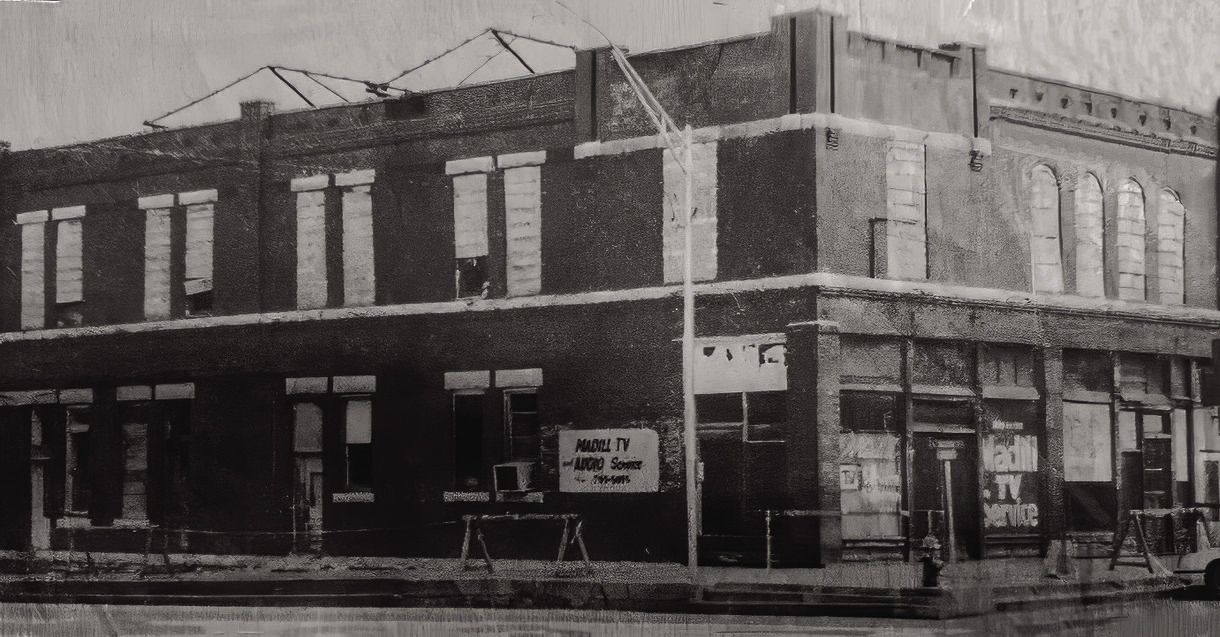
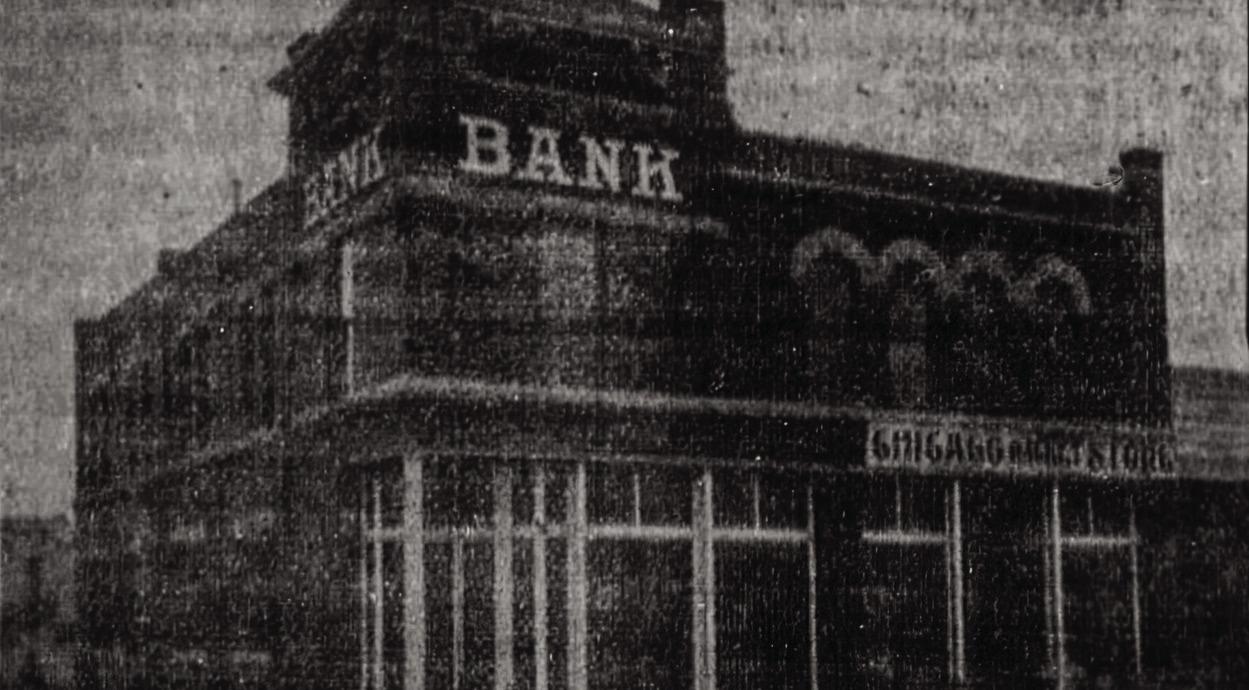
Following his being appointed to the board of the St. Louis-San Francisco (Frisco) Railway in 1901, Lazarus came to the new, growing town of Madill. It was here he saw a need and an opportunity. First, he built a large and well-known building on Market Square. His building was named “The Lazarus Building.” The building was located on the southeast corner of the square on the corner of East Main. The building was fifty-two feet across the front and eighty feet deep, and its two floors covered four-thousand, one hundred sixty square feet.
Upon completion, the building's first occupant was the newly formed Madill National Bank. The bank occupied the building until 1904 when the new bank building was completed on the southwest corner of the square. Various businesses also quickly filled the building, including the Chicago Racket Store, which later became known as the Madill Racket Store, a variety store. Other stores that occupied the Lazarus building were the Jenkins Barber Shop, a tailor shop, a hardware store, a drug store, a shoemaker, and more.
However, the County Curthouse was the most important tenantoftheLazarus Building. Before statehood, the Lazarus Building housed the “Territorial Courthouse” for the Federal Court. Here, the Federal Court conducted hearings and trials for cases and crimes that occurred in Indian Territory. Then, after statehood in 1907, it became the Marshall County Courthouse. From 1907 to 1914, the county leased the building from Lazarus for $100 monthly. County offices occupied the entire second floor, and some small space was on the ground floor. Because the building originally housed a bank, the county could use the old bank vault to store and protect early-day court records. The County leased the building from Lazarus until the new MarshallCountyCourthouse was completed and opened in 1914.
In 1920, Lazarus sold the building to the Masons, and the second-floor space that the County occupied became the Madill Masonic Lodge. The building would later house numerous different local businesses, including Parrish’s, the Madill TV and Audio Store, and more.
In addition to the Lazarus Building, Sam Lazarus either built or bought several homes along Lillie Boulevard and beyond. Lazarus managed these homes as rental properties. Some still stand today, housing families and residents of Madill.
In 1911, Lazarus began plans to build one more important building in Madill. In those early days, fine hotels were in great demand. While the town boasted the Commercial Hotel, the Lewis Hotel, the Central Hotel, the Alamo Hotel, and the Rock Hotel, Lazarus saw the need for a newer and nicer hotel and one close to the Frisco Depot so that travelers wouldn’t have to walk blocks to the Rock Hotel or call for a carriage or cab to get to any one of the other hotelsscatteredaroundtown. So, in 1911, he joined forces with W. W. Carter, who had previously run the Rock Hotel. They planned to build a hotel right next to the Frisco Depot. Lazarus acquired some land next to the railroad property because of his association with the Frisco Railroad as a director. Some may call it “insider trading,” but Lazarus was a shrewd businessmanwhowasalways looking for a way to “one up” his competition.
So, in December 1911, Lazarus began construction on Madill’s newest and finest hotel, the Royal. Lazarus then pre-leased the hotel to Carter to operate it and a restaurant. The hotel construction was completed in April 1912andopenedwithindays. In an article that appeared in the April 5, 1912 edition of the Marshall County News-Democrat, it was reported that “Mr. Carter is a hotel man par excellence and has one of the most complete and up to date small houses in Southern Oklahoma, and we predict that the Royal will be- come one of the most popular places in the country with the traveling public and those who desire splendid service and something good to eat.” The Royal Hotel was a huge success and operated as a popular hotel and restaurant for many years.
In later years, Clint Williams bought the Royal Hotel building, which served as the corporateheadquartersofthe Texoma Peanut Company. Today, Lazarus’s Royal Hotel building still stands. While it is 112 years old, it still looks in good shape, thanks to Clint Williams's efforts. In recent years, it was deeded to the City of Madill, and it awaits restoration. Hopefully, restoration will come soon, and Sam Lazarus’s legacy will live on in Madill for many more years.
Sadly, on March 5, 1920, while on Frisco Railway business in New York City, Samuel Isaac Lazarus suffered a major stroke while attending a luncheon and died. His body was returned to St. Louis for his memorial service, but in an interesting twist, he was transported to Sherman, Texas, for burial. Because of his love of the “cowboy way of life” and his loveofTexas,itwasLazarus’s desire to be buried in Sherman. In honor of Lazarus, the Frisco Railroad prepared a special train and funeral car to transport his remains to Sherman. The route of the processional train was announced, anddatesandtimes were reported in newspapers across Missouri and Texas.
Lazarus’swife,Lily,passed in1932,leavingonlytheirone daughter, Henrietta, as the sole heir to the Lazarus fortune. Lily was buried in the New Mount Sinai Cemetery in St. Louis. Following her mother’s death, Henrietta had Sam Lazarus’s remains disinterred and moved to St. Louis to be buried with his wife, Lily.
But on June 25, 1926, Samual Isaac Lazarus made one last stop in Madill en route to his resting place in Sherman. Sadly, there was no announcement or fanfare in Madill, and his train quietly passed within feet of his Royal Hotel and Lazarus Building, and no one knew. No one knew the man behind the curtain was making one last “curtain call” in Madill. I suppose this is the price of being the man behind the curtain.
I hope this article has pulled back the curtain on Samuel Isaac Lazarus, and he will now be remembered for the small but important role in Madill's growth and life. He was clearly an amazing man, going from a penniless runaway to a multi-millionaire aided by nothing but his smarts and hard work. He rose to fame and fortune, yet he never forgot his roots in poverty. And until his death, he had “a little set-to with the woodpile every morning.” Maybe we need more woodpiles.
The curtain is now open.
Courtesy photo