

This coming Monday, November 11th, is Veteran’s Day, an annual celebration to honor all military veterans who have served in the United States Armed Forces.
Initially called Armistice Day, the holiday was established to commemorate the end of World War I, which concluded on November 11, 1918, at the eleventh hour of the eleventh day of the eleventh month. President Woodrow Wilson proclaimed the first Armistice Day in 1919, honoring those who served in the Great War with a focus on peace.
In 1954, after World War II and the Korean War, Congress changed the name to Veterans Day to recognize all American veterans, both living and deceased, who have served in any branch of the U.S. military. Unlike Memorial Day, which specifically honors those who died in service, VeteransDaycelebrates the dedication and sacrifices of all service members.
Veterans Day is observed with ceremonies, parades, and moments of silence across the country, often including events at Arlington National Cemetery and local veterans’ organizations. It is a day for gratitude and reflection, reminding us of the sacrifices and contributions of those who have served to protect freedom and security.
And, while Memorial Day is expressly set aside to commemorate and remember those who gave the last full measure, and Veteran’s Day is set aside to honor all veterans, both dead and alive, I want to introduce you to the first native-born Marshall County veteran to die in combat.
Before Oklahoma Statehood in 1907, the United States had been involved in ten wars worldwide, starting with the American Revolutionary War. World War I was the first war involving American armed forces after statehood.
WorldWarI,oftenreferred to as “The Great War,” was a global conflict that lasted from 1914 to 1918, involving most of the world’s great powers divided into two main alliances: the Allied Powers and the Central Powers. The war was triggered by the assassination of Archduke Franz Ferdinand of Austria-HungaryonJune28,1914,by a Serbian nationalist. This act set off a chain reaction, drawing in significant powers due to a complex web of alliances and resulting in one of the deadliest conflicts in history.
The Allied Powers primarily included France, the United Kingdom, Russia, and later the United States, Italy, and Japan. The Central Powers included Germany, Austria-Hungary, the Ottoman Empire, and Bulgaria. Each side sought to assert power and influence in Europe and beyond, and longstanding rivalries and nationalist ambitions fueled the conflict.
The war mainly involved trench warfare, a brutal style of fighting that led to a prolonged stalemate, particularly on the Western Front, where soldiers faced appalling conditions, enduring mud, disease, and constant danger. Technological advancements, such as machine guns, tanks, airplanes, and chemical weapons, increased the scale and lethality of warfare, leading to unprecedented casualties. Key battles like the Battle of the Somme, the Battle of Verdun, and the Gallipoli campaign were marked by staggering losses.
TheUnitedStatesentered World War I on April 6, 1917, after President Woodrow Wilson asked Congress to declare war against Germany. Several factors contributed to the U.S. decision to join the Allies, including the interception of the Zimmermann Telegram,inwhichGermany proposed an alliance with Mexico against the U.S. In early 1917, British intelligence intercepted a secret message from Germany to Mexico proposing a military alliance if the U.S. entered the war. Germany promised to support Mexico in reclaiming territories like Texas, New Mexico, and Arizona.
In addition to the Zimmermann Telegram, another factor leading Wilson to request a declaration of war was Germany’s policy of unrestricted submarine warfare led to the sinking of American merchant and passenger ships, including the RMS Lusitania in 1915, which killed 128 Americans.
These provocations, along with economic ties to the Allies and public opinion turning against Germany, led the U.S. to abandon its policy of neutrality and join the war effort.
BecausetheUnitedStates entered World War I, the Selective Service Act of 1917 was passed by Congress. The act authorized the federal government to raise a national army through conscription due to the need for more troops after the U.S. enteredthewarinApril1917. It required all men aged 21 to 30 (later expanded to 18 to 45) to register for military service. Also, the Selective Service System was established to manage the draft, using local draft boards to organize and implement registration and selection. Three draft registrations were conducted in 1917 and 1918, bringing millions of men into service. The draft was crucial in rapidly building theAmericanExpeditionary Forces, which played a significant role in the Allied victory in 1918. The U.S. mobilized millions of troops and resources through the draft, contributing significantly to the Allied victory in 1918.
The World War I draft numbers and quotas for each state and locality were primarily determined based on population data from the 1910 U.S. Census to determine how many men were drafted from each state and county. Here’s how this worked: The Selective Service System used data from the 1910 Census to establish draft quotas for each state, county, and local draft board area. Quotas were designed to ensure that each community contributedaproportionate number of draftees based on population size. However, not everyone counted in the 1910 Census was eligible for the draft (such as women, younger men, older men, and non-citizens), so the raw population figures from the census were adjusted to estimate the eligible male population. Exemptions and deferments for specific jobs, health conditions, and family situations also impacted how quotas were met, but the initial allocation was population-based.
Local draft boards were created in each county across the country, and they were assigned quotas to fill based on the national quotas, which were set to meet military needs. These quotas helped standardize the number of men each area was required to send, while the lottery determined the specific individuals within those areas. The reliance on the 1910 Census helped make the draft system more balanced and ensured that no single area or community bore a disproportionate burden of military service.
Based on the 1910 Census, the number of Marshall County men to be drafted was 72. On May 17, 1917, the Madill Record reported, “Taking the 1910 census as a basis, Marshall County will furnish as her quota to the army to be determined by the selective draft 72 men. With our 23 voting precincts in the county, this number is equal to 3.13 to each voting neighborhood.” This did not mean three men would be drafted from each precinct; that number was just presented for illustration purposes.
Beginning in late May or early June of 1917, the eligible menofMarshallCounty registered for the draft by going to the draft board of Marshall County and filling out a “Registration Card.” Then,onSeptember13,1917, the local board issued a draft notice. The notice directed the men to report to the local board for transportation to themobilizationcampatFort Travis in San Antonio, Texas.
The notice stated, “The following namedmenarehereby ordered to report at the office of this local board for military duty and for transportation to a mobilization camp. The time they must report is 7 A. M. on September 20th, 1917. Fromthehouranddateabove named, the men herein shall be in the Military Service of the United States and subject to military law. Failure or unpunctuality in reporting are serious military offenses. Wilfull failure to report with intention to evade constitutes desertion, which is a capital offense in time of war. The posting of this list in the office of the Local Board constitutes notice to each of the persons named herein that they are ordered to report at the hour, date. and place named and that from that hour they are in the Military Service of the United States. LOCAL BOARD OF MARSHALL COUNTY, J. L. WOODY, Chairman.”
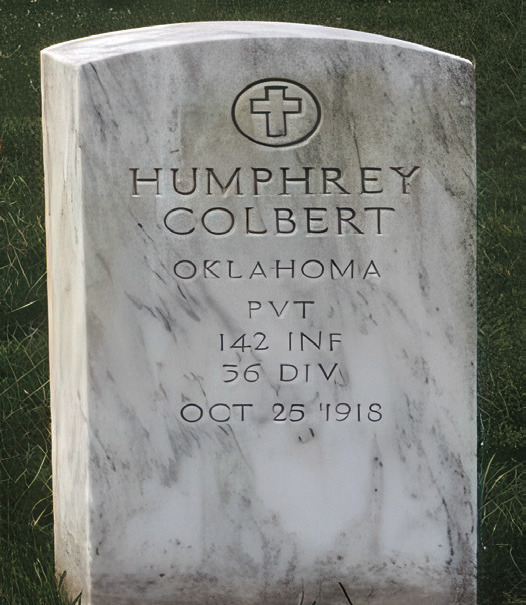
When the list was released, 87menfromMarshall County were drafted instead of the original number of 72. One of the men drafted from Marshall County was 22-year-old Humphrey Colbert, a resident of Kingston.
Humphrey Colbert was born in Woodville, Indian Territory, on September 29, 1895, to Amos Henry Colbert and Icy Hamilton Colbert. Humphrey’sgrandfatherwas Amos Henry Colbert, the son of Chickasaw Judge Abijah Jackson Colbert. Judge Colbert, born in 1813, was a prominent figure in the Chickasaw Nation during the 19th century. He was the son of Levi Itawamba Minco Colbert, a notable Chickasaw leader, and Temusharhoctay Schtimmarshashoctay.
In 1830, during treaty negotiations between the Chickasaw Nation and the United States, Levi Colbert expressed a desire for his younger sons, including Abijah Jackson Colbert, to receive education under the direction of the President of the United States. President Andrew Jackson agreed, and Abijah Jackson Colbert obtained a first-rate education, which led to his service as a judge of the Chickasaw Nation. The Colbert family playedaprominentroleinthe history of the Chickasaw Nation, which continues today with Justice Mark Holmes Colbert in the Chickasaw Supreme Court.
Following the draft, Colbert was transferred to Fort Travis in San Antonio, where he was assigned to Company M, 142nd Infantry, 36th Division of the Texas-Oklahoma National Guards. The division primarily comprised National Guard units from TexasandOklahoma,including Native American soldiers from the Chickasaw and Choctaw Nations.
The36thInfantryDivision was created from National Guard units in July 1917 after the U.S. entered World War I. The 142nd Infantry Regiment, which included Company M, became a significant part of this division, reflecting the contribution of Southwestern soldiers to the war effort. The regiment and the rest of the 36th Division trained at Camp Bowie in Texas before being deployed overseas. While Colbert was in training at Camp Bowie, he married his fiancé, Stella Frances Eldridge, from Tecumseh, Oklahoma.
The 36th Division, including the 142nd Infantry Regiment, was sent to France in 1918.CompanyManditsregiment saw combat primarily during the Meuse-Argonne Offensive, one of the largest American-led offensives of the war. This offensive, launched in September 1918, aimed to cut off German supply lines and was critical in the final push to end the war.
The Meuse-Argonne region is located in northeastern France, with the Meuse River running through it and the Argonne Forest forming a heavily wooded area with challenging terrain. The dense forest, hills, and rough landscape provided natural defensive advantages for the German forces. This engagement involved the U.S. 36th Infantry Division, particularly the 71st Brigade, which included the 141st and 142nd Infantry Regiments.
During the Meuse-Argonne Offensive, the 36th Division fought alongside experienced French forces, taking over positions from the French 4th Army. In intense fighting, including gas attacks and entrenched warfare, the 142nd Infantry Regiment played a crucial role in breaking through Germanlines,contributingto the German forces’ eventual retreat.
The soldiers of Company M, 142nd Infantry, faced arduous conditions and demonstrated remarkable courage, particularly given that many had only received basic training. The bravery and sacrifice of these soldiers contributed to the 36th Division’s legacy and the Allied victory. The unit returned home in 1919, and its members were celebrated for their service. The 36th Division’s actions, especially those of the 142nd Infantry Regiment, remain an essential part of the history of U.S. involvement in World War I.
The 71st Brigade of the 36th Infantry Division, including the 141st and 142nd Infantry Regiments, plus the 132nd Machine Gun Battalion, movedintoanewposition on the night of October 18. This position was in front of a German outpost on the south side of the Aisne River. It was the only German presence on the south side of the river for miles. Two previous French 73rd Infantry Division attempts to seize the position had only minimal success. German observers in the outpost could direct artillery with deadly effect.
The German army had cut down trees to improve their field of fire around the hilltop on the south side of the Aisne, and their position was well-defended. Three bands of barbed wire, each about twenty feet thick, separated them from the Allies. A trench line ran most of the way across the German outpost, located on a U-shaped area marked by a bend in the river. In addition to the trench, there were concrete bunkers with cannons and machine guns. More than thirty machine guns defended the hilltop. Across the river, German artillery could hit any spot for miles around.
By October 22, 1918, the 36th Division had been on the front lines for two weeks, advancing over thirteen miles and suffering more than two thousand casualties. On October 23, 1918, the 71st Brigade received orders to capture the Forêt-Ferme position. As preparations were made, opposing forces were still locked in a standoff along the river. German artillery strikes opposite Forêt-Ferme increased when the Americans replaced the French.Asaresult,American gunners in the 2nd Artillery, using captured German cannons, sent over the gas shells the Germans left behind. Incensed at being given a dose of their own medicine, the Germans lobbed shell after shell of mustard gas on the Americans. The Americans were, by this point, experienced in gas warfare. Clouds of the yellowish gas in open fields could be avoided. The chemical spread after the explosion and penetrated clothes before turning into a gas, which was more dangerous. The Germans sent over so many gas shells that villages near the front were spattered with the orangeyellow chemical.
It was during the night of October 25th that Private Humphrey Colbert was mortally wounded and died. It was never documented how Colbertdied. However,itwas likely either from mustard gas or artillery fire.
The battle raged on for several more days. Colbert’s comrades successfully captured Forêt-Ferme, contributing to the overall objectives of the Meuse-Argonne Offensive, which was a significant part of the final Allied push leading to the Armistice on November 11, 1918.
It was during this battle that the United States armed forcesfirstusedNativeAmerican “code talkers.” The first knownNativeAmericancode talkers were from the Choctaw Nation. A large percentage of Company M, 142nd Infantry, 36th Division, were citizens of the Chickasaw and Choctaw Nations.
The Choctaw code talkers wereusedtotransmittactical messages in their language, which German troops could not understand. Using Choctaw speakers helped improve battlefield communication security and marked the beginning of the U.S. military’s use of Indigenous languages as coded communication. During interrogations of capturing several German soldiers, they were asked if they had anything to say. One spoke up and asked, “What nationality were the telephonemen?” Referencing the Native American code talkers.
The Meuse-Argonne Offensive was part of the final Allied push against the German Army, intended to break through the well-fortified Hindenburg Line and drive German forces out of France. It involved over 1.2 million American soldiers, primarily from the American Expeditionary Forces (AEF), under thecommandofGeneralJohn J. Pershing. The offensive was the most extensive and bloodiest operation for U.S. forces in World War I, with over 26,000 Americans killed and around 95,000 wounded. Despite the heavy losses, the campaign was ultimately successful and contributed significantly to the war's end. Germany surrendered within days of the Allies’ victory in the Meuse-Argonne Offensive. On the eleventh hour of the eleventh day of the eleventh month of 1918, Germany surrendered, and the war was over.
The Treaty of Versailles, signed in 1919, formally ended the conflict, imposing heavy reparations and territorial losses on Germany. The treaty aimed to prevent future disputes but instead fueled resentment and economic hardship in Germany, contributing to the conditions that eventually led to World War II.
Following his death, Colbert was initially buried on the battlefield in the Meuse-Argonne region of France. During World War I, many soldiers were buried on the battlefield. The immense scale of casualties and the practical difficulties of transporting bodies away from the front lines often meant that soldiers were buried close to where they fell. This was particularly common in major battle zones like the Meuse-Argonne region, where continuous fighting made it difficult to retrieve and transport bodies back to the soldiers’ home countries. In such instances, the soldiers were often buried in temporary graves on or near the battlefield. These graves were sometimes marked with wooden crosses or other makeshift markers, and the locations were recorded as best as possible. Other times, due to the high number of casualties and limited time, mass graves were dug to bury soldiers quickly. Mass graves became common in significant battles where there were overwhelming casualties in a short period. In some cases, soldiers who died in or near trenches were buried within the trench systems themselves or in nearby shell craters, as moving them further was often too risky or logistically impossible.
After the war, massive efforts were undertaken to locate, exhume, and identify bodies where possible. Many battlefield graves were moved to formal, permanent cemeteries established by organizations like the Commonwealth WarGravesCommission and the American Battle Monuments Commission. For many soldiers, however, especially those who were never identified or whose remains were lost in the fighting, memorials like the Menin Gate in Belgium and the Thiepval Memorial in France were built to honor the missing.
Shortly after Armistice Day, Colbert’s body was disinterred from his battlefield grave and reinterred in a cemetery in the village of Chuffilly-Roche in the Meuse-Argonne region of Northern France. After a few months, Colbert’s body was moved a second time to the village of Romagnesous- Montfaucon where the Meuse-Argonne American Cemetery was founded. The Meuse-Argonne American Cemetery is the largest U.S. military cemetery in Europe. Covering 130.5 acres, it serves as the final resting place for 14,246 American soldiers who lost their lives during the Meuse-Argonne Offensive. The cemetery features a memorial chapel andmeticulouslymaintained grounds, honoring the sacrifices made during the war.
Then, on June 24, 1921, Humphrey Colbert’s body was disinterred from the AmericancemeteryinFrance and placed on the United States Transport Ship, Wheaton. The ship departed from Antwerp, Belgium, on August 6, 1921, arriving in Hoboken, New Jersey, on August 20, 1921, with the bodies of over 5000 American heroes who died defending this country.
On October 6, 1921, Private Humphrey Colbert was reinterred for the final time with full military honors at Arlington National Cemetery, theUnitedStates’most prominentmilitarycemetery. It is located in Arlington, Virginia, directly across the Potomac River from Washington, D.C. Arlington is the resting place for over 400,000 military veterans, service members, and their familymembers,symbolizing national honor and respect for those who have served the country.
The war’s toll was immense: over 16 million people lost their lives, and millions more were wounded. World War I left deep scars on Europe and the world, ushering in a new era of modern warfare and profoundly impacting social, political, and economic structures globally. The legacy of the war continues to be felt today, as it set the stage for the geopolitical dynamics of the 20th century and beyond.
Marshall County’s son, Humphrey Colbert, was one of nine Marshall County citizens killed in action during World War I, but he was the first native-born Marshall Countian to die in any war involving the United States. Following his death, the American Legion honored Colbert by naming the Kingston Post the Humphrey Colbert Post 89 of the American Legion.
OnVeteran’sDay,Monday the 11th, take a moment to rememberMarshallCounty’s son Humphrey Colbert and his sacrifice for this country and all the other men and women of Marshall County who proudly served the great country.
And always remember that on October 25, 1918, Humphrey Colbert gave his life to defend his beloved country and county, giving the “last full measure of devotion.”
Humphrey Colbert 18951918.