
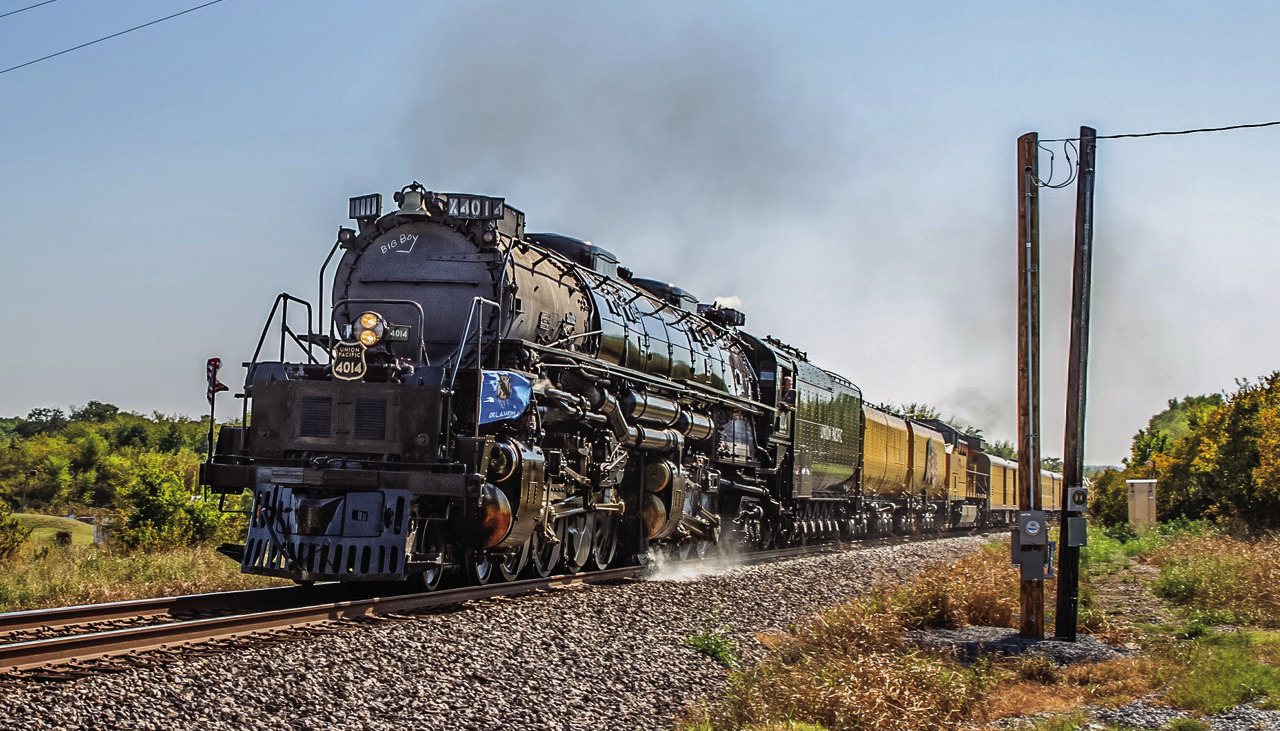
On Sunday, October 13, at about 12:25 in the afternoon, the Union Pacific No. 4014, more affectionately known as the “Big Boy,” rumbled across the Red River bridge south of Colbert, marking its third trip through the great state of Oklahoma. The Big Boy 4014 spenttwodaysinOklahomaas part of its “Big Boy Heartland of America Tour.” The tour made stops in Durant, McAlester, Muskogee and Claremore before crossing the state line at Coffeyville, Kansas.
At the Red River bridge, more than 100 train enthusiasts gathered around the tracks at the north end to greet the behemoth as it made its way to Durant and then to McAlester, where it would stop for the night. The spectacle caused a traffic jam on the US Highway 69 bridge, where traffic stopped as motorists watched the marvel of early 20th-century engineering traverse the old elegant multiarched “through-truss” bridge built by the St. Louis and San Francisco (Frisco) Railroad in 1908. The Big Boy 4014 is the last remaining operational 4000 series, Big Boy locomotive from the heyday of steam engines.
TheBigBoywasdesignedto tackle the rugged terrain and long distances of the Union Pacific rail lines. It represents the pinnacle of steam locomotive development. These enormous steam engines were created to haul heavy freight south of the Wasatch Mountain Range from the Utah-Idaho border to central Utah and beyond, crucial in transporting goods during and after World War II.
The Union Pacific Railroad’s need for a locomotive capable of hauling massive loads over steep grades was the driving force behind the development of the Big Boy. During the late 1930s and early 1940s, the Union Pacific faced significant challenges transporting freight over the Wasatch Range. The grades in this area posed a problem for the smaller locomotives that had been used previously. The existing engines required double-heading (using two locomotives to pull one train) or needed “helper” engines for assistance, both of which were inefficient and costly solutions.
Union Pacific’s management recognized the need for a more powerful locomotive to haul long freight trains over steep grades without assistance. This was especially important given the increasing demand for freight transportation in the United States during the late 1930s. The advent of World War II further intensified this demand, as supplies and military equipment needed to be transported across the country at an accelerated pace.
In response to these challenges, Union Pacific approached the American Locomotive Company (ALCO), one of the largest locomotive manufacturers in the United States, requesting the design of a larger and more powerful locomotive. ALCO had a long history of producing successful steam locomotives and had already built several large engines for the Union Pacific. Working closely with Union Pacific engineers, ALCO set about designing what would become the largest and most powerful steam locomotive ever built: the Big Boy.
The Big Boy's design is a testament to American engineering ingenuity. The locomotive is classified as a 4-8-8-4 articulated type, meaning it has four leading wheels, two sets of eight driving wheels, and four trailing wheels. This design allowed the Big Boy to navigate tight curves on Union Pacific’s mountainous routes, as the front and rear sets of driving wheels were articulated, meaningtheycouldpivot independently of each other.
Weighing approximately 1.2 million pounds (600 tons), the Big Boy was 132 feet long, including the tender (the car that carries coal and water). The locomotive’s massive size and weight required a unique frame to distribute the load evenly across the rails. The driving wheels were 68 inches in diameter, which helped the locomotive generate the necessary traction to pull heavy freight trains up steep grades.
One of the Big Boy's key features was its ability to burn large quantities of coal efficiently. The locomotive was equipped with a high-capacity firebox and a boiler capable of generating 6,290 horsepower. ThisallowedtheBigBoytoproduce enough steam to operate up to 70 miles per hour while hauling loads of up to 4,000 tons.Thelocomotiveswerealso designed to operate in tandem with a water tender, which provided additional water for the boiler on long journeys.
The Big Boy’s massive tender could carry 28 tons of coal and 25,000 gallons of water. This large capacity was necessary for long-distance trips across the western United States, where water and coal refueling stations were often far apart. The tender’s size and capacity were calculated to minimizetheneedforrefueling stops, allowing the locomotive to cover greater distances more efficiently.
The Big Boy locomotives were introduced in 1941, just before the United States entered World War II. The timing of their debut was crucial, as the war effort required an unprecedented amount of freight transportation. The U.S. military needed to move vast quantities of war materials, including tanks, ammunition, food, and medical supplies, from production centers in the Midwest to the West Coast for shipment to the Pacific Theater. The Big Boy locomotives played a pivotal role in meeting this demand by hauling long freight trains over the Union Pacific’s routes, including the rugged terrain of the Wasatch Range.
The locomotives were used extensively during the war years, and their reliability and power made them invaluable assets to the Union Pacific Railroad. The Big Boy’s ability to haul heavy loads at high speeds over long distances without needing multiple engines or helper locomotives made them more efficient than previous steam locomotives. This efficiency was critical duringwartime,astherailroad needed to transport materials quickly and with as few delays as possible.
In addition to transporting military supplies, the Big Boy locomotives hauled general freight, including coal, iron ore, and other raw materials essential to the war effort. The locomotives’ ability to handle these massive loads contributed to the overall success of the Union Pacific in supporting the war effort.
After World War II, the Big Boy locomotives continued to serve the Union Pacific Railroad in freight service. However, the post-war years saw significant changes in the railroad industry,mostnotablythe transition from steam to diesel locomotives. Diesel engines offered several advantages over steam locomotives, including lower operating costs, greater fuel efficiency, and reduced maintenance requirements. As diesel technology improved, railroads across the United States began phasing out steam locomotives in favor of diesel-electric engines.
Despite their impressive power and performance, the Big Boy locomotives were not immune to this trend. By the 1950s, the Union Pacific began replacingitssteamlocomotives with diesel engines, which were more economical to operate and maintain. However, due to their large size and high fuel consumption, the Big Boy locomotives became less practical in the face of advancing diesel technology.
The last of the Big Boy locomotives wasretiredfromactive service in 1959, ending the era of steam on the Union Pacific Railroad. However, their legacy endured, and several locomotives were preserved for future generations. Eight original 25 Big Boy locomotives were saved from the scrapyard, placed in museums, or displayed in various locations acrosstheUnitedStates.These preserved locomotives serve as a testament to the engineering achievements of the early 20th century and as a reminder of the role that steam locomotives played in the development of the American transportation system.
BigBoy4014wascompleted in December 1941 and entered service soon after. After its retirement, Union Pacific donated No. 4014 to the Railway and Locomotive Historical Society, Southern California Chapter, which housed it at the RailGiants Train Museum in Pomona, California. The museum took possession of No. 4014 in 1962 and safeguarded it until it was donated back to Union Pacific in June 2013.
The idea to restore Big Boy 4014 began in the early 2010s, when Union Pacific Railroad, which had a long tradition of preserving its rail history, began considering the possibility of reviving one of its iconic Big Boy locomotives. Union Pacific already had an active steam program, operating two other historic steam locomotives: No. 844, a 4-8-4 Northern type, and No. 3985, a 4-6-6-4 Challenger type. However, restoring a Big Boy was a much moresignificantandambitious undertaking.
Union Pacific chose No. 4014 for restoration primarily due to its relatively good condition compared to the other surviving Big Boy locomotives, its strategic location and the feasibility of moving it to their facility in Cheyenne, Wyoming, for restoration. No. 4014 was in better structural condition than others that had been preserved. Although it had been on display since 1961, it was well-maintained and structurally sound. The locomotive was less exposed to the elements than others, reducing the restoration work needed, especially for critical components like the boiler and running gear.
Although the locomotive had been sitting in the California sun for over 50 years, its less exposure to the elements than other 4000 series locomotives reduced the restoration work needed, especially for critical components like the boiler and running gear. However, it would still require extensive and detailed restoration to be brought back to life.
Union Pacific worked closely with the Railway & Locomotive Historical Society. After negotiations, the museum agreed to transfer ownership of the locomotive back to Union Pacific, making it possible to restore it. Additionally, No. 4014’s location in Southern California made it logistically feasible to move the massive locomotive. The Railiants Museum was situated near existing rail lines, allowing Union Pacific to transport the locomotive from Pomona to Cheyenne, Wyoming, with relative ease, using temporary tracks and diesel assistance. The move was a spectacle, as thousands of rail fans gathered along the route to witness modern diesel engines towing the enormous locomotive across several states.
The restoration of No. 4014 was a massive undertaking that involved thousands of hours of labor and the expertise of numerous engineers and technicians. The locomotive was restored to its original condition, and many of its original parts were repaired or replaced to ensure its safe operation on modern railroads.
Restoring Big Boy 4014 was a monumental challenge, primarily due to the size and complexity of the locomotive. No.4014hadbeenoutofservice for more than half a century, and though it had been relatively well-preserved, there was significant wear and tear on many of its components. Many original parts, such as the boiler, steam pipes, and running gear, had to be thoroughly inspected, repaired, or replaced. The sheer size of the parts required special equipment and facilities that could handle the immense weight and dimensions of the locomotive.
The restoration team also hadtoadaptthenearly80-yearold locomotive to modern rail safety standards and technology. While Big Boy 4014 would retain its original steam power, it needed to meet 21st-century safety requirements to operate on the mainline tracks. This meantmodernizingsomeofthe locomotive’s components, such as installing advanced braking systems and upgrading control mechanisms, to ensure safe and reliable operation.
One of the most significant aspects of the restoration was the boiler, the heart of any steam locomotive. The Big Boy’s massive boiler needed to be thoroughly tested and inspected to ensure it could generate theenormousamountsof steam required to power the locomotive’s 6,290 horsepower engine. This involved hydrostatic testing, where water is pumped into the boiler at high pressure to check for leaks or weaknesses in the metal.
The tender, which carries the locomotive’s coal and water, also needed significant attention. Union Pacific converted Big Boy 4014 from a coal-burning locomotive to a reclaimedoil-burningone.This decision was driven by practical considerations, as sourcing and handling the massive amounts of coal required for such a large engine would be logistically challenging in the modern era. Converting the locomotive to burn reclaimed oil also allowed for more efficient fueling and environmental considerations, as oil burns cleaner than coal.
The restoration of Big Boy 4014 was a painstaking process that required thousands of hours of labor from a team of dedicated engineers, mechanics, and specialists. The project officially began in 2014 when the locomotive arrived at Union Pacific’s Steam Shop in Cheyenne, Wyoming. Over the next five years, the team worked diligently to bring the locomotive back to life, meticulously restoring each component and ensuring it would operate reliably once it returned to service.
The first step in the restoration was to disassemble the locomotive and inspect every part. The team removed the driving wheels, pistons, boiler components, and tender, carefully documenting the condition of each part. This phase involved determining which parts could be repaired and which needed to be replaced. New parts had to be custom fabricated for some components, asreplacementsforsuch a large and old locomotive were no longer available.
The boiler was one of the most critical components of the restoration. After thorough testing and inspection, the team replaced boiler sections that had deteriorated over time. They also cleaned and repaired the boiler’s interior to ensure it could generate the high pressures necessary to power the locomotive. This phase of the project required precision and attention to detail, as any weaknesses in the boiler could pose safety risks when the locomotive returned to service.
As mentioned earlier, Big Boy 4014 was converted from a coal-burning locomotive to an oil-burning one. This involved modifying the firebox and installing new fuel delivery systems to accommodate oil. The decision to convert the locomotive to oil-burning was practical and environmentally beneficial, reducing its carbon footprint.
Once the restoration team had repaired or replaced the necessary components, the locomotive was reassembled. The driving wheels, pistons, boiler, and tender were carefully reinstalled, and the locomotive was tested to ensure everything functioned correctly. This phase also involved conducting a series of test runs to fine-tune the locomotive’s performance and address any issues during testing.
InMay2019,afterfiveyears ofhardwork,BigBoy4014was officially restored and ready to return to the rails. The restored Big Boy 4014 was a central attraction during the 150th anniversary celebration of the Transcontinental Railroad. Its inaugural run from Cheyenne, Wyoming, to Ogden, Utah, retraced part of the railroad's original route. Crowds gathered along the tracks to witness the enormous locomotive in action, and rail enthusiasts worldwide traveled to see the restored Big Boy in person.
Following its inaugural run, Big Boy 4014 embarked on a series of tours across the United States, visiting cities and towns where it had once operated during its heyday. The locomotive’s return to the rails sparked renewed interest in steam-powered trains and provided a unique opportunity for new generations to experience the power and majesty of steam locomotion.
Last week marked the third tour of Oklahoma by Big Boy 4014 since its restoration in 2019. Before last week, Union Pacific Big Boy 4014 traveled through Northeastern Oklahoma in November 2019 as part of the “Great Race Across the Southwest” tour. During the 2019 tour, the Big Boy entered the state from Van Buren, Arkansas, then traveled through Sallisaw, Fort Gibson, Wagoner and Claremore before heading to Coffeyville, Kansas. That tour marked the locomotive’s first visit to the state after its restoration to operational status, and it drew significant attention from rail enthusiasts.
Then, in the summer of 2021, the Big Boy spent two daysinOklahomaaspartofthe “2021BigBoyTour,”withstops in Vinita, Wagoner, Muskogee, McAlester, and Durant before crossing the Red River and heading to Ft. Worth.
I’m proud that my wife, Diane and I could see the Big Boy on all three tours. During the 2019 tour, we visited the train on its leg from Fort Gibson to Wagoner. But in 2021 and again last week, we spent two full days chasing the Big Boy from border to border. Since I was a kid, I have been enamored by steam locomotives, and witnessing the Big Boy up close is a thrill. Hearing the rumble of the boiler, the rhythmic sounds of the enormous pistons that move the coupling rods, and the howl of the steam whistle are all impressive. They are sounds you hear and feel as the Big Boy thunders down the track.
The appearances in 2019, 2021, and last week reflect the ongoing enthusiasm for seeing this historic locomotive in action long after it retired from active service in the 1960s. During its visits in 2021 and this week, tens of thousands of Oklahomans turned out to catch a glimpse of the majestic iron horse. In Muskogee and Claremore, the crowds were so massive that the Big Boy was delayed from departing because the crowds blocked the tracks as people hoped to get an up-close look at the Big Boy.
From the Red River to the Kansas border, thousands more flocked to every rail crossing, bridge or roadside to see the train in motion. In addition, hundreds of cars followed the train up Highway 69 to McAlester and then to Muskogee. At times, the traffic was so bad that the line of cars extended for miles. All because people wanted to witness history.
At each stop, crossing or roadside viewing, we met people from all across Oklahoma andTexas,Arkansas,Missouri and Kansas. Regardless of nationality, race, religion or political preference, we were all brought together for a few minutes for a common cause: to witness the ingenuity and creativity of the men and women who designed and built the marvelous Big Boy 4014.
The words “Big Boy” were famously written in chalk on the first Big Boy No. 4000, by a worker during its construction at the American Locomotive Company (ALCO). The nickname “Big Boy” was given because of the locomotive’s massive size, power, and the challenges involved in its production. A worker on the assembly line wrote “Big Boy” in chalk on the front of the boiler as a tribute to the locomotive’s impressive stature.
The name stuck, and Union Pacific adopted “Big Boy” as the official nickname for the 25 locomotives in the class. The chalk inscription has become an iconic part of the Big Boy's legacy. It remains a lasting symbol of these extraordinary steam engines, highlighting their status as the largest and most powerful steam locomotives ever built.
When the locomotive was restored and returned to operation in 2019, Union Pacific preserved the tradition by keeping the “Big Boy” inscription on the front of the boiler, written in a similar style to the original chalk lettering from its construction in 1941. The crew still writes the name Big Boy in chalk.
This detail honors the locomotive's history and legacy, keeping the story alive for modernaudienceswhovisitthe iconic steam engine during its excursions across the country. Preserving this small but significant piece of its heritage is a meaningful part of celebrating the Big Boy’s role in American railroading history.
The Union Pacific Big Boy has become a symbol of American industrial power and ingenuity. Its sheer size and power have earned it a place in the public’s imagination, and it is often regarded as the ultimate expression of steam locomotive technology. The Big Boy’s legacy extends beyond the rail industry, influencing popular culture, art, and media.
In addition to their historical and cultural significance, the Big Boy locomotives have become a symbol of the golden age of railroading. During the mid-20th century, the American railroad industry was at its peak, with steam locomotives like the Big Boy playing a central role in transporting goods across the country. The BigBoyrepresentsanerawhen steam power was king, and railroads were the lifeblood of the American economy.
The cultural impact of the Big Boy can be seen in the crowds flocking to the nearest crossing, overpass or roadway, hoping to catch a glimpse of No. 4014. I look forward to the next Big Boy tour. When No. 4014 returns to Oklahoma, Diane and I will be out chasing that majestic beast to once again relive the history of the golden age of railroading. I hope you can join us next time. It will be an adventure you will not soon forget.