

John Scott did not come home from the war. His name joined the long roll of young men who traded the red soil of Marshall County for foreign watersandgavebacksomething that could never be repaid. His story, like so many from that greatest of generations, ended in sacri!ce—sudden, stark, and permanent.
But towns do not stop for grief.
When the war ended, and the boys who could return did return, Little City slipped into a di'erent kind of cadence. The banners came down. The uniforms werehungincedarclosets. Therationbookswerenolonger needed. And life—stubborn, ordinary, faithful life—resumed its place at the center of the community.
From 1945 until 1957, Little City settled into the slow, steady rhythm that marks every small American town. Sunday mornings meant pressed shirts and well-worn Bibles. Church suppers !lled fellowship halls with the smell of fried chicken and cobbler. Vacation Bible schools gathered children beneath paper decorations and handlettered signs. Weddings were announced in the local paper. Babies were born. Obituaries were read aloud at kitchen tables. Families moved in, families moved out. Some left in pursuit of opportunity; others returned because home has a gravity all its own.
The Boy Scouts met in borrowed rooms and learned to tie knots that would hold. Sporting events drew crowds who knew every player by name and lineage. Christmas programs were rehearsed on wooden stages, and summer evenings were spent on front porches, where news traveled faster than any printed sheet could carry it. This was life as it had always been done: slow, communal, anchored by routine, stitched together by the simple fact that everyone knew everyone else.
Businesses followed the familiar pattern of small-town commerce. A store would change hands. A café would close and reopen under new management. A service station wouldrisewhereoncetherehad beenpasture.ThePureOilCamp continued its steady hum, providing work and anchoring the local economy. Some ventures #ourished.Othersquietlyfaded. Such is the commerce of small places—rarely dramatic, always personal. A sale was not merely a transaction; it was a story. A closure was not merely a sign in a window; it was a change in the town’s pulse.
Therewerenoheadlinestorival wartimesacri!ce.Noparades. No ceremonies. Just the honest, repetitiveworkofliving:planting gardens, repairing roofs, raising children, balancing ledgers, tending #ocks, burying parents. The years themselves took on a steady shape, and in the steady shape, there was comfort.
Formorethanadecade,Little City became what it had always hopedtobe—notaboomtown, not a battle!eld, but a home. A place de!ned less by crisis than by continuity. The kind of town where the passing of seasons matteredmorethanthepassing of national headlines.
It is easy, looking back, to see those postwar years as quiet. But quiet does not mean insignificant. They were the years that stitched the community together again. The years when laughter returned to schoolyards.When storefront windows were washed clean of dust.When hope felt less fragile. It was the kind of peace that is not declared from a podium; it is simply lived, day after day, until it becomes a habit.
And then—as so often happens in the story of any town— the sky changed.
The same horizon that had watched soldiers depart and return would soon darken in a di'erent way. The slow rhythm of ordinary life would be interrupted not by war overseas, but by violence from above. In 1957, Little City—and the Pure Oil Camp that stood beside it— would face a force no uniform could !ght and no drill could prepare them for. The peace of thepostwaryearswasreal.Itwas earned. It was lived fully. And it was about to be tested.
Bythe!rstweekofApril1957, spring had settled across the Southern Plains and the Deep South with a deceptive gentleness. The war years were a decade behind. The long austerity oftheDepressionhadfadedinto memory. Towns had resumed their rhythms—school bells, oilfield whistles, Sunday sermons, baseball practices, store ledgersbalancedatclosingtime. The land was greening again. Gardens were being turned. Church bulletins carried notices of revivals and youth meetings. It was the sort of season that persuades people that life has steadied itself.
Yet above that familiar landscape, the atmosphere was assembling somethingaltogether di'erent.
At 6:30 a.m. Central Standard Time on Tuesday, April 2, 1957, a low-pressure system was positioned over the Texas and Oklahoma Panhandles. From that center, a warm front arced eastward into northern Louisiana. A cold front trailed south and west along a surface trough stretching across West Texas, east of El Paso, Lubbock, andAmarillo.Onthesurface,the day felt warm—temperatures climbed into the 70s across North Texas—and the dew points rose into the upper 60s and near 70 degrees.The air was moist, heavy, and unstable in a way that seasoned farmers and rancherswouldhaverecognized even without meteorological charts.
But the real machinery lay aloft.
A strong upper-level jet stream cut across the region, providingthekindofwindshear that encourages rotation within thunderstorms.Beneathit,instability built steadily. A capping inversion—a layer of warm air aloft—initiallysuppressedstorm development, allowing convective energy to accumulate ratherthandissipateinscattered showers.Bylateafternoon,lifted indices approached negative seven and a half, signaling the presence of high convective available potential energy. In simpler terms, the atmosphere was primed—fuel gathered, pressurebuilding,thelidholding just long enough to allow the eventualreleasetobeexplosive.
When the cap !nally weakened, storms did not simply form; they erupted.
The outbreak that followed unfolded over four days, from April 2 through April 5. At least seventy-three tornadoes were confirmed across fourteen states. They cut from Texas through Oklahoma, Mississippi, and Tennessee, eastward through Georgia and the Carolinas, and as far north as Illinois and Indiana, reaching into Virginia. Twenty-one people would die. Three hundred forty-one would be injured. Property losses were calculated at $10,062,000 in 1957 dollars ($150,500,000 today)—a !gure that, when translated into lived experience, meant collapsed homes, scattered belongings, torn-downstorefronts,livestock killed, rail cars overturned, and entire neighborhoods rendered unrecognizable.
The state-by-state toll told its own story of the outbreak’s breadth. In 1957 dollars, Arkansas reported $28,000 in losses. Georgia, where two people died and eight were injured, recorded $855,030 in damage. Illinois sustained $500,000; Indiana, $60,250. Kentucky’s damage went unquantified, though impacts were recorded. Louisianareported$250inlosses from confirmed tornadoes. Mississippi endured one death and eighty-three injuries, with $525,000 in damage. Missouri listed $5,000. North Carolina reported $300,000 in losses and oneinjury.Oklahomasu'eredsix fatalitiesand!fteeninjuries,with $3,753,000 in damage—one of the highest monetary impacts in the outbreak. South Carolina recorded $277,500. Tennessee reported eleven injuries and $275,000 in losses. Texas bore the heaviest human toll: twelve deaths and 213 injuries, with $3,458,000 in property damage. Virginiarecorded$25,000.Taken together, these !gures reveal an outbreak that did not con!ne itself to a single dramatic strike but stitched together a swath of destruction across a vast geography.
The most visible chapter of that swath unfolded in Dallas.
In the early afternoon of April 2, tornadoes had already touched down north of the Dallas– FortWorthMetroplex.Butat approximately 4:15 to 4:30 p.m., a tornado formed in southern Dallas County, near what would later be known as Redbird Airport, south of modern-day Interstate 20.Itbegananorthward journey that would last roughly forty-!ve minutes and span approximately seventeen miles.
At first, the tornado was barely visible—only a debris cloud at the base of a thin funnel hintedatitspresence.Within thirteen minutes, the funnel became clearlyde!ned,extending downwardinunmistakablecontact with the ground. It moved deliberately, almost methodically, through Oak Cli', Kessler Park, and West Dallas, passing just two and a half miles west of downtown. It then continued toward Love Field, !nally lifting north of Bachman Lake shortly after 5:00 p.m.
As it approached the Trinity River area, the tornado reached its peak intensity. Between Singleton Boulevard and Riverside Drive, homes were swept from their foundations, and railroad cars were overturned. While such destruction might suggest F4 intensity by later standards, structural surveys found that many of the destroyed homes werepoorlyconstructed,lacked adequate wall studding, and were set on piers spaced eight totwelvefeetapart.Photogrammetric analysis of the !lm footage later estimated peak winds near 175 miles per hour in the most severely damaged area, consistent with a high-end F3 rating. After crossing the river, the tornado weakened, entered the rope stage, and dissipated north of Bachman Lake.
The human toll in Dallas was stark: ten dead, including three childrenfromasinglefamily,and at least two hundred injured— some sources place the number closerto216.Approximately131 to 154 homes were completely destroyed. One hundred eleven were severely damaged. Two hundred eighty-seven su'ered lesser damage. Nearly six hundred structures—often cited as 574—were a'ected overall, including betweennineandtwenty eight apartment buildings thatwerecompletelydestroyed. More than !ve hundred homes were damaged. Businesses and schools were struck. Parkland Memorial Hospital and Dallas LoveFieldwerenarrowlyspared.
Yet the Dallas tornado became historically significant not simply because of what it destroyed, but because of how it was seen.
The rainfall that had preceded the tornado had largely moved on. The air was washed clean. The funnel was not heavily obscured by precipitation. The sky, though overcast and threatening, did not hide the storm behind low clouds. The tornadomovedatroughlythirty miles per hour—slow enough to be tracked visually. It struck in the late afternoon, near the end of the workday, when thousands were outdoors or near windows. It passed just west of downtown Dallas, in clear view of o$ce workers, factory hands, andresidents.Televisionstations had time to position cameras on rooftops. Ordinary citizens reached for still cameras and 16-millimeter !lm.
Approximately125observers documentedthetornado.Some 2,000feetofhigh-quality16-millimeter film were produced. Thousandsofphotographswere taken.Theresultingfootagewas so clear that, even decades later, it would be regarded as remarkably sharp for the technology of the 1950s. For the !rst time in recorded history, a major tornado was not merely surveyed afterthefact—itwascapturedin motion, frame by frame.
This documentation transformed theeventfromatragedy alone into a scienti!c turning point. Researchers analyzed debris motion and estimated wind speeds with unprecedented precision. A forecaster from the Severe Weather Forecast Unit in Kansas City noted that longheld theories were challenged by the Dallas observations. One theory held that all air and debris #owed inward toward the funnel and then upward. Yet in Dallas, debris and even people were lifted along the outer edges of the circulation. Anotherobservationconcerned morphology: tornadoes often beganaswide,stubbyfunnels;as theystretchedthinnerandtaller, they were frequently nearing dissipation—though another funnel could form nearby. The Dallastornado,ine'ect,became a natural laboratory. The studies that followed, along with structural surveys from this and later events such as the Fargo tornado of 1957, contributed to research that would eventually inform the development of the Fujita-Pearson scale in 1971.
But even as Dallas was being !lmed and analyzed, the outbreak’s violence was unfolding elsewhere.
In southern Oklahoma on April 2, two F4 tornadoes struck, killing !ve people. Three additional F2 tornadoes that same day killed two in Texas and one moreinOklahoma.OnApril4,an F3tornadostruckruralMississippi, killinganotherperson.Severe thunderstorm winds reached eighty-three knots—ninetysix miles per hour—in Toledo, Ohio, on April 5. In Oklahoma’s KiowaandLatimerCounties,hail measuringtwoandahalfinches in diameter fell from the sky. Possible tornadoes, though not o$cially con!rmed, destroyed a home in the Woodlawn community near Sherman, Texas; struck Ballard County, Kentucky, unroo!ng homes and destroying a drive-in theater; hit near Tansill in Pope County, Illinois; and brie#y touched down near WestlakeandTallulah,Louisiana.
This was not a singular catastrophe but a sequence—a fourday siege in which the atmosphere repeatedly reorganized itself into rotating violence. State lines o'ered no protection. Urban density provided no immunity. Rural isolation guaranteed no safety. The same system that produced a widely photographed F3 in Dallas also generated deadly tornadoes in small towns and open countryside, where cameras were fewer and documentation scarcer.
The outbreak underscored a paradox of the era. By 1957, meteorology was advancing. Severeweatherforecastingunits were studying patterns with increasing sophistication. The Dallas tornado would become a landmarkinscienti!canalysis,its !lmfootageanddebrispatterns helping re!ne the understanding of tornadic winds. And yet, for many communities across Texas and Oklahoma, the practical defenses remained limited. There were no mobile Doppler radars. No instantaneous masswarning systems. No stormchasing #eets feeding real-time data. Tornado sirens were not yet ubiquitous. Warnings, when issued,traveledimperfectly—by radio, by telephone, by neighborly urgency.
The outbreak of April 2–5, 1957, thus occupies a unique place in history. It marked one of the !rst major quantitative successes intornadoresearch,while simultaneouslyremindingcommunities that knowledge alone did not neutralize the storm. Twenty-one people were dead. Three hundred forty-one were injured. More than ten million dollars in property damage lay scattered from Texas to Virginia.
Spring had begun gently. It endedthatweekwithsplintered lumber and broken lives.
And beyond the metropolitan lens of Dallas—beyond the cameras and the scienti!c papers—smaller towns stood under the same sky, watching the same towering clouds, and discovering that the distance between routine and ruin could be measured not in miles, but in minutes.
The outbreak that had swept from Texas to Virginia between April 2 and April 5, 1957, had alreadybeenshownonweather maps. It had already given Dallas a tornado so visible that men with cameras captured it frame by frame. It had already entered the language of science and storm analysis. But east of Madill, near the re!nery camps at Little City and Pure, none of that mattered.
There were no film crews waiting on First Street.
There were no researchers measuring debris patterns.
There were houses. There were supper tables. There were children home from school and mencomingo'shift.Therewere boilershummingandpipesticking in the evening air.
And then there was the roar. The Madill Record of April 4, 1957 did not cloak the event in poeticlanguage.Itstatedplainly what residents already knew in their bones, and what Little City learned !rst by sound, not by sight: “The terrible quick destructive powerofatornadowasinfull evidence at Pure Camp Tuesday night after a twister had swept through the community.”
Terrible. Quick. Destructive. The order of those words tells yousomething.Itwasnotmerely violent;itwassudden,anditwas intimate, and it came down into a place where people lived.
The tornado struck !rst in Warren Camp. Moving from southeast to northwest, “the funnel passed through the east side of the Warren re!nery, tearing upbuildingsandtowersand destroying one home.”It did not merely bruise the plant; it tore into its working skeleton. Buildings andtowerswere“tornup.”A home was destroyed.When one approached the hill at Little City afterward, the Record reported that“steam could be seen rising from the Warren re!nery and crackingtowerswerenoticeably bent and fallen.” The re!nery’s damage was believed to be extensive, but details could not be learned“uptonoonWednesday.” A Madill Record reporter and photographer“werenotallowed to go to the plant to obtain information Wednesdaymorning.” The reason itself was part of the dangerthathungoverthecamp longafterthefunnelhadpassed: it was reported that“all persons were being kept out as a safety precaution because of leaking gas at the plant.” Company officials from Tulsa were there on Wednesday to evaluate the damage.
A smokestack from one of Warren’s boilers—a thing of weight and purpose, designed to stand—was “deposited in the front yard of Mr. and Mrs. J. T. Bailey in Pure Camp.” Several boilers, cooling towers, and other structures“in the plant are reportedlydestroyed.”Yet,asthe papernoted,“noonewasinjured at the plant.”
The tornado’s next act was not industrial. It was residential. Itcamefromsteelandtowerand boiler into the fragile world of porches, kitchens, bedrooms, children’s rooms, and family photographs.
After leaving the refinery, “the tornado swept down Pure Camp’s First street, leaving in its wake almost total destruction on both sides of the street.”The words“almost total destruction” were not dramatic #ourish; they were the paper’s attempt to be accurate without becoming sensational. The west side of First Street was nearly obliterated: “along the west side of the street all but two houses were demolished—and the two remaining houses were so badly damaged they will probably have to be rebuilt.” On the east side, the front edge of the storm’s violence was brutal and clean in its erasure: “the !rst three houses on the east side of thestreetweredemolished,leaving only the foundations.”Roofs wereblowno'twomorehouses. Other houses on that side of the street “were damaged but not completely destroyed,” though the phrase “not completely destroyed” must have meant little to anyone standing in a room with no roof, staring at a house opened to the sky.
It was, as the paper later summed in a separate description, “disastrous,” because on Pure Camp’s First Street, 12 homes were demolished and roofs from three houses were destroyed.” Only two houses on the street “escaped the ravages ofthestorm,”andeventheywere damaged by #ying debris.
ThePureOilCompanyo$ces were“completely wrecked,”and “only the steel framework of the building remained after the storm passed.” The earlier descriptionwasevenmorevivid, like an x-ray of a stripped body: “Pure Oil Co. office building, which was steel with sheet iron, was stripped, leaving only the steel framework.” It is hard to overstate what it means for sheet iron to become airborne. It becomes a blade. It becomes shrapnel.Itbecomessomething that can pierce trees, poles, and #esh. The winds were so strong that a single sheet of notebook paperwasembedded,longways, into the trunk of a tree in the camp.
Across the road, the camp’s water tower was destroyed, and so was the pumphouse.The community’spracticallifelines— water, power, sanitation—were severedinminutes.Theareawas without electricity until “about 11 p.m. Tuesday night,” when “CREcrews”gotthejuicebackon at Little City, the Pure pipeline, andthecamp.Telephoneservice to the Cumberland area was restored “aboutnoonWednesday.”
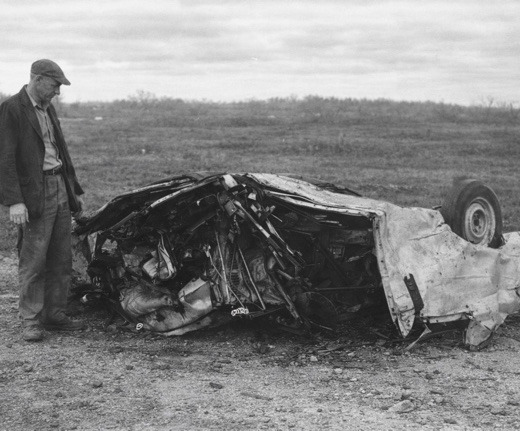
The storm’s violence did not end at structures. It seized what it could pick up, and it #ung it where it pleased. The paper recorded one of those details that lodges in the mind because it is so precise and so impossible to dismiss:“the storm picked up cars and in two cases deposited themseveralhundredyardsfrom where they were parked.” Yet it also noted the strange, almost mocking selectivity tornadoes sometimes display:“however, in some cases the cars were left intact whileagaragearoundthem hadbeencompletelydestroyed.” In other words, a building could be shredded while a vehicle inside survived.Aroofcouldvanish while a chair stayed in place. A town could be rearranged like a child’s toys—random, violent, and !nal.
Bits of wood and sheet iron were “strewn over a three-mile area.” Trees, utility poles, fence posts—all were “ready targets” assheetironfromthePureo$ce building and the Warren re!nery was hurled by the twister. The paper added that swollen streams and over#owing farm tanks were “mute evidence of the heavy rains and hail that had fallen in the area before and after the twister struck.” In at least two cases, water was running“over both the dam and spillwayoffarmtanks,”androads were #ooded in scattered spots by the heavy rains. The tornado did not arrive alone; it was part of a larger storm that soaked the land, raised the creeks, and left the roads slick and dark with runo' even as families tried to !nd their way to shelter.
Then the paper turned to what every reader needed to know !rst: the human cost.
“Death and destruction dipped down from the skies at Pure Camp, nine miles east of Madill, Tuesday evening when a tornado swept through a residential street killing two persons and injuring six others.” The twister“hit the camp about 5:35 p.m.”The dead were named without adornment, because names carry their own gravity: MRS. W. O. SIMPSON. MRS. C. L. WERT. Mrs. Simpson, the paper reported, “wasfoundinthewreckage of her home but was dead on arrival at the hospital.” Mrs. Wert’s death came with a cruel twistofironythattheRecorddid not ignore: she was killed“when the twister picked up the car in which she was riding with her husband.”And—ironically—“Mr. and Mrs. Wert’s home on Third street in the camp had little damage.” It was not the home that took her life. It was the attempt to !ee.
The paper’s reconstruction of their last moments is as heartbreakingasitisplain:“They had evidently gotten into their car to go to the storm cellar or to drive away from the storm. In theexcitementtheyturnedonto First street instead of Second and were caught in the middle of the funnel.”The Wert car was “picked up by the swirling wind and carried almost a mile before it was dropped.” Mrs. Wert’s body was found “on a hillside between the access road to the camp and Highway 193.” Mr. Wert was found “pinned [to a] tree in a 'eld nearby.” Both had been thrown clear of the car. The largest portion of the Wert car was found“on the north side of Highway 199,”while the front wheels of the car were on the south side of the highway. The car’s engine “had still not been located Wednesday morning.” The storm did not merely wreck the vehicle; it disassembled it andscattereditlikepartsthrown from a giant’s hand.
The injured were named too, and the names made the tragedy local and immediate: Charley Wert, J. B. Williams, Joe Bolin, and three Simpson children— Phyllis Rae, Bill David, and nine-month-old Mary Beth. Hospital o#cials at Memorial Hospital in Ardmore reported late Wednesday evening that Mary Beth Simpson was still in “critical” condition from injuries received Tuesday evening in the Pure Camp tornado. The condition of Bill David Simpson was listed as “good,” and Phyllis Simpson was in “fair” condition. Charlie Wert and J. B. Williams were listed in “fair” condition.
Alloftheinjuredwererushed to the Madill Hospital for emergency treatment. The oldest Simpsongirlsu$ered“adeepcut onherheadandpossiblebroken shoulder,”andherbrother’sright leg was broken. The Simpson baby was treated for a cut on her right cheek, which required severalstitches,anditwasfeared she was su$ering internal injuries. Phyllis and the baby were taken to an Ardmore hospital afteremergencytreatment,and the Simpson boy was moved to Ardmore on Wednesday morning. Mr.Wert received injuries to hisleftarmandshoulderandwas also moved to Ardmore; the paper noted that the exact extent of his injuries was reported better onWednesdayafternoon.Mr. Williams had “a deep laceration on his left side which required a number of stitches and bruises and abrasions about the head.” The paper’s sentence fell like a hammer:“All'vesu$eredsevere bruises and abrasions and were su$ering from shock.”The Bolin lad’sinjurieswerelessserious;he su$eredasprainedshoulderand bruisesandabrasions,butX-rays revealed no broken bones, and he was dismissed after emergency treatment.
The bodies of Mrs. Wert and Mrs. Simpson were being held at Watts Funeral Home early Wednesday pending funeral arrangements. Mr. Simpson was in Ardmore with his children. Mr. Wert was still hospitalized there. The paper did not need to write the rest. Every reader could supply it: the silence of a homewhereavoiceshouldhave been, the rough work of telling children what cannot be untold.
Asthecampreeled,theemergency responseunfoldedalmost as quickly as the destruction.
Ambulances, 're trucks, and wreckers from Madill were dispatched to the scene “as soon as word was received here.” At 'rst, it was thought that several people had been trapped in the wreckage, but by 6:30, all persons had been accounted for. The area was without electricity until late that night. Telephone servicewasout.Andthere'nery damageraisedafurtherfearthat madethenightevenmoretense: an explosion.
Residents of Pure and Warren camps were evacuated from their homesTuesday night “because of the danger of an explosion from leaking gas at the damaged re'nery.”National Guard troops were on hand Tuesday night and Wednesday “to guard against pilferage and looting.” The Madill National Guard unit—Service Battery, 171stBattalion—wascalledinto action. The paper emphasized the speed:“Within an hour after the news of the storm was received here,guardsmenwereon dutyinthestrickenarea.”Guards were posted, and the section was evacuated due to the risk of 're from gas leaking from thedamagedWarrenPetroleum plant. Portable kitchens were set up on the road approaching the storm area “to provide hot co$ee for the dazed residents of the camp.” When electric power was restored to the Pure Pipeline camp—which the paper notes was not damaged by the storm—the kitchens were moved to a warehouse there. Guardsmen remained on duty overnighttopreventlootingand werestillbeingusedWednesday tokeepsightseersoutandguard property. Lt. Dale Waymire, commander of the battery, was in charge.
Even amid the wreckage, people’s accounts of survival carried that raw, disbelieving tonethatfollowsanyclosebrush with death. Most of the camp’s residents were able to reach storm cellars or other protective cover as the storm approached. Mr.andMrs.C.E.Thomas,whose home was leveled, got into Thomas’s company car and outran the tornado; their family car was wrecked by the storm. Mr. and Mrs. E. H. Roberson sought cover under a bed at their home during the height of the storm. Mr. Roberson said he saw the roof of their house blow away, and at one time saw the bed’s mattress raise up and fall back down on the bed again. Automobiles were tossed “like toy cars.”One auto belonging to the Robersons was carried several hundred yards and came to rest in a 'eld, completely wrecked. Another car, belonging to Mr. and Mrs. P. J. Hooker, came to rest in a draw several hundred yards from their driveway.
In the midst of descriptions of death and structural ruin, the newspaper also recorded the kinds of details that make a tornado story feel not like an abstract calamity but like a lived moment—odd,sharp,unforgettable. One of those details was so strange it could only be true: “Dog Flying Through Window First Warning of Tornado for Jim Cline.” Jim Cline, who lived at Pure Camp, said a bird dog belongingtoClydeNewmanwas blown through the window of his home. “At 'rst I thought the roar of the tornado was a truck passing,” Cline said, “but when the dog came sailing through the window I knew a tornado was hitting.” After the dog was thrown through the window, Clineletitoutthefrontdoor.Bob Bourne found the dog wandering around the wreckage after the storm. Bourne said the dog had'rstcometothestormcellar where he and his wife were, but had wanted out. After the dog was turned loose, it was apparently thrown through the window by the force of the twister. The dog wandered around for several minutes after the storm subsided before Bourne found it and took it to Mrs. Newman.
It is a small thing, that dog— yet it shows the storm’s sheer force in a way even a list of destroyed homes cannot. A tornado is strong enough to unroof a house; it is also strong enough to turn a living animal into a projectile. That is the kind of fact that stays with people for decades.
Back in Madill, the storm arrived 'rst as sound. The Record captured it with a headline that reads like a warning itself: “Wailing Sirens Grim Signal as Tornado Strikes.”“Wailing sirens brought the 'rst realization of disastertomanyMadillresidents Tuesday afternoon,” the paper wrote. “The eerie sound, as one ambulance after another went through the town, was the 'rst warning that many persons had ofthePureCamptornado.”Many Madill residents were in storm cellars at the time, and almost all who weren’t were keeping a watchful eye on the clouds.“The word of the tornado at Pure fell on Madill’s collective ears with almost unbelievable force.”
And there was a reason for that force, a reason the word struck like a blow: less than six years earlier, the same word had gone out over the town. On May 9, 1951, a destructive tornado hit the Pure Pipeline camp about a mile west of Pure Camp. Fortunately, the paper reminded its readers that there had been no loss of life and no seriousinjuriesatthattime.Most of the residents of the wrecked homes were inside their houses then and“miraculously escaped seriousinjury.”The1957tornado did not grant the same mercy.
The tragedy became immediate for local students the next morning. Another headline told the story from the schoolhouse door: “Storm A$ects Teachers and Students Here.” The bus that served the camp arrived in Madill carrying only thirteen students instead of the usual 'fty. Youngsters listenedanxiouslytoparentsand adults discussing the tragedy Tuesday night, hoping none of their friends’ names would be included in the growing list of injured. Most of the students who weren’t in school remained at home—if their homes were still standing—to help clean up debris, and, the paper noted, also because the area had been alerted for severe weather until 11 a.m. Wednesday, so anxious parents could know where their children were every minute. Three students were injured seriouslyenoughtorequirehospitalization, althoughone—Joe Bolin—was able to be released following treatment. The other two students, Phyllis and Bill Simpson, both still hospitalized, “will always bear mental scars from the storm as they remember their mother, whose life was lost in the tornado.” The local schools were also without two teachers, Mrs. Elmer Bolin and Mrs. John Harper, who lived at the camp but were not injured. Mrs. Bolin’s son was injured, though not critically; the family’s home was demolished, and all personal possessions were lost. The paper described the children’s reaction with plain compassion: the youngsters were “hit hard as they gathered in tight little groups to discuss what they’d heard and try to understand why such a thing should happen to their friends.”
The Record also carried a sectionof“StormSidelights,”and those sidelights matter because they show how the tornado outbreak was not a single local event but a rolling corridor of fear stretching from Dallas to Durant to Madill. Mrs. Roberta Carterarrivedatthehomeofher parents, south of Madill, about 1 a.m. Wednesday morning. Reports she received by radio in Fort Worth Tuesday night were greatly exaggerated, she said, and since she could not get a telephone call through to her parents,sheimmediatelystarted out to come and see for herself. The J. B. McGills and C. H. Barber families had anxious hours after hearing of the tornado in Dallas; Mr. and Mrs. Bob Barber lived near one of the storm areas there,andMrs.Barberworkedin a telephone exchange on Harry Hines Boulevard. They got a call through Wednesday morning and found their relatives were notdirectlyinthepathandwere unhurt. The Lowell Gaylor, Jr. familylivedonlyahalfblockfrom one of the heavily damaged areas in Dallas, but were safe. Mrs. ZelinaWhiting, Mrs. Zula Morris, and Mrs. J. P. York spent Tuesday in Dallas and were on their way out of the city when they heard radio reports of the tornado cutting a path of destruction throughtheoppositesideofDallas; they reached Madill around 1:30 a.m. and knew nothing of the Pure Camp tornado until they drove into town and saw activity at the National Guard armory and the Madill Hospital. RandolBullardgotacallthrough to his brother, Boyce, in Dallas on Wednesday morning; the storm missed his home by four blocks, but his reports of the havoc in the densely populated center were terrifying. Mr. and Mrs. Charles L. Turley spent the afternoon on Tuesday running from tornadoes. They had been toDallasonbusiness,andshortly after leaving the city, they heard radio reports of twisters hitting there.Continuingtowardhome, they passed through Melissa shortly after a tornado struck, and Mrs. Turley said highway patroltrooperswereclearingthe road as they passed through. At Denison, they found a tornado hadpassedovertheirdaughter’s home, Mrs. Noel Jennings. Driving on into Durant, they found tornadoes had destroyed the sales barn, drive-in theater, and other buildings on Ninth Street. Mr. and Mrs. Turley did not learn of the tornado at Pure Camp until about 9 p.m. Ross Earl Jackson called his parents, the Travis Jacksons, on Wednesday, almost beside himself with worry because he had received reports that both Madill and Ardmore had been wiped out by a tornado.
All of that—Dallas, Melissa, Denison, Durant, Madill, Pure— was part of the same four-day siege. It was not merely a storm over one town; it was a storm season concentrated into a handful of hours.
And then, after the 'rst raw day,thestoryshiftedintoitsnext chapter: the work that begins when the wind stops.
The April 11, 1957, edition of the Madill Record carried the headline “Pure Moves Fast to Aid Employees Stricken by Tornado LastTuesday,”andthetone turned from shock to response, from debris to decisions. The paper reported that the Pure Oil Companymovedquicklytogive every assistance to employees after the destructive tornado killed two persons, injured six, andleft'fteenfamilieshomeless at their lease east of Madill. Of'cialsfromTulsawerethereearly Wednesday—only hours after thestormstruck—“withtheaim ofgivingassistanceandcomfort to those stricken.” Financial aid “amounting to thousands of dollars” was being given by the company “on the basis of need with‘nostringsattached’tohelp rehabilitate the stricken families.” Approximately half of the familiesa$ectedhadinadequate or no insurance coverage. No estimateofdamagetocompany and private property had been arrived at by Monday; company crewssurveyedlaterintheweek, and the damage was being estimated in the Tulsa o#ce.
Then came a fact that carried weight because it was 'nal: the fifteen homes either demolished or so badly damaged as to be unrepairable would not be rebuilt. Contracting crews began repairs on the remaining houses late in the storm week. Some required new roofs and extensive repairs; others had only minor damage.There were thirty-one houses left standing in the camp, six of them vacant whenthestormstruck.Thecamp was evacuated immediately after the storm until utilities and sanitation facilities could be restored. Most families whose homeswerenotdestroyedwere able to move back home by the weekend. The area was kept closed to sightseers as cleanup progressed. Furniture, clothing, and personal belongings of all kinds had been scattered over a widearea,andresidentscombed the debris in an e$ort to locate cherished items.
The community response 'lled in the spaces where insurance and construction crews could not. Madill residents “o p e n e dt h e i rh o m e sa n dh e a r t s,” and most victims were housed temporarily with friends or relatives. Most who had lost their belongings were settling into furnished apartments in Madill byearlythatweek.Churchesand other organizations gathered gifts of clothing, cash, and other o$erings to provide temporary help.Drycleaningplantsandthe MadillLaundryannouncedthey wouldgivefreeservicetorestore what clothing was saved, and they pushed back other work to give water-soaked clothing priority over everything else.
Those are not small details. That is how small towns survive catastrophe: not by grand speeches, but by spare bedrooms, borrowed coats, hot co$ee, a laundry line, a church committee quietly 'lling boxes, aneighborwhosays,“Comestay with us,” and means it.
Andso,theoutbreakthathistory might remember through Dallas'lmfootageandscienti'c analysiscamehometoLittleCity and Pure in the language that matters most—names, streets, wounds, and the smell of wet lumber. It came as “wailing sirens,” as ambulances rolling through Madill, as an emptied schoolbus,astwowomendead, as a baby nine months old in “critical”condition, as a car lifted and scattered across Highway 199 until even its engine could not be found by the next morning. It came as a steel o#ce building stripped to frame, as a water tower and pumphouse destroyed, as “bits of wood and sheet iron” strewn across three miles, as clothing hanging from trees“asifithadbeenhungthere after being washed.”It came as a dogblownthroughawindow— the 'rst warning Jim Cline had that the roar outside was not a truck passing.
For more than a decade after the war, Little City’s story had been continuity—the steady, faithful rhythm of a town that wanted nothing more than to be left alone to live its life. The Pure Oil Camp had hummed. The churches had gathered.The seasonshadturned.Andthen,in early April 1957, the sky reached down and took that rhythm in its hands.
It did not take it slowly. It took it with terrible, quick, destructive power.
Anditleftbehindatownthat, likesomanytownsbeforeit,had tolearntheoldestlessonallover again: that the hardest work begins after the storm, when you step out, count the living, name the dead, and try to build a life again on ground that no longer looks like home.
When the last ambulance light faded down the highway and the last siren’s echo 'nally died in the trees, the work that remained was not dramatic work. It was heavy work—quiet, sore-backed work done with borrowed hammers and tired hands. It was the kind of work thatdoesn’tmakeheadlinesbut keepsatownfromcomingapart.
In the days after April 2, Pure Camp tried to do what small communities always do after calamity: account for everyone, tend the injured, bury the dead, andthenbegintheslowprocess of making the broken livable again.The Madill Record caught thatshift—howthestoryturned from shock to response—when it reported that“Madill residents opened their homes and hearts to the storm victims,” and that churches and organizations gathered clothing, cash, and o$erings for families who had been thrown suddenly into need. The ordinary institutions of ordinary life—laundries, dry cleaners, kitchen tables, spare bedrooms—became the sca$olding of recovery. Watersoaked clothing was carried in by the armful and pushed to the frontoftheline.Familiescombed the debris for photographs and keepsakes, for anything that could be rescued from the three-mile scatter of sheet iron and splintered boards.
And yet a tornado does not merelydestroywoodandwire.It rearranges what people believe is permanent.
Before that evening, the camp had been a kind of promise— steadywork,asteadyhum, a place where a family could count on the paycheck and plan the next season’s needs. After that evening, even the things rebuilt could not restore what was lost: the sense of safety, the sense of continuity, the sense that tomorrow would look roughly like today. The steel framework of the o#ce building standing naked in the open air, the water tower fallen, the foundations left bare on First Street—those were not only wreckage. They were symbols, andsymbolshavelongshadows.
What happened at 5:35 p.m. didnotendwhenthewindlifted. It lingered. It settled into memory. It crept into the way people watched the sky in spring. It lived in the way schoolchildren whispered in“tight little groups,” trying to understand why it had happenedtotheirfriends.Itlived in the way the town heard sirens afterward—with a di$erent ear.
Some storms pass through and leave scars. Others pass through and change the direction of a place.
PureCamprebuiltwhatcould be rebuilt. Repairs were made. Familiesmovedbackwherethey could.Othersfoundapartments in Madill. The company moved quickly to aid its people, and“no strings attached” help arrived when it was needed most. But the tornado had done something deeper than damage. It had cracked the assumption that the camp’s world would always be there in the same shape. It had proven, in one violent hour, that even the most familiar patterns—work, home, routine—could be stripped to framework.
Little City, too, felt the shift. Not just in the loss of two lives, not just in the injuries and the rubble, but in the subtle change that followed—like a seam in a garment that has been torn and stitched back together: functional, yes, but never quite the same. A town can survive catastrophe and still be altered by it. It can keep breathing and still know, deep down, that somethingessentialhasmoved.
Part V began with a folded !ag, the emblem of a war that carried sons away. It ends with something just as sobering: the knowledge that a town can be wounded from above, right in the middle of an ordinary Tuesday, and that recovery—however brave—does not always mean restoration.
Some endings arrive loudly. Others arrive slowly, like a light being turned down one notch at a time.
Andsometimes,the'rstdimming begins on the same night the sirens start.
In the months that followed the storm, life returned the way it always does—piecemeal, improvised, stitchedtogetherwith routine. Roofs were replaced. Broken windows were covered andthenrepaired.Thewreckage was hauled away. Children went back to school. The re'nery’s hum resumed, at least in the ways a passerby could hear and see. From a distance, it might have looked like the place had simply weathered a hard blow and kept on going.
But a tornado does not only take what it hits. It takes something from what comes after.
Because after April 1957, there was a di$erence in the air around Pure Camp and Little City—a difference not measured in wind speed or damage estimates, but in tone.The community hadalwaysbeenbuilton steadiness: steady work, steady schedules, steady expectation that the camp would keep humming and the town beside it would keep living in its orbit. Now steadiness had been interrupted. Notdestroyedinasingle stroke—but disturbed, like a clockthatstillrunsbutnolonger keeps perfect time.