

In Part I of this series, we dispelled the accepted history of Madill’s founding. For over a century, books and even the official city website have repeated the story that William Norborne Taliaferro “owned” six hundred acres east of Oakland, and that when the Frisco Railroad arrived in 1900, his land became the townsite. However, the record tells a different story. Taliaferro never held fee title to that land at the time Madill was founded, and the lots were “leased” or sold. The land on which Madill now sits was leased from the Chickasaw Nation, which still retained communal ownership. The land that would become Madill was the prospective allotment for Taliaferro’s wife, Mary, a citizen of the Choctaw Nation, and Isaac Overton Lewis, a Chickasaw citizen. WhenLewisandtheTaliaferros established the Madill Townsite Company and began designating streets and leasing “lots,” they did so on land that remained tribal reservation land.
The United States government, joined by the Chickasaw and Choctaw Nations, immediately challenged the venture. They sued in the federal court at Ardmore, demanding an injunction to stop Madill before it could take hold. Their argument was broad. Section 16 of the Curtis Act only allowed agricultural and grazing leases, not town plats. Private citizens could not override the federal townsite system. The speculative “leases” being sold for $250 to $750 per lot mocked the promise of equal allotment by value. They also cited the old Intercourse Act, notingthatanyunauthorized survey or boundary marking ontriballandwaspunishable byfineandremoval.Tothem, the Madill project was nothing more than speculation dressed in thin legal cover, and if allowed to move forward, it would unravel the entire system of allotment.
By June 1900, inspectors were issuing orders to halt development in Madill, the Interior Department was weighing prosecutions, and the federal court was asked to take action.
That was where Part I left us: with Madill’s very existence hanging on the decision of a single federal judge. Part II picks up in that Ardmore courtroom, where Judge Hosea Townsend delivered the ruling that would either smother Madill in its cradle or let it take its first legal breath.
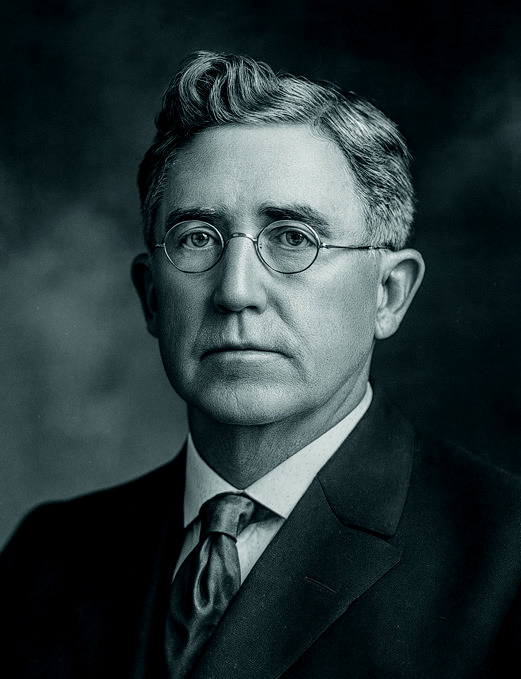
V. JudgeHoseaTownsend It was a fitting irony that the fate of a Chickasaw town in a territory that fought for the South during the Civil War, would rest in the hands of a judge who had once worn Union blue — a man whose life had carried him from the farms of Ohio to the battlefields of the Civil War, to Congress, and then to the raw edge of the American frontier.
HoseaTownsendwasborn June 16, 1840, in Greenwich, Ohio, to Hiram and Eliza Townsend, plain farming stock with a Massachusetts root. As the nation split apart, he was studying at Western Reserve College, but duty called him to the saddle. He enlisted in the Second Ohio Cavalry and soon rose to lieutenant. His service brought him south to Fort Gibson, deep in the Indian Territory — a strange and rough posting that would, unknowingly, foreshadow the court he’d one day rule. Illness ended his military service in 1863; typhoid fever forced him home.
He returned to Ohio, read law, and entered the bar in 1865, the same year he married AnnaBarnes,whowould become his lifelong partner and, in time, one of Ardmore’s most civic-minded women.
Townsend’s early legal work began in Memphis, Tennessee, where the scars of war were still fresh. In 1869, he served a term in the Tennessee Legislature — a Northern Republican amid a sea of ex-Confederates. But the West was calling. By the late 1870s, Townsend had moved to Colorado, seeking both justice and ore. In the mining town of Silver Cliff, he made and lost a fortune in silver — fitting the pattern of a man who took bold risks without regret.
After establishing himself, Townsend entered politics and, eventually, Colorado sent him to Washington. In 1888, he was elected as a Republican to the U.S. House of Representatives, serving from 1889 to 1893. Hewasa“SilverRepublican,” dedicated to free coinage and western expansion. His speeches in Congress, though not fiery, were straightforward and pragmatic — the same tonethatwouldlater resound in his courtroom.
When he lost his re-election bid in 1892, Townsend might have faded into history as just another politician from the mining frontier. But fate—andPresidentWilliam McKinley — had other plans.
Before Oklahoma was a state — before there were courthouses, counties, or even a clear line between tribal and federal authority — the Indian Territory stood as a legal wilderness. By the 1870s, lawlessness had become its defining feature. Murderers, whiskey peddlers, andhorsethievesfound sanctuary in a patchwork of tribal jurisdictions that seldom cooperated and that federal law, at first, dared not touch.
The U.S. government had created Indian Territory as a homeland for the Five Civilized Tribes — the Cherokee, Chickasaw, Choctaw, Creek, andSeminoleNations—each with its own constitution, laws, and courts. Within those boundaries, the tribal governments handled their own citizens’ affairs.
But as white settlers, freedmen, and intermarried citizens poured in, so did crime. Because tribal courts had jurisdiction only over their own citizens, a non-Indian who killed or robbed within the Territory often went unpunished — unless the crime reached across the border into Arkansas or Texas, where federal marshals could act.
The result was chaos. By the 1870s, the Indian Territory had become the most violent region in America. U.S. marshals from Fort Smith, Arkansas, under Judge Isaac C. Parker, known as the “HangingJudge,”madeperilous rides westward to enforce the law. But Parker’s court, though heroic in legend, was a blunt instrument — one court serving an entire Territory nearly the size of Pennsylvania.
Recognizing the impossibility of governing such a vast land from a single bench, Congress gradually extended federal authority westward. The first real step came with the Act of March 1, 1889, which established the United States Court for the Indian Territory at Muskogee, with one judge and limited jurisdiction. This was the first time that federal civil and criminal authority extended into the Territory itself, rather than from Fort Smith or Paris, Texas.
As the population grew and petitions for justice mounted, Congress reorganized the system again through the Act of March 3, 1895, which created three judicial districts — the Northern, Central, and Southern — each with its own federal judge, clerk, and marshal. ThelawestablishedArdmore as the seat of the Southern District, South McAlester for the Central, and Muskogee for the Northern.
The courts had both federal and territorial jurisdiction, meaning they handled everything from felony trials and contract disputes to probate cases and appeals from the old tribal courts.
The government’s intent was not merely to punish criminals but to impose uniform law and order on a region it believed was the last barrier to statehood. Washington viewed the federal courts as the spearhead of “civilization” — an instrument to prepare the Indian Territory for integration into the United States system.
For the Chickasaw and Choctaw Nations, this new judiciary meant the erosion of sovereignty. The judges, clerks, and marshals who arrived carried commissions not from the tribal governments but from the President of the United States.
And yet, paradoxically, these courts brought the stability that many citizens — Indian and non-Indian alike — had long desired.
In 1897, President William McKinley appointed Townsend as Federal Judge of the United States Court for the Southern District of the Indian Territory, headquarteredatArdmore— then a frontier town on the border between civilization and wilderness. Presidents McKinley and later Theodore Roosevelt both renewed Townsend’s commission, demonstrating the trust Washington had in their judgment.
Fromthebench,Townsend wielded authority with an iron will. His courtroom was known for its discipline. Once, when a Seventh-day Adventist juror refused to serveonaSunday,Townsend cited him for contempt of court. On another occasion, when a jury returned a verdict he found offensive to both reason and justice, he dismissed them with the thunderous rebuke: “You are discharged for the term, and I never want to see any of you in my court again.”
And yet beneath that austere exterior beat a heart capable of compassion. When a poor bootlegger stood before him—guilty by every measure but needed at home to feed his family—Townsend suspended the sentence, saying that mercy, too, was a part of justice.
His court in Ardmore was both a symbol and an experiment — the federal presence planted in a land still governed mainly by tribal custom.
Under Townsend, the Southern District Court heard cases ranging from bootlegging and cattle theft to civil suits involving railroad rights, allotment disputes, and townsite controversies — includingthelawsuitoverthe founding of Madill. He sat in judgment at a time when the very idea of “law” was being redefined: Was it the will of Washington, or the tradition of the Nations?
By the time Oklahoma achieved statehood in 1907, the Indian Territory courts had accomplished their mission — for better or worse. They had extended federal law into a land once ruled by tribal codes, paved the way for land allotment, and, in doing so, quietly buried the last remnants of the Nations’ judicial independence.
When the United States Courts for the Indian Territory were dissolved in November of that year, their records — including Townsend’s — became the backbone of the new Oklahoma state court system. In that sense, the courthouses of Ardmore, Madill, and beyond all trace their legal bloodline to those turbulent federal benches that once stood between the frontier and civilization.
While Judge Townsend’s court shaped the law, his wife, Anna Townsend, influenced the spirit of Ardmore. It wasn’t his gavel but her pen that brought one of the first major cultural institutions to the frontier. Believing Ardmore needed more than just law and commerce, she thought it required learning. So, in 1903, she wrote directly to Andrew Carnegie, the Scottish-born steel magnate whose fortune was then funding libraries nationwide. Through her persistence and vision, Ardmore became the first community in Indian Territory to receive a Carnegie grant, placing the young town alongside much older cities in progress. The Carnegie Library opened in 1904, its columns symbolizing civilization rising from red soil. Although the building’s second floor was destroyed by a tornado in 1926, it still stands today— a proud survivor of wind, time, and change— its elegant stonework now home to the Ardmore Garden Club, and its spirit still bearing the quiet mark of the judge’s wife who believed that knowledge was the ultimate measure of law and liberty.
WhenOklahomaachieved statehood in 1907, the courts of the Indian Territory were dissolved. Townsend’s judicial position was also abolished, but he stayed in Ardmore and opened a private practice. His judicial robe hung in his study as a relic of a bygone era, when it once bridged two worlds — the tribal and the state, the wild and the ordered.
On March 4, 1909 — the exact date his congressional term had ended sixteen years before — Judge Hosea TownsenddiedinArdmoreat age sixty-eight. His body was returned to Ohio to rest in Woodlawn Cemetery at Norwalk beside his ancestors. Anna lived on until 1915.
Judge Townsend’s life reflects the story of America itself: from farm to battlefield, from courtroom to Congress, from frontier to statehood. He was not a saintly jurist; he was human, sometimes irascible, often impatient, but never indifferent.
VI.Townsend’sOralOpinion: Equity Won’t Police Ghosts In the case before Judge Townsend, the government’s suit was not one of law, but of equity. A court of law decides matters where a wrong has already occurred and the injured party seeks damages—a sum of money meant to compensate for loss. But the government here sought no money. It asked the court to prevent an unlawful act before harm could be done—to restrain Overton and Taliaferro from proceeding with actions that violated federal authority. Such a remedy is called an injunction, and injunctions belongtotheancientprovince of equity. In equity, the judge does not weigh dollars and cents, but rather conscience and fairness. The question is not merely what the law permits, but what justice requires.
Thus, when Judge Townsend took up the case, he was sitting not as a judge of law, but as a chancellor in equity, exercising a more flexible and moral jurisdiction. His task was to determine whether the government’s plea for restraint was justified— not by statute alone, but by principles of fairness and good conscience. Courts of equity were designed for just such moments, when the rigid machinery of law cannot prevent a wrong in time. And so, rather than punishing Overton and Taliaferro after the fact, the government sought—andTownsend considered—an order to stop them before the damage was done.
After reviewing the plead- ings of each party and hearing argument from the attorneys for each party, Judge Townsend did not issue his ruling with the polish of a written opinion. He spoke it aloud from the bench, and the stenographers of the Ardmoreite caught it, their shorthand later reprinted in Guthrie and McAlester papers under the bold headline, “Citizen Can Build Town.” His words were plain, unhurried, and cutting.
Townsend began by laying out his understanding of the Curtis Act and the Atoka Agreement. Both, he said, were designed for a single purpose: the winding up of tribal affairs. The intent was to move title to the lands from the tribes as collective bodies into the hands of individual citizens, and then, under Congress’s timetable, to permit those individuals to sell in fee simple. This was liquidation, nothing less, and the court was bound to see the process as such.
From there, he turned to the question of possession. A ChickasaworChoctawinpossession of their proportional share pending allotment, Townsend reasoned, “has the use of it and is entitled to receive the rents thereof.” That right was not a shadow or a placeholder—it was an active, legal right. Then he posed the government’s own question back to them, with a trace of impatience: “Is there any limitation as to how he shall rent it? Whether he shall rent it in lots or blocks or in ten, fifty, or a hundredacre tracts?” His answer was blunt: “I don’t know any.”
The judge pressed the logic further. If a man had the right to rent, why should it matter if he marked off his land into blocks and alleys, and leased it piece by piece? Congress had placed no express prohibition on the form that leasing could take. If some act ran afoul of the old intercourse laws—if, say, a survey counted as unlawful marking—then let the law speak through its penalties. Section 2118 of the Revised Statutes provided for fines and even removal; it was there for use. But that was no ground, Townsend said, for equity to step in and choke a citizen’s lawful possession.
Equity, he reminded counsel, does not act on shadows. The government’s fears of future disruption—of towns springing up and allotment arithmetic collapsing—were “purely and simply imaginary.” They relied on contingencies that might never materialize. “Whoever heard of a court of equity being asked to do anything of that sort?” he asked. Injunction, in Townsend’s courtroom, was not a tool for speculation.
At the close, he made his conclusion unmistakable: “From the way I look at it, gentlemen, you are not entitled to any injunction. I most emphatically hold that there is no limitation as to the renting.” With that, he dismissed thebill.IfWashington wanted another answer, he invited them to appeal.
Townsend’s ruling was not just about Madill; it also concerned the extent of possession during the uncertain period before allotment was finalized. Congress had spoken clearly: citizens could occupy and rent their share, with future division in mind. If Congress had wanted to prohibit the form of those rents—if it intended to exclude “lots” and “blocks” from the acceptable language of possession—it would have said so. Until then, the function remained valid: the right to rent for lawful purposes, regardless of how the ground was measured.
VII. Washington’s Counterpunch: Prosecutions, Depots, and Post Offices Judge Townsend’s refusal to grant the injunction might have seemed, to Madill’s promoters, like the end of the government’s resistance. But in Washington, the fight was far from over. The Department of the Interior, stung by the court’s rejection, began exploring other levers of control.
By the end of July 1900, officials relayed word that the United States Attorney General had authorized the U.S. District Attorney at Ardmore to consider prosecutions against Isaac Overton Lewis and his associates under Section 2118 of the Revised Statutes, as well as under the Curtis Act itself. If the evidence justified it, the government could seek penalties of $1,000 per offense and even removal from the land. Townsend’s court had denied equity’s remedy, but the penal code remained at hand, sharp and ready.
The Daily Ardmoreite reported this as follows: “TO PROSECUTE BOOMERS. District Attorney Johnson Is After Trespassers on Indian Land. DistrictAttorneyW.B. Johnsonhasreceivedinstructions from the Department of the Interior to enter prosecutions against all persons concerned in laying off and platting new towns since the passage of the Curtis law. This includes all boomers, promoters and speculators, but not bona fide residents who have been induced to purchase lots and build their homes thereon. The prosecutions are now being instituted, several warrants having already issued. The prosecutions are based on Section 2118 of the Revised Statutes of the United States, which imposes a penalty of $ 1,000.”
Meanwhile, the Department of the Interior, Inspector J. George Wright, turned his attention to the railroads. In his view, the Frisco line was the artery that would give Madill life; cut it off, and the town would wither before it grew. He recommended that depots be limited to townsites lawfully set aside under the Atoka Agreement. No recognized townsite, no depot; no depot, no town. It was a neat piece of administrative leverage, and Wright urged the Secretary to wield it.
VIII. Oakland’s Counter-Narrative: Stop the Railroad, Post Office and argue Lawful Titles vs. Allotment Clouds Oakland’s counterattack did not come in the form of rifles or fists, but in petitions totheGovernoroftheChickasaw Nation, pleas to the United States Postal Service, and columns of newsprint. Its leaders crafted arguments that mingled civic pride with sharp legal reasoning. They reminded anyone who would listen that Oakland was no paper town. It was incorporated, its government in place. It had already surveyed depot grounds for the Shawnee, Oklahoma & Gulf Railway—an Illinois Central affiliate with financial muscle behind it. Its schools were operating, its cotton gins were running, and its citizens were secure in the promise that titles to their lots would be appraised and confirmed under the Atoka Agreement and federal oversight. Buyers in Oakland, they argued, could sleep at night knowing the law stood behind their deeds.
First, Mayor Ed Sacra of Oakland applied for an injunction with Governor Johnston of the Chickasaw Nation to restrain the Frisco Road from building its line through the new town of Madill. On July 27, 1900, the Daily Ardmoreite reported on the Sacra’s request and wrote, “No action has been taken as yet by Governor Johnston. Attorneys say that Governor Johnston cannot keep the road from building its line. It is said, however, should the Governor refuse to approve the map and profile of the road it would affect the road’s right of way, and probably cause it to change its location. The citizens of Oakland are making the fight against the Frisco extension into Madill, alleging that it will hurt their town.” Despite the plea, Governor Johnston declined to consider the request.
Next,JohnM.Vandervort, thepostmaster atOakland— upset at the prospect of his town being overshadowed— sent a plea to Washington to deny Madill a post office. He argued that the town was “contrary to law” and should not receive federal recognition through a mail stop. However, on July 27, 1900, the Department decided it was “not expedient” to block a post office just because the town was built on disputed land. Mail, after all, was a lifeline, and Washington hesitated to cut it off over a dispute about plats and leases.
And finally, Oakland fired its last offensive against Madill by purchasing advertisements in local newspapers across the southern Indian Territory, to plead its case and attempt to stop the new town of Madill. The campaign sounded less like small-town boosterism and more like a lawyer’s brief. One of the ads stated: “As hundreds of letters come to our town wanting to know the conditions of Oakland as a town, I would be glad if the ARDMOREITE would allow me to state briefly the facts as they exist.
Oakland has not less than 1500 inhabitants. It has a fraction less than a mile square of boundary lines. We are incorporated and have a noble set of conservative men as officers. We have a large school building and a firstclass teacher secured for the full term. We have two large gins equipped with the best and latest improvements.”
“TheShawnee,Oklahoma & Gulf railway has a line surveyed with depot grounds inside the corporate limits. This is a branch of the Illinois Central, one of the strongest companies in the United States.
The businessmen of Oakland, with a few exceptions, expecttostayanddobusiness at Oakland, where they have the protection of the law in all its provisions. Men do not have to come here and spend their money in erecting business and residence houses on some Indian’s allotment, which he cannot occupy only as a tenant. Oakland was recognized by the treaty made at Atoka as a town, known as the county seat of Pickens County.”
“What is Madill? It is a would-be-town bordering on theeasternlimitsofOakland, on the Frisco survey, one and a half miles from the center of Oakland’s limits. The Frisco officials used the plea that they could not get to Oakland on a one percent grade, which was their limit. They then proposed to I. O. Lewis if he would secure the land, they would compel Oakland to move, and they would have a town of their own, regardless of the condition this would leave hundreds of poor people in the town of Oakland. Their first plan to build the new town was such an open violation of law that they had to change it, and they have changed and rechangeduntilnooneknows what kind of a title they offer to locaters.
Oakland has grown to its present size by honest effort and enterprise. We are here to stay and extend a welcome invitation to men who want to invest their money in the best farming country in the Territory—where they will be protected, with all the privileges guaranteed to noncitizens of the country.
You can buy a lot here, and when it is sold by the town appraisers you will get a title to your property. You can’t buy a lot in Madill; it is Mr. Taliaferro’s allotment and HE CAN’T SELL IT. The law prohibits him from selling for a stipulated time.”
“We are sorry this strife has come about. Had Mr. Lewis and Mr. Taliaferro used their influence with Oakland each of them would havehadmuchvaluableland in connection with the town that would have paid them moremoneythantheycanget out of their new town. They have been misled by a greedy railroad incorporation, that has been a cyclone in point of destruction to almost every town it has touched (or misled) in the Territory.
The Shawnee line was run into our town on an easy grade of less than one per cent.”
IX. Federal Government’s change of position.
In September 1900, the federal government shifted its opposition strategy. On the 7th, the Interior Department advised that the Acting United States Attorney General had instructed the U.S. Attorney at Ardmore to suspend prosecutions under section 2118 “until further notice.” Similar restraint was recommended in other cases. Due to this change in plan, none of the arrest warrants, including those for Isaac Overton Lewis and William Norborne Taliaferro, were served. For all its bluster, Washington had no appetite for a prolonged and uncertain courtroom war.
Among other things, the shift in strategy was as follows: First, the Department directed the United States Attorney to file an appeal of Judge Townsend’s ruling. The appeal was filed in the United States Court of Appeals, located in St. Louis, Missouri. The case was set on the court’s docket, with briefs due in January 1901 andahearingbeforethecourt scheduled for April or May.
The Department also accelerated lawful surveys and appraisals, ensuring that towns recognized by statute moved quickly to secure their legitimacy. It would lean on railroads and postal authorities, tightening the channels of commerce and recognition. Section 2118 would remain in reserve, a sword in its scabbard, but it would not be drawn unless necessary.
The message was clear: while Townsend’s ruling had opened the door for Madill, the federal government would not yield the field entirely. It would no longer try to strangle the infant town in its cradle, but it would keep one hand on the rails, the mails, and the statutes— ready to remind all of Indian Territory that Washington still wrote the rules.
And yet, the market had already scented which way the legal wind was blowing. Judge Hosea Townsend’s refusal to issue an injunction against the Madill promoters changed everything. Businessmen, ever attuned to opportunity, moved quickly. Merchants announced plans to relocate their stores. Investors pledged capital for mills. Crews set to work grading streets where prairie grass had stood only weeks before. A depot was no longer a matter of “if,” but “when.”
And Oakland’s last weapons were little more than legal shadows, faint gestures against the iron certainty of progress. The law gave Johnston scant leverage, and the Frisco’s tracks were already advancing.
The truth was unavoidable. Oakland’s carefully reasoned broadsidesandappeals to prudence could not match the momentum of the rails. Townsend’s courtroom had turned the tide, and the marketplace responded faster than Washington could. The train was coming, and with it Madill’s future. Oakland’s press campaign, no matter how eloquent, could not stop the sound of hammers on fresh timbers rising just two miles east.
Newspapers across the Territory treated the ruling as a signal: “Promoters can build the town and sell town lots.” “There is no limitation as to the renting.” “Citizen canbuildtown.”(Ardmoreite, McAlester Capital, Guthrie Daily Leader, Oklahoma State Capital, Muskogee Phoenix, July 7–14, 1900). The Department’s letters show a different signal: prosecute whereevidenceisclean; slow-walk depots; accelerate lawful commission plats; do not pick a losing fight over a post office (Interior/Indian Office, July–Sept. 1900). In September, Justice put § 2118 actions on ice in the Lewis matter and suggested similarrestraintelsewhere— an implicit concession that the legal terrain was not as flat as Washington hoped (Sept. 7, 1900).
A community is a string of decisions. By 1901, the string had weight.
X. The Founders’ Ledger: Risk, Title, and Reputation It is tidy to say that Lewis and Taliaferro “won.” The truth is more textured. They won the right to proceed, not the right to prevail. Buyers still took title risk; the Department still reserved its townsite prerogatives; and § 2118remainedaswordabove anyone who crossed into clear surveying violations on tribal title land. The founders advanced under a sky of qualified legality—but they advanced nonetheless.
When the dust settled from the bitter dispute over the town, and the Frisco Railroad’s location, Lewis and Taliaferro exacted their revenge with permanent reminders of their “victory.” First, Lewis, the Chickasaw citizen-lawyer whom Oakland blamed for the railroad’s bypass, wrote his vindication into the street grid of Madill.
As the new town was platted, Lewis saw to it that Lillie Boulevard, the first street west of Highway 70, ran directly fromthetownsquareto the grand home he had built south of Oakland after his fall from grace. Every other street on the west side of town was then aligned parallel and perpendicular to that road—his road. The result was a city divided: one half bent toward the railroad that hadexiledhim,theotherbent toward the man himself. It was, in its way, an act of quiet revenge—a cartographic rebuke carved into the soil of MarshallCounty. Thetown’s odd street grid still whispers that story today, half built for commerce and half for pride, a testament to how even the geometry of a town can bear the shape of a man’s resentment and resolve.
Taliaferro, the Virginian with a builder’s pride, carved his story into stone and civic donations. In the early days, many buildings, some of which still stand today, bore his name. One of the town’s streets was named after him. He donated land for parks, schools, and churches, as well as the land that is now Woodberry Forest Cemetery, which is named after his mother’s hometown in Virginia. Together, they helped Madill navigate a legal canyon as wide as a county.
XI. The Larger Frame: Atoka, Curtis, and the Price of Statehood By the time the government’s appeal came on for hearing before the federal appellate court in mid-1901, the point was already moot. Overton and Taliaferro had moved too fast—laying track, selling lots, and raising a town almost overnight. Once commerce had begun to flow and property exchanged hands, the courts were reluctant to tear apart what had already become a living, breathing community. The ink on the injunction had barely dried before the hammering of new construction drowned out any hope of reversal. Madill existed not by permission, but by momentum. The law might have been on paper, but the power was in progress—and progress had already claimed the field.
Almost overnight, advertisements filled the columns of every regional paper proclaiming Madill’s rise. “GROWING MADILL (THE NEW TOWN) ON THE NEWFRISCORAILROAD.” “NEW BRICK BUILDINGS GOING UP.” The copy read like scripture of a boom: “Located in and surrounded by the black land belt, with a fifty-mile water front on the Red and Washita Rivers, Madill is the fastest improving and the fastest growing town on the new Frisco Railroad.”
There were lists of merchants “already building brick or stone business houses”—Cottons National BankfromOakland,Donehoo & Wheeler, F. E. Sellers, J. E. Dillingham, L. Williams, Vandervoort Bros., Noble Bros., W. B. Frame the druggist— all staking new lives on ground that had, weeks earlier, been called unlawful. Mrs. Sawtelle’s Madill Hotel offered rooms at “$3.50 per week or $1.00 per day— Drummers’ trade especially solicited.” H. B. Johnson sold harness and saddles, promising “the best grade of goods at the lowest prices.” Taliaferro himself placed the contact line at the bottom of the advertisement—“For further information, address W. N. Taliaferro, Madill, I.T.”—as though to say, the fight is over; the town is real.
The new town became a magnet for investment. Reports from the period described an explosion of industry and optimism. The Indian Territory Cotton and Oil Company announced the construction of twin mills— one in Madill and one in Roff—each costing $60,000. ($2.3 million in 2025 dollars). Both mills were strategically placed along the new Frisco line from Sapulpa to Denison. Within weeks, the Madill Cotton Oil Company filed its charter, capitalized at $50,000, under the directorship of businessmen from Greenville, Sherman, and Shawnee. The town’s advertisements boasted of a “growing town— a live town”, proudly noting that new brick buildings were rising on every corner and that merchants from Oakland and Ardmore were relocating their businesses to the new rail hub.
From the Madill Hotel, operated by Mrs. Sawtelle, to H. B. Johnson’s harness and saddle shop, the sound of commerce filled the air. The Frisco depot stood just three blocksfromthepublicsquare, and W. N. Taliaferro’s name appeared on every circular sent to potential investors. The same hand that once stoodbeforeJudgeTownsend defending his right to build now signed promotional flyers declaring Madill “The Fastest Growing Town on the New Frisco Railroad.” What began as a defiant gamble against federal injunctions had, by the time of appeal, become an irreversible fact— the iron rails, the cotton mills, and the new brick storefronts forming the very argument that no court could overturn.
No single town can carry the whole freight of the Curtis Act era, but Madill is a clean case study. Atoka promised a rational, by-value allotmentwithfederallymanaged townsites for revenue. Curtis put federal courts and commissions in charge and announced municipal incorporation to come. Those pillars aimed at three outcomes: breaking communal title, integrating the territory into the U.S. legal/economic order, and clearing the way to statehood. It worked. It also dispossessed—through taxes, fraud, swindling, and the simple unfamiliarity of fee-simple burdens. The legal means were technical; the human ends were raw.
Townsend’s opinion lived inside that machine. He didn’t bless freebooting; he declined to make equity a dragnet. He left penalties to statutes and to the executive. In doing so, he left a space— just wide enough—for Madill to become real.
XII. How Close It Came When the smoke of headlines and pamphlets clears, what remains is how close Madill came to never rising at all. The margin was razor-thin. Had Judge Hosea Townsend read Section 16 of the Curtis Act as the government urged—restricting interim use strictly to agriculture and grazing—the injunction would almost certainly havebeengranted,and the townsite effort strangled before birth. Had the Department of Justice pursued prosecutions under Section 2118 without hesitation, imposing fines and removals against Lewis, Taliaferro, and their associates, the delicate scaffold of “leases” disguised as sales might have collapsed overnight. Even the railroads could have tipped the balance; had Interior flatly refused to recognize depots at any towns not officially set aside under the Act of May 31, 1900, the economic heart of Madill would have stopped beating before it began.
But that is not how history chose to unfold. Townsend refused to stretch equity to cover speculation. The Justice Department, wary of precedents it might later regret, stayed its hand on prosecution.TheDepartment of the Interior, though uneasy, tighteneditsprocedures rather than burning the field. Outofthatnarrowconfluence of hesitation, interpretation, and accident, Madill staggered forward.
It was born in the brief gap between what the law might have done and what, in those trembling weeks of 1900, it chose not to do. And in that slender breathing room, the town drew its first breath of permanence.
XIII. The Town That Almost Wasn’t — And What It Teaches By the time the government’s appeal reached the federal bench, the case was already lost—not on law, but on time. The world had moved too quickly. Overton and Taliaferro, unshaken by injunction or threat, had racedaheadwithrails,bricks, and audacity. The Frisco line was down, the depot was open, and the sound of saws and hammers drowned out the whispers of Washington’s lawyers.Bythetimethecourt could speak, the town had already answered for itself. Madill existed—and no decree could unbuild it.
Townsend’s refusal to wield equity as prophecy had given them the only gift they needed: time. And in that narrow window, they made the most of it. The settlement erupted with enterprise; tents became timber, timber became stores, and stores became permanence.
That was the reality no court could undo. The government had sought to enjoin a speculation, but what stood before it was a city in motion. Madill had slipped the noose of theory. Equity could punish trespassers; it could not demolish a skyline. By the time the appeal came to hearing, Madill was no longer a question for chancery—it was a fact for history.
Townsend’s refusal was not mere restraint; it was, in its quiet way, creative. His opinion—delivered in twenty measured minutes—closed with a line that has since become Madill’s unwritten charter: “Whoever heard of a court of equity being asked to do anything of that sort?”
He would not enjoin a ghost, nor throttle a future still taking shape. His decision did not declare Madill lawful—it merely declined to make it impossible. In that hesitation lay creation itself. The town that almost wasn’t became the town that is. Madill endures because one judge refused to let law strangle life—and because two men moved faster than the government could stop them.
XIV. A Provocation: Was Madill the Only “Illegal” Town?
Open a map of Indian Territory in 1900, and you’ll see dozens of dots budding along the railroad. Most arose through the formal townsite process Congress had designed—surveyed under federal oversight, appraised by a commission, and sold with the proceeds credited to the tribes. They may have been hurried or politically flavored, but they were lawful.
Madill, however, was not. It came to life while title still rested in the Choctaw and ChickasawNations,beforeallotments had issued to Isaac OvertonLewisoranyoneelse, and while federal officers were actively trying to stop it—by injunction, by the Intercourse Act, even by threats to deny a depot and post office. That paper trail—court pleadings, agency memoranda, and newspaperbroadsides— makesMadilllookless like a town and more like a wager: perhaps the only community in Indian Territory deliberately platted first and legalized later, defying the United States and two sovereign Nations in plain sight.
That claim may sound bold—let’s call it what it is, a provocation—but it rests on rare facts. The lawsuit itself was extraordinary: United States (with the Choctaw and Chickasaw Nations) v. the promoters of the town. Townsite disputes were common; injunctions to prevent a town from being born were not. The government’s complaint sought nothing less than to erase Madill—no streets, no blocks, no leases.
Federal officials reacted with unusual speed and unity. The Indian Inspector demanded prosecutions, the denial of a depot and post office, and every lever of departmental authority to halt the town’s advance. They acted so swiftly because Madill had jumped the legal track—private men carving a town on communal land before allotment. Oakland’s resistance gave that legal fight a voice, its circulars branding Madill “illegal” and its founders trespassers.
The timing made it all the more incendiary. In 1900, no allotments had yet been issued at the site; Lewis’swould not come until 1903–1904. Madill rose in that gray zone between possession and title, daring the government to intervene. Townsend did not bless the act; he merely refused to suffocate it. Interior hesitated, and in that hesitation, the trespass became a town. Within two years, othertownswouldformunder federal authority, but Madill remained the outlier—a scar of improvisation on an otherwise bureaucratic map, warned, sued, and finally tolerated into permanence.
Were there others like it? Possibly. Indian Territory was a tangle of sidings and ambitions. Some places surely began in gray zones and were regularized later. But until another case surfaces withthesameconstellation— a federal suit, tribal co-plaintiffs, agency efforts to cut off depot and postal lifelines, a rival town’s denunciations, and a judge’s oral ruling that became a charter—Madill stands alone. It may well be the only “illegal” town that lived to tell the tale.
“Illegal,” of course, was the government’s word. Townsend reframed it as a question of remedy. Even if the statutes forbade surveying, equity would not erase a present right to use and rent possession. That subtle distinction was Madill’s oxygen. Its legitimacy came not from approval, but from one man’s refusal to smother it.
In the end, that refusal placed Madill in a category of its own. Other towns were born through Atoka, Curtis, and the Department’s commissions. Madill was born against them. No post office was supposed to open, no depot to operate, no plat to stand—and yet the town survivedtobecomethecounty seat of Marshall County.
And perhaps most telling of all: within mere months of the government’s retreat, Oakland’s merchants, lawyers, and even its fiercest opponents of Madill quietly packed their ledgers, wagons, and hopes and moved south. Business by business, household by household, the population followed the railroad. The lights in Oakland dimmed as Madill’s glowed brighter. In the end, even those who had fought hardest against the town found themselves living in it.
Madill’s survival was not written in statute, but in spirit. Law demanded obedience; equity offered mercy. Between them, in that narrow space where rules yield to reality, a town took form. Judge Townsend did not sanctify rebellion—he merely declined to let the law become its own idol. His ruling, quiet and almost reluctant, became the hinge on which an “illegal” dream swung into permanence.
Madill’s story is not just local history. It is the eternal frontier riddle: when order comes too late, do we wait for permission—or do we build and let the courts catch up? Here, conscience outran code. Equity blinked, and history rushed in. The town that almost wasn’t endures today as proof that sometimes the bold, the desperate, and the defiant are the very ones who give law its next chapter.
XV. The Last Word: The Boomers and Sooners of Town-Building Today, more than a century later, Madill still stands as a monument to audacity. Its courthouse square hums with commerce, its streets pulse with the same restless energy that once drew rails through timber and red clay. But beneath the asphalt and the hum of trucks lies a story of two men who dared before they were allowed—Isaac Overton Lewis and George Taliaferro—and the town they willed into being.
Their courage was not of the battlefield but of belief— belief that civilization itself can be a kind of rebellion. They looked at empty prairie and saw a future; they looked at statute and saw delay. In that gap between vision and permission, they acted. Like the Boomers and the Sooners who slipped across the border lines of Oklahoma Territory before the bugle, Lewis and Taliaferro crossed the invisible frontier of law and dared to plant a city before the government gave them leave. They were the BoomersandSoonersoftownbuilding— not of land alone, but of possibility.
And what they founded endures. The courthouse gleams where the prairie once sighed. The same square that nearly drew an injunctionnowhostsparades, festivals, and countless other civic activities, as well as the everyday rhythm of civic life. Madill is proof that courage can take the form of a town. It is the living descendant of hesitation turned to hope, of defiance ripened into destiny.
So, when one walks its streets today—past the old buildings, the old Frisco right-of-way, the stubborn grid that began as a trespass— it is worth remembering that few towns anywhere owe their birth so nakedly to nerve. Madill was not given; it was taken, tested, and proven. It was forged by men who built faster than the law could stop them, who turned peril into permanence.
The world may call them reckless lawbreakers, but history calls them founders. Madill’s courage is their echo. Like the Boomers and the Sooners before them, they saw tomorrow coming—and refused to wait.