
There are moments in a community’s life that do not simply pass into memory.
They remain. They settle into the walls. They linger like smoke after a fire, like a shadow cast at noon, sharp and impossible to ignore.
Years may pass. Generations may come and go. The building may be remodeled, abandoned, or torn down. The children who saw it may grow old. The names may fade from common conversation. But the event itself does not leave.
It becomes one of those hard, dark stones in the bed of localhistory—covered sometimes by the current of time but never washed away.
Violence between husband and wife is as old as the human story itself. It has worn many names across the years: family trouble, marital discord, a domestic matter, a private affair. Those old phrases sound almost harmless now, but they often concealed something cruel and dangerous. They allowed communities to look away.
They allowed suffering to remain behind closed doors. They gave politeness to terror.
In earlier generations, especially, domestic violence was too often treated as something that belonged inside the home, as though the front door formed a wall not only around a family, but around the conscience of everyone outside it.
But domestic violence has never truly stayed at home.
It follows. It waits. It watches. It comes to the workplace.
It comes to the church parking lot. It comes to the courthouse steps. It comes to the grocery store, the beauty shop, the school pickup line, the hospital hallway, the office lobby. It comes wherever the victim has tried to build a life beyond the control of the
abuser. Modern workplacesafety authorities now openly recognize what earlier generations often failed to say plainly: domestic violence spills into workplaces, and the U.S. Department of Labor notes that domestic violence accounts for a substantial share of violent workplace events.
And there is a particular horror when that violence enters a school.
A schoolhouse is not merely a building. It is one of a community's sacred places. It is where parents send what they love most. It is where the morning begins with small voices, lunch pails, sharpened pencils, notebook paper, paste jars, chalk dust, and the innocent commotion of children learning how to become people. A first-grade room is even more tender. It is the beginning of the beginning.
It is where children learn letters, numbers, manners, songs, and the first fragile confidence that the world is orderly enough to be trusted.
That is what makes violence in such a place so unspeakable.
A home may hide anger behind its curtains. A couple may carry bitterness in silence. A divorce petition may sit in a courthouse file,
cold and official, while fear burns hot in the heart of the person who filed it. But a classroom is different. A classroom is supposed to be a refuge from adult darkness.
It is supposed to be a place where children are protected from the storms they are too young to understand.
When violence crosses that threshold, it does more than take a life. It profanes the room. It tears at the very idea of safety. It leaves behind not only blood and grief, but bewilderment. How could such a thing happen here?
How could the troubles of a marriage walk into a room full of children? How could a teacher, seated at her desk during the noon hour, become the target of a man who had once promised to love her?
Today, sadly, we understand more about such things than people did in 1947. We understand that separation is often one of the most dangerous times in an abusive relationship. Research on intimate-partner homicide has repeatedly found that many such killings occur hen the victim is ending or has ended the relationship.
We understand that restraining orders, though necessary and often lifesaving, are not magic shields. They are paper barriers against human rage.
They declare a boundary, but they cannot by themselves stop a determined hand from crossing it.
We have seen modern examples of the same awful pattern. In April 2017, at North Park Elementary School in San Bernardino, California, Karen Elaine Smith, a special-education teacher, was killed in her classroom by her estranged husband, Cedric Anderson.
An eight-year-old student was also killed, another child was wounded, and Anderson then killed himself. Authorities later described Anderson as having a history that included weapons and domestic-violence issues. That case shook the nation because it
joined two nightmares into one: domestic murder and school violence. The private terror of a broken marriage had entered a classroom and struck not only the intended victim, but the children around her.
In 2025, another school community was shaken when an Illinois assistant principal, Nerissa O’Donnell, and her mother were reportedly shot and killed outside the middle school where O’Donnell worked; reports described the shooting as the culmination of a domestic dispute. In Texas, reports in 2025 and 2026 told of educators killed in suspected or alleged domestic-violence circumstances, leaving school communities to grieve not just the death of a colleague, but the invasion of private violence into the public trust of education.
Those modern stories remind us that the pattern is not new. Only our willingness to name it has changed.
But in 1947, in Madill, Oklahoma, such a thing was almost beyond imagining.
Marshall County was not a place prepared for this kind of headline. It was a place where people knew one another’s families, where teachers were not public employees in some distant bureaucratic sense, but familiar figures in the lives of children and
parents. A teacher stood in the community, almost like a minister, a nurse, or a trusted neighbor. She did not merely teach reading. She helped shape the first understanding of the world.
That is why the killing of Jessie Bell Laird was not only the murder of a woman. It was the murder of a teacher in the presence of childhood.
It was violence crossing a line that should never be crossed, stepping out of the shadows of a broken marriage and into the clear light of a schoolroom.
It was the intrusion of adult rage into a place built for small voices and simple lessons, where the world is supposed to be explained gently, not shattered without warning.
And in that crossing, something larger was wounded. Not just a life, but a trust.
The quiet, unspoken trust that when a child is left at a schoolhouse door, they are stepping into safety. That what happens in homes— however troubled, however strained—will not follow them into that room of desks and chalkboards. That the teacher standing at the front of the room is not only an instructor, but a guardian of that fragile peace.
On that day, that trust was broken.
And it remains, so far as local memory and the available record show, the first and only event of its kind in Marshall County history. That fact stands like a marker. Not because the county has been free of hardship or violence—no place ever is—but because this was something different.
This was not a killing in the field, or along a lonely road, or at the Corner Drug Store, or behind the closed door of a home. This was a killing carried into the very heart of community life, into a classroom where the future sat waiting, unaware.
On February 5, 1947, the old language failed.
The words people had used for generations—“family trouble,” “marital difficulty,” “a domestic situation”—fell away, exposed for what they were: thin coverings over something far more dangerous.
This was not merely “divorce trouble.” It was not a disagreement that had grown too sharp. It was not a private matter. Privacy ended the moment the schoolhouse door opened.
What happened that day was murder. It was terror. It was the final act of control by a man who had already been told, in the firm language of the court, to stay away. A line had been drawn. He crossed it. A warning had been given.
He ignored it. And when he came, he did not come in confusion or heat alone—he came armed, deliberate, and resolved to do what he had said he would do. But even that truth, stark as it is, does not tell the whole of it.
Because, like so many tragedies, this one did not begin in violence. It did not begin with the sound of a gunshot or the cry of a frightened child. It began quietly, almost invisibly—two lives moving forward through time, shaped by different years, different experiences, different burdens. One life already marked by a marriage that had ended. The other, just beginning to unfold into adulthood, into profession, into purpose. Their paths crossed, joined, and for a time held together under the name of family.
There was no headline when they married. No warning was printed in advance of what would come. Only the ordinary hope that attends every union—that things will hold, that they will endure, that whatever storms come can be weathered within the walls of a shared life.
But some storms do not stay within walls. And before the story ended, seven children would run from a first-grade room at
Camrose Elementary School, carrying with them a sight and a sound no child should ever have known—words spoken in calm intent, a scream that split the room, and the sharp report of a gun that ended a life and changed theirs.
What followed was, and remains, the only known instance in Marshall County history in which domestic violence entered a classroom and claimed a life in the presence of children. It was not merely a killing. It was not merely what the newspapers of
that day, in their restrained language, called a “domestic tragedy.” That phrase, like so many others, tries to contain what cannot be contained. This was something more final, more violent, more revealing.
It was the breaking point of a marriage already unraveling, carried out in the most public and vulnerable place imaginable. It was
the private collapsing into the public. It was fear made visible. It was the terrible proof that the line between home and school—between adult conflict and childhood safety—can be crossed in a single moment.
It happened at noon.
It happened while children sat at their desks, their lunches spread before them, beneath paper hearts and holiday decorations that
spoke of simpler things—of seasons, of lessons, of days yet to come.
And because it happened there, in that room, in that hour, it has never fully left.
This is a story that does not begin with blood.
It begins, as so many of the hardest stories do, with ordinary lives—lives that looked, from the outside, much like any other, until the day came when everything that had been held inside could no longer be contained.
Ellis Clifford Laird was born on October 3, 1886, in Valley View, Texas. His parents, Albert and Ada Laird, were both 28 years old when he was born. He came into the world in the closing years of the old frontier era, a generation before statehood, before automobiles and telephones became common, before the habits of the modern world had fully reached rural families on either side
of the Red River. He grew into manhood, learned a trade, and became known as a painter and paperhanger. He married Bennie Franks, and from that earlier marriage came children, including Edwin Laird of Denison, Texas, and Maxine Laird of Los Angeles, California. That first marriage ended in divorce. The records, at least as preserved in the accounts surrounding the 1947 tragedy,
do not pause over why. They simply record the fact and then move on.
But lives do not simply move on. They carry what came before.
Jessie Bell was born nearly nineteen years after Ellis, on August 13, 1905, in Oklahoma. Her parents were William R. Bell and Mary Bell. When she was born, her father was 25, and her mother was 23. She grew up not as a figure of scandal, but as a daughter, a sister, a student, and eventually as a teacher. She belonged to a family well known enough in Madill that the newspapers, after her death, identified her not only as Mrs. Jessie Laird, but as the daughter of Mr. and Mrs. W. R. Bell and the sister of Leslie Bell, who operated the concession stand in the courthouse. She also had a brother, Billie Bell of Madill, and three sisters:
Mrs. Zell West of Bokchito, Mrs. Ira Smith of Oakland, California, and Mrs. Helen Dennis of Dallas.
Jessie’s life had a shape beyond marriage. That matters. It matters because too often women murdered by husbands or former husbands are remembered only in relation to the man who killed them. Jessie Bell Laird was more than the wife of Ellis Laird. She was a teacher. She was a mother. She was a daughter. She was a church member. She was a woman still working toward her own future at the age of 41.
She had taught in various schools for several years before coming to the Madill schools. One account noted that she had taught at Kenefic the previous year and during the last summer session. She had also attended Southeastern State College. At the time of her death, she was still working on her degree and expected to receive it that summer. That small fact is painful. She was not at
the end of her work. She was still building. Still studying. Still preparing. Still reaching toward something. Her life was not closing naturally; it was being opened further.
In 1929, when Jessie was 24 and Ellis was 43, they married. The newspapers said they were married in August
of that year. Their marriage produced two daughters: Mildred, who by 1947 was Mrs. Jack Wilhite, and Jane Laird,
still a girl of about 13. Those daughters stood between two worlds—the older family Ellis had made in his first marriage and the younger family he made with Jessie. By early 1947, they would be left to carry a burden no child, grown or young, should have
been asked to bear.
For a time, from the outside, the marriage must have looked like many marriages. A husband with a trade. A wife with a profession. Children. Family connections. Church connections. Work. Ordinary routines. But by January 1947, whatever had been wrong between Ellis and Jessie had broken through the surface and reached the courthouse.
On January 13, 1947, Jessie Laird filed a divorce suit in the district court in Madill. The filing appeared in the Madill Record on January 16 in the brief legal style of the day: “Jessie Laird vs. Ellis Laird, divorce.” Such entries were small, almost bloodless.
A name against a name. A marriage reduced to a court caption. But behind that caption was fear. Jessie’s petition charged extreme cruelty. It further alleged that on January 12—one day before she filed—Ellis had threatened to kill her.
That allegation changes everything. This was not merely a marriage ending. This was a woman telling the court she was afraid for
her life.
District Judge William J. Monroe granted her request for a temporary restraining order. Ellis Laird was ordered not to come about her and not to molest her in any way. The law did what it could at that moment. It drew a line. It put the authority of the court
between Jessie and the man she said had threatened her.
But the law, for all its dignity, cannot stand guard at every door.
In the weeks that followed, the danger did not disappear. Miss Martha Carter, principal of Camrose Elementary School, later said
that Jessie had not discussed her personal affairs with the other teachers. If Jessie felt fear about what might come of the divorce proceedings, she kept that fear to herself. Perhaps she was private. Perhaps she did not want to burden others. Perhaps, like
many women of her time, she had learned to carry trouble quietly. But Miss Carter also said something else—something chilling. Ellis Laird had come to the school during the noon hour on two occasions the previous week, looking for Jessie. Each time, Jessie
was not there.
That detail sits heavily over everything that followed. The noon hour at Camrose had a routine. Most of the children who did not go home for lunch were taken by school bus at 11:30 to the high school cafeteria. Only a few children remained in the Camrose
building to eat the lunches they had brought from home. One teacher stayed behind each day to supervise them.
The teachers took turns performing that duty.
It was a simple system. Practical. Innocent. Predictable.
And on February 5, 1947, the teacher left in the building with those few children was Jessie Bell Laird.
Shortly before noon that Wednesday, the Camrose building was quiet in the way only a school can be quiet during lunch. The usual roar of children had thinned. Most of the teachers and approximately fifty children had gone to the downtown cafeteria or
the high school cafeteria. In the first-grade room, seven children remained. Their lunches were spread across the small desks. Some had been partly eaten. Some would never be finished.
The room itself still looked like childhood. The blackboards
were decorated with gay pots of paper flowers. Valentine’s Day and Washington’s Birthday decorations had already been placed
around the room. At the front, near the teacher’s desk, lay two toy pistols that had been taken earlier from noisy little boys who had dropped them on the floor during the morning session. It was the sort of small classroom discipline that belongs entirely to
childhood—a teacher taking away toy guns from boys who had been playing too loudly.
Then a real gun entered the room.
The children in the room included Larry Ables, a towheaded first-grade pupil who lived with his grandparents, Mr. and Mrs. Bob Ables; Jimmie Peters, 10, son of Mr. and Mrs. Roy Peters; Charles Payne, a sevenyear-old second-grade pupil and the son of Mr. and Mrs. Bill Harp; Roy Reese, son of Mrs. Pauline Reese; Martha Nell Cryer, daughter of Mr.
and Mrs. Wade Cryer; Jerry Harp, son of Mr. and Mrs. Carl Harp; and Patsy Hall, the six-year-old daughter of Mr. and Mrs. Leon Hall. Some accounts varied slightly on whether five, six, or seven children were present, but the local account identified
seven children as having been in the room when Ellis Laird entered.
Jessie had eaten her lunch. Larry Ables later remembered
the details with the strange precision of a child who has seen something terrible: his teacher had eaten a sandwich, a tomato, and
had just finished a banana.
Then the door opened.
Ellis Laird walked in.
He was wearing a long overcoat, and under it he
carried a gun. The children noticed it. Some of them knew enough to understand that what he held was not a toy, not like the little pistols lying on the teacher’s desk. Larry later described it in the language available to a child. It was “like a BB gun, but bigger’n a BB gun.”
Jessie, seated at her desk at the front of the room, saw him enter. According to Larry, she told him to “come in.” Perhaps those were words of habit. Perhaps she did not yet see the gun clearly. Perhaps she did—and in that first flash of recognition, tried to keep her voice steady, to slow the moment, to hold it together for the sake of the children watching her.
Whatever passed through her mind in that instant is lost to us.
What remains is what the children heard.
Ellis walked to within a few feet of her desk.
Then he said, “Hello, Mrs. Laird, I’ve come to kill you.” It is hard to imagine a colder sentence spoken in a warmer room. “Hello, Mrs. Laird.” Formal. Detached. Almost courteous. Then the declaration of death—not shouted, not raged, but stated. A purpose already formed. A line already crossed in his own mind before he ever stepped through the door. Jessie’s answer reveals the soul of the scene.
“Go away, Ellis,” she said.
“There are children in this room.”
She did not say, “Do not kill me.” She did not say, “Please spare me.” At least not in the words preserved by those who were there.
Her first instinct—her first recorded response—was not for herself, but for them. Even then, with death standing in front of her, she tried to push it back, to redirect it, to keep it from spilling over onto the small lives gathered in that room.
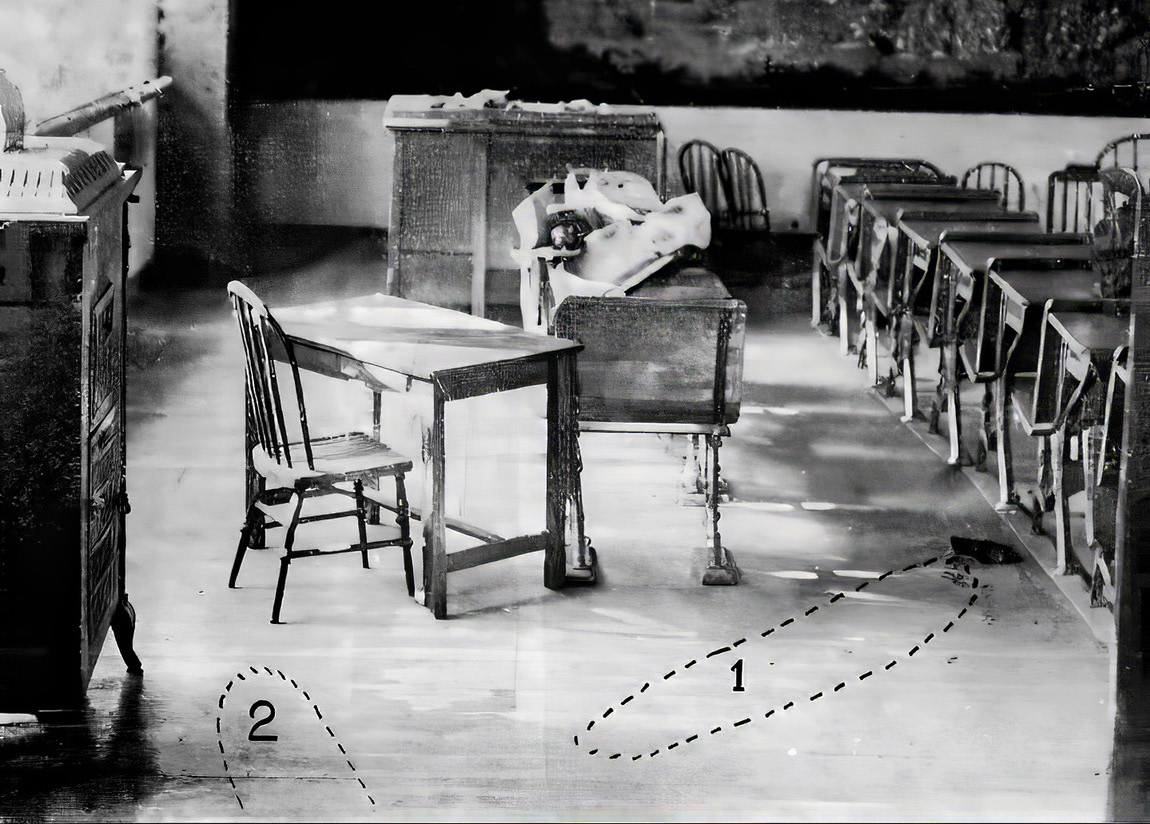
But there is more.Some accounts, and the physical evidence within the room itself, suggest that Jessie Laird did not remain seated behind her desk waiting for death to come to her. The scene tells another story. Her desk sat near the blackboard at the front of the classroom, where she had reportedly been finishing her lunch only moments earlier.
Yet when investigators marked the place where her body fell, it was not behind that desk. It was several feet away, farther out into
the room. Between those two points lies the silent testimony of movement.
She rose.
Whether it was instinct, courage, defiance, or some fierce combination of all three, Jessie Laird appears to have come forward after Ellis entered the room and announced his terrible purpose. She did not simply remain frozen in her chair. The evidence suggests motion—perhaps even a struggle. In the span of only seconds, the quiet geometry of a classroom became something
else entirely: a battleground between a determined killer and a teacher unwilling to surrender without resistance.
And that changes the meaning of what happened there. It was not merely a woman confronted. It was a teacher standing. It was a protector stepping between violence and children. When Ellis told her, “Mrs. Laird, I’ve come to kill you,” she would have understood, almost instantly, that the danger did not end with her. Behind her sat students—young boys with nowhere to go but the door, and only seconds in which to reach it.
If she moved toward him, if she engaged him, if she interrupted even briefly the awful momentum of his plan, those seconds might become enough.
Enough for children to escape.
Enough for panic to turn into motion.
Enough for life to outrun death.
And so, according to the indications left behind in that room, Jessie Laird advanced.
Perhaps she charged him outright. Perhaps she tried to seize the weapon. Perhaps she simply refused to retreat and forced his attention onto her and away from the children behind her. We cannot know every detail of those final moments. But we do
know this: she did not die where she had been sitting. She died forward of that position, closer to him than before.
That matters. Because courage is often misunderstood. People imagine courage as grand speeches, fearless certainty,
or heroic plans carried out without hesitation. But real courage is usually found in a single impossible decision made in an instant. It is standing when terror says sit still. It is moving toward danger when survival says run.
The children remembered movement. They remembered fear. They remembered Ellis reaching for another gun. Jimmie Peters saw it and ran. Larry Ables saw it and ran. Others ran too. In their minds there was no doubt that more gunfire was coming.
Yet they escaped.
And one cannot look at thephysical scene, the distance between Jessie’s desk and the place where she fell, without asking whether those children escaped because Jessie Laird gave them the seconds they needed.
Seconds purchased at the highest price.
That is the true measure of what occurred in that classroom.
Selflessness.
Not the soft, sentimental kind spoken of casually after tragedy, but the hard and immediate kind that acts before thought has time to catch up. The kind that steps into danger so others may step away from it.
Bravery in motion. Courage measured in feet crossed across a classroom floor.
Measured in heartbeats.
Measured in children who made it out alive.
Patsy Hall, apparently the only child who recognized Ellis, ran to the O. L. Beard home and told Mrs. Beard what had happened. In one account, officers first learned of the shooting after Patsy ran home saying a man was fighting or screaming with her teacher. Mrs. Beard immediately telephoned the sheriff’s office and told them to go at once to Camrose school.
Larry Ables ran out the back door of the building toward home. He later said, “I was squalling.” When he reached home, he warned
his sister Ruby, who was in the fifth grade: “Ruby, you’d better not go back to school.
There’s a man up there going to kill my teacher.”
That sentence alone is almost unbearable. Not “a man killed my teacher.” Not yet. “There’s a man up there going to kill my teacher.”
In Larry’s mind, there was still time.
And perhaps—because of her—there was just enough.
But it could not.
Charles Payne appears to have been the last child out of the room. He made it only as far as just outside the door, near the staircase.
From there, he heard Jessie scream.
Then he heard the shot.
The other children, already outside on the playground, also heard the scream and the shot. The newspaper accounts later differed
in dramatic emphasis.
Some outside reports said the teacher was shot in front of pupils as they watched. The more detailed local account made clear that all of the children had fled before the first shot was fired, though Charles was still just outside the room and the others were
close enough to hear. That distinction matters factually, but not morally. Whether they saw the shot or heard it from a few yards away, the children were witnesses to the thing itself. They heard the words. They saw the gun.
They ran from the room.
They heard her scream. They heard the shot that ended her life.
Inside the classroom, Jessie Bell Laird was struck through the heart. One account described the wound as to the right breast. The
Madill Record reported that Ellis shot his estranged wife through the heart and that she died instantly. She fell near the door of the room. Then Ellis turned the gun on himself.
He fired into his own head.
He did not die immediately.
When officers arrived, he was still alive, lying in a pool of blood a few feet from Jessie.
The revolver, identified in the local account as a .38 caliber pistol, lay on the floor nearby.
A .410-gauge shotgun stood against the wall just inside the door. It was loaded but unfired. Extra shells to fit it were found in Ellis’s pockets.
The shotgun was later determined to be one missing from the office of the city police station since Tuesday morning and was identified by Dick Perryman, the fire chief. Two shots had been fired from the pistol.
Only two.
One took Jessie’s life. One ended Ellis’s.
Sheriff Joe Everett and Constable Jim Evans reached the building within minutes of Mrs. Beard’s call. At first glance, the school seemed deserted.
That image deserves to be held for a moment.
A school building at noon, suddenly emptied of sound. No recitation. No laughter. No shuffling of feet. The children gone. The teacher dead. The man who killed her dying. The little room still decorated for February holidays, the lunches still lying on the desks.
Then the officers saw Jessie’s body near the door and Ellis lying close by.
The investigation was conducted by Sheriff Everett, County Attorney O. C. Barnes, Justice of the Peace Charlie Grider, and Constable Evans. There were no eyewitnesses to the actual firing of the shot, in the strict sense, because the children had run
out before the first shot. But there was no real mystery.
The children had heard his words. They had seen the weapons. The officers found the bodies, the pistol, the loaded shotgun, the shells, and the fired revolver. The prior divorce petition and restraining order supplied the grim context.
Sheriff Everett reached the only conclusion the evidence allowed. Both deaths were at the hand of Ellis Laird. The motive was fixed as the outcome of family troubles. Other newspapers quoted the sheriff as saying there was “no need for a coroner’s inquest.” Another account recorded his words even more bluntly: “This needs no coroner’s inquest.
It is an open and shut case of murder and suicide.”
That was the official ending.
But official endings are often the thinnest part of human stories.
The legal file could say murder and suicide. The newspaper could print the names. The sheriff could close the investigation. But
none of that restored Jessie to her daughters. None of it erased the sound from Charles Payne’s memory.
None of it unmade the sight of those half-eaten lunches, the paper flowers, the toy pistols on the desk, the loaded shotgun against the wall.
Miss Martha Carter, the Camrose principal, was deeply shaken. She said Jessie had not discussed her personal affairs with other
teachers. Whatever fear she carried about Ellis and the divorce, she had not openly expressed it at school. Yet Miss Carter knew enough to say that Ellis had been around the school before, trying to find out when Jessie would be alone. One outside account quoted her as saying, “He has been around here before just to find out when she would be alone on duty.”
She added, “We knew he was bothering her but Mrs. Laird never discussed her problems with us.”
That is one of the most painful features of the case.
People knew something was wrong. The court knew enough to issue a restraining order. The school knew Ellis had been coming around.
Jessie knew enough to file for divorce and allege a death threat. But in 1947, the machinery of protection was thin. Domestic violence was still treated too often as a family matter until it became a funeral matter. The warning signs were there, but the old world did not yet have the language, habits, or systems to gather them into prevention.
Jessie Bell Laird stood, at that moment in her life, not at an ending but in the midst of a continuation. Her place in the Madill schools was new, but her calling was not. She had already spent years in the classroom, moving from one school to another, building her craft, earning the quiet confidence that comes from standing day after day before young minds. Those who knew her did not see a beginner— they saw a teacher. And even then, she was not finished becoming what she intended to be.
She was still reaching forward— still tied, in a very real way, to books and coursework and the long, patient work of completing her degree. That goal lay just ahead of her, not in some distant, uncertain future, but within reach. It was marked out on the calendar of her life with a kind of quiet certainty. Summer was coming. The work she had invested in herself was nearing its fulfillment.
That is what deepens the loss beyond the moment itself.
Jessie was not simply living out her days in routine.
She was moving toward something—refining, improving, shaping the life she had chosen. At forty-one, with two daughters and a marriage that had come undone, she had not retreated. She had pressed forward. She had continued to teach, to study, to build.
There is a particular cruelty in that—to be so near to a long-sought milestone, to have the line of one’s life stretching forward in clear purpose, and then to have it severed, not by time or illness, but by violence.
Her future was not abstract. It had direction. It had intention. It had a season waiting for it.
It was a future that would never arrive.
Her students adored her.
Miss Carter described her as one of the school’s most popular and excellent teachers.
Larry Ables put it in the simpler and purer language of a child: she was the “goodest teacher in the whole school.”
Then came the question that should be preserved in any telling of this story. After recounting what he saw, after describing the man and the gun and the running, Larry asked, “Who’s going to be my teacher now?” His chin began to quiver, and his eyes filled
with tears.
That question is the child’s version of the whole tragedy.
Adults could speak of divorce, restraining orders, murder and suicide, funeral arrangements, survivors, and court filings. Larry had one question.
His teacher was gone.
Who would teach him now? In the days that followed, the town buried its dead, though not in the same way and not with the same
meaning.
Ellis Laird’s service was set for 2 o’clock Friday afternoon in the Watts Funeral Chapel. The Rev. D. L. Riley was to conduct it, with
burial in the Madill Legion Cemetery. The account reads more like an arrangement than a public mourning. It was not, in the sense communities often think of funerals, a celebration of a life or a gathering around innocence lost. It was the necessary disposal of the dead, the formal service due to a man who had family still living, but whose final act had made ordinary tribute nearly impossible. He was survived by his elderly mother, Mrs. A. A. Laird, who was 89; by sisters Mrs. Lula Dunn, Miss Clara Laird, Mrs. Edith Hathaway of Tishomingo, and in another account Mrs. Jack Cartland; by brothers John Laird of Madill and Pat Laird of Hot Springs, Arkansas; by his son Edwin Laird of Denison, Texas; by his daughter Maxine Laird of Los Angeles; and by the daughters he had with Jessie, Mildred and Jane. But whatever words were spoken over Ellis, they could not escape the shadow of what he had done. Jessie’s funeral was different. Her services were set for 10:30 Saturday morning at the First Presbyterian Church, where she was a member. Dr. R. M. Firebaugh, head of the Goodland Presbyterian School at Hugo, was to come from Houston,
Texas, to conduct the service.
That detail says something about Jessie’s place in the Presbyterian educational world and about the regard in which she was held. She was not simply buried as a victim. She was mourned as a teacher, a churchwoman, a daughter of the Bells, a mother, a woman whose life had been taken while she was doing her duty.
Her survivors included her two daughters, Mrs. Mildred Wilhite and Jane Laird; her parents, Mr. and Mrs. W. R. Bell; her brothers, Leslie Bell and Billie Bell of Madill; and her sisters, Mrs. Zell West of Bokchito, Mrs. Ira Smith of Oakland, California, and Mrs. Helen Dennis of Dallas.
One can imagine the difference between those two services. On Friday, the town had to reckon with the man who carried death into a classroom. On Saturday, it gathered around the woman he killed there. The first service belonged to necessity.
The second belonged to grief. And what grief it must have been.
A mother gone. A daughter gone. A sister gone. A teacher gone. A woman who had tried to free herself through lawful means gone. A woman who had told the court she had been threatened gone.
A woman who, in her last recorded words, tried to protect the children in her care.
There is a terrible poetry in the objects left behind: the sandwich, the tomato, the banana, the paper flowers, the little desks, the toy pistols, the loaded shotgun, the revolver, the restraining order, the unfinished degree.
Each one tells part of the story. Together, they form a kind of still life of innocence and violence occupying the same room.
The children had come to school that morning expecting lessons. They left with memory.
Jimmie Peters, Roy Reese, Charles Payne, Larry Ables, Martha Nell Cryer, Jerry Harp, and Patsy Hall became part of the record
because a man brought his domestic rage into their classroom. They were not the intended victims, but they were victims all the same. The newspaper accounts noted that the children were not molested, as though that were a mercy. And in the narrowest physical sense, it was. Ellis did not shoot them. He did not stop them from fleeing. But childhood is not protected only by keeping the body alive. Childhood is also protected by keeping certain knowledge away as long as possible.
Those children learned something that day that no lesson plan could contain. They learned that a schoolroom door could open and death could enter. They learned that a teacher could be there one moment and gone the next. They learned that adult anger could become a weapon. They learned that even a court order might not be enough. They learned the sound of a woman screaming and a pistol firing inside a first-grade classroom.
Time moved on, because time always does. Camrose Elementary eventually returned to the business of school. Another teacher stood before the children. The desks were cleaned. The lunches were removed. The paper decorations came down. Valentine’s
Day passed. Washington’s Birthday passed.
Spring came. Summer came. The degree Jessie Bell Laird had expected to receive that summer went unclaimed by the woman who had earned her way toward it.
But the day remained. \February 5, 1947, stands in Marshall County history as a singular wound. It was the day domestic violence crossed the threshold of Camrose Elementary School. It was the day a private terror became a public horror. It was the day Jessie Bell Laird— first-grade teacher, mother, daughter,sister,student,and church member—was killed by the husband she had gone to court to escape.
The record calls it murder and suicide.
That is accurate. But it is not enough. It was also a failure of safety. A collapse of restraint. A warning spoken and written, yet unable to hold back what was already set in motion. It was a classroom emptied by fear. It was a little boy crying as he ran home. It was a principalstandinginstunned disbelief. It was a sheriff entering a room where ordinary life had been violently broken apart. It was two daughters losing both parents in a single terrible afternoon.
And it was a community forced to learn, in the hardest possible way, that violence does not always remain wherepeoplehopeitwillstay.
In 1947, such a thing felt unthinkable. It stood outside the ordinary understanding of how the world worked. Men and women might quarrel. Marriages might fail. But the schoolhouse—the classroom—was believed to stand apart from all that. What happened at Camrose shattered that belief. It was spoken of then as something rare, something almost beyond comprehension.
And yet, with the passing of years, the terrible truth has revealed itself.
What seemed unthinkable then has, in our own time, become something we recognize all too readily. The names change. The places change. The headlines fade and are replaced by others. But the pattern returns. Violence born in private does not always remain private. Sometimes it follows its victim into the very places meant to be safest. Sometimes it walks through the schoolhouse door.
There is a hard and sorrowful lesson in that.
Butthereisanotherlesson there too.
For all the horror of that afternoon, the final image left behind is not one of surrender.
JessieLairddidnotsimply wait for what was coming. In the last moments of her life, she rose to meet it. That instinct—to protect, to shield, to confront danger rather than retreat from it—was the same instinct that had led her into a classroom in the first place. A teacher’s life is built around standing between children and harm, and it appears that even in the face of death itself, she did exactly that.
Not with speeches. Not with ceremony. But with action. Measured in seconds. Measured in movement. Measuredinthenarrowmargin of time in which frightened childrenfoundtheirway out of the room alive.
That is why her story still lingers after all these years. Not merely because of the brutality of what happened, but because of the character revealed in the middle of it. Fear entered that classroom with a gun in its hand. But it did not find Jessie Bell Laird cowering behind a desk.
It found her standing. And perhaps that is the truest ending to this story.
Not the gunshot. Not the silence afterward. But the simple and defiant fact that, when the moment came— She rose from her desk.