
For the past several weeks, we have been walking through the life and courtroom career of Charles Arthur Coakley, one of the great trial lawyers to pass through Marshall County. That series is not finished. Not by a long shot, as there is more to tell and Coakley deserves to have it told right. But this week, I am going to lay the Lion of the Courtroom aside for a short while.
The reason is simple enough. Earlier this week, on Monday, June 15, I underwent cervical spine surgery. Nothing about that sentence sounds especially pleasant, and I will not pretend otherwise. Surgery has a way of moving everything on the calendarforwardandmaking ordinary days feel suddenly crowded. In the days leading up to it, I tried to get several matters at work finished and tied down, delegated or at least placed where they would not come loose while I am out for a few weeks. Whenyouknowyouaregoing to be away from your desk, even for a short time, every unfinished matter seems to raise its hand at once.
Between preparing for surgery last week, trying to get work matters tied down and now beginning the recovery process, I simply have not had the time or focus necessary to finish the research needed to do the next chapter of Coakley’s story justice.
And if a story is worth telling, it is worth telling right.
So, this week, rather than force a half-finished article into print, I decided to return to one of the most popular stories I have written for this paper. A story that has captured the imagination of hundreds of readers. It is a story that sounds almost too wild to belong to Marshall County history. But it does. It is not a legend in the distant sense. It is local memory. It is the story of a June night in 1933, when two of the most infamous criminals in American history rolled into Madill in a stolen moment of darkness, fear and gasoline fumes.
Their names were Bonnie Parker and Clyde Barrow.
By the time they came through Madill, they were already wanted fugitives. The federal government had entered the chase. Lawmen across several states knew their names. Newspapers were beginning to turn them into legend, though the truth was far uglier than the legend. They were not romantic rebels. They were not misunderstood young lovers being chased by a cruel world. They were thieves, kidnappers and killers. They lived in stolen cars, carried stolen guns and left behind widows, grieving families, terrified witnesses and dead lawmen.
But on the night of June 8, 1933, they were not yet ghosts on a Louisiana road. They were flesh and blood. Dangerous. Armed. Tired. Desperate. Running.
And for a brief time, they were here.
This is the expanded story of the night Bonnie and Clyde came to Madill.
Clyde Chestnut Barrow was born in 1909 to a poor farming family in Ellis County, Texas,southeastofDallas. His family later moved to West Dallas, where poverty was not merely a hardship but a way of life. It settled over people like dust. Families lived in rough houses andmakeshiftshelters.Work was scarce, and money was scarcer. Boys who grew up there learned early that the world was not inclined to give them much.
But poverty alone did not make Clyde Barrow what he became. Most poor boys did not become murderers. Most did not pick up guns, steal cars, rob stores or shoot their wayacrossthecentralUnited States. Clyde made choices. Bad ones. Repeatedly. And with each choice, the road narrowed.
Bonnie Elizabeth Parker was born in 1910 in Rowena, Texas. She was small, pretty and intelligent, and by all accounts had a taste for poetry and drama. There was something theatrical about her, a draw to attention, words and performance. Had life taken a different turn, she might have been remembered by a few classmates as a girl who wrote poems, smiled for photographs and dreamed of a larger world. Instead, she became one-half of the most infamous outlaw couple in American history.
In her second year of high school, Bonnie met Roy Thornton. The couple dropped out of school and married on September 25, 1926, just six days before Bonnie’s sixteenth birthday. Their marriage was troubled almost from the start. Thornton wasoftenabsent,unfaithful and in trouble with the law. They never divorced but the marriage was over in every practical sense by January 1929. Bonnie was still wearing Thornton’s wedding ring when she died.
BonniemetClydeonJanuary 5,1930,atthehomeofone of Clyde’s friends. Both were immediately drawn to each other. The old story is that Bonnie joined Clyde because she had fallen in love with him. That is probably true as far as it goes but it is too soft a description of what followed. Love may explain why she went with him but it does not excuse what they did.
Less than a month after they met, Clyde was arrested at Bonnie’s mother’s home on suspicion of committing burglaries in the Waco area. He was convicted and sent to prison. While being held in the Waco County jail, Clyde escaped after Bonnie smuggled a weapon to him. He was soon recaptured and after that, the court system lost patience with him. Clyde was eventually sent to the Eastham Prison Farm. Eastham changed him.
Prison did not reform Clyde Barrow. It hardened him. Eastham was a brutal place and Clyde left it with a hatred that never cooled. He later helped stage the January 1934prisonbreakthere,a bloody act of revenge against the institution he despised. But long before that, his time at Eastham seemed to burn away whatever restraint he had left.
Clyde was paroled in February 1932. From that point forward,heandBonniebegan the crime spree that would carry them across Texas, Oklahoma, Arkansas, Missouri, Iowa, Louisiana and other states. Over a period of a little more than two years, the Barrow Gang would be tied to numerous robberies, burglaries, kidnappings, stolen cars and the deaths of law enforcement officers and civilians.
They were not polished public enemies. That came later, after the photographs and newspaper stories and movies. The real Bonnie and Clyde were ragged, dirty, underfed, heavily armed and constantly hunted. They slept in stolen cars, rented rooms, abandoned cabins and roadside camps. They hid in brush and fields. They carried weapons taken from armories and lawmen. They moved at night. They crossed state lines. They changed cars as often as other people changed shirts.
Cars were the lifeblood of the Barrow Gang, and that point cannot be overstated. Clyde Barrow’s survival depended on speed. He needed cars that could outrun county deputies, city marshals and state officers. He needed cars that could take rough roads, hard turns and long miles. He especially favored Fords. In that era, a new Ford was not simply an automobile. It was power. It was speed. It was escape. It could mean the difference between a clean getaway and a final stand at the end of a country road.
That is one reason the Madill story matters.
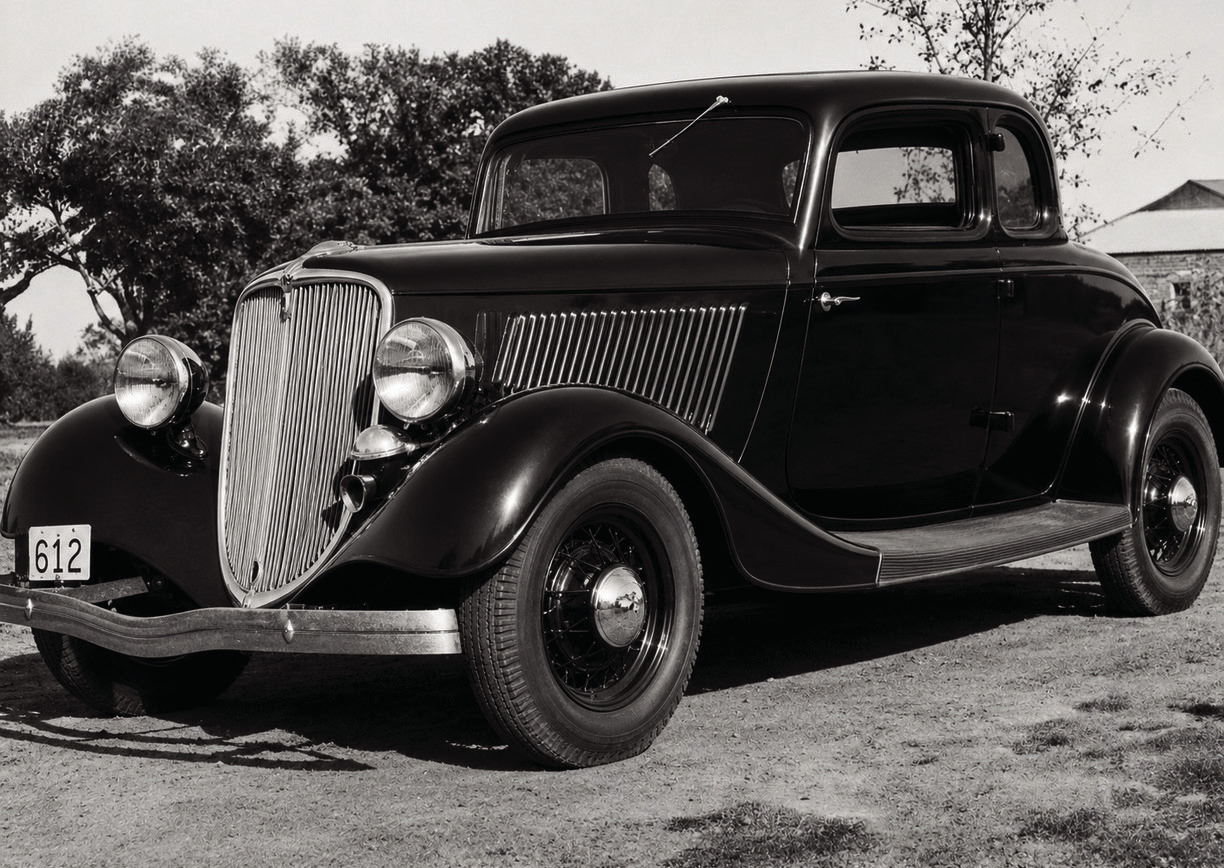
The car stolen in Madill was not merely a means of transportation.ToClydeBarrow, a new Ford Coupe was a weapon of flight. It was cover. It was an opportunity. It was another night of distance between him and the law.
Only weeks before Bonnie and Clyde arrived in Madill, the federal government had officially entered the hunt. On May 20, 1933, a federal warrant was issued charging Bonnie and Clyde in connection with the interstate transportation of a stolen automobile. That was the opening the Bureau of Investigation needed. Until then, manyofthecrimesassociated with them were local or state crimes. But stolen cars crossing state lines changed the equation. The hunt was no longer merely a patchwork of sheriffs, marshals and local police. The federal government was now involved.
So, when Bonnie and Clyde came into Madill on June 8, 1933, they were not simply two thieves passing through a small town. They were wanted fugitives inside agrowingnationalmanhunt.
In 1933, Madill was a very different place from the Madill we know today. It was a courthouse town in the middle of the Great Depression. The roads were fewer. The lights were dimmer. Highway 70 mattered. Service stations mattered. A man working nights at a filling station was part mechanic, part clerk, part watchman and part witness to every stranger passing through town.
There were no patrol cars with radios linked to every other lawman in the state. There were no instant alerts, no security cameras, no cell phones, no dash cameras, no license plate readers. News traveled by telephone, telegraph, radio, newspaper and word of mouth. A town depended on its sheriff, its deputies,itsnightwatchman, its merchants and its people knowingwhensomethingdid not look right. And in a small town, people did know.
A strange face on a quiet street could be noticed. A car out of place could be remembered. A woman looking around a neighborhood as if she were waiting on someone could draw the eye of a deputy’s wife. That evening was Thursday, June 8, 1933.
Lifelong Madill resident Robert Dorsey Taliaferro, known by most as “Hux,” or as the newspaper spelled it at the time, “Huck,” stopped by the home of his friend Tom LeeScottinsoutheastMadill. Hux was no stranger passing through town. He was rooted in Madill soil.
He was the son of William Norborne Taliaferro and Mary Estelle Taliaferro. W. N. Taliaferro was one of the founding fathers of Madill. That fact gives this story a deeper local meaning. Bonnie and Clyde did not merely steal a car from an unnamed citizen. They stole a car belonging to the son of one of the men who helped build the town itself. That is the kind of detail history likes to hide in plain sight.
Hux was driving his new 1933 Ford Coupe. According to The Madill Record of June 15, 1933, it was “the new 1933 model Ford belonging to R. D. (‘Huck’) Taliaferro of the B & H Service station.” The car had been purchased from Woody Motor Company in Madill on May 5, 1933. It was barely a month old. The newspaper later reported that the car had “only about 2500 miles on it.”
A new car in 1933 was no small thing. This was the Depression. People did not casually buy new automobiles. A new Ford Coupe would have been noticed. It would have represented work, savings, pride and probably a fair amount of sacrifice. It was not just a vehicle. It was a statement that, even in hard times, a man had managed to get ahead enough to own somethingnew. Andbecause it was a Ford, it was exactly the kind of car Clyde Barrow wanted.
When Hux arrived at Mr. Scott’s residence, he did what many people in small towns did in those days. He left the keys in the car and went inside.
That small act says something about the time and the place. People did not live carelessly but they did live with a kind of trust that is harder to imagine now. In a town like Madill, a man might leave his keys in the car because he expected the car to be there when he returned. His neighbors were nearby. His friend’s house was only a short stop. Nothing about the moment likely felt dangerous. But someone was watching.
According to the story, later preserved in local memory and in FBI reports, Mrs. Joe Everett, wife of Marshall County Deputy Sheriff Joe Everett, saw a strange, small woman in the neighborhood. The woman seemed to be looking around, as if searching for something or someone. Mrs. Everett did not know it at the time but the woman was believed to be Bonnie Parker.
That image has always stood out to me.
It is not the movie version of Bonnie Parker. It is not the beret, the cigar, the staged photograph or the outlaw glamour that later generations created. It is a small woman in a southeast Madill neighborhood on a Juneevening,lookingaround while a new Ford Coupe sat nearby with the keys inside.
When Hux Taliaferro came back outside, his car was gone.
There must have been a moment of disbelief. Anyone who has ever walked out expecting to see a car and found empty space knows that feeling. First, the mind rejects it. Then it searches for another explanation. Maybe it was moved. Maybe it was parked somewhere else. Maybe this is a mistake. But it was no mistake.
TheMadillRecordsaidthe car was stolen “about 8:30” that Wednesday evening from in front of the home of Mr. and Mrs. T. L. Scott in southeast Madill. Hux had been there “only a short while when he missed his car.”
Thecarwouldnotbefound in Madill. It would not even be found in Oklahoma. It would next appear in the newspapers in connection with a wreck, two kidnapped officers, a wounded woman, machine guns, changed license plates and the names Bonnie Parker and Clyde Barrow.
That stolen Ford did not merely disappear into the night. It rolled straight into the larger Bonnie-and-Clyde story.
At about 2:00 in the morning, Harold Kenneth Jones was working double duty at the Phillips 66 filling station at Highway 70 and East Tishomingo in Madill. We know Harold’s account in his own words because his son, Kenny Jones, later recorded him telling the story on video so it would be preserved for all time. That matters. The quotes that follow are not polished lines from a movie or secondhand embellishments added years later. They are Harold’s own recollections, spokeninhisownvoice,about the night Bonnie and Clyde came into the station.
It was the kind of place that once anchored smalltown travel. Gas pumps outside. Oil cans stacked or shelved. Tires nearby. Coveralls hanginginside.Thesmell of gasoline, grease, rubber, dust and summer air. A cash register that might not hold much after the owner had already picked up the day’s receipts. Maybe a chair by the restroom. Maybe a radio. Maybe the low hum of a quiet town settling into night.
Gas was about twenty cents a gallon. That sounds almost unreal now, but in Depression-era money, even twenty cents mattered. A service station did not necessarily accumulate much cash on a night shift. A traveler might buy a few gallons and move on. A local might stop bytotalk.Atruckmightcome through. A night worker saw the town differently than everyone else. By two o’clock in the morning, the bustle of the day had long since thinned, and every arriving car meant something.
Thestationsatacrossfrom a two-story house where, in later years, Watts Funeral Home would be located. A young woman named Annette lived there then. Harold later remembered thinking about her during the encounter because she often slept upstairs and looked out the window. They were not dating, he said but they were good friends. They had eaten five-cent hamburgers together. It was the kind of small, ordinary memory that belongs to young people in a small town, and it sat strangely beside what was about to happen.
Harold said a brand-new Ford “whipped up into the driveway.” The doors opened and a man jumped out and ran inside. The man ordered Harold to sit down in front of the cash register and Harold did as he was told. Then the man reached up, grabbed a handful of Harold’s hair, twisted it and asked him the question Harold would remember for the rest of his life: “Do you want to be a hero?” Harold answered with the kind of calm that sometimes comestoamanbecause panic will do him no good. “No,” he said. “I don’t want to be a hero. I’d just kind of like to know what you want.” The man replied, “Well, I’m Clyde and that’s Bonnie out there in the car.”
There are sentences that change the temperature of a room. That was one of them. Harold was nineteen years old, alone in a filling station in the middle of the night, with a dangerous man holding him by the hair and a woman sitting outside in a brand-new stolen Ford with something in her lap. Now the man had told him he was Clyde Barrow.
Clyde then asked Harold if he knew what Bonnie had in her lap. Harold looked toward the car and saw Bonnie Parker sitting there holding what he believed was a machine gun. “Well,” Harold said, “I think it’s a machine gun. I’ve seen themon picture shows.” That answer belongs to the 1930s. In those days, gangsters and machine guns were already part of the picture-show imagination. But Harold was no longer watching a picture show. The machine gun was outside the door, in Bonnie Parker’s lap. According to Harold, Clyde confirmed it. He told Harold it was a machine gun and said Bonnie, “likes to hear it cry.” Harold understood the meaning well enough. “Well,” he replied, “she don’t have to be having trouble with me.” Again, it was the right answer.
What makes Harold’s account so powerful is not just that Bonnie and Clyde were there. It is the strange ordinariness of what happened next. There was terror in the room, yes, but there was also conversation. Clyde asked how much money was in the cashregister.Haroldtoldhim the boss had picked it up at midnight, and there was not much there. Gas was only about twenty cents a gallon, he explained, and a night shift did not build much of a cash drawer. Clyde looked in the register, found only a few coins, pulled them out, looked at them, and put them back. “I don’t need that,” he said. That little detail says something aboutClydeBarrow.He was a thief, but he was not interested in pennies. He was not robbing that Madill filling station to get rich. He wanted motion, distance, gasoline, clothes and the advantage of surprise. The cash register was almost beneath him Then Clyde noticed the slot machine. He walked over and tried to play it but the machine was jammed. When he asked what was wrong withit,Haroldexplainedthat they had been putting tires on one of the big trucks that came through from Colorado and one of the men had put a slug in the machine and pulled it until he hit the jackpot.Theslughadjammed it. Clyde did not take that well. He asked where the man lived and Harold told him, “Well, I don’t think you can find him tonight.” Clyde said he would like to kill him because he wanted to play the slot machine. There is a strange childishness in that moment but there is nothing harmless about it. Clyde Barrow was irritated because a slot machine would not work and his first spoken impulse was violence. That was the world he carried with him. Anything that crossed him, no matter how small, could become a reason for a threat.
All the while, Harold was thinking about Annette across the street. She slept upstairs in that two-story house and often looked out thewindow.Haroldlatersaid he was afraid she might look out, see something wrong and call the police or the night watchman. That would have been the natural thing to do but Harold knew what would follow. If officers had suddenly come upon Bonnie and Clyde at that station, it would not have been a quiet arrest. It would be a gunfight. With a machine gun in Bonnie’s lap, people would die. So, while Harold was worried about himself, he was also worried about others. He was worried about Annette. He was worried about the night watchman and the police. He was worried about what might happen if the wrong person looked out the wrong window at the wrong time.
Then Clyde asked about thenightwatchman.In1933, Madill’snightwatchmanwas Charlie Walker, an older man who made his rounds through town, checked doors and stopped by late-night businesses. In a small town, the night watchman was part lawman, part guardian and part familiar comfort. He was the man walking the streets while others slept. Clyde asked where he was and Harold told him Charlie Walker had been there about fifteen minutes before Clyde arrived. When Clyde asked how long it would be before he came back, Harold knew it would not be an hour. He knew Charlie might return much sooner. But he also knew Charlie Walker would have no chance against Clyde Barrow and Bonnie Parker. So, Harold lied and said it would be about an hour. That lie may have saved Charlie Walker’slife.Itmayalsohave saved others. Had Charlie walked into that station, had Annettelookedoutandcalled the law, had some local officer arrived without warning, the night could have turned into a bloodbath at the corner of Highway 70 and East Tishomingo.
Charlie did not return while Clyde was there and Harold was glad. Clyde then looked up and saw the Phillips 66 striped Unionalls hanging in the station. He was wearing what Harold described as a blue serge suit. Clyde pulled off his coat, though. After it was removed from the river, it was eventually sold to a local family in the Wellington area. For several years afterward, the maroon Ford V8 that Clyde had been driving could still be seen around town. That is one of the stranger endings to this part of the story. A car that had carried two of the most wanted criminals in America through Madill and then into a violent crash near Wellington returned to ordinary life. It became, once again, a car someone drove around town.
One can only imagine people watching it pass and saying, “That’s the Bonnie and Clyde car.”
That detail also explains why the story did not end neatly with the wreck. The Ford was no longer Hux’s in any practical sense, but it remained a rolling piece of the story. It had left Madill as a nearly new car, gone into the river as Clyde Barrow’s getaway car, and then spent years afterward moving through the streets of Wellington as a local reminder of the night the Barrow Gang came crashing into Collingsworth County history.
The Wellington Leader of June 15, 1933, reported that officers were still trying to identify the kidnappers. Associated Press had apparently suggested that the captors might have been other jail escapees, but Sheriff Corry and Marshal Hardy denied any true similarity between those photographs and the men who held them captive. Corry said the captors matchedphotographshe had of members of the Barrow family and that the men admitted to their identities.
Again, some of the early identifications were imperfect. The article referred to Clarence Barrow, Ivy Barrow, and Clyde Champion Barrow. Later reporting and historical accounts would clarify the names and participants. But the important point is that the officers believed they had been taken by the notorious Barrow men, and the papers quickly connected the auburn-haired woman with Clyde Barrow’s constant traveling companion.
The Associated Press section in The Wellington Leader listed the charges and accusations then tied to Clyde Barrow. It said he was wanted in Texas, Oklahoma, and Missouri. It mentioned charges connected to Joplin, Missouri, in April 1933, where an officer was killed and others wounded. It also referred to Atoka, Oklahoma, in August 1932, Hillsboro, Texas, Lufkin, Texas, Dallas, Wharton County, Abilene, and a bank robbery attempt at Lucerne, Indiana.
Whether every early report was perfectly accurate is less important than what it shows. By June 1933, Clyde Barrow was not an unknown criminal. His name was already traveling faster than he was.
AndBonnieParkerwasincreasingly traveling with it.
The Wellington Leader described her as an auburnhaired woman “well known to police” and said she was known as Clyde Barrow's constant traveling companion. The article noted that, at that time, she had not been charged with any offense according to available records. That too is a revealing detail. In June 1933, Bonnie was still moving in that gray space between companion, participant, symbol, and suspect. Later in history, she would become inseparable from Clyde. But in the newspapers of the moment, authorities were still trying todefineexactlywhoshewas.
The June 29, 1933, edition of The Wellington Leader shows what happened next.
By then, the men identified as the Barrows were being sought by officers and posses after what the newspaper called a “trail of terror” across northwest Arkansas. The article reported that the “machine gun desperados” had shot down an officer The car had changed license plates. And the men involved were believed to be members of the Barrow Gang.
The Madill Record of June 15, 1933, said Hux Taliaferro read about the kidnapping in the newspaper on Monday morning. After reading the account, he called Wellington and confirmed that the wreckedcarhadthesamemotor numberashisstolenFord. The tag had been changed, but the motor number told the truth.
That is another detail worth pausing over. In 1933, astolencarcouldbedisguised quickly with a different tag. And according to The Wellington Leader, the fugitives were angry because they had left behind license plates for Texas, Oklahoma, Arkansas and Kansas in the wrecked car. Those plates were more thanmetal.Theywereescape routes. They allowed a stolen car to wear different identities in different states.
The Leader reported that both officers said their captors “cursed fluently and frequently because they left license plates for Texas, Oklahoma, Arkansas and Kansas in the wrecked car and were afraid that the plates would disclose their proposed route.”
That one sentence tells the reader how Bonnie and Clyde lived.
They did not merely drive. They vanished and reappeared under different plates, different names, different cars, and different directions. They moved across state lines like foxes through a broken fence. But now the wreck had betrayed them. Their plates were scattered evidence. Their stolen car was exposed. Their route might be guessed.
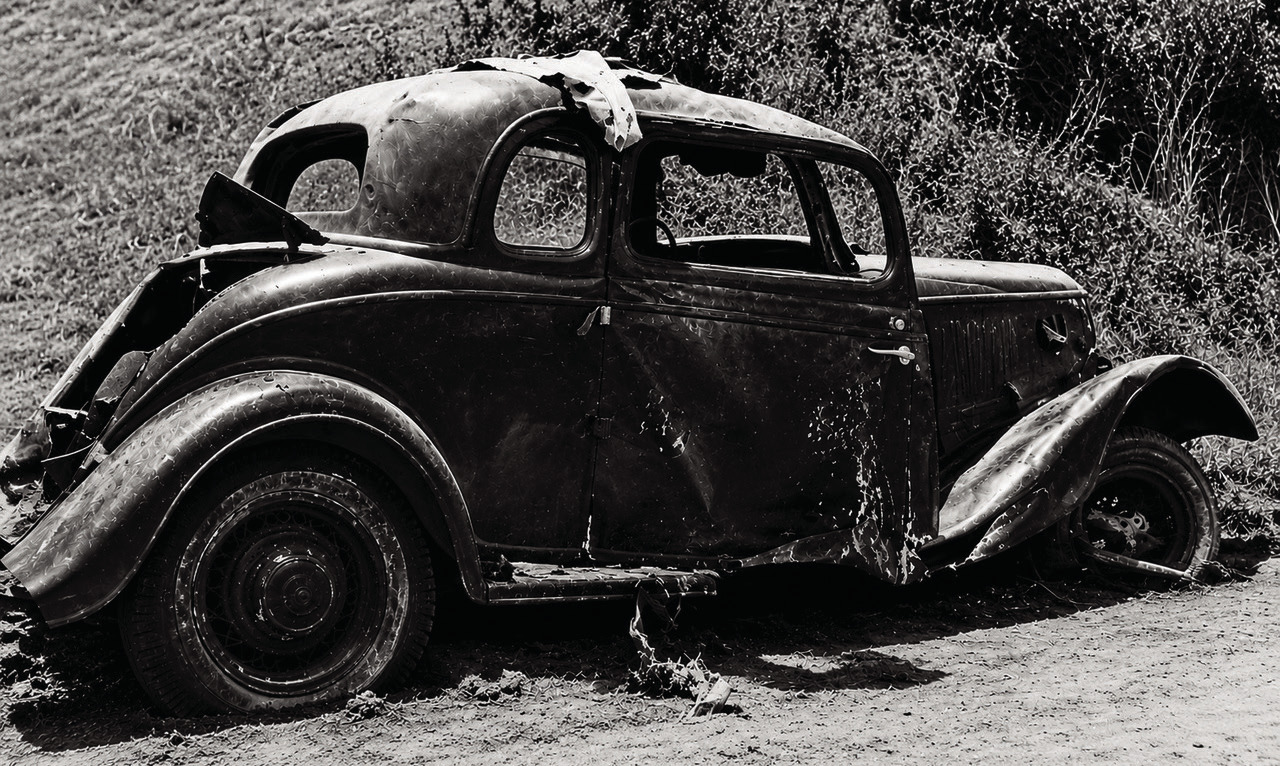
Near Wellington, road construction had changed the route. A new highway was being built near the old Wellington-Shamrock road, close to the Salt Fork River bridge. The Wellington Leader reported that the fugitives had gotten off the old road and driven onto the newhighwayunderconstruction, parallel to the old road. Speeding at more than sixty miles an hour, their coupe plunged from a thirty-foot embankment into the riverbed late Saturday night.
A thirty-foot drop at sixty miles an hour in a 1933 automobile was not a mishap. It was a catastrophe.
The car was badly damaged. The windshield was gone. The Ford was on its side near the river. The men were bruised but not critically hurt. The woman was unconscious and badly injured.
The Leader gave one of thebestaccountsthroughthe wordsofStevePritchard,who lived about 200 yards from the crash scene. He said he was sitting in his front yard when he saw the car pass at a high rate of speed. When he heard the crash, he rushed to the scene.
At first, the scene looked like a terrible accident. Pritchard found the woman unconscious. He did what decent people do. He gathered the injured woman into his arms and started toward his house.
But then mercy met machine guns.
“When I picked up the woman,” Pritchard told the newspaper,“themenreached into the car and secured the guns.”
That sentence turns the story.
One moment, Pritchard was helping crash victims. The next moment he was under the control of armed fugitives.
Pritchard carried the badly injured woman to his home. He insisted that they call a doctor or an ambulance. Themenrefused.Oneofthem reportedly said, “No. We can’t afford to have a doctor. You do what you can, and we will pay you anything you want.”
They seemed to have money, Pritchard said. But money was not the issue. A doctor meant questions. An ambulance meant witnesses. Witnesses meant lawmen. And lawmen meant the end of the road.
The Madill Record, reprinting the Tulsa World account, stated that one of the men addressed the injured woman as “Sis” and “Sweetheart.” That too is a telling detail. The men could be tender toward the woman and brutal toward everyone else in the same breath. Bonnie was hurt. Clyde was frightened for her. But his concern for Bonnie did not make him decent. It made him more dangerous to anyone standing between her and escape.
While one of the men went back to the wrecked car to get another gun, Lonzo Carter, who lived at the Pritchard home and was identified by The Wellington Leader as Pritchard’s son-in-law, slippedaway.Thenewspaper said he went to the garage, pushed the Pritchard car down a long grade, started the engine, and escaped to Wellington, where he reported the event to Sheriff George T. Corry.
That was no small act. Carter knew armed men were present. He knew they had already taken control of the house. He knew the womanwasbadlyinjuredand themenweredesperate.Still, he slipped away and carried the news to law enforcement.
While Carter was gone, Mrs. Jack Pritchard, Steve Pritchard’s daughter-in-law, came to the house. The Madill Record said she knocked at the door, and one of the desperadoes fired at her, wounding her in the hand. The Wellington Leader reported that several rounds were fired when she started to open the back door, and that her hand was wounded. There was concern that, at worst, her thumb might have to be amputated.
Bonnie heard the shot and jumped from the bed.
According to the newspaper accounts, she ran to the porch or front yard, cursing fluently, followed by her companions. The Pritchard family was ordered to lie down on the floor and keep quiet.
The house had become a trap.
Sheriff George T. Corry andCityMarshalPaulHardy arrived at the Pritchard place around 11:10 or 11:30 that night. They parked and entered through the rear door.
Sheriff Corry later said Bonnie was lying across the bed and seemed to be in serious condition. Mr. Pritchard was sitting in a chair. Corry asked where the men were. Pritchard pointed toward the front yard and said, “Out there.”
Corry thought they were probably a couple of drunks.
That assumption nearly killed him.
He picked up a lamp and walked out onto the porch without even drawing his gun.CityMarshalHardywas with him.
The Wellington Leader preservedCorry’saccount.As soon as the officers stepped onto the porch, the men commanded them “to put ’em up and put ’em up high.” Two submachine guns were trained on them.
Corry and Hardy complied.
Thenewspapersdescribed the moment with the plain terror it deserved. The officers had walked into the dark expecting disorder. Theyfoundthemselvesfacing machine guns.
The men fired random shots. Bonnie rushed from the bed to the porch and took the officers’ guns from their holsters. Corry and Hardy were then handcuffed with Corry’s own handcuffs.
The bandits took Sheriff Corry’s car. Corry was placed in the front seat. Hardy was placed in the back. Bonnie rode with them. They left the Pritchard home around 11:30 p.m. after shooting and puncturing the tires on Pritchard’s car so they could not be followed.
From there, the captors drove first toward Shamrock. According to The Wellington Leader, they reached Shamrock, went four miles on the Pampa road, turned around, and then headed onto the Erick road. Eventually, they drove toward western Oklahoma, wheretheywerejoined by another Confederate in a separate car near Sayre.
The officers were captives for hours.
The newspapers reported that the officers did not especially fear for their lives after the first terrifying moments at the Pritchard home. That is easy to say after surviving. Still, there must have been a long and terrible uncertainty in that ride. They were disarmed, handcuffed, and in the custody of armed men believed to be the Barrow brothers. They did not know whether they would be released, tied up, or shot.
Near Sayre or Erick, Oklahoma, the group met another man.
The Madill Record repeated Sheriff Corry’s statement that a confederate joined the Barrows near Erick and asked, “Are we going to kill those men?”
Clyde replied, “No, I’ve been with them so long I’m beginning to like them.”
The Wellington Leader gave a similar version: “What are we going to do with these men, kill them?” Barrow answered, “No,Ihavebeenwith them so long that I am beginning to kind of like them.”
It is a chilling line because it sounds almost friendly.
But there is no comfort in it. It shows how casually life and death were discussed in that car. Two officers lived not because of law, justice, or morality, but because Clyde Barrow decided, in that moment, not to kill them.
The officers were taken to a point several miles from Erick or near Sayre. There, according to The Wellington Leader, the confederate took the handcuffs from the steering wheel and joined the two officers together. Then he got barbed wire, spread it apart, and wired their free hands to trees.
The newspaper headline called the episode “Wired Between Trees.”
It is a phrase that belongs to another time. Hard, vivid, and exact.
After about thirty minutes, Sheriff Corry worked his hand free from the wire. The two officers then made their way to a farmhouse, where they called the Sayre sheriff to come after them. The officers later recovered Corry’s car, abandoned near the area where they had been bound. Tracks were followed for a time, but early morning traffic ruined the prints, and the trail was lost.
The Wellington Leader added one more haunting detail. Between the place where the two officers were bound and the road where the fugitives left the car, officers saw an impression whereBonniehadapparently become exhausted and had to rest.
Shehadbeenbadlyhurtin the crash. Her injuries gave officers hope that the fugitives would soon be forced to seek medical aid. That was a reasonable hope. But Bonnie and Clyde had survived by doing unreasonable things. They avoided doctors when they could. They relied on acquaintances, hideouts, and the fear they created around them.
On Wednesday, June 14, 1933, Hux Taliaferro left for Wellington to inspect what The Madill Record called “the remains of the demolished car.” That phrase says all that needs saying. The Ford that had left Madill almost new was now a wreck.
The battered car had been pulled from the Salt Fork of the Red River. It was the 1933 maroon Ford V8 that had only days earlier been Hux Taliaferro’s nearly new car in Madill. But after seeing what remained of it, Hux decided not to take it back. That is easy to understand. The car had been stolen, driven by Bonnie Parker and Clyde Barrow, crashed into the river, and tied forever to kidnapping, machine guns, and bloodshed.
The car did not disappear, slipped into the Phillips 66 uniform and said, “I’ll just take these.” They happened to be Harold’s. That was not justachangeofclothes.Itwas a disguise. A man in a blue suit might be remembered. A man in filling-station coveralls could be mistaken for a worker, a mechanic or someone who belonged around cars and gasoline. Clyde Barrow understood the value of looking ordinary.
Harold said Clyde stayed around for a while and seemed determined to impress him. In Harold’s words, Clyde “wanted to really impress me that he was Clyde, and that was Bonnie.” That rings true. Criminals often wanttwothingsthatdonotfit together. They want to hide, and they want to be known. They want to escape but they also want their names remembered. Clyde had just stolen a new Ford and was moving through a dark Oklahoma town in the middle of a federal manhunt but he still wanted a nineteen-year-old filling-station attendant to know exactly who he was.
While they sat there, Harold noticed Clyde looking at the large screwdriver in the side pocket of Harold’s coveralls. Harold sensed that the screwdriver bothered Clyde, as though Clyde thought Harold might grab it as a weapon. Perhaps Clyde simply did not like anything sharp within reach. Either way, Harold understood that the screwdriver had become dangerous not because of what it was but because of what Clyde imagined it could become.
So, Harold did another smart thing. He asked Clyde to remove the screwdriver from his pocket and put it somewhere else.
Clyde reached over, took the screwdriver and put it aside. That seemed to reassure him. Harold had made it clear he was not looking for trouble. He was not going to fight. He was not going to be a hero. He was going to survive. And he did.
After a time, Charlie Walker did not return. Clyde finally got up and started toward the door. As Clyde was leaving, Harold asked him, “Do you need any gas?”
That question almost sounds absurd under the circumstances but it was also practical. Harold was still a service station attendant. A car was outside. A man was leaving. The habits of ordinary life held even in the presence of danger.
Clyde looked back and said, “No. It’s full. We just stole it down the road there.” He pointed toward southeast Madill.
ThenClydeBarrowwalked out of the Phillips 66 station, got into Hux Taliaferro’s stolen Ford Coupe with Bonnie Parker and drove away into the dark.
Harold remembered Clyde’s appearance clearly. He said Clyde was darkheaded, with his hair slicked back the way men often wore it then. He thought Clyde weighed about 165 pounds and said that, to him, Clyde “wasn’t such a bad-looking man.” Bonnie made less of an impression, partly because Harold saw her mostly from the back and partly because, as he plainly admitted, he was too afraid of the machine gun. He remembered her hair as a kind of reddish color, what he called “tingey red.” He did not think she was especially attractive but he also did not spend much time studying her. Under the circumstances, that was understandable. His attention was on the gun.
Years later, Harold saw one of the so-called Bonnieand- Clyde cars on display in Oklahoma City. He asked about it, wanting to know if it was the car that had come to the Phillips 66 station in Madill. He was told it was not. The man showing the carsaidClydehadmentioned “the boy” connected with the car in Madill and said the car Haroldwastalkingaboutwas being shown down in Texas. Whether that showman’s statement was true or just part of the old carnival trade that grew up around Bonnie and Clyde relics is hard to know. After Bonnie and Clyde were killed, cars, guns, clothingandsupposedoutlaw artifacts were displayed for money across the country. Some were real. Some were not. The legend became its own business.
But Harold ended the story preserved by his son Kenny with one final plainspoken line: “I never did get my Unionall back.” That is the kind of detail no novelist could improve. Bonnie and Clyde came to Madill in a stolen Ford, armed with a machinegun,alreadywanted by the law and moving toward the crash that would cripple Bonnie for the rest of her life. They frightened a nineteen-year-old fillingstation attendant, may have come within minutes of killing an old night watchman and stole a set of Phillips 66 Unionalls on their way out of town. Because Kenny Jones recorded his father’s account, Harold’s voice remains part of Marshall County history, telling us not merely that Bonnie and Clyde came to Madill, but what it felt like to be there when they did. Then Clyde Barrow walked out of the Phillips 66 station, got into Hux Taliaferro’s stolen Ford Coupe with Bonnie Parker and drove away into the dark.
For Madill, that might havebeentheendofthestory. A stolen car. A terrifying encounter. A young man lucky tobealive.Anightwatchman who never knew how close he may have come to death.
But for Bonnie and Clyde, the road continued.
AndthestolenMadillFord was not done making history.
Two days later, on the eveningofSaturday,June10, 1933, Bonnie Parker, Clyde Barrow and another man wereinthatsamestolenFord Coupe, speeding through Collingsworth County, Texas, near Wellington.
At the time, the newspapers did not have every name right. Early reports identified the men as Clyde Champion Barrow and Ivy Barrow, also known as Buck Barrow. Later accounts of the Barrow Gang generally identify the three people in the wrecked car near Wellington as Clyde Barrow, Bonnie Parker, and W. D. Jones. That kind of confusion was common in the first hours and days after an event like this. The newspapers were working with what officers and witnesses knew at the time, and in those days, factsmovedmoreslowlythan rumors.
But the central facts were clear.
A new Ford Coupe, believed to be Hux Taliaferro’s stolen car from Madill, had plunged off an embankment near the Salt Fork of the Red River. Two armed men and an injured woman were involved. Two Wellington officers were kidnapped.
at Alma, Arkansas, beaten a woman who defied them, and spread fear through the Ozark hills.
The same article reported that a woman treated by a physician at a tourist camp in Fort Smith, Arkansas, was believed to be the same woman injured in the wreck near Wellington. That fits with the broader history of Bonnie’sinjury. After theSalt Fork crash, she needed treatment. The gang could not safely take her to a hospital, but they could not ignore her wounds either.
The June 29 article reported that the men and another companion had stayed at a tourist camp in Fort Smith for a week before two of them went to Fayetteville, robbed a store, and shot and seriously woundedMarshalH.D. Humphrey of Alma when he attempted to intercept them. The article further said they fired at motorists along the road with a submachine gun, stole cars, and attempted to kidnap a couple during their flight.
Thisis where the romantic fog around Bonnie and Clyde must be burned away.
They were not charming rogues. They were “machine gun desperados,” to use the newspaper’s own phrase. They left fear behind them in every direction. Those who helped them often did so under duress. Those who crossed them risked being beaten, shot, kidnapped, or killed.
After the Wellington crash, the Barrow Gang’s road only grew bloodier and shorter.
Bonnie’s injury slowed them and complicated everything. She was burned, weak, and in pain. That meant hiding places had to last longer. Movements had to be adjusted. Clyde had to think not only about escape but also about caring for Bonnie. But none of that softened the gang. If anything, it made them more desperate.
In July 1933, the gang was involved in another major confrontation at the Red Crown Tourist Court near Platte City, Missouri. Law officers closed in. A gunfight erupted. Buck Barrow was wounded in the head. Blanche Barrow was injured. The gang escaped again, but they were no longer simply running. They were bleeding.
From there they made their way to Iowa.
In late July 1933, the gang camped near Dexfield Park, an abandoned amusement park area near Dexter, Iowa. By then, they were in miserable condition. Buck was badly wounded. Bonnie was still suffering from the burns she received after the wreck of Hux Taliaferro’s Ford. The others were exhausted. They were hiding, but they were also leaving signs behind. Bloody bandages. Suspicious movements. People noticed.
Local officers and a large posse eventually surrounded them.
A shootout followed. Clyde, Bonnie, and W. D. Jones escaped on foot. Buck and Blanche Barrow were captured. Buck was gravely wounded and died a few days later in an Iowa hospital. Blanche survived, but her life with the gang was over.
The gang was shrinking. W. D. Jones later left and was captured. Others came and went. But Clyde and Bonnie were not finished.
On January 16, 1934, Clyde helped stage the prison break at Eastham Prison Farm, the same Texas prison system he hated so deeply. Raymond Hamilton and others escaped. A prison guard was killed. This was one of the acts that intensified the pursuit of Bonnie and Clyde and hardened law enforcement’s determination to end the gang.
Then came April 1, 1934, near Grapevine, Texas, where two Texas highway patrolmen were killed. Those killings shocked the public and added to the already growing outrage.
Five days later, on April 6, 1934, the Barrow Gang returned to Oklahoma history in blood.
Near Commerce, Oklahoma, Constable William “Cal” Campbell and Police Chief Percy Boyd encountered members of the gang. Campbell was killed. Boyd was wounded and taken captive. He survived and later gave testimony about what happened.
That killing was among the last in the Bonnie and Clyde crime spree. By then, there was no romance left even for those inclined to romanticize them. There were only bodies, stolen cars, grieving families, and lawmen determinedtostopthem.
Then came May 23, 1934. That morning, on a rural road in Bienville Parish, Louisiana, officers lay in ambush. The posse included Texas and Louisiana lawmen who knew Bonnie and Clyde were expected to pass that way. When the outlaw couple drove into the trap, the officers opened fire.
In a matter of seconds, Bonnie Parker and Clyde Barrow were dead.
The legend began almost immediately.
That has always been one of the strange things about Bonnie and Clyde. The legend is cleaner than the truth. The legend has music, photographs, fast cars, doomed romance, and Hollywood lighting. The truth has dead officers, terrified service station attendants, kidnappedlawmen,wounded bystanders, stolen cars, and families who never got their loved ones back.
The truth has Harold Jones sitting in a chair by the restroom at a Phillips 66 station in Madill while Clyde Barrow asks him if he wants to be a hero.
The truth has Charlie Walker,anoldernightwatchman, walking his regular route without knowing how close danger came to him that night.
The truth has Hux Taliaferro, son of one of Madill’s foundingfathers,walkingout of Tom Lee Scott’s home and finding empty space where hisnewFordCoupehadbeen.
The truth has Mrs. Joe Everett seeing a strange, small woman looking around a southeast Madill neighborhood before the car disappeared.
The truth has Steve Pritchard running to help crash victims and finding himself under the shadow of machine guns.
The truth has Lonzo Carter slipping away to summon help.
The truth has Mrs. Jack Pritchard being shot in the hand for walking into her own family’s crisis.
The truth has Sheriff George Corry walking onto a porchwithalampinhishand, thinking he was dealing with drunken boys, and instead staring into the muzzles of submachine guns.
The truth has Corry and Hardy wired between trees with barbed wire in the Oklahoma darkness.
The truth has Bonnie Parker burned, exhausted, andforcedtorestbetweenthe place where the officers were boundandtheroadwherethe gang abandoned Corry’s car.
And the truth has Hux Taliaferro traveling to Wellington to bring home the remains of a Ford that had left Madill nearly new and returned as wreckage.
Marshall County’s piece of that history came on June 8, 1933.
It came quietly at first. No gun battle. No sirens. No newspaper photographer. No posse. Just a new Ford Coupe, a small-town visit, and a woman watching.
Then it moved to the Phillips 66 station at Highway 70 and East Tishomingo, where Harold Jones had the misfortune to be working late and the good sense to survive.
Harold did not overpower anyone. He did not reach for the screwdriver. He did not challenge Clyde. He did not call Bonnie’s bluff. He did not try to save the cash register. He did not try to be a hero.
And because he did not try to be a hero, he lived to tell the story.
There is wisdom in that too. Courage is not always noise. Sometimes courage is silence. Sometimes courage is knowing when not to move. Sometimes courage is telling a dangerous man what he needs to hear while quietly protecting someone else. Harold’s lie about Charlie Walker’s return was not cowardice. It was clear thinking under pressure. It may havebeenthemostimportant thing he did that night.
Today, there is a historical marker near Wellington, Texas, close to where Bonnie and Clyde took their Red River plunge in Hux Taliaferro’s stolen Ford. That is fitting. The crash was important. It changed the course of Bonnie Parker’s life and marked the beginning of the gang’s final, brutal year.
But there is no marker in Madill.
Nothing in southeast Madill to tell where Hux’s car was stolen.
Nothing at the old corner of Highway 70 and East Tishomingo to tell passersby that a nineteen-year-old service station attendant once sat across from Clyde Barrow and lived to tell about it.
Nothing to mark the place where Madill’s night watchman might have died had Harold Jones not thought quickly under pressure.
Nothing to tell that the son of one of Madill’s founding fathers had his new Ford stolen by the most infamous outlaw couple in America.
But not all history is carved in stone.
Some history survives because families tell it. Because old men remember. Because old newspapers yellow but do not quite fall silent. Because somebody’s grandfather or uncle or neighbor once said, “I was there,” and the story was passed from one generation to the next like a pocketknife, worn smooth by time but still sharp.
That is the kind of history this is.
For most of America, Bonnie and Clyde belong to wanted posters, newspaper headlines, old photographs, and later, Hollywood. But for one night in June 1933, they belonged to Madill. They came through town in a stolen car, armed and dangerous, with the federal governmentbehindthemand death waiting somewhere down the road.
They were not yet the bullet-riddled bodies on a Louisiana road. They were not yet the legend. They were simply two desperate criminals in a stolen Ford, moving through the night, looking for distance.
And then, just as quickly as they came, they were gone.
All that remained were the memories of Hux Taliaferro, Harold Jones, Charlie Walker, Mrs. Joe Everett, and the families who never forgot the night Bonnie and Clyde came to Madill.
As for the Lion of the Courtroom series, I have not abandoned it. If I am able, we will return to Charles Arthur Coakley next week and continue following the trail of one of the great trial lawyers in Marshall County history. If surgery and recovery have other plans, then we may revisit another older piece, or perhaps take up something a little less research-intensive until I am back in fighting shape. Either way, the old stories will still be here. They have waited this long. They can wait one more week.