
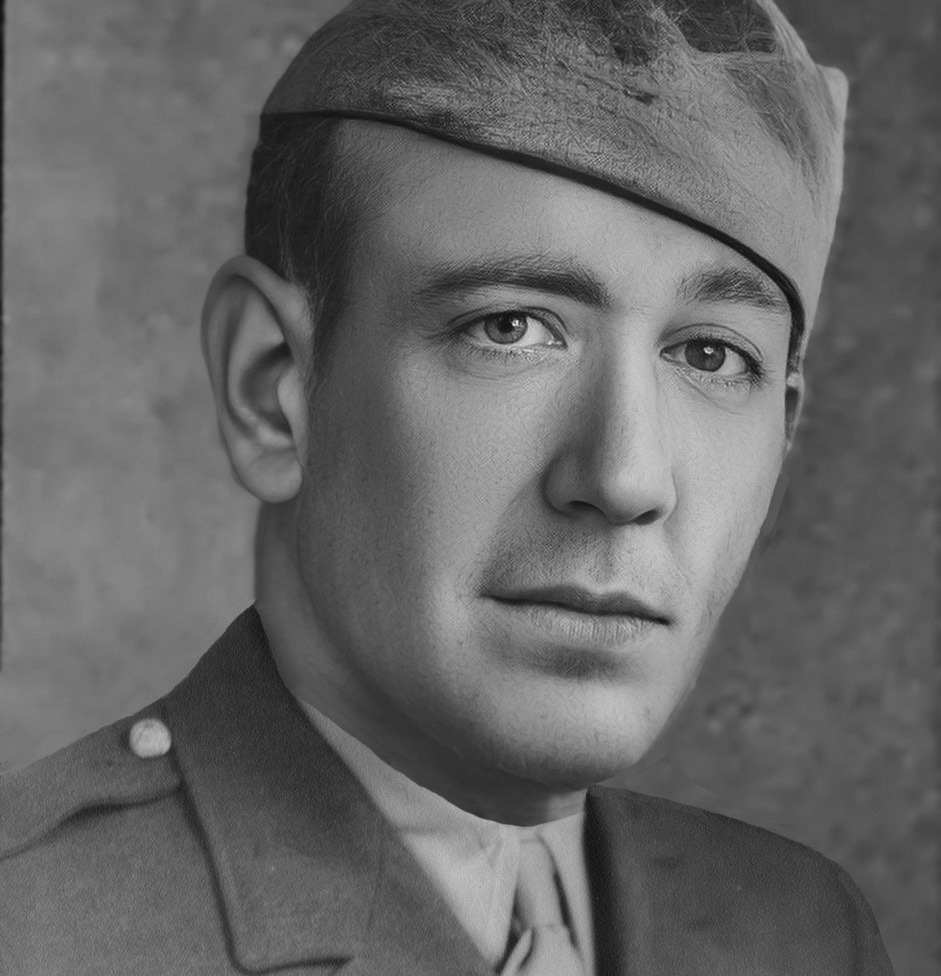
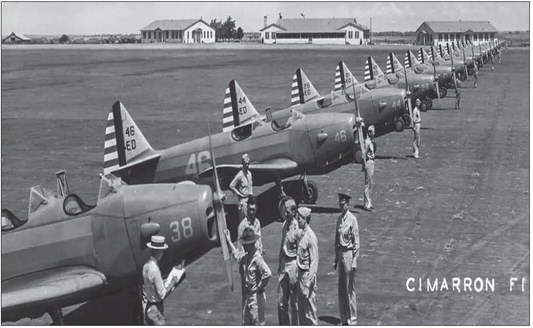
They won’t need to issue wings to Overton Martin 'Rusty' Bounds in whatever corner of heaven is reserved for those who gave their lives so that others might learn to fly. Rusty Bounds, it always seemed, had been born with wings. For nearly three decades, he shaped the future of aviation in Oklahoma and beyond, first as an instructor at multiple flight schools and later as the flight director at Cimarron Field and the Oklahoma Air College. His students became airmen, his methods became legendary, and his legacy remains written in the sky.
It was a curious fate that allowed Overton 'Rusty' Boundstomeethisendonthe ground after 28 adventurous years of flight. A former Marshall Countyman,Rustywas born in Madill, Oklahoma, whereheattendedschooland first encountered aviation's wild, intoxicating promise.
He brought the second airplane ever seen in Marshall County and the first remembered by local boys, who recall watching Bounds swoop into the old ballpark near City Lake. He could clear a field faster than a whistle with a single low pass. Local legend says his father, half in jest, once muttered, 'He’s goin' to let that crate fall on two of my goodmulesoneofthesedays.'
Bounds taught himself to fly in California under the loose guidance of an instructor who couldn’t fly. His flying career began in 1914, and his federal license, issued in May 1915, was number 322—in a country with more than 100,000 licensed pilots.
As early as 1915, Bounds organized a company, purchased a Day tractor biplane, and barnstormed across the countryside. In 1916, he was appointed chief instructor for the first National Guard aviation unit in New York. From July 1916 to January 1, 1917, he served as the senior instructor for the Army Signal Corps at Roosevelt Field, Long Island—the forerunner of today’s United States Air Force.
After exhibition flying, Bounds became a civilian instructor at Mineola, L.I., and served as chief test pilot for a New Jersey firm manufacturing the Army’s Standard training aircraft. A 1923 return to Oklahoma saw him farming again in Marshall County.
In 1929, his career took a detour into professional baseball, where he played third base for the Paris team in the East Texas League. He also worked for an oil company, which provided him with an airplane. In 1930, he became the general manager of a Tulsa air school, and by 1932, he had taken a position as a state employee in Oklahoma City. Although he had no airplane during those years, the sky continued to call to him.
By the late 1930s, the world was inching toward war. With conflict already erupting in Europe and Asia, the United States launched the Civilian Pilot Training Program to cultivate a base of trained aviators should war come to its shores. Bounds was a natural fit. So, seven years after leaving aviation as his primary occupation, Bounds returned to his first love. He was “back in the saddle again.” He joined the Oklahoma Air College at Cimarron Field as flight director and second in command of civilian instructors. There, hisno-nonsenserigorbecame even more pronounced.
TheOklahomaAirCollege atCimarronFieldemergedas a beacon for young men eager to earn their wings in service to their country. Bounds was its most respected instructor. He wasn’t flashy or romanticized; he simply wanted to be at the controls of an airplane. Cadets expecting a glamorous aviator encountered a thin, red-faced man with sharp, cold eyes, wearing a brown felt hat, corduroy pants, and a battered gray jacket. His flight suit was dusty, and his boots were scuffed. However, he commanded absolute attention both in the air and at the blackboard. He was often seen rolling cigarette foil at his desk for his daughter to collect for the war effort. Because of this, everyone at the base would throw tin foil on Bound’s desk.
First impressions were quiet and gruff. “Glad to know you,” he’d say, while shaking hands, followed by. “Let’sgo.” Boundsdemanded excellence. In the hangar, he paced with folded arms, eyes sharp, noting how cadets treated their planes, logs, and procedures. 'Flying,' he would say, 'starts long before you leave the ground.'
Bounds led cadets in silence to the aircraft. His habitual stoop spoke of his years bearing the weight of parachutes on his back. The first lesson was always the same: the propeller.
'That's the prop,' he would say, pointing. 'And you'd better learn to respect it right now. It's a baseball bat with a motor on it, and it’s not something to lean on. Keep out of its way and don't guess the switch is off when you touch it.'
He taught them to spin it to start the engine. He demanded that taxiing be done in S-curves instead of straight so the pilot could see “dead ahead.” And don't trust the brakes—take it easy.'
He was mostly wordless and poker-faced on the ground but was a firm, relentless instructor who demanded precision and obedience in the air. Through the Gosport tube, he barked orders like a machine gun. Precision was everything. A sloppy maneuver brought a stinging rebuke. 'Damn it,' he once said after sitting through a “hair raising” bounce of a student’s first landing. His usual reply was, 'that's what I call a 'prayer' landing. You just pull the stick back and pray it'll land by itself. That's what suicides do.'
He'd cut the engine at an altitude of about 800 feet and then call for a forced landing: 'Okay, forced landing! Let's see you sit down in the grass over there!' Students circled and came in right over a nice green stretch, beaming with self-satisfaction. Inevitably, in late winter in Oklahoma, the grass wasn’t green. “I said grass, not wheat,” he would shout. “That’s grass overthere—it’sbrown!Damn it man, this is flying—not agriculture!'
Excuses were met with half-patient sighs. He’d listen with the tolerance of a man who had heard the same joke countless times before, then shake his head and spend 20 minutes explaining what should have been obvious. To Rusty, an airplane was a violin. Precision made the music.
His praise was rare, but it counted. When a cadet was ready to solo, he'd quietly climb out of the front cockpit. 'Okay,' he’d say. 'Do that again—by yourself.'
When they returned from that nerve-wracking flight, hearts still pounding, cadets hoped for praise and adulation, but instead, he'd climb back in with a grin. His only words were usually, 'Okay, see if you can get it back to the hangar.'
And when they finally passed the flight test, much to Bounds’ “professed amazement,” he’d invite the newly licensed pilots for coffee. There, the mask lifted they saw the other half of Bounds. He razzed them. He laughed. 'I cussed the hell out of you, all right,' he’d say. 'But don’t think I didn’t see you out of the corner of my eye, up there cussing me out, too.'
He shaped men into fliers. His students flew in combat squadrons over Europe and the Pacific. Some became instructors themselves. Many heard his voice in their heads in quiet moments of danger: curt, direct, and saving their lives.
As one former student recalled: 'If Rusty had come spinning in, calmly trying to talk some frantic fledgling off frozen controls, the heartbreak would not have been half so bad. Rusty might have expected it to come that way. But fate played an especially cruel trick on the great instructor. It seemed Rusty had to die to prove the point of the first lesson he hammered into every student.' His “Final Lesson” came on January 10, 1942 January 10, 1942, was a cold, windy day at Cimarron Field, near Yukon, west of Oklahoma City. Bounds, dressed in his flight suit, helmet, and goggles, made his way toward his plane. As he walked across the field, another aircraft, a Fairchild PT-19,wastaxiingtothehangar and approached Bounds from behind.
Mechanic Bill Boudreau sawwhatwashappeningand shouted. At first, Bounds did not hear Boudreau’s warning cries. But after more shouting and waving from Boudreau, Bounds finally heard the warning, and he turned toward the plane—but it was too late. The propeller of a plane, taxiing straight down the taxiway, and not in an S-curve pattern as he demanded, struck him in the head and chest.
It tore his flight suit all to pieces but left his body seemingly untouched. After the impact, Bounds fell to the ground.Boudreauandothers then rushed to his side.
'How bad is it, Bill?' Bounds asked.
'Your suit's torn apart,' Boudreaureplied.'Butyou're not cut. I think you'll be all right.'
Bounds was taken to the field hospital, where Lieutenant Lewis S. Frank administered emergency care. That night, Dr. R.H.S. Adams examined him. It was thought he was improving slightly.
But on the morning of January 11, 1942, Overton Martin 'Rusty' Bounds died.
There were no deep cuts. No broken bones. No massive bleeding. But the blow had been real, and the wounds were hidden. The likely cause: a closed head injury—an epidural hematoma or similar trauma, the kind of injury that would not be fully understood until decades later.
In 2009, actress Natasha Richardson, wife of Liam Neeson, died from a similar injury after a fall while skiing. She stood up, joked, and walked away seemingly unharmed. However, hours later, she was gone. The bleed in her brain had built silently, fatally.
Bounds’s case matches the same tragic pattern: a powerful but unseen injury, a lucid interval, then collapse. In 1942, there were no MRI machines or CT scans. No neurosurgery on call. Nothing that could have saved him.
The man who spent his life teaching others to respect the propeller—the very first lesson in every flight manual, classroom,andrunway—had become its final victim. He died the way he lived: in service to his students, to the field, and to the country.
On Tuesday, January 13, 1942, the First Presbyterian Church in Oklahoma City was at full capacity. More than 400 cadets, instructors, and friends came to honor Bounds.
Flight operations at Cimarron were suspended. Sixty-two cadets from his class marched in formation. Behind them came 54 instructors. A floral spread in the shape of red wings stood behind his flag-draped casket.
ReverendWardDavispaid tribute. 'Rusty has passed on to the other shore,' he said, 'his spirit being piloted by the Great Pilot of us all.'
At Memorial Park Cemetery in north Oklahoma City, six private planes circled overhead in a final salute. Pallbearers were his fellow instructors: Bob White, Joe Reed, O. C. Jones, Charles Brogan, Lyle Bressler, Joe Bates, and E. H. Randel. Honorary bearers included George Dale, Marvin Bradley, Dave Munro Jr., M. J. Pederson, Cal Appleby, C. C. Callahan, and Claude Hoover.
Hewasburiedinthekhaki uniform he wore while teaching cadets.
In March 1942, his widow, Ursula M. Bounds, filed a $76,530 lawsuit against the Oklahoma Air College for wrongful death. The complaint recognized his death as the direct result of unsafe working conditions at the field.
A little more than a year later, on March 27, 1943, Ursula Bounds passed away. She had lived with her husband in Madill, Okmulgee, Tulsa, Ponca City, and finally, Oklahoma City. She wasburiedinOklahomaCity besidethemanwhohadspent his life in flight. Their daughter, Ursula Jeanne “Betty” Bounds, survived them both. She eventually moved to Kansas, where she met and married George Kalamaroff. They eventually moved to Rochester, New York. They had three children. Ursula, Kathlene and George. Betty died in 2010 at the age of 87.
Though he never wore a military uniform, Overton Martin “Rusty” Bounds died in service to his country just the same. He trained the young men who would become the lifeblood of America’s air effort in both world wars. His instruction molded them not only into pilots but into soldiers. And though his death came on the ground, it was on a military airfield, in the line of duty, during a time of declared war.
Rusty did not need to carry a rifle to serve his nation. His weapon was a flight stick, his battlefield the training sky, and his mission was survival— for others. He gave his life so that others might fly, and his legacy was measured in wings earned, lives saved, and freedom defended.
In honoring Rusty, we must affirm that sacrifice takes many forms and that those who fall while building warriors deserve remembrance nolessthanthosewho fall in battle.
With deep respect and a call to conscience, your humble author appeals to the American Legion and the Veterans of Foreign Wars to add the name of Overton Martin“Rusty”Boundstothe war memorial on the county courthouse lawn. He is, in every meaningful sense, a casualty of war—one who gave his life in the earliest weeks of America’s entry into the Second World War while actively training its defenders.
Likewise, I urge the Madill City Council to consider formally renaming the municipal airport the Overton Martin “Rusty” Bounds Municipal Airport. Rusty brought the first airplane to Madill and put the town on the map in the aviation world. Let his name once again rise with the wind from the ground he called home.
And finally, this article serves as a public notice that I am nominating Overton Martin “Rusty” Bounds for posthumous induction into the Oklahoma Hall of Fame, Class of 2026. A son of Oklahoma, a pioneer in American aviation, a dedicated instructor, and a man who gave his life so that others might fly—Rusty Bounds stands among the finest ever to call this state home.
Bounds left behind a legion of airmen; men forged in his image. Disciples of discipline. Soldiers of the sky. He taught them not only how to fly, but how to think, focus, and survive.
They flew over the English Channel, through flakridden skies, across oceans and continents, and heard his voice in every dive, turn, and emergency landing.
His death was a tragedy, yes. But his life was a triumph. A testament to what one man can pass on.
Let his name not be forgotten.
Let it rise with every plane that lifts from Oklahoma soil. And somewhere beyond the clouds, perhaps there is still a thin, red-faced man in a battered gray jacket, watching over a new cadet struggling to keep his wings level.
He leans in, nods once, and says: 'Okay. Do that again—by yourself.'
Marshall County’s Fly Boy, Overton Martin “Rusty” Bounds, 1895-1942.