
After working as the lead salesman of aviation fuel for Continental Oil Company (Conoco), Overton Bounds left the company and moved to Oklahoma City in 1934, where he built his new company, Bounds Parachute Airbrake Incorporated. While Bounds was working for Continental Oil, the former owner and president, E.W. Marland, who was ousted from the company in 1928, entered politics.
In 1932, capitalizing on Franklin D. Roosevelt’s New Deal's widespread appeal, Marland secured a seat in the U.S. House of Representatives. His tenure in Congress was marked by staunch support for New Deal policies, reflecting his commitment to addressing the economic challenges of the Great Depression. This alignment with Roosevelt’s vision laid the groundwork for his subsequent gubernatorial ambitions.
Marland’s gubernatorial campaign was launched against the backdrop of the Great Depression, a time markedbywidespreadunemployment, agricultural distress, and economic instability in Oklahoma. Presenting himself as a supporter of progressive reforms, Marland campaignedonthepromiseof implementing a “Little New Deal”inOklahoma,aimingto replicate Roosevelt’s federal initiatives at the state level. His platform highlighted economic rehabilitation, job creation, and social welfare programs to ease the hardships faced by Oklahomans.
The Democratic primary was a crowded and competitive event, featuring fifteen candidates, including notable figures such as former Governor Jack C. Walton, Lieutenant Governor Robert Burns, and Attorney General J. Berry King. Marland’s substantial wealth and reputation as a philanthropist who had previously provided significant benefits to his employees bolstered his campaign. His slogan, “Bring the New Deal to Oklahoma,” effectively capitalized on the popularity of federal relief programs and resonated with voters seeking concrete solutions to their economic challenges.
Despite the fragmented field, Marland secured just over30%ofthevoteintheprimary. His closest competitor, State Senator Tom Anglin, opted not to contest a runoff, effectively granting Marland the Democratic nomination. This strategic withdrawal underscored the momentum Marland had garnered and set the stage for the general election.
In the general election, Marland faced Republican nominee William B. Pine, a former U.S. Senator. Marland’s campaign continued emphasizing his commitment to New Deal principles and his vision for state-level reforms. His story of overcoming financial adversity and his dedication to worker welfarefurtherendearedhim to the electorate. The election concluded with Marland achieving a decisive victory, securing 58.2% of the vote compared to Pine’s 38.8%. This outcome reflected a clear mandate from the citizens of Oklahomafortheprogressive changes Marland advocated.
Marland’s tenure as the tenth governor of Oklahoma (1935–1939) is among the most ambitious and progressive in the state’s early history. Marland had the zeal of a reformer and the vision of a New Deal disciple. Though marred by economic constraints and political opposition, his administration attempted to redefine the role of state government during one of the most turbulent periods in American history—the Great Depression. His governorship was markedbysweepingreforms, infrastructure development, and bold, sometimes controversial, efforts to modernize Oklahoma's economy and institutions.
Marland coined the “Little New Deal” to describe his agenda, a state-level mirror of Roosevelt’s federal programs. He aggressively pushed for public works, social welfare programs, and regulatory reforms to stabilize the state’s economy and uplift its struggling citizens. Hisadministrationpromoted labor protections, expanded educational funding, and created jobs through infrastructure development.
Among his signature initiatives was the creation of the Oklahoma Planning and Resources Board, which was designed to coordinate federal and state public works projects. He also sought to establish a state social security system, improve public health infrastructure, and regulate utilities to protect consumers.Marlandbelieved that the state government should be an active agent of relief and reform, not a passive observer.
Despite Roosevelt’s national programs' popularity, Marlandfacedstiffresistance from the Oklahoma legislature. Conservative Democrats and Republicans alike viewed his proposals as too radical or fiscally irresponsible. The legislature often blocked or watered down his initiatives and sometimes refused to fund programs he considered essential.
One of Marland’s most bitter battles was his attempt to implement a state income tax and reorganize the state government to streamline services. The resistance from entrenched political interests proved formidable, and many of Marland’s proposed structural changes were either stalled or shelved. His relationships with state lawmakersgrewincreasingly strained, contributing to a rising perception that his administration was overly idealistic and out of step with Oklahoma’s more conservative political climate.
Nonetheless, Marland’s tenure resulted in notable achievements. His emphasis on infrastructure facilitated the construction of roads, bridges, and public buildings—many financed through New Deal partnerships. Marland also championed the arts and culture, most famously commissioning the Pioneer Woman statue in Ponca City, which honors frontier women and beautifully combines his civic pride with a celebration of culture.
Marland’s efforts in conservation and land use planning also stood out. He championed soil erosion control and reforestation—urgent concerns in a state plagued by Dust Bowl conditions. His administration was among the first in Oklahoma to promote long-term environmental stewardship.
By the end of his term, Marland’s political capital had eroded. Although his ideals resonated with many suffering Oklahomans, his inability to push through key legislation and the state’s ongoing economicwoesdimmed his public standing. Barred by the state constitution from serving consecutive terms, he returned briefly to national politics but failed to regain office.
While working for Continental Oil, Overton Bounds became acquainted with Marland. After being elected governor, Marland began employing Bounds as his pilot when he traveled across Oklahoma and nationally. Through this connection, they became friends, ultimately leading to Governor Marland appointing Bounds as a special agent and inspector for the new Oklahoma “Ports of Entry” program.
Inthemid-1930s,America was clawing its way out of the Great Depression. Franklin D. Roosevelt’s New Deal reshaped thenationaleconomy, and states adapted to the seismic shifts in transportation, taxation, and law enforcement. Amid these transformations, under Marland’s leadership, Oklahoma launched a forward-thinking initiative that would become a cornerstone of its public policy for decades: the Ports of Entry program. Established in 1935, this program was designed to regulate commercial transportation, collect taxes, and, most notably during the state’s long “dry” years, serve as a barrier against illegal liquor smuggling. In its scope and symbolism,thePortsofEntry embodied Oklahoma’s effort to assert control over its borders—not just for commerce, but for morality, law, and order.
Oklahoma’s decision to create Ports of Entry in 1935 arose from necessity. As truck transport rapidly expanded nationwide, Oklahoma’s roads—many constructed under New Deal programs—were being damaged by overloaded commercial vehicles. The state had limited resources for highway maintenance, and every unchecked truck posed a potential revenue loss from unpaid taxes and a threat to infrastructure. The Ports of Entry were established as weigh stations to ensure that commercial vehicles complied with weight regulations, held the proper permits, and paid the required fuel and highway taxes.
These ports were strategically placed along key highways at Oklahoma’s borders, allowing state officers to inspect vehicles entering from Texas, Arkansas, Kansas, Missouri, New Mexico, and Colorado. Operated by the Oklahoma Highway Patrol, the Oklahoma Tax Commission and other state agencies, the Ports of Entry became a visible and functional symbol of state authority.
While the Ports of Entry were essential for road protection and tax enforcement, they also became the frontline in one of Oklahoma’s most protracted and contentious policy battles: enforcing statewide prohibition. Oklahoma entered the Union in 1907 with prohibition enshrined in its constitution. Even after national Prohibition was repealed by the21stAmendmentin1933, Oklahoma remained “dry.” Liquor remained illegal, and the smuggling of alcohol into the state evolved into a booming underground enterprise.
The 1930s were a golden ageforbootlegging,andOklahoma— with its strict laws and thirsty population— was a prime target. Border states like Texas, Missouri, and Arkansas had relaxed or repealed their dry laws, creating easy access to beer, whiskey, and other spirits. Smugglers used backroads, hidden truck compartments, and passenger vehicles to transport liquor across state lines.
The Ports of Entry became one of the state's most effective tools in this battle. Vehicles suspected of transporting alcohol could be stopped and searched. Commercial trucks, in particular, were closely monitored for false manifests or secret cargo. In some cases, officers even used informants and surveillance to identify bootlegging operations before they crossed into Oklahoma.
Officers at the Ports of Entry had many responsibilities, but liquor enforcement quickly became a priority. Every vehicle entering the state was subject to inspection. Officers reviewed permits, manifests, and bills of lading. Discrepancies raised red flags. Officers conducted physical searches of trucks and, in some cases, private cars. False panels, hidden compartments, and modified cargo spaces were frequently uncovered.
The Ports of Entry didn’t operate in isolation. When a significant seizure was made, the Highway Patrol and local sheriffs worked together to investigate, arrest, and prosecute offenders. Over time, port officers developed networks of informants and patterns of behavior to track bootleggers. Repeatoffenders and known smugglers were often intercepted based on prior intelligence.
The enforcement of liquor laws through the Ports of Entry wasn’t just a matter of criminal justice—it carried deep cultural and political weight. Many Oklahomans, especially in rural and religious communities, viewed alcohol as a social evil. Politicians who supported strict prohibition laws found that vigorous enforcement at the borders helped them maintain their support among conservative voters.
However, there was also resistance. Urban centers and younger voters increasingly viewed prohibition as outdated.Thistensionplayed out in public debates, legislative sessions, and eventually, in the slow rollback of dry laws. Yet through it all, the Ports of Entry remained a crucial line of defense for those determined to uphold the state’s ban on liquor.
By the late 1950s, the winds of change were blowing. In 1959, Oklahoma voters approved the legal sale of 3.2% beer, and broader liquor reformfollowedinthecoming decades. As prohibition laws softened, the focus of the Ports of Entry shifted away from alcohol enforcement and back toward commercial regulation, vehicle safety, and tax compliance.
Nonetheless, the Ports' role in the anti-liquor campaign remains a significant aspect of their legacy. They were not merely highway outposts—theywereideological barriers, locations where Oklahoma defended its roads and values.
Today, modernized ports of entry utilize the advanced technology to weigh vehicles, verify registrations, and monitor compliance in realtime. While their tools have evolved, their role as guardians of Oklahoma’s borders remains unchanged.
Oklahoma’s Ports of Entry program represented an early and lasting manifestation of state authority at the point of entry. It combined practicality with ideology and revenue enforcement withmoralgovernance.Amid the depths of the Depression, these ports served as bulwarks of order and accountability. Furthermore, during the twilight of prohibition, they became watchtowers in a border war against illegal liquor.
Although times and laws have changed, the program's spirit endures—anchored in a tradition of vigilance, integrity, and a profound belief in Oklahoma’s right to chart its own course, one truckload at a time.
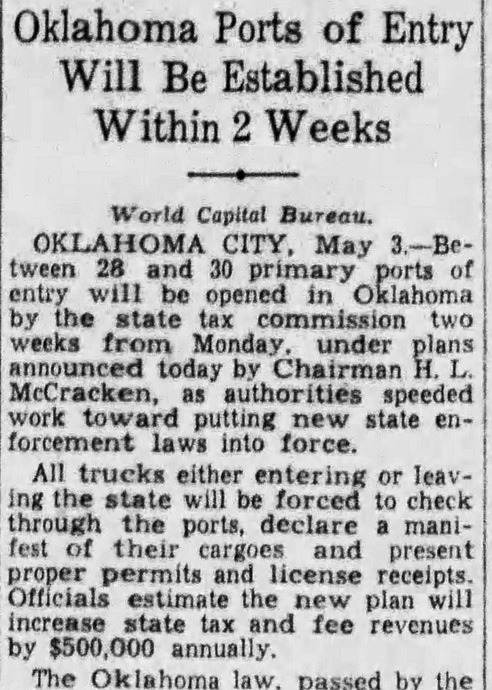
On June 6, 1935, an article appeared in newspapers across the state announcing the creation of the “Ports of Entry” program and Bounds’ appointment as an inspector and agent. The articles read, “More than a score of Oklahoma ports of entry will be established with approximately 100 men to enforce the port law…Chairman H. L. McCracken of the state tax commission announced.”
“The commission announced the employment of its primary force of assistant inspectors and said secondary ports will be established in the near future to catch those merchandise cargoes which are missed by the primary ports. All men were to report to the tax commission today for supplies and will be on duty at the ports Tuesday. McCracken said the men would ‘be armed only with an indelible lead pencil.’ While the chairman refused to comment, it was regarded as likely that police and peace officers will be asked to cooperate with the port of entry force in the near future in collecting taxes on goods moving in and out of the state.”
“The assistants working at the port receive $80 per month. Rees Moran, in charge of the tax enforcement division, will direct the port men for the present.”
“Both McCracken and Gov. E. W. Marland have announced that port of entry men will stop the flow of Liquor into Oklahoma from surrounding wet states. Warning signs are to be placed on highways near the ports Monday, and each port headquarters will be equippedwithasignadvising trucks to stop and register for paymentoftaxes,McCracken said.”
“The port of entry men were selected after rigid physical and mental examinations, which many applicants failed to pass. Those chosen included: Edwin J. Barbour, Norman; Temple Bailey, Altus; Clayton Bagwell, Erick; J. O, Bell, Erick; H. Everett Black, Moore and Overton M. Bounds, Norman.”
As a “Port of Entry” Inspector, Bounds was a new kind of civil servant—the Port of Entry Inspector. In that role, he stood at the heart of these new outposts.
He bore a weighty responsibility. Tasked with safeguarding Oklahoma’s infrastructure, treasury, and moral laws, his duties were diverseandoftendemanding. He was one of the “guardians of the gate,” inspecting every vehicle that crossed the state line with an eye trained for detail, deception, and duty.
One of his primary roles was enforcing vehicle weight limits. As commercial trucking expandedacrossAmerica, heavy loads threatened to destroy Oklahoma’s fragile roads—many built through New Deal public works programs. Bounds and inspectors like him used large platform scales to weigh trucks and trailers, ensuring they complied with legal weight limits. Overloaded vehicles were either fined, required to redistribute cargo, or, in some cases, barred from entry. This function was crucial to preserving infrastructure when maintenance dollars were scarce.
Equally important was Bounds’ responsibility to enforce fuel tax and permit compliance.Oklahoma’sroad system depended on revenue from motor fuel taxes and commercial hauling permits. Trucks entering the state were required to carry documentation proving that these taxes had been paid. Inspectors reviewed this paperwork, verifying that out-of-state carriers weren’t shortchanging the state. If discrepancies were found, fines could be issued on the spot.
Bounds’ duties also ensured that vehicles entering Oklahoma were properly registered and licensed. This applied to commercial trucks and private passenger vehicles suspected of engaging in unauthorized transport or bootlegging. Out-of-state tags, expired permits, or forged documentation drew immediate scrutiny. This task required careful inspection of paper records and quick decision-making in an era before digital records.
Perhaps Bounds’ most colorful and contentious duty was enforcing Oklahoma’s prohibition laws. Bounds became the state’s first line of defense against this illicit trade.
He physically searched commercial trucks, passenger cars, and even buses. He reviewedcargomanifestsand bills of lading, looking for inconsistencies that might point to smuggled liquor. False walls, hidden compartments, and misleading freight documentation were all too common. If alcohol was discovered, inspectors had the authority to detain the vehicle, confiscate the goods, and alert law enforcement for prosecution.
This enforcement wasn’t done in isolation. Bounds worked closely with the Oklahoma Highway Patrol and the Tax Commission. His collaboration ensured that bootlegging routes could be tracked, repeat offenders identified, and statewide interdiction strategies developed.
Beyond enforcement, Bounds was also tasked with maintaining meticulous records. Every vehicle inspection, every fine issued, and every permit verified had to be logged. These daily reports were submitted to the state, forming the backbone of revenue tracking, enforcement statistics, and legislative oversight.
Though his primary role was regulatory, he occasionally served a softer function as well. He answered travelers' questions, offered directions, and helped stranded motorists. Over time, some Ports of Entry evolved into modest welcome centers, but even then, his uniform reminded all who entered Oklahoma that the state took its laws seriously.
Aninspectorneededarare combination of traits to perform these tasks effectively. He had to be precise and detail-oriented yet firm and authoritative. He had to be skeptical without being cynical— able to detect deception but respectful in his dealings.
his dealings. He was a hybrid figure in many ways: tax officer, highway patrolman, and customs agent. Bounds had all of these traits and more. Traits formed during his youth in Marshall County and his service to his country, companies and state.
In many ways, Bounds was a “Renaissance man.” He was a man of wideranging knowledge, talents, and interests, excelling in multiple fields—intellectual, artistic, physical, and beyond. The phrase “Renaissance Man” harkens back to the European Renaissance (14th–17th century), when polymaths like Leonardo da Vinci embodied the ideal: painter, inventor, engineer, anatomist, and philosopher all in one.
Bounds certainly possessed the traits of a Renaissance Man. He was intellectually curious – always learning, always asking; skilled in the arts – often in music, painting, writing, or design; practically adept – capable in mechanics, science, or engineering; well-spoken and articulate – able to communicate ideas clearly and persuasively; physically cultivated – sometimes athletic, often health-conscious; and morally grounded or philosophically inclined – seeking meaning, not just mastery.
Being a “Renaissance man” is a high compliment— a nod to his versatility, depth, and excellence in multiple realms. It suggests a kind of timeless nobility, a soul not content with mediocrity, ever striving to know, create, and improve.