
Between 1914 and 1931, Overton Bounds was a barnstorming stunt pilot, a flight instructor for the United States Army Air Service, a test pilot, and the world’s highest-paid aviator for the Standard Aircraft Company. He was a visionary and cofounder of the United States Post Office airmail program, a rancher, and an entrepreneur who established Oklahoma’s first airplane manufacturing company. Additionally, he served as the vice president and operations manager of Garland Aircraft Company, had a stint as a professional baseball player, and ultimately worked as a flight instructor for an aviation school in Tulsa.
Following these accomplishments, Bounds was considered one of America’s preeminent aviators. His fame stretched from sea to shining sea, and his name became a household word. Due to this fame, he was hired as a salesman for an Oklahoma company that once controlled one-tenth of the world’s oil reserves. That companywastheContinental Oil Company, also known as Conoco.
The merger of Marland Oil Company and the Continental Oil Company created Conoco. Marland Oil was founded by Ernest Whitworth Marland, born in Pittsburgh, Pennsylvania,onMay 8, 1874. He studied law at the University of Michigan and began his professional life as a lawyer in his home state. But it wasn’t long before he was drawn to the siren call of oil—a force that would define his fortune and fate.
After an early setback in West Virginia oil speculation, Marland moved to Ponca City, Oklahoma, in 1908, convinced the region held untapped promise. Shortly after he arrived in Oklahoma, Marland founded the 101 Ranch Oil Company and struck a gusher on the Miller Brothers’ 101 Ranch there. It was the first of many.
The famed 101 Ranch was founded by Colonel George Washington Miller, a Confederate veteran from Kentucky who migrated to Kansas after the Civil War. He later ventured into Indian Territory and founded the 101 Ranch. Established in 1879, the ranch was named for its cattle brand: “101.”
Miller leased thousands of acres from the Ponca, Otoe, and Tonkawa tribes, eventually acquiring control over a staggering 110,000 acres of grazing land near the Salt Fork of the Arkansas River, close to present-day Ponca City. There, he began to raise longhorn cattle and horses and later diversified into wheat, corn, hogs, and oil. His sons—Joe, George Jr., and Zack Miller—would inherit and grow the enterprise into something far beyond a ranch.
In the early 1900s, as the frontier closed and Americans turned nostalgic for the old West, the Miller brothers sought to capture and preserve the vanishing spirit of the open range. Inspired by Buffalo Bill Cody, they launched their own Wild West Show in 1907.
The 101 Ranch Wild West Show toured across the United States and Europe, featuring a mix of cowboy pageantry, Native American performances, trick riding, roping, sharpshooting, and reenactments of frontier battles.
Some of the show’s notable performers included Will Rogers, Tom Mix, who would go on to Hollywood fame, Bill Pickett, a Black cowboy and originator of “bulldogging,” andnumerousNativeAmerican performers, including members of the Ponca and Sioux tribes. At its peak, the show rivaled Buffalo Bill’s popularity and reach, with dozens of wagons, hundreds ofhorses,andamultinational cast. But like all empires, it would not last forever.
While spectacle drew crowds, the real wealth of the 101 Ranch would come from what lay beneath the soil. In the early 20th century, E. W. Marland secured the drilling rightsonthe101Ranchlands and in 1911, one of his wells struck a gusher, and Ponca City began transforming into a petroleum capital.
This discovery made Marland wealthy and added immense revenue to the 101 Ranch and the Miller family. The ranch’s vast acreage was suddenly dotted with oil wells alongside cattle and wheat fields.
Due to this success, by 1917, E. W. Marland had formed the Marland Oil Company, and within a few years, it controlled over onetenth of the world’s known oil reserves. Under Marland, Ponca City transformed from a dusty frontier outpost into a modern boomtown. He built refineries, pipelines, research labs, and public parks. He housed his employees, paid them well, and treated themwithuncommonrespect for the era.
He also constructed the MarlandMansion,a55-room palace often called the “Palace on the Prairie,” symbolizing his wealth and vision for Oklahoma’s future. Today, the Marland Mansion is a treasured piece of Oklahoma history.
Despite his industrial success, Marland’s empire was vulnerable. His ambitions were financed through eastern capital, particularly J.P. Morgan & Co., and when his expenditures outpaced his revenues, the bankers seized control. In 1928, he wasforcedoutofthecompany he built. It was soon merged with the Continental Oil Company, forming Conoco— but Marland was no longer at the helm.
Thoughfinanciallyruined, he was not finished. He turnedtopolitics,determined to serve the people of Oklahoma in the same visionary way he had once served his workers.
After Marland was removed as head of Continental Oil, the company hired Bounds as the lead salesman for the company's new aviation fuel division. Conoco began marketing aviation fuel in the early 20th century, aligning with the burgeoning aviation industry’s demand for specialized fuels. By 1929, Conoco had evolved into a fully integrated oil company, expanding its product offerings to include aviation gasoline. During World War II, Conoco played a pivotal role by dedicating refineries to produce high-octane aviation fuel, which was crucial for enhancing the performance of Allied aircraft.
Astheleadsalesmanofthe aviationfueldivision,Bounds traveled across the country to marketandpromoteConoco’s latest aviation fuel products. Naturally, he flew on one of the company's various airplanes. At that time, Conoco owned two airplanes: the Lockheed12AElectraJr.and the Ford Tri-Motor. Both are regarded as some of the earliest corporateandcommercial airplanes developed.
Shortly after being hired by Conoco, Bounds was featured in an article published by the Daily Oklahoman that recognized three Oklahoma men as pioneers of aviation in the state. The article appeared inthepaper’sJune21, 1931, issue. It was penned by BillyParker,whoatthattime was the head of aviation for Phillips Petroleum Company in Bartlesville, Oklahoma.
Parker began his article by stating: “We are all too prone to forget the work of our pioneers in any particular line until after they have been dead and gone for many years, someone decides that they should be recognized and, consequently, erects a memorialor.insomemanner, endeavors to give them recognition, but in many instances so much time has elapsed that recognition is given to the wrong parties. In order that such may not be the casewithourearlyOklahoma aviators, I am attempting to set down an accurate history of their exploits. I have personally been acquainted with and associated with all of them to some extent. Many of them have been my closest friends.”
“When I speak of pioneer aviation, I refer to aviation before the war, and this article concerns itself with that period only. In order to get the true picture, one must forget entirely about modern airplanes and modern engines--yes, and even modern people, for at the outset of Oklahoma aviation history, the public almost without exception-looked upon an aviator as a foolhardy, reckless individual who had little time to look forward to on this earth. The public wasn't far wrong at that, for with the crude machines available at the time, the pilot was indeed fortunate and could survive the crashes and accidents which were almost Inevitable.”
After writing about Oklahoma’s first aviator, Frank Champion, who was killed in Kobe, Japan, in 1914 or 1915, Parker began telling the history of the two other pioneers in Oklahoma aviation—Billy Bourke of Okmulgee and Overton “Rusty” Bounds of Madill.
In the article, Parker wrote of these two, “About thetimeChampionwasgoing strong,someotherOklahoma boys began to get the aviation fever. Some few of them became discouraged and were soon no longer known to the aviation fraternity-but there were others to whom no obstacle was too great, and they soon made names for themselves and have contributed an untold amount to the development of American aviation.” “Chief among these were Overton M. Bounds, of Madill, Okla, who went to California in 1914 and learned to fly at the Schiller school and Willlam A. Burke, of Okmulgee, who taught himself to fly in about 1914 or 1915.” “Of all the pioneer Oklahoma pilots,nonewasbetterknown or liked...”
“Many high government officials and members of President Wilson's cabinet flew with him. (Bounds) In fact most of them refused to ride with anyone else if they had to fly at all.”
In 1934, E.W. Marland, riding a wave of populist support during the depths of the Great Depression, was elected as the 10th Governor of Oklahoma. A staunch Democrat and supporter of President Franklin D. Roosevelt, Marland brought a version of the New Deal to Oklahoma—calledthe“Little New Deal.”
His administration pushed for old-age pensions, unemployment insurance, and public works programs (over 1,300 WPA projects employing 90,000 people.). He also created the Oklahoma Highway Patrol and brought about regulation of the oil industry through the Interstate Oil Compact.
Before Marland’s election, Bounds resigned from his positionatConocoandmoved his family to Oklahoma City, where he embarked on a new business venture. On May 12, 1934, Bounds founded Bounds Parachute Airbrake, Incorporated, a company chartered to design and manufacture Bounds’ invention, the airplane parachute airbrake.
The Legal Record newspaper of Oklahoma City published information about the company in their May 17, 1934 issue by writing, “Charters have been issued to…the Bounds Parachute Airbrake, Ine, Oklahoma City.” The partnersinthecompanywere Overton M Bounds, Clint T Johnson and E P Ledbetter. The initial capital investment in the company was $100,000. In today’s money, that investment would equal $2,500,000.
By mid-summer of 1934, Bounds had designed and constructed the prototype for his parachute airbrake, and he had begun conducting demonstrations. The Daily Ardmoreite reported on August 8,1934,that“OvertonM. Bounds,formerlyofMarshall County, has invented a parachute attachment to huge airplane sedans which will enableanemergencylanding to be made in a space of 75 feet, which formerly took a run of 500 feet.”
“Bounds is in Oklahoma City demonstrating his invention, which enables the flier to get down safely in a small area with or without the aid of a motor, Bounds says and protects the aviator from nosing over as is often the case in quick stops.”
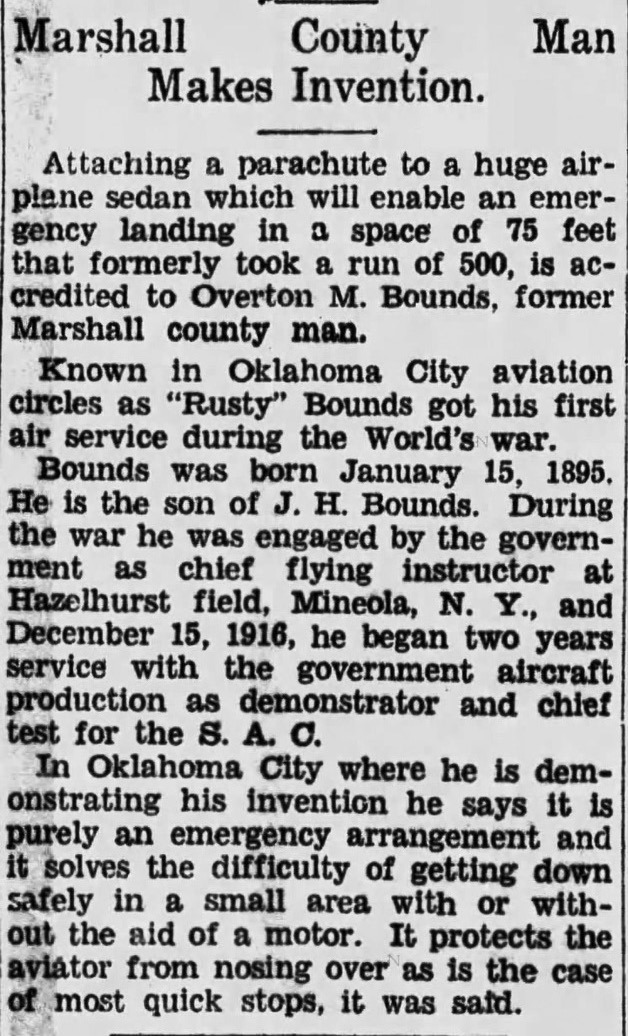
Then,thenextday,August 9, 1934, under the headline, “Bounds Perfects Landing Brakes,” the Madill Record reported, “Marshall County Man Makes Invention. Attaching a parachute to a huge air-plane sedan, which will enable an emergency landing in a space of 75 feet that formerly took a run of 500, is accredited to Overton M. Bounds, former Marshall County man.”
“KnowninOklahomaCity aviation circles as ‘Rusty,’ Bounds got his first air service during the World's war. BoundswasbornJanuary15, 1895. He is the son of J. H. Bounds. During the war, he was engaged by the government as chief flying instructor at Hazelhurst field, Mineola, N. Y., and on December 15, 1916, he began two years service with the government aircraft production as demonstrator and chief test for the S. A. C.”
“In Oklahoma City, where he is demonstrating his invention, he says it is purely an emergency arrangement, and it solves the difficulty of getting down safely in a small area with or without the aid of a motor. It protects the aviator from nosing over as is the case of most quick stops, it was said.”
Flight has always been a story of defiance—against gravity, against distance, against limitation. But the mastery of flight has never depended solely on lift or thrust. It depends, too, on control—especially when descendingfromtheheavens. Amongthemanyinnovations that enabled the jet age and space age to take shape, none was as quietly essential, or as elegantly simple, as the parachute airbrake.
Thoughhumbleinappearance— amerecanopyofnylon and cord—it has played a crucial role in slowing some of the world’s fastest machines. From ice-caked Soviet runways to the fiery landings of space-bound vehicles, the parachute airbrake has proven itself as an enduring solution to one of aviation’s oldest problems: how to stop.
The parachute itself has ancient roots, stretching back to the Renaissance when Leonardo da Vinci sketched early concepts of devices meant to slow a fall. However, using parachutes to slow a moving aircraft, not just a falling body, is a 20thcåentury invention. It arose out of necessity when aircraft speeds began to outpace the safety margins of wheels, brakes, and flaps.
The earliest inklings of drag chutes were seen in rocketry experiments of the 1920sand1930s,whereparachutes were used to stabilize and recover test payloads. But these were vertical applications— retrieving items dropped from the sky. The actual horizontal airbrake had not yet been born.
Sadly, today's “history books” credit the Soviets with Bounds’ invention. Those “books” report that during World War II, when Soviet engineers grappled with icy runways, heavy aircraft, and the emerging realities of jet propulsion, they began experimenting with parachutes as braking aids. By the mid-1940s, the Soviet MiG-9 and the MiG-15 were equipped with tail-mounted braking chutes, deployable upon touchdown.
Thesedragchutesenabled safe landings on rough or frozen airfields, where mechanical brakes alone were unreliable. The Soviet Union, often pragmatic in its engineering, embraced the technology not for elegance but for sheer effectiveness— and in doing so, led the way.
Those same “books” also report that as the Western powers developed their jet programs, they, too, encountered the harsh truth of high-speed landings. In later variants, aircraft like the F-86 Sabre, the B-47 Stratojet, and the Gloster Meteor carried drag chutes. These parachutes were tucked into tail compartments and deployed shortly after the rear wheels touched down, creating instant drag and reducing stopping distance.
Inparticular,heavybombers and high-performance fighters benefited. Their speed, mass, and mission profiles made traditional braking systems insufficient—especially on forward airstrips carved hastily into hostile terrain. In this context, the parachutebecamemorethan a safety feature—it became a necessity.
Parachute airbrakes' utility grew as humanity left the Earth’s atmosphere. The X-15 rocket plane, which skimmed the edge of space in the 1960s, relied on drag chutes to slow its landings on desert runways.
Later, NASA’s Space Shuttle carried an enormous braking parachute. After gliding down from orbit at speeds exceeding 200 mph, the shuttle’s rear wheels hit the runway, and—seconds later—the chute burst open, blooming behind it like a silken blossom of salvation. It slowed the shuttle enough to prevent runway overruns and reduce stress on its braking systems.
Other spacecraft, such as Mercury, Gemini, Apollo, Soyuz, and Dragon, have used parachutes for reentry deceleration, although those function more like recovery systems than horizontal airbrakes. Still, they echo the same principle: that the air, used wisely, can be a tool for restraint and motion.
Today, parachute airbrakes remain standard on many military aircraft, especially those designed for short takeoff and landing (STOL) operations or high-speed missions. The F-16 Fighting Falcon, F-22 Raptor, Dassault Mirage 2000, and Sukhoi Su-57 all incorporate drag chute systems for rapid deceleration in combat theaters.
Modern drag chutes are made of Kevlar-reinforced nylon, which can withstand extreme heat and tensile loads. Deployment mechanisms are compact and reliable, allowing pilots to engage the chute with the flick of a switch. Once deployed, the chute is usually jettisoned on the runway and retrieved by ground crews.
Yet the core idea remains unchanged from those early Soviet prototypes: air resistance harnessed to slow motion. A paradox turned to practical use.
While not glamorous, the parachute airbrake is one of aviation’s most unsung heroes. It reduces wear on brakes and tires, prevents overruns, and is a critical backupinemergencies.Itcan mean the difference between a safe landing and a disaster in icy, short, or damaged runways.
It also represents a poetic balance in the evolution of flight. As technology gave us greater speed and power, the parachute reminded us that control is just as important as thrust. The tether grounds ambition in reality—the final word in a journey that begins with takeoff.
Despite what the “history books” tell us, the true inventor of the parachute airbrake was not some scientist in the Soviet Union or even American military engineers. The first man to imagine, design, create and utilize a parachute airbrake was Marshall County’s own, Fly Boy, Overton Martin “Rusty” Bounds.
We are taught that history is the record of what happened. Yet, in truth, it is the record of what was remembered and, more often, what was chosen to be remembered. The victors, it is said, write the history books—but in time, the vanquished may find a pen of their own. Rewriting history can serve as a form of reckoning, a way to unearth buried voices, challenge myths, and right the narrative scales. To rewrite history is to recast memory—to rearrange the past in the service of the present.
Through this series of articles about Overton Martin Bounds, it is your humble writer's intention to rewrite history and change the record from what was “chosen to be remembered” to what truly happened. For some reason, “history” has all but forgotten Rusty Bounds. Be it because he was from the smallestcountyinOklahoma or because he never sought the limelight, the truth is, no one knows anything about him today. He went from a household name to an unknown in a relatively short period of time. But that ends in 2025.
Overton Martin, “Rusty” Bounds was a hero. A man who dreamed of soaring through the air. A man so committed to his dream that he made it his reality. He then shared that dream and expertise with countless Americans, from simple farmers to men who fought for and died serving their country. He also worked to create safety features that made aviation safer for pilots and passengers. He was a visionary, hero and giant in aviation.
More Next Week.
Subscribers also have complete access to the website 24/7
•Breaking News, Daily Updates, Archives & Photo Galleries•