

I don’t write local history to admire the past behind glass. I write it to keep the living threads connected: people to places, decisions to consequences, and names to the ground they walked on. Marshall County is not just a backdrop for larger events; it serves as a stage where the same forces that shape nations—faith, power, politics, money, weather, and hope—unfold on a human scale. When we study our own place, abstractions turn concrete: policy becomes porch talk, government wears a handshake, and every success or failure bears a familiar name.
Westudybecausememory is infrastructure. Roads and bridges need repair; so do stories. Untended stories sag into myth or disappear completely. Maintained stories— documented, debated, and footnoted—become a public resource. They help us see patterns: how a boom follows a promise, how neglect follows a boom, and how ordinary people hold a communitytogetherbetween headlines. They also help us push for improvements. A well-maintained record is the community’s ledger: what was envisioned, what was built, who kept faith, and who did not.
I write Marshall County history for both accountability and nostalgia. When a park is dedicated, when land is sold, when a bond is floated, or a tax district is proposed, the public is asked to trust. History is how that trust is measured. It tells us which plans worked and why; which warnings were ignored; which “temporary” fixes became permanent; which promises returned dividends, and which dissolved into press releases. It is easier to make good decisions when yesterday’s decisions aren’t forgotten.
I also write out of gratitude. The county I know— its schools, churches, boat docks, ballfields, cafés, and cattle guards—didn’t just happen by chance. People wrote letters, attended meetings, debated, compromised, and sometimes risked their names and livelihoods. If we don’tnamethem,quotethem, and put them back in their moment, we lose not only facts but also a meaningful understanding of what civic effort truly looks like.
Finally, I write to invite you. Local history belongs to everyone, not just archivists. If you fished here as a kid, taught school here, farmed or ranched here, or kept a box of clippings in a drawer, you own a piece of the record. My job is to gather those pieces— newspaper lines, meeting minutes, photographs, family stories—and fit them together until the picture becomes clearer. Where it’s unclear, I’ll say so. Where it’s clear, I’ll show my work.
In short, we study to remember accurately, to decide wisely,andtothankproperly. We write so that our children inherit more than land and buildings; they inherit a clear account of how those things came to be, and a standard bywhichtojudgewhatcomes next.
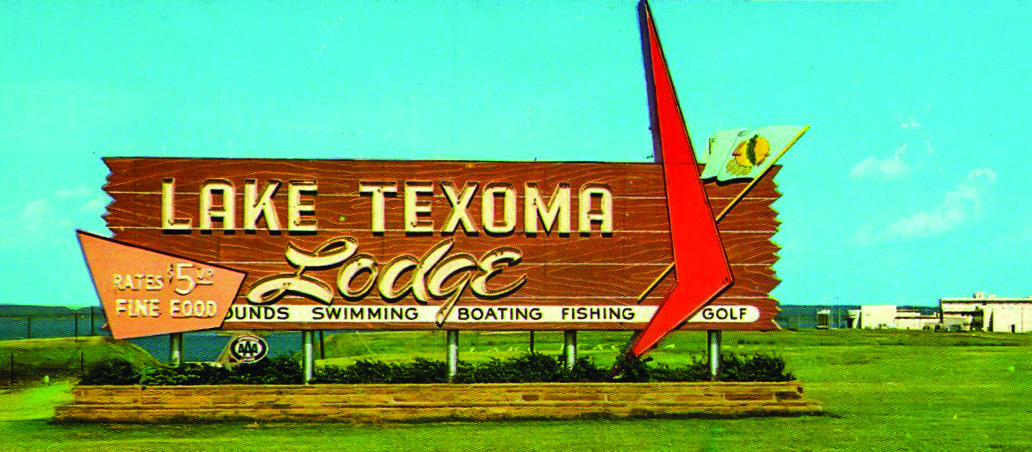
And that brings us to one of the finest and most fragile chapters in that ledger—the rise and fall of the Lake Texoma State Park and Lodge.
Few projects better capture why we study and why we remember. It began not as a building but as a statement— Oklahoma declaring that its lakes and parks could stand beside any in the nation. It pulled together the same blend of idealism and grit that built the bridges, rail lines, and courthouses before it: citizens demanding progress, lawmakers promising prosperity, and architects daring to design beauty into public work.
The lodge was born from optimism, held up by pride, and fallen due to neglect. It opened with orchestras, governors, and a crowd that stretched across the Roosevelt Bridge, then gradually— predictably—slippedinto silence as budgets shrank and the paint peeled. Its story, like many told in Marshall County, is both a triumph and a warning.
So we return to the beginning: to a time when the state was young enough to dream boldly, and the people of this county stood on the red-clay shore and watched bulldozers carve the foundation for a “resort second to none.” It was an age when progress was still measured by the sound of engines breaking new ground, and hope by the length of a new concrete span reaching toward the horizon.
Stand now at the west end of the Roosevelt Memorial Bridge and imagine what they saw taking shape—a glass-walled ballroom catching late sun over Catfish Bay, terrazzo floors gleaming from yesterday’s dances, a pool shaped like a mushroom, and motorcoaches idling as eight governors shook hands beneath the proud flag of a young and confident state. Then, let the silence fall.
This, too, is part of the story. A crown jewel can be lost not with a bang, but through deferred budget lines, roofs that leak one season too many, and a sale that promises the moon but delivers only a holding pattern. We remember because these places were never accidents. They were deliberate—built from civic pride, political will, and the stubborn optimism of a generation that believed public works could also be beautiful. And we share their stories now because memory is leverage. When the same ground is later sold, promised, mothballed, or rescued, history provides the ledger: what was envisioned, what was built, who kept faith, and who did not.
Before there was Lake Texoma Lodge, before the terrazzo floors and the governors and the talk of “a resort second to none,” Oklahoma had seven state parks—and a handful of men and women who believed public land could serve both beauty and bread.
The first state parks were born in hard times. In 1935, with the Great Depression gripping the nation, the federal government sent the Civilian Conservation Corps to Oklahoma. Their tools were simple—axes, shovels, wheelbarrows—but their vision was large. They built roads, cabins, shelters, and dams out of native rock and red clay. Out of that effort came seven parks that would become the seedbed of Oklahoma’s outdoor heritage: Roman Nose, Quartz Mountain, Robbers Cave, Greenleaf, Boiling Springs, Beavers Bend, and Osage Hills. When these parks were constructed, there was no Lake Texoma; there was only a river.
These parks were never meant to be luxurious. They were built to keep men working, to give families a place to breathe, and to prove that conservation and recreation could coexist. They were, in their own way, Oklahoma’s first public works of beauty— places where labor met landscape.
The dream that would become Lake Texoma State Park began not with architects or bulldozers, but with a river—broad, unruly, and known for turning farmland into floodplain. The Red River’s temperament shaped the early years of both states, washing out bridges, drowning crops, and cutting deep scars into the prairie. Out of that destruction came the idea for something enduring: a dam so large it could hold back disaster and turn the river into promise.
Authorized under the Flood Control Act of 1938, the Denison Dam was the largest rolled-earth dam in the world when construction began in 1939. At its heart was a vision both practical and grand: to control floods, generate hydroelectric power, and create a dependable water supply for communities across southern Oklahoma and north Texas. But engineers and planners saw something else taking shape behindthatwallofcompacted clay and limestone — a new inland sea.
When the dam was completed in 1944, the rising waters swallowed farms, rail lines, and entire towns — places like Woodville, Willis and Aylesworth. Yet in that flood of loss, new possibilities took root. The reservoir that formed, christened Lake Texoma, sprawled across 93,000 acres and more than 1250 miles of shoreline, stretching farther than either ocean’s edge along the continental United States.
For the first time, Oklahoma and Texas shared not just a border but a destination. The Army Corps of Engineers called it a flood control project; locals called it a miracle. Fishermen, boaters, and tourists arrived by the thousands, and in those early postwar years, civic leaders began to dream of something more — a resort that could match the grandeur of the lake itself.
That dream would take a decade to fund, plan, and build. It would require state bonds, political will, and the boldness to believe that a once-flooded wilderness could become the pride of Oklahoma. Out of that conviction cametheplanforLake Texoma State Park — and at its heart, the jewel that would define it: Lake Texoma Lodge, the “resort second to none.”
The state park began with a stroke of a pen in the state capitol. On a warm Friday afternoon in May 1951, Governor Johnston Murray signed a bill appropriating $70,000 as the initial investment in what was described as “a huge recreational state park on Lake Texoma.” That act of authorization—backed bySenatorsRaymondGaryof Madill, Keith Cartwright of Durant,andJoeB.Thompson of Ardmore—set in motion one of the most ambitious tourism projects in Oklahoma’s history.
The appropriation was modest, but its backers had a grander design. The total development, they said, would require “several million dollars” to be financed not through taxes but through self-liquidating bonds, repaid by the revenues of the park itself. It was a bold plan—a direct descendant of the Lake Murray model—and it carried with it a certain postwar confidence that Oklahoma could build prosperity out of its own scenery.
Under the measure, the state would lease 2,000 acres of federal land from the U.S. Army Corps of Engineers, stretching along the west shore of Lake Texoma from Glasses Creek to the Frisco railroad bridge. That tract, already marked by Corps engineers as a potential resort area, included the Catfish Bay Resort—a private property owned by Jack Goodman, which the state moved quickly to acquire and incorporate into its new park. “Facilities of the resort will be incorporated into the overall development program,” Senator Cartwright said, announcing the agreement. “Our plan will provide for adequate facilities for the one million tourists, fishermen, and picnickers who already visitLakeTexomaannually.”
The proposed park would be bisected by U.S. Highway 70,linkingMadillandDurant to the new resort. The plans called for a tourist cottages scatteredthroughthewooded shoreline, golf courses, campgrounds, boat docks, and a “huge modernistic lodge,” or grand hotel, overlooking the lake.” Architecturally, the vision was as daring as it was ambitious—a modern resort built in the red-clay hills of Marshall County, blending recreation, commerce, and public pride.
By June, enthusiasm was contagious. The Madill Record called the project “one of the finest things of its kind in the nation” and marveled at the speed with which the state was moving. The State Planning and Resources Board had already obtained the lease from the federal government, purchased the Catfish Bay Resort, and begun architectural work— all within weeks of the appropriation’s passage. The board’s chairman, Morton R. Harrison, confirmed that multiple firms were already competing to handle the bond issue, “despite the fact that the planning still is in the preliminary stage.”
“Never before,” the Madill Record wrote, “have we seen somuchgrowingenthusiasm for any project as has been evidenced recently in the developmentofLakeTexoma State Park.”
The momentum culminated on Sunday, July 22, 1951,whenGovernorMurray and a host of state dignitaries gathered on the lake’s shore for the park’s formal dedication. More than 5,000 peoplecrowdedthesiteunder a punishing summer sun. The Durant and Madill High School bands provided music as a flotilla of boats paraded before the crowd. The Coast Guard Auxiliary staged a regatta and a water skiing exhibition gleamed across the bay.
From a platform on the north side of the highway, Colonel H. D. Weston, of the U.S. Army Corps of Engineers, officially transferred title to the 2,000-acre tract, grantingOklahomaa99-year lease “free of rental charge.” “The Army Engineers gladly turn this area over to the state of Oklahoma,” Weston declared, “and congratulate the state on its plans to develop what will be a resort second to none in the nation.”
Chairman Morton R. Harrison accepted the title on behalf of the state. “All that touriststakewiththemwhen they leave an attractive resort area is goodwill,” he told the crowd. “In Oklahoma, we have more water than the state of Minnesota, which advertises itself as the ‘state of a thousand lakes,’ but we have not told the world about it.”
ThencameGovernorMurray’s address—part proclamation, part vision statement. Facing a sea of hats and handkerchiefs under a relentless sun, he declared: “Lake Texoma has more shoreline than the Atlantic and Pacific oceans adjoining the United States combined. Fishing comprises only a smallpercentageofthosewho visit resorts. Most of them want to play in the water, rest, and refresh themselves on cool porches and in airconditioned rooms. For this reason, we must develop Lake Texoma State Park as a resort which will attract every type of vacationer.” When Governor Murray declared that Lake Texoma “has more shoreline than the Atlantic and Pacific oceans adjoining the United States combined,” he was speaking in political poetry—but he wasn’t far from the truth in spirit: Lake Texoma’s 1,250 miles of shoreline does indeed rival the general measured coastlines of either ocean individually, though not their full tidal perimeters.
He went on to predict that the new park would relieve the overcrowding at Lake Murray, which was already “overrun with tourists,” and would make the two lakes together “a double attraction for the tourists of America.”
The governor emphasized that the $2.5 million park development“willnotbebuilt with tax money, but through issuance of self-liquidating bonds which will not cost the taxpayers a cent.” To drive the point home, he revealed a bit of humorous pride: a film company that had recently released a documentary about Lake Texoma, but set entirely in Texas, had apologized and promised to correct the oversight. “They will now show that the real Lake Texoma,”Murraygrinned,“is in Oklahoma.”
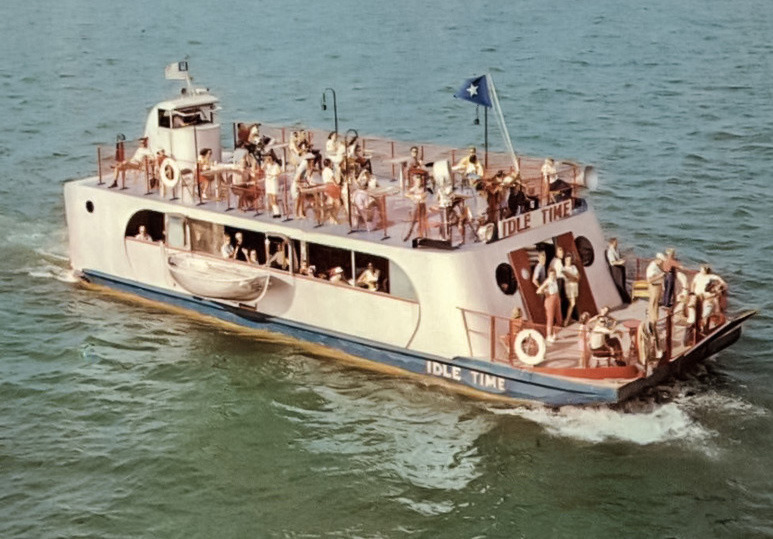
Theweekendsurrounding the dedication became a celebration ofthenewstatepark system itself. The governor was feted with a birthday banquet at Southeastern State College, presented with a 500-pound cake, and serenaded by local dignitaries and the Idle Time, a newly arrived excursion boat making its maiden voyage on Lake Texoma. Murray donned the captain’s hat, steered the vessel, and even played a few notes on the piano in its lounge as it cruised toward the University of Oklahoma Biological Station at Willis.
The excursion boat “Idle Time” was once a charming crown jewel of Lake Texoma’s golden era of shoreline amusements. Under the stewardship of G.E. Hibarger, she plied the waters from Burns Run, her doubledecked iron and steel hull carrying sunlit crowds on daily cruises, stopping at Willow Springs Marina and Lake TexomaLodgealongtheway. In off-season months, she transformed into an elegant dinner-dance cruise vessel, a floating ballroom where local groups and chambers of commerce “show-boated” across the waves.
Her origin was romantic and audacious: built at the Lake of the Ozarks, she was sailed down the Osage River to the Missouri, then the Mississippi, and up the Red River to Texoma. Measuring approximately 48 feet, she embodied the ambition of mid-century lakeside entertainment. But the tides of time turned harsh. As marinas and private boats proliferated in the 1960s, Idle Time’s excursions lost their luster. By the mid-1970s, her fate was sealed: rust and disuse overtook her, and she was ultimately dismantled for scrap.
She now lives mostly in memory and on vintage postcards, as a symbol of Lake Texoma’s bygone spectacle— an “excursion queen” whose hull once mirrored the sun, now receding into the mists of local lore.
Frombeginningtoend,the dedication of Lake Texoma State Park captured the full optimism of mid-century Oklahoma—a faith in progress, tourism, and public works as symbols of civic pride. Within weeks, planning began for the park’s crowning jewel: a modern lodge to anchor the state’s southern shore and proclaim that Oklahoma’s era of rustic parks had given way to one of architectural elegance and ambition.
By 1952, that system was formally sketched. The Planning & Resources Board greenlit three big resort complexes—Sequoyah,Texoma, and Quartz—a smaller lodge at Roman Nose, and a separate, smaller lodge at Sequoyah for Black guests, providing a stark snapshot of the era’s segregation. The financing would be novel for a state: self-liquidating revenue bonds, not taxes, retired by earnings. The board said plainly it would “spend $1,800,000 at Lake Texoma; $1,100,000 at Quartz Mountain; and $1,500,000 at Sequoyah,” with a further $500,000 “ear-marked for a proposed Negro lodge at Sequoyah.” In Tulsa, architects Ralph M. Black and Robert E. West unfurled Sequoyah’s U-shaped plan—104 rooms, an assembly hall that will seat 500 and a dining hall for 350 that could be “divided into three sections to handle three dinners simultaneously,” all air-conditioned, with a 50×100-foot pool, tennis court, and a children’s terrace above the lake. Seventy air-conditioned cabins were planned behind the lodge—50four-unitbuildings and 20 two-bedroom deluxe cabins—with a capacity of about 300 people.” At Quartz, Wright & Shelby drew a 50room, air-conditioned lodge with 40 standard cabins and five deluxe cabins.
And at Texoma, Architect, Dow Gumerson of Enid laid out a 106-room lodge at Catfish Bay with seven suites, a “huge dining room,” swimming pool, drug store, and concessions, flanked by 40 deluxe two-unit cottages and 20 one-room ‘fisherman’ cabins.” It was a system, not a one-off; a bet that Oklahoma couldcompeteinthebooming mid-century travel market.
Dow Gumerson, the architect whogaveOklahoma’s Lake Texoma Lodge its iconic piano-shaped silhouette, was born in 1914 in Pond Creek, Oklahoma. A graduate of OklahomaA&MCollege(now OSU) in 1935, Gumerson began his architecture career in Enid, where he designed buildings for the George Failing Company and Champlin Refining.
In 1941, he married Jean Gilderhus, and together they raised three sons — Bill, Ted, and Jon. After earning the commission to design the William J. Holloway, Federal Building and U.S. Courthouse in Oklahoma City, Gumerson moved his family to the metro area, where he continued to practice until he died in 1978.
Over his long career, Gumerson designed some of Oklahoma’s most striking mid-centurylandmarks,each defined by balance, light, and a sense of permanence. His firm’s other prominent projects included the Masonic Home for the Aged, the Oklahoma Grand Lodge in Guthrie and the Masonic Lodge in Oklahoma City.
Gumerson’s architecture reflected a distinctly postwar optimism — clean lines, bold geometry, and a confidence in progress. His design for the Texoma Lodge, visible from across the bay like a sculpted note on the landscape, stands as one of the most ambitious public resort designs ever built in Oklahoma.
On the same week Lake Texoma State Park itself was born with a ceremony and a clock, Gumerson phoned Marshall County to say he would bring his entire staff to study the peninsula and would “work day and night just to get the preliminary sketches ready in time” for the park dedication—because there was “no structure on the entire lake that can be classified as a resort hotel,” and self-liquidating bonds would be easy to “handle.” His first public drawing fixed the lodge at Little Glasses Creek (instead of the final location along Highway 70), stacking the steep shoreline into terraces and throwing a glassed-in triangular dining room over the top two big enough, the caption boasted, for a dining room seating 1,500 persons at tables, with a pool to the west. Eventually, his design would change as would the location of the planned lodge.
Across the Red River, Texas aimed to build its own Lake Texoma Lodge at “Eisenhower State Park,” staking a luxury lodge on a prized 140-acre strip west of Denison Dam. The Texas Park Board also wanted to use revenue bonds. Resort owners—calling themselves the Texas Resort Association— rallied in Austin, insisting the plan was “a socialistic project that would put them out of business.” Concessionaire DeWitt Loe fumed that private operators paid rent and taxes—“I have a quarter of a million dollars invested here”—only to face a state-backed competitor; when he floated a private hotel plan on 10 acres, “the government turned me down,” while a bond house of “private investors” would “be in competition with us.” The legislature sought an Attorney General’s opinion. The AG knocked the legs from under the financing by declaring such revenue bonds unconstitutional, aiming to stall the Texas lodge completely.
Meanwhile, Oklahoma pressed on, with no such revolt on its side: “It’s simply a matter of good business judgment,” said board member Lon Fuller. “Construction of a lodge will attract more people to the lake. And the more people attracted, the more it will help every resort.”
Oklahoma’s financing still had to survive scrutiny. In May 1954, the board announced that Nuveen & Co. would buy $7.2 million in park bonds after Black & Veatch certified that park revenues could pay them off. In August, after a 5–4 Supreme Court decision upholding the issue and knocking down a protest over a segregated lodge because “nothing in the bond proceedings would justify such complaint,” the board sprinted to market. There was a sober trim here and there: Quartz Mountain was reduced from a 50-room lodge to 26 rooms, with 42 proposed cabins deferred; Roman Nose was approved for a $165,000 group cabin rather than a full lodge. Still, Texoma would be the first to take the shovel—and the largest. Soon thereafter, the plans changed at Roman Nose and a small, 20 room lodge was constructed along with single and group cabins.
Interest was immediate: sixteen contractors withdrew their plans for the Texoma project. Then, on bid day, came the surprise. Minutes before the opening, the board announced a hard cap: $1,650,000 could be spent on construction from the statewide bond fund designated for Texoma. “Don’t you mean $2,165,000?” someone called out, so every bid was rejected without being opened. Gumerson promised to “re-figure specifications to bring the cost down,” and the board assured that “none of the revenue-producing facilities… such as lodge and cabin space” would be cut because the concessionaire wasguaranteedtheamounts. State Sen. Keith Cartwright announced he would sit on his Senate Parks Committee with the board “to find out what is going on here.”
Three weeks later, round twocamearound,andCharles C. Dunning Construction Co. of Oklahoma City submitted the lowest bid: $1,613,444— $1,399,174 for the lodge, $162,234 for utilities, and $51,925 for the swimming pool. Locals referred to it as a “$2.2 million” project when fully equipped; the board said that if work started by November, the lodge could open by July 1.
Thegroundbreakingevent in the fall of 1954 attracted over 1,000 people on Sunday, and another ceremony drew 2,500 attendees, with Governor Johnston Murray actually “manning a bulldozer to turn the first dirt.” Governorelect Raymond Gary called it “the most important park development of any state.” By early 1955, newspapers started calling it the nickname that would stick: the “piano-shaped lodge.” Located on the west bank of Catfish Bay, the complex had become a true mid-century statement — featuring 'a glassed-in, elevated dining area,” extensive terrazzo floors in public spaces, and a long, low, lyrical shape that resembled a grand instrument against the lake.
ByJune,foundationswere poured for the lodge and the fisherman’s lodge; walls and roofswereuponthe50cottages; utilities were in; and the mushroom-shapedpoolstood “almost ready for use.” The operator on paper that summer was Soonerland Resorts (Glenn “T-Bone” McDonald). Publicity spiraled beyond Oklahoma: Architectural Record praised the project as a national example of “the modern trend in accommodations for the ever-expanding traveling public.
To pair the “piano” with a pianist, George Liberace, brother of the famous pianist Liberace, approached Governor Gary to “talk about bringing his brother to Oklahoma to dedicate the new pianoshaped Lake Texoma lodge.” The board office said the star was “seriously considering” an April appearance and that “there was room for negotiations.” A Tulsa columnist sniped—“The State of Oklahoma now promises the ineffable… the Great LIBERACE is to appear at thepianointhepiano-shaped Lake Texoma lodge”—then shrugged, “WHY?” The point was made: this lodge was a stage.
At the same time, the board floated a drawing for a $50,000 gubernatorial “Hospitality House” at Texoma— privatelyfunded—“handyfor the governor to entertain visiting dignitaries.” The symbolism was clear: Texoma would be where Oklahoma greeted the wider world.
In January 1956, a consulting engineer warned the board that the contractor wouldn’t hit March 1, and revenue likely wouldn’t start “until after July 1.” Meanwhile, McDonald—the original concessionaire—told the board he would not honor his contract because the lodge hadn’t been delivered to him the previous June. The Attorney General advised the board to negotiate a replacement and sue on McDonald’s bond if the new deal was worse. By February 2, the board signed Western Hills of Fort Worth to operate Texoma and granted them the first option to meet the best bid for the coming Tenkiller lodge. The profit split was structured to protect the bonds: the first $200,000 in profits went to the state for debt service, the next $30,000 was split 50-50, and “all above that split 80-20,” with the larger share going to the state. In March, the board okayed what even members called a “record-high” opening rate card—most doubles $11–$16, reaching $21.50— with one member cautioning the rates might need to be lowered after opening.
The curtain falls there for now, with the lodge nearly ready, its contracts rewritten and its operators freshly signed. The blueprints had come to life—native stone rising against the winter wind, terrazzo floors gleaming under bare bulbs as painters and carpenters hurried to meet a deadline that had long since slipped away. The optimism of a new era still hung in the air, even as bills mounted and tempers flared. For all its delays and disputes, the Lake Texoma Lodge still promised to be the crown jewel of Oklahoma’s fledgling park system—a place where governors and fishermen, legislators and laborers alike might share a table and a view.
Butthegrandopeningwas only the beginning. In the months that followed, politics and personalities would collide like waves against the shore, testing whether idealism could survive the realities of management, maintenance, and money. What began as a dream of public service would soon become a story of pride, decline, and loss—echoing the fate of so many great civic ventures.
Next week, in Part II, we’ll step through the front doors at last—into the lobby, the dining room, and the long, winding years that followed. We’ll trace how the lodge that once symbolized the state’s ambition became a mirror of its neglect—and what its rise and fall still say about Oklahoma today.