
The year 2024 has been a year for phenomena. It was a Leap Year, which obviously only happens every four years. There was also a total solar eclipse on April 8 that certain people in the southern part of the United States were able to see.
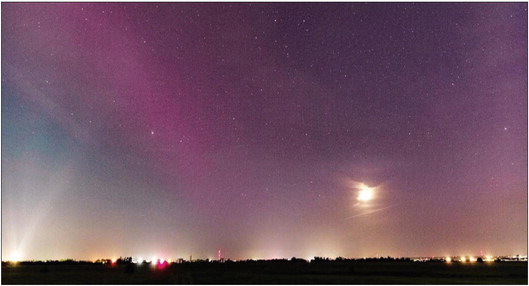
Southerners were also able to see something really rare in the south, the aurora borealis. On May 10, aurora borealis was very vivid and was able to be seen by the nakedeye.Accordingtospace weather forecasters, a rare severe geomagnetic storm triggered auroras and made it possible to be seen.
The storm, originally predicted to be a G2, or moderate, geomagnetic storm was upgraded to a G4, or severe. According to USA Today, this is the first time that a geomagneticstormwasrated as severe as a G4 since 2005.
Space forecasters were warning that even though thephenomenonwasgoingto be breathtaking, it also could have some danger hidden in it. They were expecting some disruptions to radio communications and satellites. They were also predicting that it might knock out power systems. Fortunately, nothing quite so dramatic occurred.
SomeTexanswerecurious about the color of the aurora borealis. Typically, it’s green, yet the one seen in Texas was pink. When energized particles from the sun hit the Earth’s upper atmosphere, the planet’s magnetic field directs the particles towards the Earth’s poles.
When particles enter the atmosphere, they supercharge electrons in different gasses. Once that occurs, those molecules then release the energy as light. This is typically how neon lights work.
The different elements in the atmosphere that give off the light, emit different colors. Green is the most common color in an aurora because green is the color it emits when there is a high concentration of oxygen.
The auroras that were seen in Texas were very high in the atmosphere, where there is a low concentration of oxygen. That is why the recent phenomenon was pink.