
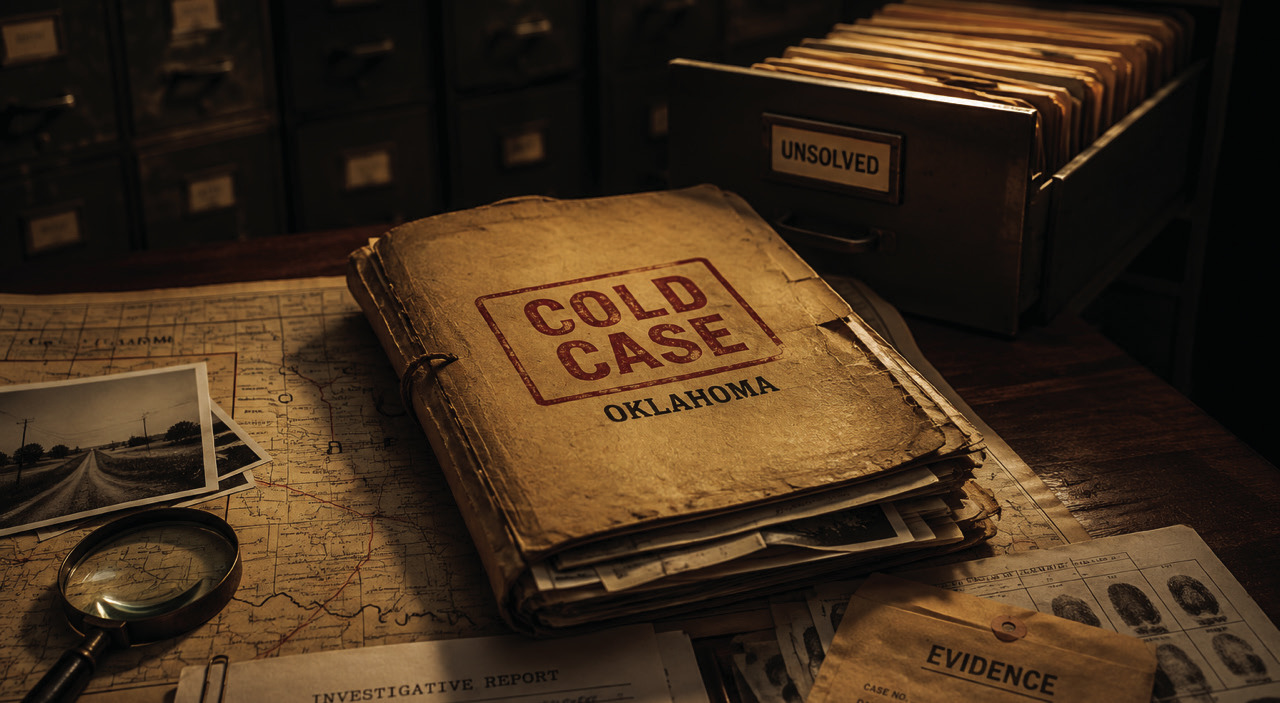
Some crimes do not stay buried in the past. They linger instead—locked in a file cabinet drawer, sealed in an evidence box or stored in a digital archive no one has opened in years. The detective who once carried the case has long since retired. The witnesses have moved away, grown older or died. The courthouse where it began may have been remodeled, renamed or replaced. Yet the case itself does not disappear. It waits.
In Oklahoma, there are thousands of them. Unsolved murders.Unanswereddisappearances. Violent crimes whose trails went cold and never warmed again. Some are well known, their names still spoken in news stories and true-crime discussions. Most are not. They exist only in agency files and in the memories of families who refuse to let them fade. For those families, time has not moved on. It has only passed.
The problem extends far beyond Oklahoma. Across the United States, hundreds of thousands of homicides have gone unsolved over the past several decades. According to FBI Uniform Crime Report data analyzed by the Murder Accountability Project and compiled by Project:ColdCase,morethan 352,000 homicides and nonnegligent manslaughters went unsolved in the United States between 1965 and 2024. Other estimates, using different starting dates and methodologies, have placed the total between approximately 240,000 and 340,000. Regardless of the calculation, the conclusion is the same: America has accumulated an enormous inventory of unsolved killings.
Those numbers require some explanation. There is no single national definition that precisely determines when an unsolved homicide officially becomes a “cold case” and different law-enforcement agencies use different criteria. Nor should the national number be taken to mean that hundreds of thousands of boxes are literally sitting on shelves labeled “cold case.” Some investigations remain active, some have exhausted every conceivable lead, and others may no longer contain evidence suitableformeaningful examination. Nevertheless, the statistics demonstrate the extraordinary size of the problem. Depending on the years examined, roughly a third or more of American homicides have gone unsolved and each year additional unclearedmurdersareadded to those left behind from previous decades.
Oklahomahascontributed its share to that grim total. Here, too, determining a precise number is difficult because no single publicly available master list contains every unsolved homicide investigated by every municipal police department, county sheriff’s office and state agency. Estimates vary substantially depending on whether older historical cases are included and which agencies and reporting periods are counted, but available estimates have placed the number of unresolved Oklahoma murders between roughly 1,000 and more than 2,500.
The Oklahoma State Bureau of Investigation maintains a Cold Case Unit and tracks hundreds of documented cold cases, but OSBI represents only one part of the picture. Many murders are investigated primarily by municipal police departments or county sheriffs. Oklahoma City has its cases. Tulsa has its cases. So do Lawton, Ardmore, Durant andcommunitiesthroughout the state. County sheriffs have their own files. Some cases are decades old and predate modern computerized recordkeeping. Some involved OSBI assistance, while others did not. When the Oklahoma Legislature considered its new cold-case legislation this year, Senator Carri Hicks of Oklahoma City said that approximately 1,000 Oklahoma families were still waiting for answers in the unsolved murders of their loved ones.
Behind those statistics are people. A cold case is not simply a number in a government database. It may represent a mother who died without ever learning who murdered her child, children who grew into adulthood without knowing who killed a parent, or brothers and sisters who have spent decades wondering whether someone somewhere knows something that was never told. It may also represent a detective who retired with one case he could never put to rest, or an evidence box containing an answer that science could not reveal when the evidence was originally collected.
A cold case is not just an old investigation. It is an investigation that stopped— where the leads ran out, the answers never came, and the file was set aside with the hope that someday something might change. In Oklahoma,thathopehasnow been given new structure.
This year, the Legislature created a formal process for reviewing cold criminal cases, giving families of qualifying victims a defined path to request that old files be reviewed again with fresh eyes, modern tools and renewed attention. It is a recognition of something law enforcement has always known: cases do not always go cold because they are unsolvable. Sometimes they go cold because, at the time, there was simply nowhere else to go. Years later, however, there may be somewhere new to go.
Governor Kevin Stitt signed Senate Bill 1636 into law on May 7, 2026, and the new statute takes effect on November 1. The measure received remarkable bipartisan support, passing the Oklahoma Senate 47-0 and the House of Representatives 81-0. The legislation was authored by Senator Carri Hicks and Representative RossFord,withSenatorJulia Kirt Goodwin and Representatives Scott Fetgatter and Danny Stewart serving as coauthors.
The legislation grew in significantpartfromanOklahoma tragedy that has remained unresolved for nearly four decades. In 1987, sisters Cheryl Genzer and Lisa Pennington disappeared after attending the Oklahoma State Fair. Their bodies were subsequently discovered in a shallow grave. Their murders remain unsolved. Their family has lived with the unanswered questions ever since, and their case helped provide impetus for legislation intended to give families like theirs a formal avenue to seek another review of an old investigation.
Senate Bill 1636 cannot promise those families that a murder will be solved. No Legislature can manufacture evidence that no longer exists, resurrect a deceased witness,compelsomeonewho knows the truth to speak, or guarantee that usable DNA, fingerprints, or other physical evidence was preserved. What the Legislature can do is establish a process that, under appropriate circumstances, requires an old case to be taken from the shelf and examined again. Sometimes that is all an investigation needs to get moving again.
The new law begins by defining exactly what constitutes a cold case, and that definition is important. It does not apply simply because acrimeisoldorbecause someoneisdissatisfiedwith anongoinginvestigation.The case must involve a “violent crime” as defined elsewhere inOklahomalaw,atermthat encompasses murder and numerous other serious violent offenses. In addition, all probative investigative leads must have been exhausted, and no likely perpetrator identified. In other words, the statute is aimed at investigations that have truly reached the end of the road.
Once a case reaches that point, the law permits a “designated person” to submit a written application for a case-file review. A designated person includes an immediate family member of the victim or another individual the reviewing law-enforcement agency determines should qualify. The statutory definition of immediate family is broad and includes a spouse, biological or adopted child, stepchild, biological or adoptive parent, stepparent, grandparent, grandchild, sibling, or stepsibling. Once the appropriatelaw-enforcement agency receives the written application, it must acknowledge receipt in writing within 30 days.
That represents a significant change for families of cold-case victims. In the past, a family member could telephone the sheriff, police department or OSBI and ask someonetotakeanotherlook. A sympathetic investigator might do so, particularly if new information had surfaced, but there was no statewide statutory mechanism establishing a formal process by which a qualifying family member could request a comprehensive review. Senate Bill 1636 creates one.
Perhapsthemostinteresting feature of the new law is its requirement about who performs the review. The individuals conducting the case-file review cannot have previously investigated the case. The Legislature has, in effect, required fresh eyes.
That requirement should notbeinterpretedascriticism of the original investigators. A detective investigating a murderin1976,1986,or1996 had access to the witnesses, evidence, scientific knowledge, and investigative technology available at that time. Good investigators follow the evidence, develop theories, and gradually determine which facts and witnesses appear important. That is how investigations are supposed to work. But anyone who has spent years working with criminal cases also understands that prolonged familiarity with a case can make it difficult to approach it without the assumptions that have developed around it.
A new investigator begins without those intellectual attachments. That person may question an assumption everyone else accepted, reconsider a witness dismissed years earlier, notice an inconsistency buried in an old statement, or recognize that a piece of physical evidence cannowbeexaminedinways that were impossible at the time of collection. The original investigators may have done everything reasonably possible and still reached a dead end. Forty years later, the road may no longer end in the same place.
The statute therefore contemplates something considerably more substantial than simply reading the old investigative report. A case-file review encompasses the information, evidence, records, testimony, and other pertinent material associated with the case, and its purpose is to determine whether further investigation might yield probative investigative leads. The reviewing investigators must examine investigative and follow-up steps that could contribute to the investigation, consider whether witnesses should be interviewed or reinterviewed, examine the physical evidence and determine whether appropriate forensic testing was originally performed, and consider whether additional testing now available could yield information relevant to the case. The agency must also consider modernizing the investigation to current investigative standards when doing so could yield useful leads.
That portion of the law may prove particularly important because forensic science has changed almost beyond recognition over the lifespan of many Oklahoma cold cases. DNA profiling has transformed criminal investigation. Biological material that could tell an investigator virtually nothing forty years ago may now identify the person who left it. Fingerprint and DNA databases have grown enormously. Computers can compare information in seconds that investigators once searched for manually. More recently, investigative genetic genealogy has provided another avenue for identifyingunknownpersons throughgeneticrelationships and family trees.
The evidence itself may not have changed at all. Our ability to understand what it contains has.
Witnesses change as well. A person who refused to talk in 1985 may be willing to talk in 2026. Friendships end. Marriages dissolve. Loyalties fade. Fear diminishes. A twenty-year-old who once protected a friend may view that decision very differently at sixty. Someone who has carried a secret for four decades may finally decide he no longer wants to die with it. Memory fades with time, but sometimes silence does too.
Under the new law, the reviewing agency ordinarily has six months to determine whether further investigation is warranted. The Legislature recognized that agencies may receive more requests than they can reasonably complete during that period, so the statute permits extensionsofuptosixmonths when the number of pending files makes the original deadline impracticable. An agency cannot simply allow the deadline to pass without explanation, however. The person who requested the review must receive written notice explaining the extension and the reasons for the additional time.
The statute also recognizes that criminal investigations do not always fit neatly within a single agency’s jurisdiction.Whenmorethan one law-enforcement agency would be responsible for reviewing the same cold case, the agencies must coordinate the review. This is particularly importantinOklahoma, where an investigation may involve a municipal police department or county sheriff’s office, assistance from OSBI and the Office of the Chief Medical Examiner, and ultimately a district attorney’s office. Jurisdictional lines should not become walls between pieces of the same investigation.
Another significant feature of the legislation concerns communication with victims’ families. Over time, relationships between families and law enforcement can become strained, even when everyone involved is acting in good faith. Families desperately wantanswers,while investigators may simply have none to offer. Detectives transfer or retire, and new officers inherit files they did not create. Telephone calls become less frequent, and eventually families may begin to believe that their loved one has simply been forgotten.
Senate Bill 1636 seeks to address at least part of that problem by requiring the reviewing agency to consult with the person who requested the review and to provide periodic updates. When the review is complete, law enforcement must meet with that person to discuss its findings, including whether further investigation will be undertaken.
That does not give the victim’s family control over a criminal investigation, nor should it. A family member cannot order investigators to interrogate a particular person, conduct a specific forensic test, or arrest someone the family believes committed the crime. Nor does the legislation alter the prosecutor’s authority to determine whether sufficient evidence exists to file criminal charges. Those decisions remain where they have always belonged—with law enforcement and prosecutors. What the new statute does is give the family a recognized place in the review process rather than leaving it entirely outside the door.
The Legislature also imposed limits to prevent the review process from becoming repetitive or unmanageable. Only one case-file review involving the same victim may be underway at a time. If the review concludes that further investigation is not warranted,anotherstatutory review generally cannot be undertaken for five years. An important exception applies when materially significant new evidence is discovered. Likewise, if further investigation is conducted but investigators remain unable to identify a suspect, another review or investigation under the statutory procedure ordinarily will not occur for at least five years.
None of those restrictions prevent law enforcement from acting independently when circumstances warrant it. If new DNA evidence identifies a suspect or a witness walks into a sheriff’s office with meaningful new information, investigators need not wait for the fiveyear period to expire. The statute expressly preserves law enforcement’s existing authority to investigate. The new law adds another doorway through which an old case can be examined; it does not close any of the doors that were already there.
Whether Senate Bill 1636 ultimately solves a single Oklahomamurderremainsto be seen, but history offers reason for hope. Cold cases have a peculiar relationship with time. Time is unquestionably their enemy. Evidence deteriorates, memories fade, witnesses die, and records disappear. Yet time can also becometheirally.Technology advances, databases expand, relationships shift, loyalties fade, and secrets become increasingly difficult to keep.
There was a time when solving a murder thirty or forty years after it occurred seemed remote. That is no longer necessarily true. Across the country, cases once considered virtually hopeless have been solved because biological evidence preserved decades earlier could finally be tested, an old fingerprint matched a modern database, or a new investigator revisited an overlooked witness. A killer who escaped detection at twenty-five may find himself looking over his shoulder at sixty-five because the evidence sitting quietly in an evidence room has not aged nearly as much as he has. The killer grows older. The science grows better. That is a race worth running.
All of this brings me to something new I will be doing in this newspaper. For the past several years, I have had the privilege of writing about the history of Marshall CountyandOklahoma.Much of that history has involved crime, courtrooms, lawyers, judges, lawmen, and the people whose lives crossed their paths. Most of those stories have one advantage that cold cases do not: we generally know how they ended.
There are other stories scattered across Oklahoma that remain unresolved. Not yet. Beginning with this article, I will occasionally step awayfromsettledhistoryand into those unfinished stories in a new series I am calling Oklahoma Cold Cases.
This will not be a weekly column. My regular historical column will continue, and properly researching an unsolved homicide takes time. These cases deserve more than hurried treatment just to meet another deadline. My intention is to publish an installment of Oklahoma Cold Cases at least once a month and, when time and circumstances permit, perhaps twice.
The cases will primarily come from Oklahoma. Some will involve murders, while others may concern disappearances or suspicious deaths in which foul play is suspected. Some will be decades old, while others may be considerably more recent. Some will be cases that readers across the state immediately recognize. Others may have been almost completely forgotten outside the community where they occurred.
I intend to approach these cases much as I have approached the historical stories I have written in these pages: begin with the record, determine what is actually known, separate fact from rumor, and be candid when the available evidence does not provide an answer. However, there is an important distinction I want to make at the outset of this series. I will not be investigating these cases. I will not be trying to solve them, nor will I be arguing that one theory, suspect, or explanation should prevail over another. That is not the purpose of this series, and moreimportantly,itisnotmy job. Investigating unsolved crimes is the responsibility of law enforcement.
Thatdistinctionhasgrown increasingly important amid the true-crime industry's extraordinary growth. There are excellent journalists, authors and podcasters who have brought deserved attention to forgotten cases, uncovered important records and reminded the public that victims whose names have disappeared from the headlines still matter. Public attention can sometimes be immensely valuable. A story may reach a witness who never came forward, revive interest in a neglected case or generate information that ultimately reaches investigators. There is nothing inherently wrong with telling the story of an unsolved crime.
The danger begins when telling the story becomes trying to solve it.
Too often, some true-crime podcasts and social-media communities cross that line. Reporting gives way to investigation, and investigation gives way to advocacy for a particular theory. Rumor is repeated until it sounds like evidence. Innuendo becomes suspicious circumstance. Anonymous statements are treated as established fact. Inconsistencies that may have perfectly innocent explanations areassembledinto elaborate theories, while facts that do not fit those theories are discounted or ignored. Before long, listeners are no longer being told what is known about a case. They are being invited to decide who committed the crime.
There is a fundamental problem with that approach. The public rarely has access to the entire investigative file. We do not know everything the police know. We may not know what witnesses have said in interviews that have never been released, what physical evidence has been collected, what forensic testing has been performed, what investigative leads have been eliminated, or why investigators chose to pursue one avenue and abandon another. A theory assembled from the fragments available to the public may appear compelling, yet collapse when comparedwithinformationin the actual investigative file.
There is another danger, and it is more serious. Amateur efforts to solve an active cold case can actually harm the investigation they are supposedly trying to help. Repeated public rumors can contaminate witnesses. A person who has heard the same theory hundreds of times may eventually have difficulty distinguishing what he actually remembers from what he has since heard. Public accusations can brand innocent people as murderers without evidence sufficient to justify an arrest, let alone a conviction. Potential witnesses canbecomefrightened, defensive, or unwilling to cooperate. Investigators may be forced to spend valuable time disproving internet rumors rather than following legitimate leads.
Most troubling of all, once a theory becomes popular, every new fact tends to be filtered through it. Evidence supporting the theory is magnified; evidence contradicting it is explained away. That is confirmation bias, and it is dangerous enough within an investigation where trained professionals have access to the evidence. In the hands of thousands of people working from incomplete information on social media, it can become something considerably worse: a public verdict rendered before the evidence is known.
Our criminal justice system wasdeliberatelydesigned to operate differently. Suspicion is not evidence. Rumor is not proof. Repetition does not turn speculation into fact, and popularity does not make a theory true. Before the State can brand someone a murderer, investigators must develop evidence, prosecutors must determine that the evidence justifies criminal charges, and ultimately the State must prove guilt beyond a reasonable doubt in a courtroom governed by rules of evidence and constitutional protections. Those safeguards can sometimes seem frustratingly slow, but they exist for very good reasons.
That is the line I will not cross in Oklahoma Cold Cases. I will present only what can responsibly be established from the public record. We will examine the victim, the circumstances surrounding the crime or disappearance, the evidence publicly disclosed, the course of the investigation, and what law enforcement has publicly said about the case. Where competing explanations have legitimately entered the public record, I may explain them, but I will not select a winner. I will not identify someone as a suspect merely becausepeopleontheinternet suspect that person. I will not elevate rumor or innuendo to the status of evidence, nor will I attempt to build a case against anyone.
There may be times when the public record allows us to askobviousquestions.Wecan identify gaps in what is publicly known. We can discuss the significance of released forensic evidence. We can explain investigative procedures and,whereappropriate, place evidence in historical or legal context. But there is an important difference between asking a question and pretending to know its answer. Where the record ends, this series will stop.
That may occasionally make for a less sensational story. So be it. These cases are not fictional mysteries written for our entertainment, and the people involved are not characters in a television drama. They are real victims, real families, real witnesses, and sometimes real people who have lived for years in the shadow of suspicion despite never having been charged with a crime. They deserve more care than a good story requires.
For the rest of us, a murder committed forty years ago may be history. For the mother who still remembers the last time she saw her daughter, it is not. For the child who grew up without a father, it is not. For the brother or sister who has spent decades wondering what happened, it is not. Nor should the passage of time offer comfort to the person who actually committed the crime. There is no statute of limitations onmurderinOklahoma. A killer who escaped justice in 1986 has not earned freedom simply because the calendar now reads 2026.
The witnesses may be older, the original detectives may be gone, the courthouse may have changed and the newspaper clippings may have yellowed, but somewhere the file remains. Perhaps inside it is something everyone missed—a statement, a fingerprint, a photograph, a strand of hair, a drop of blood, or a name written once in an investigator’s notebook and neverpursuedagain.Perhaps modern science will someday give meaning to evidence that could not speak when it was collected. Or perhaps there is nothing left except questions.
We will encounter those cases too, because not every mystery has an answer waiting for us to discover. More importantly, it is not our responsibility to find one. That responsibility belongs to the men and women entrusted by law with investigating crime, who have access to evidence and investigative tools we do not.
The purpose of Oklahoma Cold Cases will therefore be simpler and, I believe, more responsible. We will remember the victim. We will reconstruct the story from the public record. We will examine what is known, acknowledge what is not, and distinguish evidence from speculation. We may ask questions, but we will not manufacture answers.
Oklahoma’s new cold-case law rests upon a simple proposition: the passage of time does not necessarily mean the search for truth must end. That is also the premise of this new series. At least once each month, we will open one of those old files, return to the placeandtimewherethestory began, and examine what the public record can tell us.
As for solving the case, we will leave that where it belongs—with the police.