
At the close of last week’s installment, Jake Louis Hamon stood at the highest point of his remarkable life at precisely the moment when the private world beneath him was becoming impossible to hold together. For more than twenty years, he had moved steadily upward. The ambitious young Kansas lawyer who had gone south in search of opportunity had become one of the builders of Lawton, then one of the dominant figures in Oklahoma Republican politics, and finally one of the wealthiest and most influential businessmen in the Southwest. Oil, railroads, banking, real estate, political organization, and an almost uncanny ability to cultivate powerful friendships had carried him farther than even the confident young lawyer of 1901 could have imagined.
By the autumn of 1920, Hamon’s influence reached well beyond Oklahoma. He had worked aggressively for Warren G. Harding’s nomination at the Republican National Convention in Chicago and had emerged from that convention with a reputation as one of the men who helped break the deadlock in Harding’s favor. WhenHardingwonthepresidential election, Hamon’s own political stock rose with him. Newspapers speculated openlyaboutHamon’sfuture. His name was mentioned in connection with the new administration. Some believed Harding might offer him a Cabinet position, most often the office of Secretary of the Interior. Whether Harding had made any firm promise is impossible to establish with certainty, but there is no question that Hamon and those around him believed he stood on the threshold of an even greater role in national politics.
That timing is important to everything that followed. Warren Harding was elected President of the United States on November 2, 1920. Jake Hamon was shot on November 21. Only nineteen days separated the greatest political triumph of Hamon’s career from the gunshot that would end it. Yet Harding would not actually become Presidentformorethanthree additionalmonths.Underthe systemthenineffect,histerm would not begin until March 4, 1921.
To modern readers accustomed to presidential inaugurations on January 20, that delay may seem unusual, but for most of American history March 4 had been the traditional beginning of a presidential term. The date reached back to the very beginning of the federal government under the Constitution. Although George Washington’s first inauguration was delayed until April 30, 1789, because of the difficulty of organizing the new government, March 4, 1789, was the date Congress had designated for the new constitutional government to begin operations. Beginning with Washington’s second termin1793,March4became the regular date upon which Presidents entered office, and it remained so for nearly a century and a half.
There were good practical reasons for such a long interval between election and inauguration. Intheeighteenth and nineteenth centuries, election returns traveled slowly. Votes had to be collected, counted, certified, and communicated across a nation in which information moved no faster than a horse, stagecoach, sailing vessel, or eventually a railroad train. A President-elect might live hundreds of miles from the national capital and require considerable time to settle personal affairs, organize an administration, travel to Washington, and assemble the people who would serve with him. What appears today to be an unnecessarily long transition was, in the early Republic, largely a product of geography, transportation, and communication.
By the twentieth century, however, those conditions had changed dramatically. Railroads had reduced journeys from weeks to days. Telegraph and telephone communication allowed election results and political decisions to move across the country almost instantly. Yet the old constitutional calendar remained. The result was a prolonged period of nearly four months in which an outgoing President remained in office while the Presidentelect assembled his Cabinet, negotiated appointments, rewarded political allies, considered policy, and prepared to assume power. The arrangement increasingly came to be criticized as the “lame-duck” system because defeated or retiring officials could remain in authority long after voters had chosen their successors.
The shortcomings of that system became especially obvious duringtimesofnational crisis, and Congress eventually proposed the Twentieth Amendment to shorten the transition. Ratified in 1933, the amendment moved the start of presidential and vice-presidential terms from March 4 to January 20 and the opening of the new Congress to January 3. Franklin D. Roosevelt therefore became the last President inaugurated on March 4 when he took office in 1933. Four years later, on January 20, 1937, Roosevelt became the first President inaugurated on the date Americans now recognize as Inauguration Day.
Noneofthatreformhadoccurred whenWarrenHarding won the presidency in 1920. He remained Presidentelect for approximately four months, and those weeks between election and inauguration were when the architecture of the new administration was assembled. Cabinetpostswerediscussed. Federal appointments were considered. Political obligations accumulated during theconventionandcampaign were remembered. Party leaders who had helped deliver delegates, money, organization, and votes naturally waited to learn what place theymightoccupyonceHarding took the oath of office.
Jake Hamon was one of those men. Indeed, his position was particularly tantalizing because the election had settled the question of whether Harding would become President but had not yet settled who would accompany him into power. Hamon had spent years cultivating precisely the relationships thatmattered.He hadsupportedHardingwhen the Ohio senator remained a long-shot candidate, worked for him during the deadlocked Republican convention, and emerged from the election as one of the most influential Republicans in the Southwest. Now, during those long months before March 4, the political debts of 1920 were being counted, and the new administration was beginning to take shape.
For Hamon, therefore, November 1920 was not supposed to be an ending. It was supposed to be the beginning.
Only nineteen days after Harding’svictory,JakeHamon was preparing to discuss what that beginning might look like. For a man whose business interests spanned oil, railroads, land, Indian affairs, and western development, the Department of the Interior would have been a particularly important office. The department exercised authority over public lands, natural resources, Indian affairs, and other matters of enormous significance throughout the West. Hamon’s name being seriously considered for such a position illustrates how far he had risen. Less than twenty years earlier, he had been a young lawyer struggling to establish himself in a new Oklahoma town. Now, less than three weeks after helping elect a President, he was reportedly discussing what role he might play in that President’s administration.
The future awaiting Hamon in Washington demanded something his private life could no longer easily provide: unquestioned respectability. For years, he had somehow maintained two separate worlds. Georgia remained his lawful wife, the woman who had shared the years before, when wealth and political prominence were still in the future. Clara Smith had become his secretary, business confidante, traveling companion, and lover. The arrangement had survived because those who knew stayed silent and because newspapers of that era frequently treated the private affairs of prominent men as outside the scope of legitimate public reporting, so long as the scandal remained discreet.
Harding’s election threatened that discretion. A nationally important adviser to the President-elect could expect scrutiny that a wealthy Oklahoma oilman might avoid. Cabinet appointments invited investigation. Political enemies searched for vulnerabilities. Washington correspondents wanted to know everything about the men expected to surround the new administration. Suddenly, a relationship that had been whispered about in Oklahoma for years threatened to become the kind of story that could follow Hamon all the way to Washington.
By November 1920, the understandings that had allowed Jake, Georgia, and Claratocoexistforyearswere under enormous pressure. What Jake had promised Clara would later become one of the central issues in the case. Clara would insist that Hamon had repeatedly led her to believe he would eventually divorce Georgia and marry her. Others would tell the story differently. What cannot reasonably be disputed is that Clara had devoted years of her life to Hamon, had become deeply involved in his business affairs, had traveled with him, had occupied adjoining quarters with him at the Randol Hotel, and had every reason to believe that Harding’s election might fundamentally change her future.
If Jake Hamon went to Washington, who would go with him? For Georgia, the answer was obvious. She was Mrs. Jake Hamon, his lawful wife and the woman political society would expect to stand beside him. For Republican leaders considering Hamon for high national office, the answer would have been equally obvious. For Clara, however, that same answer threatened to bring an end to the life she had known for years. What represented political triumph for Jake could represent abandonment for Clara.
Thecollisionthathadbeen buildingquietlywasnowonly days away.
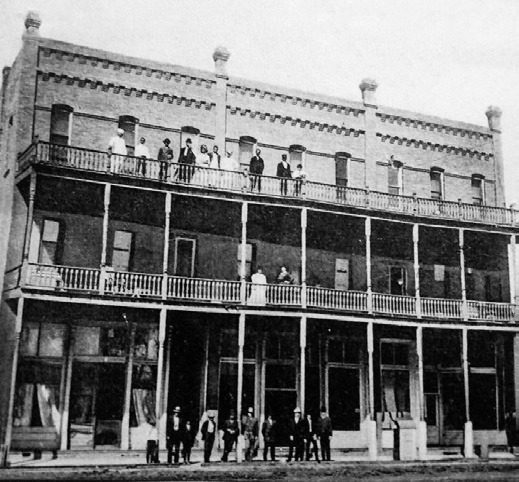
The Randol Hotel
To understand what happened on the evening of November 21, 1920, it helps to understand the building in which it occurred. The Randol Hotel was not merely the accidental setting for Jake Hamon’s final confrontation with Clara Smith. For years it had been part of the world they shared, and by the time Hamon reached the pinnacle of his fortune and political influence, the hotel had become one of the familiar centers of his life in Ardmore.
The history of the site reached back into the closing years of Indian Territory. Before 1899, J. W. Banks constructed a building there that combined a mercantile establishment with lodging quarters. In 1903, W. F. “Dixie” Gilmer arrived from North Carolinaandleasedthehotel. Contemporary descriptions portray a substantial threestory structure, with guest rooms occupying the second and third floors and broad verandas facing Main Street. Like other respectable hotels of the period, the Randol maintained transportation for arriving guests; a horsedrawn carriage met travelers at the railroad station and carried them and their luggage to the hotel.
By 1910, the establishment was advertising itself as the New Randol Hotel, and that September its new dining room opened to the public with an evening dinner. The Daily Ardmoreite reported that Mrs. A. C. Bell had been placed in charge of the dining room and noted her local reputation for serving unusually good meals. Three years later, Ardmore’s 1913 city directory listed the New Randol Hotel in the 200 block of West Main Street, placing it squarely within the commercial heart of a city rapidly being transformed by oil. Today, the hotel’s location is the site of the current “Charles R. Smith Plaza.”
That location mattered. Ardmore was a railroad town before it became an oil capital, and much like earlyday Madill, its downtown hotels occupied a place in community life that is difficult to appreciate in an age of automobiles, interstate highways, telephones, and instantaneous communication. Traveling businessmen did not simply sleep in hotels. They conducted business there. Lawyers met clients there. Salesmen displayed merchandise there. Oilmen negotiated leases there. Politicians counted votes there. Deals were discussed over dinner, in lobbies, and behind closed doors upstairs. In fact, the present-day term ' lobbyist” used to describe those paid or hired to persuade lawmakers and government officials to vote or act in favor of a specific company, organization, or cause, came about partly because those paid to persuade lawmakers often cornered them in the lobbies of government buildings, restaurants or hotels. The Oklahoma Historical Society’s description of the Randol specifically remembers it as a place where enormous oil transactions were consummated.
By the time the Healdton field exploded into production, a hotel such as the Randol had become part of the machinery of the oil boom itself. Ardmore filled with lease brokers, drilling contractors, geologists, investors, bankers, equipment salesmen, railroad officials, speculators, and men carrying maps showing tracts of land that might be nearly worthless one morning and worth a fortune by nightfall. Much of that business necessarily occurred wherever those men gathered. The hotel lobby, dining room, and guest rooms therefore became extensions of the offices, banks, and courthouses surrounding them.
Jake Hamon fit naturally into that world. Indeed, the Randol became much more of a residence and business headquarters than a temporary stopping place for Hamon and Clara. Historical accounts place the two of them living there during the First World War, while Hamon acquired additional oil and gas properties and expanded the fortune that made him one of the wealthiest men in Oklahoma. At Clara Smith’s later trial, testimony went even further. A witness stated that Hamon andClarahadtakenroomsat the Randol in 1913 and had maintained them continuously thereafter.
That detail gives the events of November 21 an entirely different character. Hamon was not walking into an unfamiliar hotel room on the night he was shot. Clara was not simply a visitor who happened to encounter him there. These rooms had formed part of their shared existence for years. Business had been conducted there. Arguments had undoubtedly occurred there. Plans had been made there. Their complicated relationship had unfolded against those walls while Hamon moved from successful businessman to oil millionaire and finally to amanwhosenamewasbeing discussed in connection with the incoming presidential administration.
The Randol therefore stood at the intersection of almost every important element of Jake Hamon’s life: oil, money, politics, and Clara Smith. Men came through its doors to discuss business worth enormous sums of money. Political associates metHamonthere.Claralived there. And on November 21, 1920, only nineteen days after WarrenHardinghadbeen elected President, Hamon returned to the Randol as discussions about his own place in the new administration reached their most consequential stage.
Within a matter of hours, the hotel would cease being merely one of Ardmore’s important business establishments. It would become a crime scene.
The events that occurred upstairs that evening would make the Randol Hotel famous far beyond Oklahoma. After Hamon’s death and Clara Smith’s return to face trial, reporters descended upon Ardmore from across the country. The hotel became part of the story. During the March 1921 trial, the rooms occupied by Hamon and Clara became so important thatthejurywasallowed tovisitthem.Acontemporary newspaper account referred to the room connected with the shooting as the “murder chamber.”
For a time, the Randol survived its unwanted fame. Guests continued to register, meals continued to be served, and Ardmore continued with the ordinary business of a prosperous oil city. The hotel remained standing as a physical reminder of a tragedy that had become part of national history. Anyone walking its corridors could still walk past the rooms where Jake Hamon and Clara Smith had lived and where, on that November evening, their long relationship had reached its violent conclusion.
The building itself would not survive much longer. On July 17, 1925, less than five years after Hamon was shot and only four years after Clara Smith’s celebrated trial, a fire of undetermined origin sweptthroughtheRandol Hotel and destroyed it. The building that had witnessed enormous oil transactions, housed one of Oklahoma’s most powerful businessmen, become the scene of his fatal shooting, and drawn national attention during one of the mostfamousmurderprosecutions in Oklahoma history was gone.
There is something strangely fitting about the Randol’s fate. Jake Hamon’s empire had seemed permanent in November 1920. So had the hotel in which so much of his Ardmore life had unfolded. Within five years, both had disappeared. Hamon was dead. Clara had stood trial. Warren Harding hadenteredtheWhiteHouse, and he himself died before completing his term. The political futureHamonbelieved awaited him in Washington had vanished, and finally the very building in which his story reached its climax disappeared in flames.
Today, a historical marker on West Main Street preserves the memory of the Randol Hotel and identifies the place where it once stood. The hotel itself is gone, but its place in Oklahoma history remains secure. For one extraordinary period, its rooms witnessed the convergence of oil wealth, presidential politics, forbidden love, and murder.
November 21, 1920
None of that history had yet been written on November 21, 1920. On that Sunday evening, the Randol was simply a familiar Ardmore hotel, a place where Jake Hamon had conducted business and where he and Clara had maintained rooms for years. Hamon entered it with every reason to believe that the greatest chapter of his life was still ahead of him. His political influence had never been greater; his friendship with the president-elect had placed him within reach of national power and talk of a place for him in the new administration had moved well beyond idle speculation. Before the night was over, however, Hamon would leave the Randol with a bullet inside his body and only five days left to live.
The setting would become enormously important to everything that followed. The fatal shooting did not occur in an isolated cabin or along a lonely country road, but in the heart of Ardmore, inside a busy hotel where Hamon was well known and where employees, associates, and guests observed portions of the events surrounding the shooting. There were people who saw Jake before he went upstairs, people who saw Clara, and people who encountered Hamon afterward. Yet for all those nearby, no disinterested eyewitness was inside the room when the critical events occurred. What happened there would ultimately have to be reconstructed from the physical evidence, Hamon’s statements and conduct before his death, Clara’s account of the confrontation, and the testimony of those whosawthetwoimmediately before and afterward. That absence of an independent eyewitness would become one of the defining features of the case and, eventually, one of the central problems confronting the jury.
The events of November 21 began not with romance or violence, but with politics. According to Bob Hutchins, one of the men closest to the eventsofthatday,aconfidant of President-elect Warren G. Harding arrived in Ardmore that day, and Hamon arranged a private dinner at theRandolforhimselfandhis visitor. Hutchins later said the subject to be discussed was the incoming Harding administration and the role Hamon might play in it. If Hutchins’s recollection was accurate, the timing could scarcely have been more dramatic.Onlynineteendays had passed since Harding’s election. Cabinet selections and other important appointments were being considered, the new administration was beginning to take shape, and a man from the Presidentelect’s circle had come to Ardmoretositdownprivately withJakeHamonanddiscuss what might come next.
For Hamon, the evening promised to be another step toward the culmination of more than twenty years of political work. He had helped build the Republican organization in Oklahoma, cultivated relationships in Washington, championed Harding’s candidacy and emergedfromtheRepublican convention with a national reputation as one of the men instrumental in Harding’s nomination. Now that Harding had been elected, Hamon’s own future appeared to be part of the conversation. For a man whose name was already being mentioned for high federal office, there could have been few discussions more important.
For Clara, however, the evening seemed to mark something very different. She was not invited to the private dinner. On its face, there was nothing particularly remarkable about that. A confidential political discussion about forming a presidential administration hardly required the presence of Hamon’s companion or business associate. But Jake and Clara’s relationship complicated the exclusion. She had been beside him through years of expanding business interests and growing political influence. She had traveled with him, handled correspondence, assisted with his affairs, and occupied an intimate place in his daily life. Now, just as the White House moved within reach, a door was closing between them while Jake’s future was being discussed on the other side.
Harding’s election had changed the equation between Jake and Clara in a way that neither could easily ignore. The arrangement that had somehow survived through years of oil speculation, railroad building, political conventions and Hamon’s rise to extraordinary wealth was suddenly colliding with thepossibilityofWashington. What Oklahoma political acquaintances had been willing to overlook was one thing. What could survive the scrutiny surrounding a Cabinet officer or a prominent presidential adviser was another matter. If Jake were to enter the Harding administration, the public wife expected to accompany him into that new world was Georgia Hamon. Clara could hardly have failed to understand what that might mean for her.
According to Hutchins, Clara came downstairs before the dinner and was intoxicated. Later accounts described her as deeply upset and convinced that Jake intended to cast her aside now thatWashingtonhadbecome a genuine possibility. How much Clara had been drinking, how much Jake had consumed, and precisely what wassaidbetweenthemwould later become important parts of the trial testimony. Those details belong with the courtroom story. What matters here is that, well before the gunshot, the atmosphere insidetheRandolhadbecome tense and the strain that had accumulated between Jake and Clara was beginning to break into the open.
Hutchins recalled that the two argued before the planned dinner. Jake reportedly ordered Clara to return to her room and threatened to have her arrested for disorderly conduct if she continued creating a disturbance. Hutchins then escorted her upstairs, where she apparently laydownandfellasleep. His account suggests that this was not a sudden quarrel that erupted without warning later that evening. The emotional confrontation had alreadybegunasHamonprepared for a political meeting that might have represented the greatest opportunity of his life.
There was a cruel symmetry to their positions. The election that promised to give Jakeeverythinghehadspent his adult life pursuing may have threatened to take from Clara the life she had spent years building around him. Jake saw Washington opening before him. Clara may have seen Jake disappearing into it. The same political triumph could therefore represent opportunity to one and abandonment to the other.
Hutchins apparently understood how dangerous that combination had become. After Clara had been taken upstairs, Jake told him that he wanted to go to her room and console her. Hutchins urged him not to go. According to his later recollection, he warned Hamon in words that would become haunting after what followed: “She thinks you are giving her the brush-off. If you go up there now, you will come down on a death wagon.”
Whether Hutchins remembered those exact words precisely after the fact would eventually be for others to judge. But if his recollection was accurate, the warning was chillingly prophetic. Hutchins believed Clara was distraught, feared Hamon was abandoning her, and believed the situation had become dangerous enough that he specifically urged his friend to stay away.
Jake Hamon did not take his advice. He went upstairs.
What happened after he entered Clara’s room would become the central mystery of the murder case. The precise words spoken, the physical confrontation later alleged, the location of the pistol, the movements of Jake and Clara, and the exact circumstances under whichtheweaponfiredwould eventually be examined in painstaking detail before a Carter County jury. Those facts belong properly to the trial portion of this series, because it is there that the competing accounts can be weighed against the witnesses and evidence rather than presented prematurely as established fact.
For now, the door can remain closed. Jake Hamon went upstairs alive. Later that evening, he came back down with a bullet in his body.
The Wounded Kingmaker
According to Hutchins, Hamon eventually appeared downstairs alone. He was reeling and seriously wounded, and when he reached the diningarea,hecollapsed.The transformation in that room must have been extraordinary. Only a short time earlier, preparations had been made for a private dinner concerning the future administration of the Presidentelect of the United States. Jake Hamon had expected to talk about Washington, political appointments, and perhaps the greatest opportunity of his career. Instead, the man expected at the table staggered in wounded and fighting for his life.
By remarkable coincidence, a local surgeon was waiting for dinner in the restaurant. Medical assistance was therefore available almost immediately. Hutchins and the physician helped get Hamon to the nearby Ardmore Sanitarium and Hospital, where doctors began examining the wound and attempting to determine the extent of the internal damage.
The bullet had penetrated deeply. What initially appeared from the outside to be a relatively small pistol wound had traveled through Hamon’s body, passing through the region of the liver before lodging near his back. The full seriousness of the injury was not immediately apparent. Hamon remained conscious, was able to speak, and, remarkably, was still able to walk after being shot. Those circumstances helped create an early sense that the wound, while painful, was survivable. The greater dangers—internal injury, blood loss, infection, and the complications that could follow—would reveal themselves only with time.
Yet the first public explanation for what had happened inside the Randol Hotel was remarkably simple. JakeHamonhadaccidentally shot himself.
That was not rumor or speculation whispered around Ardmore the following morning. It was the account given publicly and repeated almost uniformly by newspapers across Oklahoma. OnNovember22,readers awakening to the first reports of the shooting were not told that one of the most powerful political figures in the Southwest had been shot during a confrontation with his longtime mistress. They were told that Jake Hamon had suffered an unfortunate firearms accident while preparing for a trip.
TheOklahomaCityTimes carried the story beneath the headline, “JAKE HAMON SHOT WHILE CLEANING GUN.” The newspaper reported that the Ardmore millionaire and Republican national committeeman had “shot himself accidentally” while cleaning a firearm. The report placed the wound in his right side near the liver and assured readers that medical authorities did not believe it would prove fatal unless unexpected complications developed. The paper even supplied an innocent explanation forwhyHamonhad beenhandlingtheweapon:he was reportedly preparing to leave on a hunting trip.
The same account appeared elsewhere in the state. The Bartlesville Examiner-Enterprise announced, “JAKE HAMON ACCIDENTALLY SHOOTS HIMSELF,” followed by the subheading, “ACCIDENT OCCURRED WHILE CLEANING GUN.” According to the newspaper, Hamon’s business manager, Frank L. Ketch, reported that Hamon had been cleaning a .25-caliber automatic pistol at approximately eight o’clock the previous evening, preparing to place it in his traveling grip, when the weapon accidentally discharged. The paper reported that the bullet passed through the upper portion of his liver and lodged in the muscles of his back near the spinal column.
Even more striking was the description of Hamon’s condition immediately afterward. The Examiner-Enterprise reported that the wounded man had walked from the Randol to the nearby hospital and told those treating him that “he had accidentally shot himself.” His physicians were quoted as believing the wound was painful but not necessarily serious unless complications developed. Mrs. Hamon, who was in Chicago, had been notified by telegram.
The Daily Ardmoreite, reporting from the very city where the shooting occurred, gave its readers essentially the same account. Its headline read, “JAKE L. HAMON SUFFERING FROM ACCIDENTAL SHOT,” and described the prominent oilmanandRepublicanpolitician as having been “severely injured while loading gun.” The newspaper reported that Hamon had been in his room at the Randol cleaning and loading a .25-caliber automatic pistol in preparation for an upcoming trip when the weapon discharged.
The Ardmoreite supplied considerable detail. According to its account, Hamon had been preparing the pistol for travel, something he apparently did routinely when making extended trips. The bullet entered his body near the center of his torso, passed through the upper portion of the liver and traveled toward his back. The paper reported that Hamon subsequently went downstairs to the Randol Cafe, where Dr. A. G. Cowles was eating dinner. After being told what had happened, Cowles accompanied Hamon to the hospital.
That detail is important because it demonstrates how deceptive the injury’s seriousness initially appeared. Hamon had not been carried unconscious from the Randol. He had not collapsed immediately after the shooting and died within minutes. According to the first newspaper reports, he remained sufficiently alert and mobile to seek out a physician and participate in the decisions concerning his treatment. To those around him—and apparently toHamonhimself— the possibility of recovery remained very real.
The Ardmoreite reported that Hamon was placed under anesthesia and that physicians probed the wound in an effort to deal with the bullet and the internal injury. It further reported that he hadlostasubstantialamount of blood internally, but the early prognosis remained guardedly optimistic. “Unless complications arise,” readers were assured, the injury was not expected to prove serious. Friends were being told that Hamon would soon recover.
That optimism traveled quickly. News of the shooting had already spread beyond Ardmore by the following morning, producing what the Ardmoreitedescribedashundreds of telegrams arriving at Hamon’s office. The reaction was hardly surprising. Jake Hamon was no longer merelyaprominentArdmore businessman. Nineteen days earlier, Warren G. Harding had been elected President of the United States, and Hamon was widely regarded as one of the men who had helped place him there. His healthwasthereforeamatter of interest far beyond Carter County.
Onetelegraminparticular revealsjusthowcloseHamon had come to the center of national power. Among the first inquiries received in Ardmorewasamessagefrom Harry M. Daugherty of Ohio. Daugherty was no ordinary political acquaintance. He had managed Harding’s presidential campaign and was one of the Presidentelect’s closest political advisers. Within a few months, Harding would appoint him Attorney General of the United States. According to the Ardmoreite, Daugherty made “diligent inquiry” concerning Hamon’s condition, and Frank Ketch responded with assurances that Hamon was resting comfortably and that no serious consequences were expected.
The telegram is a small detail, but an extraordinarily revealing one. The morning afterJakeHamonwasshotin an Ardmore hotel room, one ofthemostpowerfulmensurrounding the President-elect was already asking about him. It confirms in a very tangible way the political statureHamonhadachieved. The relationships described in newspapers during the presidential campaign were notmerelyceremonialfriendships created for political appearances. Hamon belonged to the circle of men surrounding the incoming President, and news that he had been wounded immediately attracted their attention.
Nothing in those first reports suggested scandal. Nothing suggested Clara Smith. Nothing suggested an argument or that another person had been in Hamon’s room when the pistol fired. Instead, the public was given a coherent and entirely plausible explanation. Hamon had been preparing to travel. He routinely carried a pistol on long trips. While cleaning or loading the weapon, it accidentally discharged. He sought medical treatment, told those around him that he had shot himself, and appeared likely to recover.
For the moment, the story held.
More importantly, the accidental-shooting explanation protected nearly everyone involved. It protected Clarabyremovingany immediate suggestion that she had fired the weapon. It protectedJakebykeepinghis years-long relationship with her out of the newspapers. It spared Georgia, still in Chicago, the immediate humiliation of the public learning about her husband’s private life through sensational newspaper reports. And at a moment when Harding’s advisers were considering the men who would serve in the new administration, it prevented the Presidentelect from being dragged into a scandal involving one of his most important Oklahoma allies.
ForJakeHamon,theword accident could accomplish what all his wealth and political influence suddenly could not. It could close the door to Room 37, at least temporarily.
There is another reason the early newspaper accounts deserve attention. They were published while Hamon was still alive. They were not reconstructions assembled months later for Clara Smith’s trial, after witnesses had heard other accounts, chosen sides, consulted lawyers, or lived through the enormous publicity surrounding Hamon’s death.Thesewerethereports reaching the public within hours of the shooting, while Hamon remained capable of speaking for himself. Whatever the ultimate truth of what occurred upstairs at the Randol, the story coming from Hamon and those around him on November 22 was that no crime had occurred.
That raises one of the most intriguing questions in the entire case. If Clara had deliberately shot him, why would Jake Hamon protect her? If the shooting had occurred during a violent struggle, why conceal it? If he believed he would recover, did he simply intend to handle Clara privately once he was well? Was he protecting thewomanwithwhomhehad shared years of his life? Was he protecting Georgia and his children from scandal? Was he protecting his own reputation at precisely the moment he stood on the threshold of national office? Was he protecting WarrenHardingfrom an embarrassing association before the new President had even been inaugurated? Or was Hamon telling the truth, and the shooting really had been accidental?
Those questions would later become part of the enormous puzzle confronting investigators, lawyers, newspaper reporters and, ultimately, twelve Carter County jurors. They should not be answered simply because we know how the story ends. On November 22, 1920, the evidence available to the public pointed in only one direction because Jake Hamon himself apparently insisted that it should.
There was also every reason for Hamon to believe that the explanation might end the matter. He was still alive. Doctors initially expected him to recover. The newspapers had accepted Hamon’s account of the accident. Clara’s name had not yet become part of the public story. If Hamon survived, returned to his businesses and resumed his political career, the shooting might have become little more than an embarrassing footnote—the storyofawealthyoilmanwho carelessly discharged a pistol while packing for a trip.
But Jake Hamon did not recover.
As November 22 became November 23, and then November 24, the reassuring reports began to give way to growing concern. The wound that initially seemed survivable wasbecomingsomething far more dangerous. Complications developed. The man who had walked downstairs from the Randol and helped create the explanation of his ownshootingwasweakening.
And once it became possible thatJakeHamonmight die, everything changed. An accidental shooting could remain a private embarrassment. A homicide could not. The distinction would soon transformClaraSmithfroma womanwhosenamehadbeen conspicuously absent from the first newspaper accounts into one of the most soughtafter women in America.
According to Hutchins, even from the hospital, Jake remained concerned about Clara.Thatiswherethestory becomes stranger still.
One Last Arrangement
Hutchins later said that while doctors were treating Hamon and Jake drifted in and out of consciousness, Hamongavehiminstructions concerning Clara. According to the account, Jake wanted Hutchins to take Clara to Hutchins’ home in El Paso, get her across the border into Mexico, and then ensure she returnedwhenthetimecame for her to testify in court.
If that recollection is accurate, it reveals a great deal about Jake Hamon’s state of mind in the hours after the shooting. This was not, at least according to Hutchins, a man immediately demanding that police arrest Clara. Hamon apparently understood that legal proceedings might eventually follow, yet he wanted Clara away from Ardmore in the meantime and trusted Hutchins to ensure she was protected.
There was something entirely characteristic about such an instruction. Jake Hamon had spent his adult life solving problems by making arrangements. Political disputes were settled through alliances. Business obstacles were met with financing. Transportation problems became railroad projects. Party fights were negotiated through friendships and favors. When circumstanceschanged,Jake adjusted.
Now, lying in a hospital with a bullet near his spine, he apparently attempted one final arrangement. Clara needed to leave Ardmore, and Hutchins later said he complied.
The exact route of Clara’s flight would soon become tangled in rumor, conflicting newspaper reports, alleged sightings, and later testimony. Those details deserve their own treatment, and we will follow them next week. For the moment, what matters is simply that Clara disappeared while Jake Hamon remained alive.
Her disappearance began changing the story almost immediately. A prominent man accidentally shooting himself was unfortunate but understandable. A prominent man shooting himself while the woman who had occupied adjoining hotel quarters with him suddenly vanished was something else entirely. Questions began multiplying. Why had Clara left? Where had she gone? HadJakesentheraway?Was she fleeing prosecution? Had the shooting occurred during anargument?HadHarding’s election caused a rupture between them? Was Jake preparing to abandon Clara in order to restore Georgia to her public place beside him before going to Washington?
Those questions were only beginning. While Clara moved away from Ardmore, JakeHamonremainedinthe hospital, and for five extraordinary days the future of the entire story depended upon whether he lived or died.
Jake Hamon did not die that Sunday night. He lingered for five days, creating one of the strangest intervals in the entire Hamon story. Had he died immediately in the Randol Hotel, authorities wouldhavebegunahomicide investigation at once, and Clara’s disappearance would instantly have been interpreted through that lens. Instead,Jakeremainedalive, continued speaking, and initially maintainedthathehad shot himself accidentally.
For a time, there was genuine hope that he might recover. Contemporary reports reflected that uncertainty. Some described his condition as serious but not necessarily hopeless. Others became increasingly pessimistic as complications developed. The bullet had caused severe internal damage, and the danger lay not simply in the wound itself but in the infection and physical decline that followed.
Had Jake recovered, the entire history of the case might have changed. He could have continued insisting the shooting was accidental. Clara might have remained outside Oklahoma until the immediate scandal cooled. Political allies could have closed ranks around him. The Harding administration might have moved forward with Jake still somewhere within its circle. His wealth and political influence were sufficient to withstand an extraordinary amount of gossip.
Every passing day, however, made that possibility less likely. Jake weakened. The scandal grew. Clara remained gone. And Georgia began making her way back to Ardmore.
Georgia Comes Home
For all the turmoil in their marriage, Georgia remained Jake Hamon’s wife. She had been with him before Clara, before oil, before Ringling, before the railroad, before national Republican politics, and before anyone imagined that Jake might someday stand on the threshold of a presidential Cabinet.
Now she returned as his life was ending.
Thereissomethingalmost painfully symmetrical in that journey. For years, Jake had divided his life between two women. In his final days, those two lives moved in opposite directions. Clara traveledsouth,awayfromArdmore andeventuallytoward the Mexican border. Georgia traveled back toward him.
Contemporary newspapers reportedGeorgia’smovements andsoughtstatements from her. She had been living in Chicago with the children whenwordofJake’scondition reachedher.Whateveranger, humiliation, or grief she carried from the years of Clara’s presence in her marriage, those emotions did not keep herfromreturningtotheman she had married more than twenty years earlier.
According to Hutchins’ later account, Georgia reached Jake before the end. She was there when his strength finally failed. On November 26, 1920, five days after the shooting, Jake Louis Hamon died at the age of forty-seven. Georgia was reportedly holding his hand when he took his last breath.
The young schoolteacher from Kansas who had married him before there was money, power, oil, or national fame was there at the end of the extraordinary journey they had begun together in 1898.JakeHamon’sadultlife had begun beside Georgia. In the end, after all the wealth, political power, triumph, betrayal, and scandal that had intervened, it ended beside her as well.
November 26, 1920
Hamon died at the exact moment when his political influence appeared to be at its highest. He was not an aging political boss whose power had begun to fade, nor a businessman looking backward at a completed career. He was forty-seven years old, enormously wealthy, politically connected, and widely believed to be headed toward a significant place within the incoming administration.
His death ended all of that at once. There would be no Cabinet office, no move to Washington, no future Republican conventions, no opportunity to determine whether Jake Hamon could exercise in Washington the same influence he had mastered in Oklahoma, and no next oil field or railroad enterprise. The man who had spent more than twenty years building an empire had finally encountered the one obstacle wealth, friendships, political influence, and negotiation could not overcome.
His death also transformed the legal situation instantly. As long as Jake lived, Clara was connected to a shooting. When Jake died, she became connected to a homicide. The woman who had occupied a hidden place in his life was now the principal suspect in his death, and no one in Oklahoma seemed certain where she was.
There is a final, almost cruel measure of how quickly Jake Hamon’s world disappeared. On November 2, Warren G. Harding had been elected President of the UnitedStates.Nineteendays later, Hamon was shot while the incoming administration was still being assembled and his own future in Washington was reportedly being discussed. Five days after that, on November 26, he was dead. Only twenty-four days separated the greatest political victory of Hamon’s life from the end of it.
For more than two decades, JakeHamonhadaccumulated wealth, businesses, property, influence, friendships, and political power. He had survived territorial politics, bitter factional disputes, speculative ventures, oilbooms,enormousfinancial risks, and the unpredictable mathematics of national conventions. Yet the future he had spent all those years building disappeared in five days.
The questions surrounding his death did not disappear with him. They multiplied. Jake had publicly said that he shot himself. Clara had vanished. Hutchins would later claim that Jake himself had arranged for her departure. Rumors of a quarrel were beginning to circulate, and reporters were onlybeginningtodiscoverthe extraordinary relationship that had existed for years behind the respectable public image of one of Oklahoma’s most powerful men.
But those questions would have to wait.
Jake Louis Hamon was dead.
Clara Smith was gone. And somewhere between Ardmore and the Mexican border, the only living person who knew exactly what had happened behind the closed door of Room 37 was disappearing into one of the greatest newspaper manhunts of the era.
Next week, in Part XII of The Lion of the Courtroom: The story turns to Clara Smith. We will follow her disappearancefromArdmore while Jake Hamon still lived, the extraordinary instructions Bob Hutchins later claimed Hamon gave from his hospital bed, the trail through Texas and toward Mexico, and the nationwide search that transformed an obscure Oklahoma woman into one of the most famous fugitives in America. As newspapers compete for every sighting and rumor, the private life Jake Hamon had guarded for years will be exposed to the nation—and the murder case that will eventually bring Charles Arthur Coakley to the center of the story will begin to take shape.