
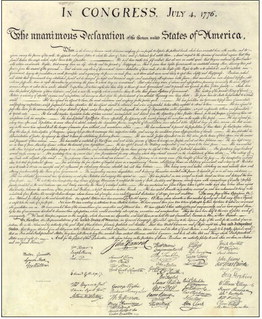
This week, the United States of America turns 250 years old.
A quarter of a millennium. That is a long time for a man. It is a long time for a family. It is a long time for a town, a county, a courthouse square, or a graveyard. But for a nation, 250 years is not ancient. It is old enough to have a memory, but young enough that its founding words still sound as if they were spoken yesterday.
And on this 250th anniversary of our country, it would do us good to return to those words.
Not merely to the fireworks. Not merely to the flags. Not merely to the songs, speeches, parades, and family gatherings. Those things have their place. A free people ought to celebrate their freedom.
But before the celebration, or perhaps in the quiet after it, we should return to the most important document in the history of our nation: the Declaration of Independence.
It is still preserved in the National Archives today. The inkhasfaded.Theparchment has aged. The signatures are harder to see than they once were. But the words remain. They still stand as the birth certificate of the American Republic, the bill of indictment against tyranny, and the promise by which this nation has measured itself for two and a half centuries.
Those words were not whispered.
They were declared. On July 4, 1776, the Continental Congress approved the Declaration of Independence. Two days earlier, Congress had voted for independence itself. The July 4 document explained why. It told the world that the thirteen colonies no longer considered themselves colonies at all, but free and independent states.
But even that final document did not come easily.
The Declaration was not written in a moment of reckless heat and then rushed into history. It was drafted, debated, altered, trimmed, softened in places, strengthened in others, and argued over by men who understood that every word mattered.
Thomas Jefferson wrote the first draft, but Congress did not simply receive it and bow. The delegates took it up line by line. They removed words. They changed phrases. They cut whole passages. Jefferson, who had labored over the language, later grieved over what he called the “depredations” made to his draft — meaning the cuts, changes, and alterations Congress imposed on words he had carefully chosen, as though they had raided his prose and carried pieces of it away. But Congress understood something every lawyer, legislator, and public man should understand: when a people declares independence from an empire, the words must not merely be beautiful. They must be precise. Theymustbedefensible. They must be strong enough to carry a nation.
There were hard disagreements. Some delegates believed independence was necessaryandoverdue.Some believeditwasdangerousbut unavoidable.Somefearedthe time was not yet right. John Dickinson of Pennsylvania, one of the most respected men in Congress, opposed declaring independence at that moment and did not sign theDeclaration.GeorgeRead of Delaware voted against independence on July 2nd but later signed the Declaration. Robert Morris of Pennsylvania also had deep reservations, believing the move premature, but when the decision was made, he signed as well.
That matters. The Declaration was not the product of one man’s temper or one faction’s ambition. It was the final act of a divided, anxious, serious body of men who had debated the matter, counted the cost, and then moved from argument to commitment.
They knew the document would be read in London.
They knew the king would see it.
They knew Parliament would see it.
They knew British generals would see it.
They knew loyalists in America would see it.
They knew that once their names were attached to it, there would be no pretending they had merely been misunderstood.
The words were too clear for that.
The accusations were too direct.
The demand was too final. Today, we know how the story ended.
That is our disadvantage. WeknowWashingtonsurvived. We know the army endured. We know the French came in. We know Yorktown arrived. We know Cornwallis surrendered. We know the Constitution was later written. Weknowtheflagbecame recognizedamongthenations of the earth. We know there would be presidents, courts, elections, armies, railroads, states, territories, wars, amendments,moonlandings, and marble monuments.
The men of 1776 knew none of that.
They did not sign a victory speech. They signed a death warrant if the cause failed.
They were not acting after the danger had passed. They were acting while the danger was gathering. British power still towered over them. British ships prowled the coast. British soldiers were already in America. The king they defied commanded one of the most powerful military forces on earth. The colonies had a fragile army, uncertain finances, divided loyalties, and no guarantee that the world would recognize them asanythingmorethanrebels.
The word for what they were doing was treason.
Not protest. Not disagreement. Not politics as usual. Treason. If Great Britain crushed therebellion,thesemencould be hunted, arrested, imprisoned, stripped of property, or hanged. Their families could be ruined. Their homes could be taken. Their names could be cursed. Their children could inherit disgrace instead of honor.
And still they signed. But to understand their courage,wemustunderstand what they signed.
The Declaration of Independence was not a timid document. It was not a cautious petition. It did not beg the king for mercy. It did not ask Parliament for permission. It did not request independence as a favor.
It demanded it as a right. The Declaration began by claiming that there are moments in history when “one people” must “dissolve the political bands” that connected them to another. It declared that the American people were entitled to take a “separate and equal station” among the powers of the earth, not by permission of the British Crown, but by “the Laws of Nature and of Nature’s God.”
That was not soft language.
That was thunder.
The Declaration then moved to one of the most important statements ever written by the hand of man: “We hold these truths to be self-evident, that all men are created equal.”
It did not say those truths weregrantedbyKingGeorge. It did not say they were gifts of Parliament. It did not say they depended upon the changing opinions of men in power.
It said men “are endowed by their Creator with certain unalienableRights,” andthat among those rights are “Life, Liberty and the pursuit of Happiness.”
Then came the political heart of the American founding: governments do not create rights. Governments are created to secure rights.
And where do governments get their lawful power? Not from kings.
Not from armies. Notfrominheritedcrowns. Not from titles, bloodlines, palaces, or parliaments sitting an ocean away.
Governmentsderive“their just powers from the consent of the governed.”
That sentence changed the world.
But the Declaration did not stop there. It went further. It said that when any form of government becomes destructive of the rights it was created to protect, “it is the Right of the People to alter or to abolish it, and to institute new Government.”
Even that was not the strongest part.
Thesignersacknowledged that stable governments should not be changed for “light and transient causes.” They understood prudence. They understood order. They understood that no serious people should tear down an old government merely because politics had become unpleasant.
But then they drew the line.
“When a long train of abuses and usurpations,” they wrote, shows a design to reduce a people under ‘absolute Despotism,’ then ‘it is their right, it is their duty, to throw off such Government, andtoprovidenewGuardsfor their future security.”
Their right. Their duty. Not merely their preference. Not merely their desire. Not merely their political program.
Their duty. That was the subject of the pledge at the end. That was what they were placing their lives behind. They were not pledging themselves to a vague patriotic feeling. They were pledging themselves to the proposition that a people createdbyGod,endowedwith rights by God, and governed only by consent had both the right and the duty to throw off a government that had become tyrannical.
Then the Declaration became, in effect, an indictment.
The signers did what lawyers, judges, and statesmen understand well. They laid out their grounds. They stated their charges. They submitted facts “to a candid world.”
And their chief accusation was direct: “The history of the present King of Great Britain is a history of repeated injuries and usurpations.”
They accused him of having “in direct object the establishment of an absolute Tyranny over these States.”
That is not polite language.
That is not compromise language.
That is not the language of men hoping no one in power will take offense.
They accused the king of refusing his assent to necessary laws. They accused him of dissolving representative houses for opposing his invasions on the rights of the people. They accused him of obstructing justice by refusing laws establishing judiciary powers. They accused him of making judges dependent on his will alone. They accused him of creating swarms of officers to harass the people and “eat out their substance.”
They accused him of keeping standing armies among them in times of peace without consent. They accused him of making the military independent of and superior to civil authority. They accused him and Parliament of quartering troops among them, cutting off trade, imposing taxes without consent, depriving them of trial by jury, transporting them overseas for trial, taking away charters, abolishing laws, and fundamentally altering their governments.
And then the accusations became even darker.
“He has abdicated Government here,” they wrote, “by declaring us out of his Protection and waging War against us.”
“He has plundered our seas, ravaged our Coasts, burnt our towns, and destroyed the lives of our people.”
Theyaccusedhimoftransporting “large Armies of foreign Mercenaries” to complete “the works of death, desolation and tyranny.”
They accused him of forcing captured American sailors to bear arms against their own country, to become “the executioners of their friends and Brethren.”
They accused him of stirring up domestic insurrections and bringing war upon the frontier.
Read those words slowly. Those were not harmless phrases. Those were fighting words. They were written to justify revolution. They were written to explain to the world why allegiance to the Crown was being cast off. They were written knowing full well that the king and his ministers would read them not as criticism, but as rebellion.
The signers were not hiding what they meant.
They were making the record.
They also did something else many Americans forget. They did not only accuse the king. They spoke of their “British brethren.”
Theysaidtheyhadwarned the people of Britain “from time to time” about attempts by Parliament to extend unlawful power over them. They said they had appealed to their “native justice and magnanimity.” They said they had called upon the ties of common blood.
But those appeals had failed.
“They too,” the Declaration says, “have been deaf to the voice of justice and of consanguinity.”
Then came the hard conclusion: “We must, therefore, acquiesce in the necessity, which denounces our Separation.”
And then one of the most severe lines in the Declaration: “We hold them, as we hold the rest of mankind, Enemies in War, in Peace Friends.”
Enemies in war. Peace friends. There was no mistaking the meaning.
The Declaration was not a request to renegotiate colonial policy. It was not a complaint letter. It was not a plea for better treatment.
It was a formal announcement that the old political bond had been broken, that allegiance to the British Crown had ended, and that the United States had entered the world as an independent power.
The closing words made that unmistakable: “We, therefore, the Representatives of the United States of America, in General Congress, Assembled, appealing totheSupremeJudge of the world for the rectitude of our intentions,” declared that the colonies “are, and of Right ought to be Free and Independent States.”
Appealing to the Supreme Judge of the world.
That phrase matters. They were not merely appealing to history. They were not merely appealing to public opinion. They were not merely appealing to political theory.TheywerecallingGod as witness to the justice of their cause.
And then they declared that the colonies were “Absolved from all Allegiance to the British Crown,” and that all political connection between them and Great Britain “is and ought to be totally dissolved.”
Totally dissolved. That is the final language. That is door-closing language.
That is the language of men who knew they had passed the point of no return.
Only after all of that did they write the sentence we remember so well: “And for the support of this Declaration, with a firm reliance on the protection of divine Providence, we mutually pledge to each other our Lives, our Fortunes and our sacred Honor.”
That last sentence was not floating alone in patriotic mist. It rested on everything that came before it.
They had declared that rightscamefromtheCreator.
They had declared that the government exists by consent.
They had declared that tyranny must be thrown off.
They had accused the king of repeated injuries and usurpations.
They had accused him of tyranny.
They had accused him of war against his own subjects.
They hadaccusedtheBritish people of refusing to hear the voice of justice.
They had appealed to God. They had declared themselves independent.
Then they pledged everything.
Lives.
Fortunes. Sacred honor. Eventually,56mensigned the Declaration of Independence. Most signed the engrossed parchment on August 2, 1776. A few signed later. But all of them placed themselves on the record. They moved from private conviction to public commitment. They crossed the line that separates grievance from rebellion.
They were not all alike. That is worth saying. They were not marble saints. They were not identical patriots cut from the same cloth. They were lawyers, merchants, planters, physicians, ministers, scholars, judges, farmers, landowners, printers, and public servants. Some were wealthy. Some were not. Some were cautious. Some were fiery. Some were old enough to have watched colonies grow fromfrontiersettlementsinto communities of consequence. Others were young enough to be risking not merely their estates, but the whole long future of their lives.
Benjamin Franklin was 70 years old. Edward Rutledge of South Carolina was only 26. Thomas Lynch Jr. was also in his twenties. Thomas Jefferson was 33. John Hancock was 39. John Adams was 40. Some had already built fortunes. Some had inherited family names. Somehadearnedreputations in law, commerce, politics, medicine, or learning. Some hadwivesandyoungchildren waiting at home. Some had farms, libraries, mills, ships, offices, clients, churches, and estates.
Theyweremenwithsomething to lose.
That is what gives the story its force.
Revolutions are sometimes begun by desperate men who believe they have no future unless the world is overturned. But that is not the whole story of 1776. Manyofthesemenhadstand- ing, comfort, influence, and property. They had names worth preserving. They had a place in society. They could have chosen caution. They could have waited. They could have trimmed their sails and hoped the storm passed over them.
Instead, they put their names beneath words that could hang them.
Not merely words about liberty, but words accusing their king of tyranny.
Not merely words of separation, but words declaring themselves absolved of all allegiance.
Not merely a theory of government, but a demand for a new nation.
So, what happened to them?
The honest answer is more complicated, and more powerful, than legend.
Not all were ruined. Not all died poor. Not all lost their homes. Not all were captured. Not all suffered in thesameway.Manysurvived the war and went on to serve the new nation. Two signers, John Adams and Thomas Jefferson, became presidents of the United States. Others became governors, judges, diplomats, senators, and leaders in the states they helped create.
But some paid dearly. Richard Stockton of New Jersey was captured in 1776. He was imprisoned under harsh conditions, and his health was badly damaged. His estate at Morven was plundered. He was released, but he never fully recovered. He died in 1781, before the war was won.
FrancisLewisofNewYork saw his property destroyed. His wife, Elizabeth, was captured by the British and held prisoner. She was later exchanged, but her health was broken, and she died not long afterward. Lewis lived to see independence secured, but the cause had taken from himwhatnomancanreplace.
Philip Livingston of New York came from one of the great families of colonial America. His property was affected by the war, and he continued to serve in Congress despite illness. He died in 1778 while still in public service.
Lewis Morris of New York saw his estate in a heavily contested area suffer during the war. His family was scattered. His property was damaged. Like many Americans whose land lay between armies, he learned that war does not politely distinguish between public men and private households.
William Floyd of New York had his home occupied and his property damaged. He and his family were displaced for years. When peace finally came, he returned not to comfort untouched, but to the work of rebuilding.
John Hart of New Jersey was an older man when he signed. During the British invasion of New Jersey, he was forced to hide. His farm suffered damage. His life was disrupted. His wife died during those bitter years, and Hart himself died in 1779, before the war ended. The legends around him have often outrun the record, but the truth is enough: he was an old patriot who endured hardship when it would have been easier to bend.
Abraham Clark of New Jersey had sons who served in the American cause and were captured. A father who signs a Declaration may risk his own neck. A father whose sons are in uniform risks something even deeper. The Revolution was not an abstraction to Clark. It had his blood in its hands.
John Witherspoon of New Jersey, president of the College of New Jersey, later Princeton, gave more than his signature. His son James was killed at the Battle of Germantown. The college itself suffered during the war. Witherspoon was a minister, a scholar, and a statesman, but he also knew the private grief that hides behind public history.
George Walton of Georgia was wounded and captured during the fighting at Savannah. Button Gwinnett of Georgia died in 1777, not from British punishment, but from wounds received in a duel with a political rival. Lyman Hall of Georgia saw property losses and dislocation. The southern war was bitter, violent, and personal, andtheGeorgiasignersknew its fury.
EdwardRutledge,Thomas Heyward Jr., and Arthur Middleton of South Carolina were captured after the fall of Charleston in 1780. They were held as prisoners. Their plantations and properties suffered in the war. Thomas Lynch Jr., another South Carolina signer, had served in the military and suffered ill health. He and his wife were later lost at sea while sailing in hopes that a warmer climate might restore his health.
Thomas Nelson Jr. of Virginia gave heavily to the Revolutionary cause and strained his own finances in doing so. He served as governor of Virginia and as a military leader. The stories of cannon fire at Yorktown have grown in the telling over the years, but the essential truth remains: Nelson put his standing, his property, his health, and his fortune behind independence. He died only a few years after the war, his finances damaged andhisbodyworndown.
Carter Braxton of Virginia lost ships and suffered serious financial reverses. His story was not simple, and all his later troubles cannot be laid at the feet of the Revolution alone. But the war cost him heavily.
Robert Morris of Pennsylvania used his financial genius, credit, and reputation to sustain the American cause when the cause often had little else to stand on. He helped keep armies supplied and the government functioning. His later ruin came from financial speculation after the war, but during the Revolution, he risked the one thing a financier cannot afford to lose: his credit.
Benjamin Rush served as a physician and patriot. George Clymer suffered property losses. William Ellery of Rhode Island saw propertydamagedinthewar. Caesar Rodney rode through illnessandstormtocastDelaware’s vote for independence. Samuel Adams, never a rich man, gave himself wholly to the cause long before it was safe, respectable, or likely to succeed.
And then there were the many who did not become legends at all.
Men whose names are now read quickly, if they are read at all.
Josiah Bartlett. William Whipple.MatthewThornton. SamuelHuntington.William Williams. Oliver Wolcott. Roger Sherman. Robert Treat Paine. Elbridge Gerry. James Wilson. George Ross. George Taylor. James Smith. George Read. Thomas McKean. Samuel Chase. William Paca.ThomasStone.Charles Carroll of Carrollton. George Wythe. Richard Henry Lee. Francis Lightfoot Lee. Benjamin Harrison. William Hooper. Joseph Hewes. John Penn.
Some of those men lived long enough to see the Republic take form.
Some did not. Some gained honor. Some lost wealth. Some served in quiet offices.
Some became famous.
Some sank into the footnotes.
But every one of them signed the same pledge.
Thatisthegreatequalizer. The large signature of JohnHancockandthelesserknown signatures below it were bound by the same peril. History may remember themunequally,buttheKing would not have hanged them unequally.
That is the part we must not forget.
The Declaration was not written by men who knew they would someday be painted in heroic poses. It was written by men in a hot room, in a hard season, with flies at the windows, armies in the field, and danger closing in. They argued. They edited. They compromised. They struck out words and added others. They were practical men, not dreamers only. They knew that words alone would not win a war.
But words can summon a people to one.
The Declaration did not createAmericanlibertyoutof nothing. The American colonies had long traditions of local self-government, English rights, colonial assemblies, juries, charters, pulpits, pamphlets, and hard-earned independence of spirit. But the Declaration gathered those inherited rights and colonial grievances into something larger. It said that government exists by consent. It said that rights do not come from kings. It said that there are truths no parliament can repeal.
“We hold these truths to be self-evident.”
Those words still thunder. They thunder because they were not fully obeyed in 1776. They thunder because the men who wrote and signed them did not always liveuptothem.Theythunder because America has spent 250 years being judged by them.
That is not a weakness of the Declaration. That is its enduring strength.
A small document approved in Philadelphia became the standard by which the nation would be measured. It would haunt slavery. It would stand behind Lincoln at Gettysburg. It would echo through the abolitionist movement. It would speak when immigrants saw the American shore. It would beinvokedbywomenseeking the vote, by soldiers fighting tyranny overseas, by citizens demanding equal justice under law, and by every generation that asked whether America would honor the promise it made at birth.
The Declaration did not make us perfect.
It made us accountable. That is why the 250th birthday of the United States should not be treated as just another Fourth of July. It should not be reduced to fireworks, speeches, sales, and a long weekend. There is nothing wrong with celebration. A free people ought to celebrate. But celebration without memory becomes noise.
We need memory. We need to remember that independence was not inevitable.
Weneedtorememberthat liberty was not handed down like an heirloom that nobody had to defend.
Weneedtorememberthat the men who signed that document were not guaranteed statues, cities, schools, and counties named in their honor. They were far more likely, in that moment, to earn the rope, the prison, the confiscated estate, the ruined family, and the bitter label of traitor.
Weneedtorememberthat courage is not the absence of fear. Courage is knowing exactly what fear has to say and signing anyway.
That is what they did. They signed anyway. They signed before the winter at Valley Forge. Before the victory at Saratoga. Before the alliance with France. Before the long southern campaigns. Before the surrender at Yorktown. Before the Treaty of Paris. Before anyone could know whether the words “United States of America” would survive as a nation or die as a failed rebellion.
They signed in uncertainty.
That is the purest kind of courage history offers.
Here in our own time, patriotism is often treated as either a slogan or an embarrassment. It is neither. True patriotism is not blind. It does not require us to pretend every American chapter was noble, every leader wise, every law just, or every battle necessary. A patriot can tell the truth about his country.
But a patriot also knows what his country is worth.
He knows that liberty is rare in the history of man. He knows that ordered freedom is not the natural condition of the world. He knows that rights once taken for granted can be lost. He knows that self-government requires more than complaint. It requires memory, duty, restraint, courage, gratitude, and sacrifice.
The signers knew that. They did not merely demand liberty. They pledged themselves to it.
That is the difference between a grievance and a founding.
A grievance says, “Someone should do something.”
A founding says, “I will stand here, and let history do what it will.”
Those 56 men stood there. They were not perfect men. Nogenerationproduces those. But they were consequential men. They were brave men. They were men who took the ancient longing for liberty and fastened it to a new nation.
And 250 years later, we are still living in the house they framed.
The walls have been repaired. Rooms have been added. Some foundations hadtobestrengthened.Some doors, once barred, had to be forced open. There have been fires, storms, bloodshed, sins, triumphs, failures, and renewals. But the house still stands.
It stands because men in 1776 pledged their lives, fortunes, and sacred honor.
It stands because soldiers later froze, marched, bled, and died.
It stands because farmers, ministers, mothers, printers, blacksmiths, lawyers, sailors, merchants, immigrants, pioneers, teachers, and ordinary citizens carried the Republic forward when the famous men left the stage.
It stands because each generation, sooner or later, is asked whether the inheritance is still worth keeping.
That question now comes to us.
Not in the same form. Not with British redcoats at the door. Not with a king across the sea. But the question is still there.
Do we still believe liberty is worth sacrifice?
Do we still believe selfgovernment is worth the discipline it requires?
Do we still believe that rights come from God and not from the permission of government?
Do we still believe that honor matters?
Themenof1776answered with ink on parchment.
Some paid with fortune. Some paid with family sorrow.
Some paid with captivity. Some paid with health. Some paid with years of service they would never get back.
All risked more than they could know.
As America reaches 250 years, perhaps the best tribute we can offer is not merely to praise them, but to understandthem.Nottoturn them into marble gods. Not to tear them down because they were men. But to see them clearly, standing in the heat of that dangerous summer, knowing enough to be afraid and believing enough to proceed.
The last line of the Declaration remains one of the noblest promises ever made by Americans to one another: “We mutually pledge to each other our Lives, our Fortunes and our sacred Honor.”
They wrote it. They signed it. They meant it. And because they did, a nation was born.
And so, as this column reaches you on July 2, two days before the nation’s birthday, I wish each of you a happy Fourth of July.
And not just any Fourth of July, but the 250th Fourth of July since the founding of this Republic—the greatest experiment in self-government, and the greatest nation ever conceived by man.
Enjoy the fireworks. Raise the flags. Gather with your families. Let the children laugh. Let the old songs play. Let the grills smoke and the evening sky burn bright with color.
But somewhere in the celebration, take a moment and remember.
Remember those 56 men who stood in the long shadow of empire and signed their names anyway. Remember that they did not know how the story would end. Remember thattheywerenotsigning a holiday into existence. They were signing a defiance. They were signing an indictment. They were signing a declaration thatcouldhavecostthem everything.
They pledged not merely their opinions, not merely their complaints, and not merely their hopes. They pledged their lives, their fortunes, andtheirsacredhonor.
They gave the Republic its beginning.
But they left its keeping to us.
Two hundred and fifty years later, the question is no longer what they were willing to give. History has answered that in ink, blood, sacrifice, and graves.
The question now belongs to us.
What are we willing to give?
Not merely what are we willing to say. Not merely what are we willing to post, applaud, criticize, or complain about. But what are we willing to do, to defend, to preserve, and to pass on?
Forthecountrytheydared to declare, for the liberty they risked all to claim, for the Republic handed down through blood, sacrifice, duty, and grace—should we offer any less?
Happy Fourth of July. And may God continue to bless the United States of America.