
The shots had scarcely stopped echoing across the Kingston countryside before the arguments began.
Long before a jury was selected, long before formal trial testimony began, and long before Charles Arthur Coakley had the opportunity to stand before twelve Marshall County citizens and argue for John Wesley Honeysuckle’s life and liberty, the case had already moved into thatolder,roughercourtroom of public opinion.
By the afternoon of April 22, 1915, two women were dead. Creacy Merriman, the matriarch at the center of the guardianship dispute, was dead. Her daughter, Ida Mutz,wasdead.JohnWesley Honeysuckle, married only days before, had gone to Madill and surrendered himself to the sheriff’s office. The bodies had scarcely cooled before Kingston, Madill, Woodville, Ardmore, Oklahoma City, and Guthrie began hearing versions of the story.
Some of those versions would favor Honeysuckle. Some would condemn him. Some would repeat his statement almost as though it were an established fact. Others would suggest uncertainty, rumor, and danger. And one newspaper report, carried beyond Marshall County, would go so far as to warn that “feeling runs high atMadill,andtalkoflynching is frequent.”
That is how quickly this case became more than a local tragedy.
It became the case everyone talked about.
The first newspaper accounts already understood the terrible force of the story. The Madill Times, in its April 22 issue, had carried a simple marriage announcement: “J. W. Honeysuckle, 28, Kingston, to Minnie Hardwick, 30.” Yetinthatsameissue,thepaper also carried the shocking report of the double killing. Under the headline “Killing At Kingston,” it stated that John Honeysuckle had shot and killed Mrs. George Mutz andMrs.Merriman“atabout 9 o’clock this morning.”
The speed of those two notices tells the story almost better than any later commentary could. In one column, a marriage. In another, death. The ink had hardly driedontheannouncementof a new household before that household became the scene of one of the most sensational killings in Marshall County history.
The Madill Times offered an early version favorable to Honeysuckle. It reported that Honeysuckle, recently marriedtoMinnieHardwick, “came home and found Mrs. Mutz and Mrs. Merriman beating his wife.” According to that account, he “undertook to pull them away” and was then “attacked by the women with a butcher’s knives.” The paper stated that Honeysuckle “tried to make a getaway” and “ran over a stove, knocking it down,” before being cornered by the women and pulling his gun. The shots killed one woman immediately, and by noon word had reached town that the second woman had also died.
Thencameasentencethat revealed how deeply the tragedy struck the community’s imagination: “The women killed were both full-blood Indians. No member of the family has ever died from natural causes.”
That statement was not literally true in a genealogical sense, but it captured the public mood. To newspaper readers in 1915, this was not merely a sudden double homicide. It was the latest eruption from a family already surrounded by stories of violence, sudden death, old grievances, and courthouse proceedings.
The Marshall County News-Democrat, the next day, gave the most important early account under the great headline: “Tragedy Near Kingston—Two Women Are Killed.”Itssubheadingstated the essential facts in stark form: “J. W. Honeysuckle Fired Four Shots From Revolver That Caused Death of Mrs. Creacy Merriman and Her Daughter, Mrs. G. M. Mutz.”
The News-Democrat placed the shooting “three miles east” of Kingston, in Honeysuckle’shome,atabout nine o’clock in the morning. It also identified the heart of the conflict immediately: “The trouble leading up to the killing arose from a difference over the guardianship of certainminorchildrenofMrs. Honeysuckle, over which Mrs. Creacy Merriman, one of the women killed, was the guardian.”
That sentence is the key that unlocks the case.
The deaths were caused by bullets, but the case was born in guardianship.
This was not merely a quarrel over pride, manners, or family dislike. It involved the legal and practical control of children, and through those children, the control of allotment property. In early Oklahoma,especiallyinfamilies tied to Indian allotments, guardianshipwasnotaminor domestic arrangement. It could determine who managed land, who controlled income, who made decisions, who stood between a child and exploitation, and who might profit from that child’s inheritance.
The News-Democrat understood that. It reported that Honeysuckle and his wife had been in Madill the day before the shooting and had retained Attorney Charles A. Coakley to file a petition in county court asking that Mrs. Merriman be removed as guardian of the minor children. The paper stated that this was “probable cause of the immediate quarrel that resulted in the death of Mrs. Merriman.” Friends on both sides reportedly said Mrs. Merriman intended “to get the children of Mrs. Honeysuckle, who held allotments, and take their property in charge.”
But the newspaper also gave Mrs. Merriman’s side. It reported that she had told friends “she had no selfish motive in the matter,” and that she “merely wanted to see that her grandchildren were not robbed,” which she feared would happen if their custody passed fully into Honeysuckle’s hands.
That was the moral battlefield.
On one side stood Creacy Merriman,grandmotherand guardian, claiming to protect the inheritance of her grandchildren.
On the other stood John Wesley Honeysuckle, new husband and stepfather, claiming to protect his wife, his home, and the family he said he wished to build.
The law would eventually have to decide whether Honeysuckle was a murderer or a man justified in defending his home. But before the law could decide, Honeysuckle gave his own account.
According to the News-Democrat, Honeysuckle spoke from the jail on Thursday afternoon. His statement reads almost like the defense's opening argument that Coakley would later build. Whether shaped by instinct, fear, truth, or early legal advice, the statement struck every note necessary for a claim of justifiable homicide.
He began by placing himself at home, at peace, on a rainy morning.
“I was at home this morning about 9 o’clock,” he said, “when a buggy was stopped in front of the house.”
He went outside and found Creacy Merriman and Ida Mutz in the buggy. He claimedheinvitedthemtoget out and come inside and told themhewouldhitchthehorse because“itwasraining.”That detailmattered.Honeysuckle wasnotpresentinghimselfas a man waiting for trouble. He waspresentinghimselfasthe courteous man of the house, offering shelter, assistance and ordinary hospitality.
Then, according to his statement, the tone changed.
Mrs. Merriman, he said, cursed him and declared, “we intend to come in, and will anyway; you cannot keep us out—we will hitch the horse ourselves.”
From that point forward, Honeysuckle’s statement is built around invasion. The words are not accidental. “You cannot keep us out.” “We intend to come in.” “Will anyway.” In the legal and emotional architecture of the defense, those phrases would matter. They turned the case from a shooting into a confrontation at the threshold of a home.
Honeysuckle said he permitted the women to hitch the horse. Then they started toward the house, “swearing and abusing” him. His wife, Minnie, was standing in the doorway. According to Honeysuckle, Minnie said to Mrs. Merriman, “ma, I don’t want you to come into my house talking like that.”
That sentence contained the whole domestic tragedy. Minnie called her “ma.” This was family. But she also said, “My house.” This was authority. And in that instant, the mother-in-law, the daughterin- law, the children, the dead husband, the new husband, theallotments,andthewhole questionofwhocontrolledthe household all met at the door.
HoneysuckleclaimedMrs. Merriman then rushed into the house, knocked Minnie down, pushed Mrs. N. F. Benson (also a daughter of Creacy Merriman) aside, and attacked his wife. He said Mrs. Mutz joined in and kicked Mrs. Honeysuckle. Only then, Honeysuckle claimed, did he intervene.
“I then rushed in and grabbed Mrs. Merriman,” he said, “to prevent her from doing my wife any possible injury.”
This was the second pillar of the defense: protection of wife.
The first pillar was the defense of the home.
The second was the defense of the wife.
The third would be the defense of self.
Honeysuckle stated that both women turned on him and pushed him back into a corner of the room near the stove, where a butcher knife was lying. Mrs. Merriman, he said, picked up the knife and tried “a number of times” to stab him. He then drew a pistol and fired one shot through the floor.
His claimed warning was direct: “Do not make me hurt you!”
That sentence would become central to the story because it suggested restraint. Honeysuckle was not claiming he shot immediately. He was claiming he warned them. He was claiming he fired into the floor first. He was claiming the women had a chance to stop.
“This had no effect on them,” he said. “They continued to assault me and I fired two more shots, hitting them both.”
Still, according to Honeysuckle, the fight did not end. He stepped back. They continued to follow him. Mrs. Merriman still had the butcher knife. He fired two more shots.
“This ended the fight.” There is terrible finality in that phrase.
When asked what happened next,Honeysucklesaid Mrs.Merrimanwentoutonto the front porch and fell dead. Mrs. Mutz went out of the house and sat down. Minnie went out and brought Mrs. Mutz back inside and placed heronthebed,whereshedied within a few minutes.
Then Honeysuckle made one more important point. He said that when he fired the last two shots, he aimed both at Mrs. Merriman, but one struck Mrs. Mutz accidentally.
“I did not want to shoot her,” he said.
Thatstatementattempted to separate the two deaths morally. Honeysuckle was not denying responsibility for firing the shots. But he was trying to tell the public, and eventually a jury, that Ida Mutz had not been his intended target in the final volley. The implication was obvious: in his version, Creacy Merriman was the aggressor with the knife. Ida Mutz was caught in the deadly confusion of the struggle.
The Red River Farmer, also on April 23, approached the case with more caution. Its headline was powerful: “Double Killing Result of Family Trouble. Mother and Daughter are Hurried Into Eternity by the Deadly Gun.”
That phrase—“hurried into eternity”—belongs to the old newspaper world, dramatic and solemn, but it conveyed the horror that swept over Kingston that morning. The paper reported that “a thrill of horror was sent over our town by a telephone call for officers,” carrying word that a tragedy had occurred at the Honeysuckle home, “four miles north-east of town,” and that Mrs. Creacy Merriman, “an Indianwoman,aged60years, and an old citizen of this section,” and her daughter, Mrs. George Mutz, “36 years old,” had lost their lives.
A large number of people, togetherwithofficers,wentat once to the scene “to render whatever assistance might be necessary.”
The Red River Farmer confirmed the basic guardianship dispute. The trouble, it wrote, grew out of the marriage of Minnie Hardwick, “daughter-in-law of Mrs. Merryman,” to John Honeysuckle about a week earlier. After the marriage, Minnie wantedherchildrenwithher. Mrs. Merriman, guardian over two of them, objected. Legal advice was sought by Minnie and Honeysuckle. On Wednesday evening, one child was taken from school to the Honeysuckle home, while another refused to go. That act was resented.
According to the paper, threats were made that the child would be taken away from the mother, and a warning had been sent to stay away from the Honeysuckle home.
Then came Thursday morning. The paper reported the story as follows: Mrs. Merriman, accompanied by Mrs. Mutz, went to the Honeysuckle home, reportedly to get the child. Honeysuckle met them as they drove up and offered to tie their horse. His assistance was refused. He turned and started toward the house, apparently preceded by the two women. As they approached the door, Minnie warned them not to come inside. When they persisted, she tried to close the door, but they prevented it and gained entrance.
Then the Red River Farmer did something important. It refused to pretend certainty.
“As to what occurred following this,” the paper wrote, “there are conflicting stories.”
That sentence deserves emphasis. The Red River Farmer (a Kingston newspaper) was close to the scene. It had heard the accounts. It knew the families. It knew the county. Yet even in the first wave of reporting, it recognized that the heart of the case remained in dispute.
The paper reported that it was claimed the two women attacked Mrs. Honeysuckle and that there was evidence of a struggle in the room, including “stove pipe scattered about the floor and promiscuous scattering of utensils.” It was also claimed that when Honeysuckle interfered, the women turned on him with a hammer and a butcher knife, picked up from the floor of the room.
But the paper added a dangerous qualification for the defense: “There is nothing to show that they were used by them, nor were there any visible marks of bodily injury on the person of Mrs. Honeysuckle.”
Thatwastheprosecution’s opening.
No eyewitness to the full shooting. No visible injuries on Minnie. No proof that the knifeorhammerhadactually been used. Two women were shot twice each. A revolver in Honeysuckle's hands. A defendant who claimed necessity, but no independent witness who saw every decisive instant.
TheRedRiverFarmeralso reported that there were “no eyewitnesses to the tragedy.” Honeysuckle had been talking to his brother-in-law, and Mrs. Honeysuckle had a lady visitor, but both left when they saw the two women approaching. Mrs. Merriman, after being shot, reportedly walked out of the house into the orchard, returned to the house, and asked to lie down on the bed, where she died. Mrs. Mutz walked through the house and out onto the porch, stepped off, and apparently fell back dead. (The paper ended up having this sequence wrong) Again,thepaperrefusedto overstate: “There are various opinions regarding the terrible affair, and we refrain from any comment beyond giving the statements we have been able to gather.”
That restraint itself tells us how tense the county had become.
The dead women were buried in the family burying ground east of town. Funeral services for Mrs. GeorgeMutzandMrs.Creacy Merriman were held at the Baptist church in Kingston on Friday afternoon at three o’clock, conducted by Rev. H. R. Long of Davis, formerly pastor of the Baptist church there. The services, the Red River Farmer reported, were “largely attended.”
Meanwhile, Honeysuckle sat in jail.
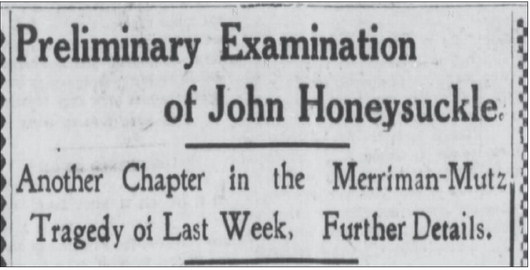
Thelawmovedquickly.On April 28, only six days after the killings, the preliminary hearing was held in Madill before Justice I. O. Lewis. By any measure, it became one of the most extraordinary preliminary hearings in Marshall County history.
TheMadillTimesreported on April 29 that the hearing washeldintheCountyCourtroom, with Judge I. O. Lewis presiding.Thecourtroom,the paper said, “was crowded to its full capacity.” The case had created “much interest throughout the county.” The paper noted that “there were a number of society ladies and women with babies and children present.” That small detail is striking. This was not merely a gathering of lawyers, officers, and curious men from town. Women came. Mothers came with babies. Children came. The entire county seemed drawn toward the courthouse as though pulled by a bell.
George L. Sneed represented the State. Kennamer and Coakley represented Honeysuckle.
Thedefendantwasbrought in and seated between his lawyers. The Madill Times studied him closely. “In demeanor,” the paper wrote, “hewascalmwithnooutward show of nervousness. He took an interest in the evidence of each witness as introduced.”
That image matters. Honeysuckle was accused of killing two women. He was held without bond. Public feeling was intense. Newspapers were spreading the story across Oklahoma. Yet there he sat between Kennamer and Coakley, calm, alert, listening carefully as the first pieces of testimony were placed into the public record.
The scale of public interest is difficult to overstate. The Daily Ardmoreite reported that “one thousand people attempted to crowd into the courtroom to hear the testimony.” TheDailyOklahoman repeatedthesamereport.For a preliminary hearing, that was astonishing. It would be astonishing today. It was unimaginable in Marshall County in 1915.
The courthouse was then larger than the courthouse room known today. The old courtroom had a full balcony and greater depth. Yet even that larger space could not hold the crowd. People came from across the county, not merely to hear whether probable cause existed, but to witness the first public testing of the story that had already divided Marshall County.
The Red River Farmer described it as “the largest crowd ever assembled in a court trial” in the county. People came “from all parts of the county,” anxious to hear “the details of the tragedy.” Precautions were taken to prevent further trouble, with “numerous deputies on duty in and about the courtroom.”
That phrase cannot be passed over lightly.
Deputies were stationed not merely as a formality. They were there because the casewasvolatile.Twowomen were dead. Their kin and friends were grieving. Honeysuckle had supporters. The community had split. Feelings ran high enough that the Guthrie Daily Leader reported the possibility of lynching. Whether that report exaggerated matters or not, it shows how the case was being understood beyond Marshall County: as a dangerous, emotional, potentially explosive prosecution.
The preliminary hearing began with H. H. Delay, city marshal of Kingston.
The Red River Farmer printed his testimony in detail. Delay said he was walking down Main Street in Kingston around nine o’clock Thursday morning when Rufe Crow called across the street that he had received a telephone message saying John Honeysuckle had killed Mrs.MutzandshotMrs.Merriman, andthatHoneysuckle wanted officers to come after him.
Delay telephoned the sheriff’s office in Madill and was instructed to go and act on behalf of the sheriff. He got a buggy and first went toward Mrs. Merriman’s home, believing the killing had occurred there. Finding no one, he continued to the Honeysuckle home.
There he found death waiting.
According to Delay, he found“thecorpseofMrs.Merriman lyingonthefrontporch with a quilt spread over her.” Hewenttothedoor,wherehe met Mrs. Honeysuckle. After shaking hands with her, he toldherhehadcomeforJohn. She replied, “Mr. Delay, he has already gone to Madill.”
Delay asked where Mrs. Mutz was. Minnie pointed to the bed. Delay went inside, turned the sheet down from her face, and saw that she wasdead.Aftersearchingthe house to satisfy himself that John was not there, he went downunderthehill,wherehe met Mr. Muse, George Mutz, Mr. Benson, and other men, and told them Honeysuckle had already gone to Madill.
On cross-examination, Delay testified that he found no one at home except Mrs. Honeysuckle. He also found “a hammer and a butcher knife about 9 or 10 inches long, on the floor.”
The Madill Times gave additional details. It reported that Delay saw a hammer lying midway between the stove and the wall and a butcher knife near the door. He took both with him, and they were placed in the bank vault at Kingston.
That detail must have seized every ear in the courtroom. The defense needed that knife and hammer. Honeysuckle’s statement depended heavily on the claim that the women turned on him with a butcher knife and hammer.TheState,however, would later point to the same problem the newspapers had already noticed: the objects existed, but proof of their actual use was another matter.
Then came the Nance testimony.
Mr. Nance testified that Honeysuckle came to his house the morning of the killing. According to the Red River Farmer, Honeysuckle did not knock but seemed to run against the door and called for Nance’s son John to open quickly. Honeysuckle asked John to get officers and said, “I have killed Mrs. MerrimanandGeorgeMutz’s wife.” They then went to Peg Benson’s and telephoned Kingston.
TheMadillTimesreported the same core statement: HoneysucklecametoNance’s door saying, “John, open the door quick, go get officers and come quick, I’ve killed Mrs. Mutz and Miss Merriman.”
John W. Nance testified substantially the same.
This testimony helped Honeysuckle in one sense and harmed him in another. It helped because it showed he did not flee. He immediately summoned officers. He acknowledged the killings. He placed himself within the reach of the law. But it harmed him because the words were blunt and fatal: “I have killed” them. No ambiguity. No denial. The question would never be whether Honeysuckle fired the shots. The only question would be whether the law excused them.
Then the hearing moved to the children.
The defense apparently called Agnes Hardwick, a child of nine years. The Madill Times reported she was too young to understand the nature of an oath and was excused.
Then, fourteen-year-old Marietta Hardwick was sworn.
Marietta was one of the children standing at the center of the entire guardianship war. In her young life, the adults around her had carried the weight of allotments, remarriage, dead fathers, family distrust, and now a double killing. Her testimony carried the awful burden of a child trying to describe violence among her own blood.
According to the Red River Farmer, Marietta testified: “I am 14 years old. I was at homelastThursdaymorning. My Grandma and Aunt Ida came over to Mama’s house. Whentheycamein,Grandma pushed my mama down and began fighting her.”
She said she had been sitting on a trunk with her aunt, Mrs. Benson. Her grandmother came in first. Honeysuckle came next. Aunt Ida came last. Marietta was standing near the front door when she heard the first shot. She did not see a pistol. She did not see her grandmother or Aunt Ida with anything in their hands. Shewentontotheporchwhen she heard the second shot and then ran away. When she returned, Aunt Ida was on the porch, dead, and her grandmotherwasintheyard. Her mother told her to go to Mrs. Benson’s.
Justice Lewis asked whether her mother or anyone else had instructed her on what to swear. Marietta answered no and said she had told only what she knew.
Her testimony cut both ways.
For the defense, she supported the claim that Creacy Merriman entered first, pushedMinniedown,andbegan fighting.Thatwaspowerful. It placed the first physical aggression on Creacy.
But Marietta also testified that she did not see a pistol, did not see a knife, and did not see either dead woman holding anything. She heard shots but did not fully witness the shooting. Her testimony gave the defense a beginning but not an ending.
Then came Mrs. Janie Benson.
Benson was also Mrs. Merriman's daughter. She was therefore kin to the dead women but also present at the Honeysuckle home that morning. Her testimony was among the most important given at the preliminary hearing.
According to the Red River Farmer, she testified that she had been at her mother’s home Wednesday night and at Mrs. Honeysuckle’s house Thursday morning when her mother and her sister, Mrs. Mutz arrived. Honeysuckle met them at the fence and offered to hitch the horse. They started toward the house. Minnie went to the door and said, “Ma, you can’t come in here unless you will behave yourself.” Mrs. Merriman answered, “I will come in anyway.”
AsMrs.Merrimanentered the door, Benson testified, she knocked Minnie down. Honeysuckle came in after her.Mrs.Mutzfollowed.Honeysuckle pulled the women off Minnie, and then they began fighting him.
That testimony was extremely useful to the defense. It supported the claim that Creacy forced entry, knocked Minnie down, and that Honeysuckle did not begin as the aggressor but intervened after his wife was attacked.
But Benson also gave testimony that the prosecution could use like a blade.
She said that while they were all fighting, she heard the first shot. They were all still standing. She left the house. As she passed off the end of the porch, she heard a second shot. She did not hear any words spoken. John was between the wall and the stove when she left. She did not see any weapons. She did not see her mother or her sister holding anything.
Then came the most dangerous sentence of all.
“Before they come into the house,” she said, “I saw John go to the bed and raise up the foot of the bedding and walk off. I did not see anything.”
In the courtroom, that detail musthavehungintheair.
The defense could argue it meant nothing. Benson did not see a pistol. She did not knowwhathedid.Perhapshe moved the bedding. Perhaps he did nothing significant. Perhaps he was already worried andsimplyreactedtotwo hostile women approaching the home.
But the prosecution could argue something else entirely.
Why did Honeysuckle go to the bed?
Why lift the bedding? Was the pistol hidden there?
Did he arm himself before the women entered?
Had he anticipated the confrontation?
Was this truly a sudden defensive act, or had he prepared for violence?
That single gesture—lifting the foot of the bedding— became one of the small facts upon which great cases often turn. Criminal trials are not always decided by thunderous facts. Sometimesthey are decided by gestures, glances, timing, and the difference between what a witness saw and what a lawyer can persuade a jury it meant.
By the close of the preliminary hearing, the State had put on only a limited case. County Attorney George L. Sneed made that clear. The Marshall County News-Democrat reported that Sneed said, “There was no effort made from my office to get any more facts before the Court than was absolutely necessarytobindHoneysuckle over to the District Court.” Theprosecution’spurpose,he said, was simply “to establish evidence sufficient to lead the court to believe that a killing hadbeencommitted,andstop with this information.”
That was a common prosecutorial strategy. At a preliminary hearing, the State does not always reveal its full case. The State needs probable cause, not conviction. Sneedapparentlyintendedto show enough to hold Honeysuckle and preserve the fuller battle for the district court.
Kennamer and Coakley were equally strategic.
The News-Democrat described them as “very reserved” and said they had little to say publicly. But what they did say was clear. They announced that an application for a bond would be made immediately to the district court and stated that they were “very positive” that a bond would be granted based on the evidence introduced.
Then they laid down the defense theme in unmistakable terms: “There is no question but that this is a clean and clear case of a justifiable homicide, and no fear is held of the final verdict in the case.”
That was not merely a comment to a reporter. That was public positioning. Kennamer and Coakley were tellingMarshallCountywhat the case would be about. Not denial. Not mistaken identity. Not insanity. Not an accident, except perhaps as to one shot striking Ida Mutz. The defense would be justification.
Home. Wife. Self. No duty to retreat. The castle. A man’s right to defend those under his roof.
Justice I. O. Lewis was not persuaded to release Honeysuckle at the preliminary stage. The News-Democrat reported that Lewis committed Honeysuckle to the common jail without bond, setting forth the facts in minute detail. The Red River Farmer reported that Justice Lewis stated that while the evidence introduced did not show directly that the killing was done by Honeysuckle, the circumstances indicated that he did it, and he would therefore commit him to jail without bail.
TheMadillTimesreported that after the ruling, the crowd was ordered to remain seated inside the courtroom until Sheriff Glenn escorted Honeysuckle back to jail.
That detail is powerful. The crowd had to be controlled. The defendant had to be moved safely. The hearing was not merely legal; it was combustible. The courthouse itself had become the center of a public storm.
Outside Marshall County, the case was already spreading. The Daily Ardmoreite reported that Honeysuckle, twenty-seven, had been bound over without bond for prosecution in district court and that his attorneys would seek bond if possible. It reported that no defense witnesses were introduced at the preliminary hearing and that “one thousand people attempted to crowd into the courtroom to hear the testimony.” It named F. E. Kennamer and C. A. Coakley as his attorneys and George L. Sneed as the prosecutor.
TheDailyOklahomancarried the same essential facts to readers beyond southern Oklahoma. It too reported the attempted crowd of one thousand people and stated that Honeysuckle shot the two women in his home following “a quarrel over the guardianship of Honeysuckle’s stepchildren.”
Then came the Guthrie Daily Leader’s harsher report: “May Lynch Murderer of Women.” It described Honeysuckle as having “brutally murdered two women near Madill” and stated that he was held without bond. “Feeling runs high at Madill,” the paper warned, “and talk of lynching is frequent.”
Thatreportmayhavebeen sensationalized.Newspapers of that era often sharpened headlines for dramatic effect. But even allowing for exaggeration, it shows how the case had changed shape as it traveled. In Madill and Kingston, people were arguing over justification, selfdefense, guardianship, and family history. In Guthrie, the story became a brutal murder and a possible lynching.
That contrast reveals the danger Kennamer and Coakley faced. Public opinion was unstable. Locally, opinion was divided. Beyond the county, the case could easily be simplified into “man kills twowomen.”Thedefensehad to prevent that simplification. They had to keep the focus on the home, the entry, the struggle, the knife, the children, and the law.
By May 21, the Marshall County News-Democrat reported that opinion was shifting. Under the headline “New Developments in Honeysuckle Murder Case,” and the extraordinary subheading “Popular Opinion SeemstoVindicateManWho Killed Mrs. Creacy Merriman and Mrs. Mutz—Law Is Conclusive as Cited by a Popular Law Paper,” the paper stated that the “now famousHoneysuckle murder case” had caused “so much talk in Marshall County” and seemed to be awakening interest and sentiment in Honeysuckle’s favor.
The paper reported that many prominent citizens had discussed the case and believed it was “a deplorable tragedy that may be justified under the law.” It referred to an article appearing in Harlow’s Weekly, described as an authority among lawyers, citinganOklahomacase involving Grover Armstrong of Texas County, which the paper called “almost identical to the Honeysuckle affair.”
The legal principle quoted by the News-Democrat was exactly the principle Kennamer and Coakley needed: “A man has the right to defend his domicile against every unlawful invasion, to defend himself and those within it, against every and all violence, without the necessity of retreat, even to the extent of taking life if it be actually or apparently necessary to do so in order to prevent the commission of a felony thereon or therein.”
The second quotation was even more vivid: “A man’s house, however humble, is his castle, and his castle he is entitled to protect against invasion and a man in his own habitation has a right to resist force with force and repel the entrance against his will of one who in a violent manner attempts to enter, for the manifest purpose of assaulting or offering violence to him, or to the inmates under his protecting care even to the extent of taking life if it be actually or apparently necessary to do so in order to prevent such unlawful entrance.”
That was the defense theory in legal form.
A man’s house is his castle. His castle, however humble.
In 1915, in Marshall County, that phrase would have carried enormous force. These were people who understood homes not as abstractions but as places scratched out of the land— farmhouses, cabins, porches, yards, fences, wells, barns, smokehouses, and nearby family graves. A home was not merely a shelter. It was authority, identity, and survival. To say a man could defend his home was to speak a language jurors already understood.
The News-Democrat then summarized the case to date in a way favorable to Honeysuckle. According to Honeysuckle’s statement, the two women attempted to enter his home over his protest and his wife’s protest, refused to listen, entered, attacked Mrs. Honeysuckle, and then attacked him. They attempted to stab him with a butcher knife, backing him into a corner. He drew a revolver, fired one shot through the floor, warned them not to make him hurt them, and only fired at them when the assault continued. The paper stated that the fight stopped for a few seconds and then resumed“withgreatervigor,” after which Honeysuckle fired two more shots, ending the struggle.
The article also repeated that Honeysuckle surrendered to Sheriff John Glenn and was placed in the county jail.
Under the heading “Two Sides to the Story,” the News-Democrat acknowledged the county remained divided. Around Kingston and near the scene of the killing, there was “a general division of opinion as to the justice or injustice of the murder or justifiable homicide, as the case may be.” Some thought the killing was inevitable and “would sooner or later occur” regardless of Honeysuckle’s conduct toward the deceased women. Others believed there was “little or no cause whateverforthetragedy”and that it “could and should have been avoided.”
That was the county in miniature.
One side saw inevitability. The other saw needless death.
The same article made several points that would matter at trial. All eyewitnesses to the struggle were related to both sides by blood or marriage. Mrs. Merriman was the mother of Mrs. Mutz and Mrs. N. F. Benson, and the mother-in-law of Mrs. Honeysuckle. Creacy Merriman had been guardian over two minor children of Mrs. Honeysuckle by her former husband, Brit Hardwick, who was Creacy’s son. Honeysuckle and his wife had asked Charles Coakley to file a petition seeking to remove Mrs. Merriman as guardian and appoint Mrs. Honeysuckle as custodian of the children and their estate.
The article also repeated the allegation that Mrs. Merriman feared Honeysuckle intended to gain possession of her grandchildren’s estate and improperly dispose of it. Her only interest, according to the report, was to ensure that the minor children of her deceased son were properly cared for “in the matter of their rightful inheritance.”
Then came another rumor: that Honeysuckle had purchased a revolver the day before the killings, while in Madill on the guardianship matterandcarriedituntilthe killings. The paper was careful to state that this “seems to have been an unsupported rumor.”
Rumor was everywhere in this case.
Rumor that Honeysuckle was armed.
Rumor that Creacy intended to take the children.
Rumor that Honeysuckle intended to exploit the allotments.
Rumorthatthekillingwas inevitable.
Rumor that it was avoidable Rumor that lynching was being discussed.
Rumor, in a case like this, was not background noise. It was part of the battlefield. Coakley understood that. Any good trial lawyer would. Before evidence ever reaches a jury, rumor has often already been there, sitting quietly in the jury box, waiting to be confirmed or dispelled.
The case was set for trial May 25. That meant the defense was moving toward trial with remarkable speed—barely more than a month after the killings and only a few weeks after the preliminary hearing. Earlier, Kennamer and Coakley had indicated they would seek bond, but later, according to the News-Democrat, they decided not to pursue the application because Honeysuckle would receive an immediate trial during the current term of court.
That decision tells us something important.
Defense lawyers do not hurry into murder trials unless they believe there is an advantage in doing so. Delay can help a defense. Witness memories fade. Public anger cools. Investigation deepens. Motions can be prepared. But delay can also hurt. Rumors harden. Stories change. Sympathy fades. The prosecution finds more witnesses. A defendant sits in jail while public imagination fills the silence.
Kennamer and Coakley apparently believed time was not their friend—or perhaps they believed the facts already available were as favorable as they were likely to become.
Most importantly, public sentiment appeared to be shifting in Honeysuckle’s favor under the castle doctrine theory. If the defense could try the case while that sentiment was fresh, while the legal principle was being discussed, and while the public still saw the farmhouse as an invaded home rather than merelyamurderscene,speed might be an advantage.
The prosecution also prepared. The News-Democrat reported that Attorney Charles McPherren of Durant had been employed by those interested in the prosecution as special counsel to assist County Attorney Sneed. That was another sign of the case’s importance. This would not be a routine murder trial handled quietly by the county attorney alone. Private forces aligned with the dead women wanted additional firepower in the courtroom.
The newspaper predicted a crowd even greater than the one at the preliminary hearing. “On account of the unusual interest manifested in the case,” and in view of the record crowd already seen, it was predicted that “the biggest crowd that has ever attended a trial of any kind in Marshall County will be present.”
By then, the lines were drawn.
The State would argue murder.
The defense would argue justifiable homicide.
The prosecution would point to two dead women, four revolver shots, no visible injuries on Minnie, no independent witness who saw the knife used, and the possibility that Honeysuckle armed himself before the confrontation.
The defense would point to forced entry, prior threats, the guardianship fight, Crecy’s determination to take the children, Minnie being knocked down, a struggle in the room, the butcher knife and hammer, the warning shot, and the ancient principle that a man need not retreat from his own home.
And in the middle of it all sat Charles Arthur Coakley.
Only months earlier, he had been Marshall County Attorney. He had stood for the State. He had helped prosecute cattle thieves and build cases for the people of Oklahoma.Nowhesatbeside a man accused of killing two women in his own house. The reversal was complete. The courtroom was the same, but the burden had changed. He no longer had to prove guilt. He had to create a reasonable doubt. More than that, he had to persuade a Marshall County jury that the deaths of Creacy Merriman and Ida Mutz, terrible as they were, had occurred under circumstances the law itself recognized as justified.
This was the kind of case that could shape a lawyer’s career.
It had everything a great courtroom battle requires: death, family, children, property, race, Indian allotments, conflicting witnesses, public emotion, rumor, legal doctrine, and a defendant whose fate turned not on whether he fired the gun, but on why.
By late May 1915, Marshall County was waiting.
The preliminary hearing had only opened the door. It had shown the crowd a glimpse of the evidence, enough to inflame interest but not enough to satisfy it. A thousand people had tried to crowd into the courthouse once already. Deputies had guarded the room. Newspapers across the state had carried the story. Lawyers were citing appellate law. Citizens were choosing sides.
Now came the true test. The trial would begin not in the quiet atmosphere of detached justice, but in a county already humming with judgment. Men would come in from farms and towns. Women would fill the benches where they could. Lawyers would sharpen every fact. The names Merriman, Mutz, Hardwick, Honeysuckle, Kennamer, Coakley,Sneed,andMcPherren would become part of the courthouse air.
In Part V, the case moves from a preliminary hearing to a full trial.
There, the story would no longer belong to rumor.
It would belong to witnesses under oath.
It would belong to lawyers on their feet.
It would belong to the judge and jury.
AndCharlesArthurCoakley, standing at the threshold ofthecareerthatwouldmake him the Lion of the Courtroom, would face his first truly great murder defense with all of Marshall County watching.