
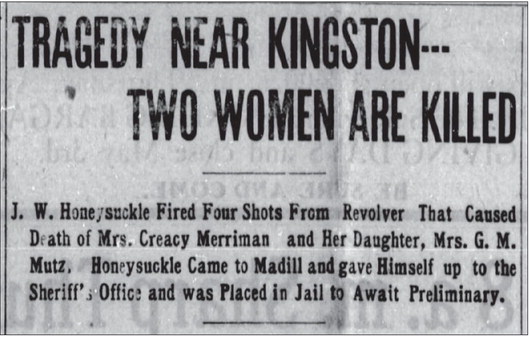
The murder case that first drew Charles Arthur Coakley fully into the arena of murder defense did not begin in a saloon, on a dark road, or in a sudden quarrel between strangers. It began within a family, and that made it worse. It was not merely a killing. It was a double killing—two women dead in the same house, on the same morning, from the same revolver, in a tragedy rooted not in random violence but in marriage, children, property, guardianship, old grief, and the long shadow of the Indian Territory frontier.
Strangers may kill over money, whiskey, pride, or insult, and the community can sometimes keep such violence at arm’s length. But family violence is different. It grows under the same roof. It feeds on inheritance, resentment, obligation, old wounds, loyalty, and fear. By the time it erupts, the spark is often only the final visible flash of a fire that has been burning for years.
The old criminal cases of early Marshall County often carried the familiar marks of frontier life—liquor, land, cattle, pistols, grudges, and blood. But this first great murder defense for Coakley carried something more intimate and far more combustible at its center. It involved marriage, children, guardianship, Indian allotments, property, suspicion, old family violence, and the dangerous question of who possessed the right to control the future of minor children whose land itself carried value. It was a collision between the old Indian Territory and the new Oklahoma; between household authority and court-appointed guardianship; between a mother’s claim to her children and a grandmother’s fear that those children’s property might be lost; between blood kin and a new husband who had entered the family only days before two women lay dead.
By the spring of 1915, Charles Arthur Coakley had only recently returned to private practice after serving one term as Marshall County Attorney. He had reunited with Franklin Elmore Kennamer, and the firm of Kennamer and Coakley had reopened its offices in the McMillan Building in Madill. Coakley was no longer the prosecutor. He was no longer the lawyer standing before juries on behalf of the State of Oklahoma, demanding convictions and speaking in the name of public order. He had stepped back into private practice, and almost immediately, what could be considered the most sensational murder case in Marshall County history came through his office door.
Thattimingiswhatmakes the case so important in the story of Coakley’s career. This was not simply another case taken by a capable young lawyer. And while it may not have been his first murder case in any technical sense, it was his first great murder defense—the first case that would place him before the public as a lawyer capable of standing beside a man accused of the gravest crime known to the law. It was the moment when the former county attorney, fresh from prosecuting cattle thieves and asserting the authority of the new state, turned and stood on the other side of the courtroom. From that point forward, the skills he had used as a prosecutor—the ability to read witnesses, understand probable cause, anticipate the state’s theory, and measure the mood of a rural jury—would become weapons for the defense.
The defendant was John Wesley Honeysuckle.
Honeysuckle was born on October 2, 1886, in Marshall County, Mississippi, the son of Enoch and Mary Honeysuckle. He was still a young man when the events at Kingston unfolded—only twenty-eight years old according to the newspapers of the time. Just days before the killings, he had married MinnieSnellgroveHardwick, a widow with children and a family history already deeply marked by violence, instability, and tragedy.
Minnie Snellgrove was born in Texas in May 1882. Before marrying Honeysuckle, she had been married to Brit Walter Hardwick. Brit was born May 4, 1880, in what later became Marshall County, Oklahoma, and he belonged to one of the old, intertwined family networks of theKingstonandPowellcommunities. Brit and Minnie had five children together: Mayetta, Dave, Agnes, Joe, and Billy. In ordinary circumstances, that would have made Minnie’s remarriage a simple domestic event—a widow beginning again, a new husband entering a household with children, a family rearranging itself after death. But there was little ordinary about the Hardwick-Merriman family history.
Brit Hardwick’s own life had ended violently, and that death must be understood as more than a passing genealogical fact. It was another dark strand in the same family web that would later tighten around the Honeysuckle case. On March 5, 1911, Brit HardwickdiedatKingstonat only thirty years of age. He was buried in the Hardwick Family Cemetery near Powell, leaving behind his wife, Minnie, and their children. Four years later, that widow would marry Honeysuckle, and that remarriage would become the immediate spark case that would put Coakley in the spotlight as one of the best defense lawyers in Oklahoma.
The details of Brit Hardwick’s death were reported in both the Marshall County News-Democrat and the Madill Times. According to the Marshall County News-Democrat of March 10, 1911, the fatal trouble occurred the previous Saturday night nearKingston,aroundeleven o’clock. The paper reported that Brit Hardwick’s throat was cut so severely that “he died soon after reaching Kingston.” Will Moore surrendered to officers, was brought to Madill, and lodged in jail. A preliminary hearing was held before Justice of the Peace G. K. McGhee, who remanded Moore back to jail. Moore’s lawyers then sought habeas corpus relief before Judge Summers Hardy, who determined that the offense was bailable and fixed Moore’s bond at $10,000. The bondwaspromptlymadeand signed by John Vandervort, R. O. Thompson, D. B. Taliaferro, and W. N. Taliaferro, all of whom were founding fathers of Madill.
The account is vivid because it shows the death not as a silent ambush, but as the tragic end of a drunken nightmovingtowardviolence almost from the beginning. The evidence, according to the News-Democrat, showed that around 8:30 that evening, Brit Hardwick, Will Moore, and several others left Kingston together in a double rig wagon to attend a dance. “All were drinking,” thepapersaid,andHardwick was reportedly trying to pick a quarrel, seemingly with Moore. According to the testimony, Hardwick said, “I have killed one man and would kill another.” That statement, if accurately reported, carried terrible weight. The “one man” was almost certainly Tate Merriman, Hardwick’s own stepfather, whom Brit had killed in 1906.
The March 9, 1911, issue of the Madill Times provided even more detail. It reported that Brit and Eastman Hardwick, Jim Peoples, Will Moore, Jim Matchen, and another man drove from Kingston to the dance together. A gallon jug of whiskey was provided for the trip, and according to the evidence, all of the men partook of it frequently. On the way to the dance, Brit Hardwick seemed to have “a special pick” at Will Moore and cursed him repeatedly. After they arrived, the conduct allegedly continued. At three different times, according to the testimony, Brit cursed Moore, called him names, and hurled epithets at him.
TheMadillTimesreported another haunting statement attributed to Brit: that he had “been out of jail just about as long as he wanted to be” and would like to do something that would put him back in jail, that he would like to “hear the locks click behind him again.” Those words, whether drunken bravado or something darker, sound like a man walking toward disaster and daring fate to meet him there.
The only eyewitness identified by the Madill Times was Jarl Buck. Buck testified that he and Will Moore were outside in the yard talking when Brit Hardwick came up and accused Moore of stealing his knife and two dollars. Moore denied having either the knife or the money. Brit cursed him and called him names. Moore reportedly insisted that he did not want trouble and reminded Hardwick that he had been his friend. After enduring the abuse for some time, Buck testified that Moore slapped Hardwick. Hardwick then turned and walked away about twenty-five or thirty feet toward some other men. Buck heard more swearing and went to see what was happening, while Moore left for the house. When Buck reached the group, Hardwick complained that something was wrong with his neck. A match was struck, and only then did those present realize that his throat had been cut and that he was bleeding badly.
The men tied a handkerchief around his neck to check the bleeding as much as possible, placed him in the wagon, and drove him back to Kingston for medical assistance. By the time they reached town, Hardwick had lostsomuchbloodthathewas nearly dead. They arrived around 12:30, and he died about four o’clock Sunday morning. A brief death notice later stated the cause plainly: Brit Hardwick of Kingston, knife wound severing the jugular vein, age thirty years and eleven months.
The case moved quickly into court. Moore was first committed to jail without bail by Justice McGhee, but Judge Hardy soon set bond at $10,000. The Madill Times described Moore as a man raised in the county, married, with three children, and possessing “the name of being a quiet law-abiding citizen.” Hardwick, by contrast, left a wife and five children, and the evidence printed in the newspapers portrayed him as the aggressor that night.
The trial came the following month. On April 20, 1911, the Madill Times reported that the jury in State of Oklahoma v. W. Moore returned a verdict of “not guilty” after deliberating from 1:25 until four o’clock. The case had begun Monday morning and reached the jury Thursday afternoon. The jury included J.J.Gilmore,W.R.Hume,W. A. Adams, F. L. Yarger, C. C. Bonner, W. C. Dowell, J. S. Blalock, J. M. Coleman, E. G. McAdoo, Jim Runnels, Joe Reirdon, and Tom McGuire.
The prosecution was formidable. County Attorney J. O. Minter was assisted by Assistant Prosecuting Attorney A. W. Rison and by W. B. Johnson of Ardmore. The Madill Times noted that Johnson was considered “one of the best prosecutors in the state,” having served for years as a federal prosecutor during territorial days. They “put up a strong fight for a conviction.”
Butthedefensewasequally strong. Moore was represented by Franklin & March andbyKennamer&Coakley, all of Madill. The paper wrote that these lawyers “put up an able defense.” The sympathy of many who attended the trial appeared to rest with the defense, and when the verdict was read, Moore’s wife, brother, and friends showed unmistakable relief and gratitude. Will Moore wasdischargedfromcustody, and in the language of the paper, “was a free man and was exonerated by the court.”
The Marshall County News-Democrat of April 21, 1911, likewise reported Moore’s acquittal and emphasized the public interest in the case, noting that both men were well known in the county. It praised the prosecution by Minter and W. B. Johnson but stated that “for the defense Kennamer & Coakley and Judge I. O. Lewis made a winning fight.” Then came a sentence of special importance to the larger Coakley story: “We have heard more than one remarkthatKennamermade the best speech of his life.”
Years before the Honeysuckle case, years before Coakley became known for murder defense, the firm of Kennamer & Coakley had already stood in a Marshall County courtroom defending a man accused of killing someone inside this same violent family circle. In 1911, they defended Will Moore for killing Brit Hardwick. In 1915, they would defend John Wesley Honeysuckle for killing Brit Hardwick’s mother, Crecy Merriman, and his sister, Ida Mutz. The irony is sharp enough to cut. Coakley first helped defend the man accused of killing Crecy Merriman’s son. Four years later, he would help defend the man accused of killing Crecy herself. The legal and family histories were not separate roads. They crossed and recrossed like wagon tracks in red mud.
Brit Hardwick’s death, however, was not the first violent chapter attached to that family. Years earlier, in December 1906, Brit himself had shot and killed his stepfather, Tate Merriman, on the Hardwick place east of Kingston. That earlier killing pushed the story backward into the old Indian Territory years, into a world of intermarried Chickasaw citizenship, tribal courts, federal habeas corpus, cattle larceny, and a sentence of thirty-nine lashes on the bare back.
The Red River Farmer of December 7, 1906, reported that Brit Hardwick had shot Tate Merriman to death with a shotgun “on the Hardwick place about two miles east of town.” The paper stated that details were difficult to obtain, but reported that Merriman had been in town drinking heavily and “snapping his pistol around” before Marshal Grider took the weapon away from him. Later, according to the account, Merriman obtained another gun, returned home, and the fatal shooting followed.
The Woodville Beacon described the matter in the blunt language common to frontier-era newspapers: “Brit Hardwick shot and killed Pate Merriman yesterday afternoon in a drunken row at Kingston. Merriman is the stepfather of Hardwick. Both parties are well-known in this country.”
A week later, the Red River Farmer reported that Brit Hardwick had been cleared after an examining trial at Tishomingo, explaining that there was “no evidence at all against him of a damaging nature.” The same article added a darkly fatalistic editorial observation: “Sometimes it seems that a person gets drunk to die, and this certainly seems a case of that kind.”
That sentence carried the rough fatalism of old frontier communities where violencewasfrequentenough that newspapers sometimes treated sudden death almost as weather. Yet the remark also foreshadowed the later Honeysuckle case itself. The family into which John Honeysuckle marriedhadalready known bloodshed, firearms, courthouse scrutiny, and violent death inside the family circle.
At the center of that older family history stood Lucretia “Crecy” Harney Merriman.
Crecy Harney was born in March 1860 in Oklahoma, the daughter of Maulsie and Will Harney. She first married John David Hardwick, with whom she had children, including Brit Hardwick and Ida Hardwick. John David Hardwick was born in March 1852 in Marshall County, Mississippi, the son of John Hardwick and Elizabeth Hardwick. Before marrying Crecy, he had also been married to Sarah Frances Duniphin, withwhomhehadone daughter. He died on October 23, 1889, in Paris, Texas, at the age of thirty-seven, and was buried in Marshall County, Oklahoma. After his death, Crecy later married TateMerrimanonNovember 6, 1902, in Marshall County.
Tate Merriman brought hisowntroubledandremarkably complicated history into the family. Long before his death at Brit Hardwick’s hands in 1906, Merriman had already become a figure known throughout portions of Indian Territory because of one of the strangest and most revealing criminal jurisdiction disputes of the 1890s.
In 1895, while Indian Territory still existed and before Oklahoma statehood, Merriman—described in newspaper accounts both as Tate Merriman and as John Loudermilk or Laudermilk, alias Tate Merriman—was convicted in the Chickasaw court at Tishomingo of stealing a steer from another intermarried citizen and sentenced to receive thirtynine lashes on his bare back.
That sentence alone tells us how different the legal system of the Indian Territory was from what modern readers recognize as criminal justice. The punishment was not a term in a penitentiary. It was not a fine. It was the lash. By the 1890s, public whipping had largely disappeared fromAnglo-American criminal justice systems, yet portions of tribal law still preserved corporal punishment as a lawful penalty. Merriman’s case quickly became more than a cattlelarceny matter because his attorneys attempted to invoke federal jurisdiction to stop the Chickasaw sentence from being carried out.
The Daily Ardmoreite of November 14, 1895, described thecontroversyunder the headline “Writ Granted,” explaining that Judge Kilgore had taken a hand in “the case of an intermarried citizen convicted in the Indian court.” The paper reported that Merriman, “an intermarried Chickasaw,” had been convicted at Tishomingoofstealingasteer and sentenced to “thirty-nine lashes on the bare back.” The whippingwasscheduledtobe administered the following day unless the Chickasaw authorities recognized the federal writ.
The Ardmoreite immediately understood that the case raised more than one man’s punishment. It called the central issue “that disturbing one of jurisdiction” and wrote that the result wouldbewatched“withmuch interest,” particularly by intermarried citizens whose exact legal status had been “tossed to and fro on the sea of uncertainty.” The paper thendeliveredoneofthemost vivid lines in the entire controversy, observing that such citizens were “practically speaking, between the devil and deep sea” and wanted to know “once and for all to the laws of what government they are amenable.”
That was the old Indian Territory in a single paragraph. Men like Tate Merriman lived in a legal borderland. They were not simply residents of a county inside a state. There was no State of Oklahoma yet. The Chickasaw Nation still exercised governmental authority. Federal courts existed, but their jurisdiction was complicated and contested. Tribal citizenship, intermarriage, criminal law, property rights, and federal supervision overlapped in ways that could turn even a cattle theft into a major jurisdictional test.
Two days later, on November 17, 1895, the Daily Ardmoreite reported the federal court’s ruling under the headline “An Important Case.” The subheadline was even sharper: “Once an Indian Citizen, always an Indian Citizen and Loudermilk Alias Merriman will be Whipped.” Judge Kilgore denied thewritofhabeascorpus and remanded Merriman to Chickasaw authorities. The paper explained that the case involved “some delicate points of law,” especially “the status of the intermarried citizen” who, after the death of an Indian consort, had married a citizen of the United States. By the court’s ruling, the article stated, “once a citizen of a tribe was to be always a citizen,” and that principle was “established and held to be a fact by the court.”
The courtroom itself seems to have drawn more than casual attention. The paper noted that many intermarried citizens attended the hearing, their interest sharpened by the uncertainty surrounding their own status. The Chickasaw Nation was represented by Johnson, Cruce & Cruce, C. L. Herbert, H. C. Potterf, and Attorney General I. O. Lewis. JudgeR.H.Westrepresented Merriman. W. B. Johnson reportedly delivered “one of the most forcible speeches ever heard in the courthouse” on the rights of the Indian government, insisting that Merriman be dealt with according to the verdict of his peers.
The Chickasaw Chieftain of November 21, 1895, likewise, reported that Judge Kilgore held his court had “no jurisdiction over the case” and remanded Merriman to theIndianauthorities.Merriman’s attorneys filed a notice of appeal with the court of appeals in South McAlester, and, according to the paper, the prisoner would be held by federal authorities in the meantime.
The Vinita Leader of November 28, 1895, added another vivid layer to the story. It identified Merriman as “John Loudermilk, alias Tate Merriman, an intermarried Chickasaw citizen,” convicted at Tishomingo of cattle larceny and sentenced to “thirty-nine lashes on his bare back.” The paper explained that the writ was sought late at night through the usual legal process, but added a revealing practical concern: ordinarily the writ would have been served on the officer holding the prisoner, but “it was feared in this case that that officer, being an Indian, would first administerthethrashingand then obey the writ.”
That line is ugly in the way nineteenth-century newspapers often were ugly, but it also shows how urgent the situation appeared to Merriman’s lawyers. This was not merely a theoretical question. If the sentence was carried out before federal intervention, the legal argument would be meaningless. The lash would have already fallen.
For a brief time, Merriman resisted the sentence. Then, in a turn that reads almost like frontier theater, he changed his mind.
On December 5, 1895, the Daily Ardmoreite reported under the headline “Appeal Withdrawn” that “John Laudermilk, alias Tate Merriman,” described as “the whitemancondemnedbythe Chickasaw courts and sentenced to thirty-nine lashes on the bare back,” appeared in Judge Kilgore’s court and withdrew his appeal. The subheadline was grim and almost theatrical: “Now For the Lash.”
The paper wrote that Merriman had sought to avoid the penalty through habeas corpus proceedings but now requested that the court return him to Chickasaw custody. His reasoning was brutally practical. According to the report, Merriman said that while the courts might delay matters, “the Indians would whip him any day,” and he had concluded, “it would be just as well for him to save time by taking his medicine now.”
That phrase—“taking his medicine”—belongs to the old vocabulary of punishment and endurance. It makes Merriman sound resigned, almost fatalistic, as though he had decided that the quicker path through humiliation was better than the longer path through legal uncertainty.
But there was another reason for his urgency. Merriman told the court he was under bond to appear in Paris, Texas, as a witness in a murder case the following Monday. Because of that obligation, he asked Marshal Stowe not to delay in placing him back into the hands of the Chickasaw authorities so that he could “pay the penalty” and avoid forfeiting his bond.
It is a remarkable detail. Tate Merriman was at once fighting, or no longer fighting, a sentence of thirty-nine lashes in the Chickasaw Nation while also under bond to appear as a witness in a murder case in Paris, Texas. His life already seemed to move from one courthouse to another, from one jurisdiction to another, always near accusation, violence, punishment, or testimony.
The Oklahoma Weekly LeaderofDecember12,1895, carried the story under the blunt headline “Must Be Whipped,” writing that “a little variety spiced the proceedings” at Ardmore when Merriman withdrew his appeal and expressed willingness tosubmittothesentence of the Indian court. The paper added that Chickasaw officials saidthewhippingwould be “the first whipping to take place in their government in the past fifteen years.” The CrescentCityTimesrepeated much the same report, also under the headline “Must Be Whipped,” noting that Merriman had tried to “dodge a whipping”butthenwithdrew his appeal and submitted to the Chickasaw sentence.
And yet, despite all that publicity, all that legal drama, and all those headlines promising the lash, the sentence apparently was never executed.
By January 19, 1896, the Daily Ardmoreite reported that Tate Merriman had filed a bond for his appearance at theApriltermoftheSupreme Court of the Chickasaw Nation and left for home accompanied by his wife. Then, in June 1897, the Daily Ardmoreite reported from Denison that Merriman had been convicted in district court there of selling mortgaged property and swindling, and had been sentenced to five yearsinthepenitentiary.The paper reminded readers that Merriman was “well known to court officials in this district,” had been before the court on various charges, had once been convicted in the Indian court, and had been sentenced to receive a whipping for larceny. Then came the key clarification: “The sentence was not executed.”
That final line matters. The whipping case did not end with the lash. But it left behind something equally important for understanding the later Honeysuckle tragedy: a public record of Tate Merriman as a man repeatedly entangled in criminal courts across Indian Territory and Texas, a man whose legal status had helped produce an important jurisdictional dispute, and a manwhosenamehadalready become familiar to newspaper readers years before he entered the Hardwick household.
By the time Merriman married Crecy Harney Hardwick in 1902, he carried that turbulent history with him. Fouryearslater,inDecember 1906, he was dead, killed by his stepson, Brit Hardwick, in another violent family episode.
The following week, the Red River Farmer reported that Brit Hardwick had been cleared at Tishomingo and that Tate Merriman had been buried in the Hardwick family graveyard east of Kingston. Officially, the matter was over. Another killing had passed through the rough machinery of territorial justice and disappeared into the closing years of Indian Territory. But the deeper consequences did not disappear with the verdict or the burial.
The violence remained inside the family itself.
By then, the Hardwick-Merriman name carried more than ordinary family history. It carried memory. In a small community, people did not need every old story retold to understand what those names meant. They remembered the trials, the burials, the quarrels, and the hardreputationthatfollowed a household touched more than once by violence. Those memories did not stay locked in newspaper columns. They traveled by porch talk, courthouse talk, and family talk, shaping how neighbors understood every new conflict that arose around the same people.
By the spring of 1915, thoseolderwoundshadnever fully healed. Instead, they hovered beneath the surface of daily life in the Kingston country like old scars that never stopped aching. The dispute that eventually exploded at the Honeysuckle home was therefore not simply an isolated domestic disagreement. It grew out of years of accumulated distrust, family strain, and anxiety over the future of children whose allotments carried both financial and emotional importance.
Crecy Merriman appears to have genuinely believed shewasprotectinghergrandchildren and their property interests. Honeysuckle, meanwhile, insisted he was trying to build a stable home with Minnie and the children and that outside interference threatened to destroy that effort before it even began. Each side believed the other posed danger. Each side believed the children’s future was at stake.
And in early Oklahoma, particularly in families tied to Indian allotments, such fears carried enormous weight. Allotments were not abstract pieces of paper. They represented land, inheritance, survival, and future wealth at a time when many families possessed little else of lasting value. Guardianship disputes over Indian minors could quickly become emotionally explosive because whoever controlled the children often controlled access to the land and the income connected to it. Entire legal industries had already begun to form around allotment guardianships in early-statehood Oklahoma, and stories of fraud, exploitation, and manipulation were common throughout the region.
Againstthatbackdrop,the Honeysuckle conflict became far more dangerous than an ordinary family argument. By the time Crecy Merriman and her daughter, Ida Mutz, arrived at the Honeysuckle homeinApril1915,theywere walking into a family history alreadymarkedbybloodshed andmistrust.Theimmediate quarrel may have centered on Minnie’s children and the question of guardianship, but beneath that lay years of accumulated grief, old violence, tangled loyalties, and unresolved fears about who would control the future of the family itself.
The killings that followed thereforedidnotemergefrom nowhere. They were the latest eruption from a long and troubled history that had already been burning through the Hardwick-Merriman family for years before John Wesley Honeysuckle ever appeared in Marshall County’s headlines.
That is what made the Honeysuckle case so explosive. It was not merely a double killing. It was the eruption of a whole family history.
The marriage itself appears to have lit the final fuse.
On April 22, 1915, the MadillTimescarriedasimple marriage announcement: “J. W. Honeysuckle, 28, Kingston, to Minnie Hardwick, 30.” But in the very same issue, the paper also carried the terrible news that followed almost immediately afterward. Under the headline “Killing At Kingston,” the paper reported that John Honeysuckle had shot and killed Mrs. George Mutz and Mrs. Merriman at about nine o’clock that morning.
Othernewspaperaccounts identified the dead women more fully as Mrs. Creacy Merriman and her daughter, Mrs. George M. Mutz—Ida HardwickMutz.Idahadbeen born in April 1877 in Oklahoma, the daughter of John David Hardwick and Crecy HarneyHardwickMerriman. She married George Martin Mutz in Grayson County, Texas, on January 26, 1892, and had six children over the next seventeen years. On April 22, 1915, she died beside her mother at Kingston at the age of thirty-eight.
The Marshall County News-Democrat of April 23, 1915, carried the fullest early account beneath the enormous headline “Tragedy NearKingston—TwoWomen AreKilled.”Thepaperreported that John W. Honeysuckle had fired four shots from a revolver, causing the deaths of Mrs. Creacy Merriman and Mrs. G. M. Mutz. The shooting occurred in Honeysuckle’s homeapproximately three miles east of Kingston at about nine o’clock in the morning.
And there, at the edge of that terrible morning in April 1915, Part III of the story comes to rest—not with resolution, but with smoke still hanging in the air above the Kingston.
Two women were dead. A new husband sat in jail at Madill.
Five frightened children stood in the middle of a shattered family. And all across Marshall County, people argued over what had really happened inside that little farmhouse east of Kingston.
Some believed John Wesley Honeysuckle had defended hiswife,hishome,and himself against two enraged women determined to seize control of the children and break apart the marriage before it had even properly begun.Othersbelievedsomething darker had happened inside the house that morning— that the killings were not merely the desperate acts of a cornered man, but the bloody climax of a guardianship war fueled by suspicion, fear, and property.
The county divided almost immediately.
That division is important to understand because the Honeysuckle case was never a simple murder prosecution. Even before trial, people viewed the killings through the lens of kinship, allotments, and old loyalties. In rural Oklahoma, families did not exist as isolated units. They existed as networks. One marriage tied households together. One death echoed across cousins, in-laws, neighbors, church pews, schoolhouses, and courthouse benches. Nearly everyone in Marshall County knew somebody connected to the Hardwicks, the Merrimans, the Mutz family, or the Honeysuckles.
And many remembered the older violence too.
They remembered Tate Merriman.
They remembered Brit Hardwick.
They remembered the old drinking quarrels, the killings, the trials, the whispers, and the funerals.
Now the family stood again at the center of another catastrophe.
What made the case so gripping was that nearly every element carried emotional force. There was a young widow remarrying after tragedy. There were children caught between their grandmother and their mother. There were Indian allotmentswhosevaluehung silently behind the guardianship dispute. There was the image of two women arriving at a farmhouse in the rain to confront a new husband they distrusted. There was the fear—on both sides—that the children’s future was slipping away. There were frightened family members who would soon becomewitnesses.Therewas adefendantwhosurrendered himself rather than fleeing. And above all else, there was the terrible, immovable fact that by the end of the morning, two women lay dead on the floor in a small farmhouse east of Kingston.
Even the setting deepened the drama.
This was not Tulsa or Oklahoma City. This was Marshall County in the first years after statehood, where the old Indian Territory had not yet fully disappeared beneath the structures of the new state. The people involved still carried territorial histories with them. Tribal courts, intermarried citizenship disputes, allotment guardianships, federal jurisdiction fights, and frontier violence all remained close enough to memory that they still shaped how people understood justice itself.
And now into that world stepped Charles Arthur Coakley.
Not as prosecutor. Not as county attorney. But as defense counsel in the most explosive homicide case of his young career.
That transformation mattered. It marked the beginning of the role for which Coakley would later become famous across Oklahoma. The instincts he had sharpened as a prosecutor now belonged to the defense. He understood how criminal cases were built because he had built them himself. He understood how juries reacted to fear, sympathy, anger, and uncertainty. He understood the enormous power of local rumor before trial even began. And perhaps most importantly, he understood that cases are rarely won merely by arguing law. They are won by persuading jurors whichhumanstorytobelieve.
Was John Honeysuckle a murderer?
Or was he a man who believed his home and wife were under attack?
That question would soon move from newspaper headlines into the courtroom itself.
And when it did, Marshall County would witness one of the fiercest legal battles in its early history.
The crowds gathering at thepreliminaryhearingwere only the beginning.
The real storm had not yet arrived.
In Part IV, the case moves fully into the courtroom. The witnesses will testify. The physical evidence will be dissected. The prosecution and defense will battle over self-defense, guardianship, motive, and preparation. Old woundsinsidetheHardwick-Merriman family will be reopened in public view. The newspapers will follow every development. And Charles Arthur Coakley, still early in the career that would eventually make him one of Oklahoma’s most feared criminal defense lawyers, will fight his first truly great murdertrialbeneaththeeyes of an entire county waiting to see whether John Wesley Honeysuckle walks free—or hangs beneath the weight of a double killing.