
There comes a point in any railroad story where the line itself is no longer the whole subject. The surveys have been made. The grades have been chosen. The camps have comeandgone.Therailshave been laid, the depots set, the sidings spiked into place. After that, the story changes. It becomes no longer a story of where the railroad would go, but of what the railroad did once it got there.
That is where this part begins.
The first five parts of this Iron Road series traced how the Frisco entered the country that would become Marshall County and, in doing so, changed it. We followed the surveyors who came first, those men with chainandtransitwhowalked the ridges, measured the draws, studied the creeks, and decided where the line could run with the least hardship and the greatest practical gain. We saw how therailroadwasneversimply “laid down” in some careless way, but engineered through thousands of choices—grade, curvature, drainage, timber, water, distance between stations, access to wagon roads, and the simple but powerful question of which communitieswouldbeserved and which would be left behind.
We followed the Frisco’s north-south main line as it cut through Indian Territory, threading its way toward Denison and the Texas connection that gave the road much of its strategic significance. We saw how station placement became destiny, how Randolph emerged as an early station of importance, how the old settlement of Kingston was bypassed by the final route, and how Helen rose beside the rails and, in time, took the name Kingston for itself. We traced the legal and practical background that made these towns possible— the communal nature of Chickasaw land before allotment, the townsite process under federal law, the way railroads and post offices together could create, rename, and fix a place in the geography of memory.
And then, in the later parts, we turned to the east-west branch—Ardmore through Madill, Aylesworth, Durant, Boswell, Hugo, and onward in time toward Arkansas. If the north-south line gave Marshall County its vertical spine, the eastwest line gave it reach. Once those two lines crossed at Madill, the town was no longer merely another stop in the string. It became a junction. And a junction is a differentkindofplace.Things do not just pass through a junction. They meet there. They exchange there. They split there. They gather weight there.
By 1904, the groundwork for the story had already been laid. The rails are in place. The route decisions havebeenmade.Thestations have risen. The names have shifted. The railroad has shaped the map.
What remains is to see what that meant in lived reality.
And the answer, when one turns to the newspaper record, is astonishing.
By1904,Madillwasseeing twelve passenger trains a day.
Not twelve trains a week. Not twelve trains in some occasional rush of activity. Twelve trains a day. In the country that would become Marshall County, that was not a small thing. It was proof that the railroad had not merely arrived. It had succeeded.
The significance of that number can be missed if one reads it too quickly. A dozen daily trains meant that the life of the town had begun to revolve around the depot and the schedule. It meant that passenger trains were stopping in Madill every hour or two during the day. It meant that people in town could reasonably expect arrivals from multiple directions and departures toward multiple destinations before the sun went down. It meant that mail, express freight, baggage, local shipments, livestock papers, merchants’ orders, newspapers, and traveling menwereallmovingthrough a place that, only a short while before, had been raw country.
The depot, in such a setting, was never quiet.
Newspaper clippings capture something of its atmosphere, and they do so beautifully by showing not only the trains themselves but also the social drama that gathered around them. The depot was a point of arrival and a point of performance. Hotels sent runners. Men shouted for business. Passengers stepped down from coaches into a small storm of activity. Baggage was seized, offers made, names called out. There was a scramble for custom and a practiced confusion that, in truth, was a sign of prosperity. If no one is waiting at the station, if no one hurries to meet arrivals, if the town lies still when the train comes in, then the place is not thriving. Madill, in those years, did not lie still. By 1904, Madill had five or six hotels, all competing for travelers. For a town the size of Madill in 1904, that many hotels showed the significance the railway had on the community.
Oneclippingspokesharply of the depot's inadequacy, calling it a shame and a disgrace. That is not merely civic complaining. It is evidence of something more significant. A town does not condemn its depot for being too small unless it believes it has outgrown it. And that, in turn, tells us that Madill’s people understood what the railroad was doing for them. They saw the traffic. They knew the volume. They grasped that this was no backwater siding but a growing railroad town, one with enough activity to justify demands for a better station, more facilities, more investment, and more recognition.
Another article pressed the point further, urging the town to seek not just cosmetic improvements but the substantial marks of railroad importance: a roundhouse, shops, coal chutes, and ultimately the status of a division point. That language matters. Those were not the demands ofpeoplewhosawtherailroad as a mere convenience. Those were the demands of people who understood the economic engine before them, and they wanted a larger share of its machinery permanently anchored in their town. They knew that every salaried railroad man based there meant money circulating in local stores. They knew that coaling and servicing locomotives there would mean payroll, stability, and rank. They knewthatrailroadgeography could make or break towns, and they had no intention of letting Madill remain secondclass if they could help it.
So, when we say that twelve trains a day passed through Madill, we are not simply reciting a timetable. We are describing a town entering a new station in its own life.
To understand that life, however, one must understand the trains themselves.
The trains that moved through Madill between roughly 1904 and 1910 were not all of one kind. There were north-south passenger trains on the main line; east-west passenger and mixed trains on the branch; accommodation trains; local stopping trains; and through runs of greater importance. Some bore names that would become famous on the Frisco. Others were known chiefly by number and by their practical value to the people who depended on them.
On the main line, trains such as the Meteor and the Texan represented something larger than purely local service. The Meteor, inaugurated in the early years of the twentieth century, was part of the Frisco’s effort to create a prestige passenger service linking important cities and drawing the road into the higher class of long-distance travel. In later years, the Meteor would become one of the Frisco's signature trains, running overnight between Oklahoma City and St. Louis via Tulsa and, later, extending westward to Lawton. But even in the early years, when its form and route were not yet the polished streamliner of the postwar era, the very use of that name in the newspapers of southern Indian Territory shows that Madill sat on a line of consequence.
TheTexanlikewiseevoked a wider reach. Any train with that name on a north-south line through southern Indian Territory and into Texas was not merely a local shuttle. It belonged to the Frisco’s effort to tie the Territory and Texas traffic into its broader network. Such trains carried more than local passengers. They carried businessmen, commercial travelers, railroad men, and others traveling long distances, often with sleeping accommodationsandexpress service.
There was also a service that was less glamorous but was no less essential: the east-west trains between Ardmore and Hugo. These deserve more attention than they often receive, because they were the daily connective tissue of life in Marshall County. A great named through train may stir the imagination, but the train that lets a man leave in the morning for business in another town and return by evening often matters more in lived experience. The Ardmore-Hugo line did that work. It linked Madill to county and regional commerce in both directions. It made possible the carrying of mail, the movement of merchandise, the arrival of newspapers, the shipment of small freight, and the ordinary yet transformative fact that people could travel from one town to another in hours rather than days.
When the papers announced schedules on this line, they were telling peoplewhencommercewould happen. The train from Hugo arriving at Madill in the morning and the quick onward departure to Ardmore were not mere abstractions. They meant that the railroad had been timed for connection. The same was true of the west-toeast pattern later in the day. The schedule was evidence of coordination. That alone says a great deal about the maturity of the line.
And these trains, whether named or numbered, local or through, were all pulled by locomotives whose classification and design reflected the needs of the work before them.
Here, it is worth pausing to explain the system of numberslike4-4-0,4-6-0,2-80, and the rest, because those numbers tell a reader exactly what kind of locomotive is being described. They are not random codes. They are wheelarrangements,written in the Whyte system. The first number tells how many leading wheels the engine has—those small wheels on the front truck that help guide the locomotive into curves. The second number tells how many driving wheels it has—those large wheels connected by rods and powered by the pistons. The final number tells how many trailing wheels it has at the rear, usually supporting the firebox.
A 4-4-0 has four leading wheels, four driving wheels, and no trailing wheels. A 4-6-0 has four leading wheels, six driving wheels, and no trailing wheels. A 2-8-0 has two leading wheels, eight driving wheels, and no trailing wheels. A 2-8-2 Mikado adds a trailing truck beneath a larger firebox. A 4-8-2 Mountain combines speed and power with a longerwheelbaseandgreater steam capacity. A 4-8-4 Northern represents one of the ultimate expressions of American steam, with high speed, a large firebox, and substantial power.
Those numbers, then, are not just classification. They describe the locomotive’s balance between guidance, traction, speed, and firebox support. They tell you something about what the engine was built to do.
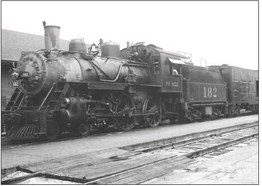
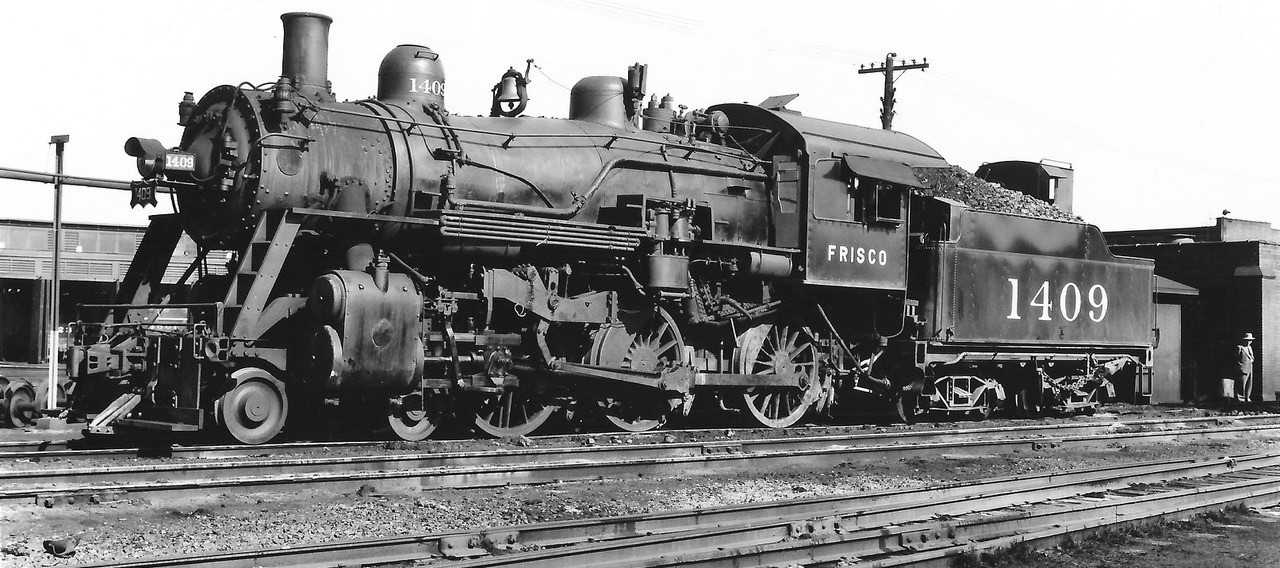
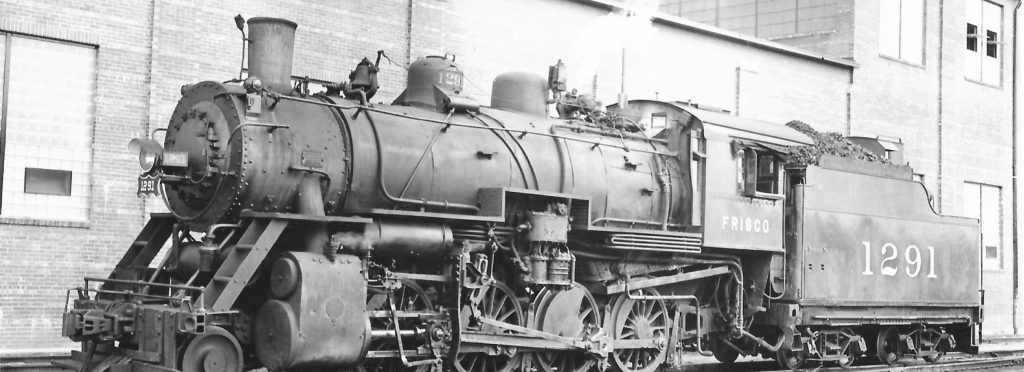
In the early Frisco years in Marshall County, three steam types were especially important: the 4-4-0 American, the 4-6-0 Ten-Wheeler, and the 2-8-0 Consolidation.
The 4-4-0 American had once been the image of American railroading itself. In the nineteenth century, it was the standard. It was graceful, balanced, and comparatively light on the rail. High drivers made it suited to passenger work. By July 1903, the Frisco still had 159 of these locomotives in service, built by twentyfive different companies. That figure alone tells us something important: the Frisco was still carrying a great deal of nineteenthcentury motive power into the twentieth century. These engines had not vanished because they still had uses— lighter passenger work, branches, and services that did not require the heavier and more modern power emerging around them. In a place like Marshall County, where the system was still developing and not every train required the newest heavy engine, the American type likely still appeared with someregularity,especiallyon secondary work.
If the 4-4-0 belonged emotionallytothenineteenth century, the 4-6-0 Ten-Wheeler belonged practically to the age when Marshall County was being made. By 1903, the Frisco rostered 430 Ten-Wheelers. That is an enormous number, and it tells its own story. The Ten-Wheeler was the Frisco’s great general-purpose road engine. It had more adhesion and pulling power than the 4-4-0, thanks to the extra pair of driving wheels, yet it could still maintain good speed and handle passenger service respectably. In a rapidly growing railroad system, especially one serving a mix of main-line passenger traffic, locals, mixed trains, and branch service, that versatility was invaluable. The Ten-Wheeler was the locomotive you used when youneededoneclassofengine to do many things reasonably well. In Marshall County, this likely made it one of the most familiar steam types people saw.
The 2-8-0 Consolidation was the freight workhorse. Eight driving wheels meant traction. Traction meant tonnage.Cotton,timber,farm products, livestock, building materials,machinery—these movedbehindConsolidations. They were not built for grace. They were built for work. Their appearance reflected that: compact, muscular, purposeful. The Frisco operated numerous Consolidations, and later surviving engines like 1351, 1352, and 1355, though rebuiltandoflaterdate,stand asremindersofhowenduring that basic design was. Even therepresentative“Frisco19” display in the city of Frisco, Texas—though not actually an SLSF locomotive—exists because the Consolidation type was so typical of Frisco steam freight power.
Smaller branch and mixed-train work was also handled by engines such as the 2-6-0 Mogul. These were lighter, economical, and well-suited to lower-volume service. Later surviving Frisco 73, though acquired through a different corporate path, gives a sense of the kind of power that could be assigned to such work. And all the while, in yards and terminals, 0-6-0 switchers worked constantly, moving cuts of cars, making up trains, spotting freight, and performing the unglamorous labor without which no road service could function. Surviving Frisco 3695 and 3749 testify to that hard, hidden side of railroading.
Now, all of these engines had to be built somewhere, and here we come to the great locomotive manufacturers whose histories are inseparable from the history of the trains that rolled through Marshall County.
The greatest of them was Baldwin Locomotive Works. Baldwin’s origins lay in Philadelphia in the 1830s, in theshopofMatthiasBaldwin. From that beginning, it grew into the world’s largest locomotivebuilder.Baldwin’s rise was not accidental. It came because the company learned to industrialize locomotive production while still building engines suited to the very different needs of different railroads. Baldwin couldbuildelegantpassenger locomotives, rugged freight engines, switchers, export locomotives, narrow-gauge power, and special-purpose engines. Its strength was breadthasmuchasvolume.By the late nineteenth century, Baldwin was so large and influential that it had become one of the defining industrial names in the United States. When railroads thought of locomotives, they thought of Baldwin.
The company’s Philadelphia shops were vast. Boilers were rolled and riveted there, wheels cast and turned there, rods machined there, frames erected there. Men worked in specialized gangs, each responsible for a phase of construction. The locomotive that emerged at the end was the product of thousands of acts of skilled labor. Baldwin mattered not only because of how many engines it built, but because of the trust it inspired. Roads ordered from BaldwinbecauseBaldwinhad experience, because Baldwin could adapt designs, and because Baldwin’s product was proven.
The Frisco bought many engines from Baldwin. That is why Baldwin’s name surfaces repeatedly in the Friscostory—Consolidations, Mountains, Northerns, switchers,Moguls,passenger engines. When an engine with Baldwin bloodline rolled through Madill, it carried with it the weight of one of the greatest industrial enterprises in the railroad age.
The second major builder wastheAmericanLocomotive Company, better known as ALCO. ALCO was formed in 1901, at the precise moment when the Frisco lines in Marshall County were becoming established. It was created by merging several older builders: Schenectady, Brooks, Cooke, Dickson, Manchester, Pittsburgh, Richmond, and Rhode Island. That consolidation is important because it reflects the broader movement of American industry toward larger combinations and national scale. Railroads were growing. Orders were increasing. Standardization mattered more. ALCO broughttogethertheskilland traditions of those older firms under a single organizational roof. In practical terms, that meant locomotives from multiple old-line builder traditions now belonged to one industrial giant capable of competing with Baldwin.
ALCO and the earlier firms it absorbed mattered enormously because the Frisco roster in the early years was not a tidy fleet from a single or even two sources. It was a broad collection of engines built over time, by different makers, for different eras of railroad need. Thus, when one says ALCO or Schenectady or Richmond in the Frisco story, one is not just naming a factory. One is naming an industrial heritage.
Then there was Lima Locomotive Works, the builder most associated with some of the later, more advanced steam locomotives on the Frisco. Lima began as a machinery concern and became a locomotive builder of growing importance, first through geared Shay locomotivesandlaterthrough its famous emphasis on highcapacity, high-performance steam. Lima’s later role in developing “Super Power” concepts helped prove that steam locomotives still had engineering life in them even as diesels loomed. On the Frisco, Lima-built Mikados such as 4003 and 4018 gave the railroad powerful and durable freight engines. These are from later years, but that is precisely the point: the lines through Marshall County remained active long enough to witness the whole evolution of Frisco motive power, from relatively light early engines to heavy, mature steam designs.
Other earlier builders mattered too, especially because many old 4-4-0s and 4-6-0sontheFriscocamefrom a variety of makers before consolidation narrowed the field. Hinkley, Rogers, Brooks, Cooke, Richmond, and others all had a hand in shaping the locomotives of that earlier age. The Frisco’s 4-4-0 fleet in 1903 had been built by twentyfive different companies. That one fact shows how broad the manufacturing base of nineteenth-century railroading had been.
As the Frisco matured, so did its steam.
The later roster included the 1500-series 4-8-2 Mountains, built by Baldwin in batches beginning in 1923. These were larger, stronger road engines suitable for both freight and passenger service. Several survive today—1501, 1519, 1522, 1526, 1527, and 1529—and their survival reminds us that the Frisco did not stand still. It kept modernizing steam.
There were also the Russian Decapods, the 1600 series—2-10-0 locomotives built originally for the Tsarist government in Russia, then redirected and adapted to American standard gauge after revolution interrupted delivery. The Frisco acquired twenty of them. Few locomotive stories are stranger or more revealing of the global upheavals of the age. Engines intended for imperial Russia ended up haulingAmericanfreightand later, in some cases, hauling ore in Oklahoma for Eagle-Picher. Frisco 1615, 1621, 1625, 1630, and 1632 survive in various places, and they stand for a peculiar but real chapter in Frisco power.
Frisco also built or rebuilt some of its own later steam in imaginative ways. The 4300 and 4400 series Mountains, assembled from older 2-10-2 parts and boilers, show that the road was not merely buyinglocomotiveswholebut was capable of substantial mechanical creativity in its own shops. These rebuilt Mountains became some of the heaviest 4-8-2s ever built. Even in the late steam era, the Frisco was still wringing new value out of old iron.
And at the top of the road’s late passenger steam stood the 4500-series 4-8-4 Northerns, including 4500, 4501, 4516, and 4524, among others. Built in the 1940s, some oil-burning and some coal-burning, these engines represented the peak of Frisco steam passenger and high-speed capability. 4500 and 4501 became especially associated with the Meteor in their distinctive livery, while 4524 has the distinction of being the last steam locomotive built for the Frisco.
That leads us naturally to thenamedtrainsthemselves, because locomotives were only half the story. The trains they pulled had identities, reputations, and careers of their own.
The Meteor deserves special attention. In its earliest form, inaugurated in 1902 between St. Louis and Tulsa, it was later used for broader service. Over time, it became one of the Frisco’s premier trains, running overnightbetweenOklahoma City and St. Louis via Tulsa, and later extending west to Lawton. In the early years, the Meteor was part of the Frisco’s effort to establish itself in the long-distance passenger business. In later years, it became a polished streamliner with EMD diesel power and Pullman cars, purchased in coordination with the Texas Special. Early train schedules published in Madill newspapers in 1904 showed the Meteor running through Madill and making two daily stops, one in each direction.
The locomotives that handled the Meteor evolved as the train did. In its early years, it ran behind Frisco 1300-class high-wheeled Baldwin 2-8-0s. Later, Baldwin 4-8-2 Mountains of the 1500 class followed. Still later, the great 4500-class 4-8-4 Northerns arrived, especially 4500, 4501, and 4502, painted in special Meteor colors. Still later, in the diesel era beginning in 1948, the streamlined Meteor ran behind EMD E7 locomotives in bright red and stainless-steel dress.
The Texan was part of that earlier generation of named or semi-named Frisco passenger service that linked the Indian Territory and Texas to the broader network. Even when we cannot reconstruct every exact train for every year, the name itself appearing in local Madill schedules is telling. It means the line through Madill carried service of sufficient importance to be branded and recognized.
The Hustler, which appears in later material, shows the continuing refinement and marketing of Frisco passenger service. Pullmans, dining service, advertised speed, Kansas City connection—all of those point to a road conscious of itspassengerimage.Andthat matters even when writing about Marshall County, because it means the lines through Madill were not provincial backwaters. They belonged to a system that aimed at quality, prestige and utility.
But alongside the named trains stood the branch and local services that most directly shaped daily life. The Ardmore–Madill– Aylesworth–Durant– Boswell–Hugo trains were the everyday carriers of the region. They carried passengers to county seats, stores, and business appointments. They moved mail and express. They made it possible for a person to ride out in the morning, conduct business, and return later. They linked Madill not just to distant cities but to neighboring communities whose ties mattered just as much.
Then, beginning around 1910, another kind of train entered the story, and in Marshall County memory it would loom surprisingly large for something so small.
This was the Doodlebug, known locally as the Dinky.
The Frisco’s Doodlebugs were self-propelled rail motorcars,mostlyinthe2100 series, and they represented one of the railroad’s practical answerstolow-volumebranch service. Instead of assigning a full steam locomotive and conventional passenger cars to a light route, the Frisco could send a single motorcar that combined propulsion, passenger space, andbaggageormailcapacity. Some units were gas-electric, others gas-mechanical. The first Frisco order came in 1910, with additional units following by 1913. In time, Frisco became a leader in such equipment.
The history of the Dinky serves as a vital bridge between the broader story of the railroad and the lived experience of the people of Marshall County. Here, the Dinky was never an abstract class of equipment or a technical footnote in railroad development—it was a familiar and recognizable presence. It ran regularly fromArdmorethroughMadill and Aylesworth to Hugo, and later through Kingston after the construction of Lake Texoma altered the landscape and the route itself. In doing so, it became an essential part of daily life.
The Dinky carried more than passengers. It carried mail, small freight, and the quiet routines of a connected community. It made possible thesimplebuttransformative acts of travel—shopping trips, business errands, visits between towns—that defined life at a local level. Its importance was not measuredinspeedorsize,but in accessibility. It operated at a human scale, close to the ground and close to the people it served.
Locally, it was known simplyasthe“Dinky,”aname that carried with it a kind of quiet affection, born not of grandeur but of familiarity. It was small, practical, and dependablepartoftherhythm of everyday life in Marshall County. The Frisco Railroad, however, called these same machines by a different name: “Doodlebugs,” a term drawn from their slow, wandering motion along the rails, as though they were doodling their way across the countryside without urgency or strain. It was a fitting description. These motorcars did not thunder into town like the great steam engines; they arrived with a hum and a purpose, carrying mail, passengers,andthesmallbut steady commerce of local life.
Yet behind that modest presence lay something far greater than most who watched them pass could have known. These Doodlebugs were tied to the work of the Electro-Motive Corporation, a name that, at the time, meant little to the average citizen of Madill. But that name would not remain obscure. It would grow, evolve, and—under the vast industrial reach of General Motors—become the Electro-Motive Division, known simply as EMD. In that transformation lies one of the great turning points in railroad history. For the same lineage that produced the humble Dinky would, in time, reshape the entire nature of locomotive power in America.
What began as an experiment in lightweight, economical rail service— these small gas-electric cars creeping along branch lines—quietly laid the groundwork for a revolution that would sweep aside the age of steam itself. The Dinky, then, was more than a local convenience. It was a signpost pointing forward, an early whisper of the future moving, almost unnoticed, through the present.
And then that future arrived.
The shift from steam to diesel-electric power was not simply a matter of changing fuels. It was a fundamental reimagining of how a locomotive worked— of how power was created, controlled, and applied to the rails. To understand its significance, one must first understand what it replaced.
A steam locomotive was a living thing in all but name. It breathed fire. Coal or oil fed a roaring furnace, heating water in a boiler until it became steam under immense pressure. That pressure drove pistons back and forth, and those pistons, through a system of rods and linkages, turned the driving wheels in a visible, pounding rhythm. It was power made manifest— mechanical, forceful, and alive with motion. But it was also demanding. It required constant attention: firemen to feed the flames, engineers to manage pressure, crews to maintain the intricate machinery. It needed water towers and coal chutes, roundhouses and ash pits. It needed hours to raise steam before it could even begin its work.
The diesel-electric locomotive swept that world aside with a kind of quiet efficiency that, in its own way, was as revolutionary as the steam engine had once been.
In these new machines, there was no firebox, no boiler, no steam. Instead, a large diesel engine— massive, industrial, and self-contained—turned a generator or alternator. That generator produced electricity, and that electricity powered traction motors mounted directly on the axles. Those motors turned the wheels. There werenosiderodshammering in the open air, no pistons driving motion in plain view. The power was internal, controlled, almost invisible.
The implications of that designwereprofound.Where steamlocomotivesdemanded hours of preparation, diesel-electrics could be started in minutes. Where steam required constant servicing—water, fuel, cleaning, inspection— diesel reduced those needs dramatically. There was no boiler to maintain, no ash to remove, no fire to tend. The long chains of infrastructure that had grown up around steam—water tanks spaced along the line, coal chutes rising beside the tracks, roundhouses filled with heat and smoke—began, slowly but surely, to disappear.
And perhaps most transformative of all, dieselelectric locomotives could be operated in multiple units. Several engines could be linkedtogetherandcontrolled from a single cab, their power combined without the need for separate crews. What had once required coordination between multiple steam engines, each with its own crew and limitations, could now be accomplished with efficiency and precision.
For the Frisco Railroad, and for the people of Marshall County who had long lived within the rhythm of its trains,thistransitionmarked the end of one era and the beginning of another. By the late 1940s, the change was no longer theoretical—it was visible, undeniable. In 1948, when the streamlined Meteor began running in its modern form, it did so behind EMDE7locomotives,painted in bright red and accented with stainless steel. These were not the soot-darkened engines of earlier decades. They were sleek, deliberate, and unmistakably modern machines that spoke not of fire and steam, but of speed, efficiency, and a new industrial age.
And so the people who had once stood at the depot in Madill, watching the great steam engines arrive—long beforetheywereseen,hearing their approach, feeling the ground tremble beneath their weight, watching the clouds of steam rise and drift across the prairie—would, in time, witness something altogether different. The new locomotivesdidnotannounce themselves with the same force. They came on with a steadier presence, quieter, more controlled, almost effortless in their motion.
It was still the Frisco. The rails were the same. The towns were the same. The destinations remained unchanged. But the world that moved along those rails had been transformed.
For the Frisco, the diesel storybeganmodestlyenough. Its first diesel locomotives arrived in November 1941 as five Baldwin VO-1000 switchers. It is one of the great ironies of railroad history that Baldwin, the king of steam, was also there at the Frisco’s first step into dieselization. The VO-1000s were yard and switching locomotives, not glamorous road power, but they marked the opening of a new era.
After that, the process accelerated. The Frisco undertook a serious dieselization program beginning in 1947, and in only about five years, the transformation was essentially complete. By the time regular steam service ended in February 1952 with thelastrunofFrisco4018,the Frisco diesel fleet had grown to 407 units. That roster included passenger diesels, freight diesels, generalpurpose road switchers, and yard engines. At that point, the Frisco became the largest Class I railroad in the United States, operating entirely with diesel power.
The makers of this diesel power mattered just as much asBaldwin,ALCO,andLima had mattered in steam days.
Foremost was EMD, the Electro-Motive Division of General Motors, descended fromthesameElectro-Motive tradition that had built the Doodlebug motorcars. EMD became the dominant builder of American road diesels because it solved the practical problems of diesel-electric railroading better than anyone else. Its locomotives were reliable, standardized, modular, and well supported. The Frisco’s streamlined Meteor entered the diesel age in 1948, behind EMD E7 locomotives, which were purchased alongside new Pullman equipment. Later E8s and other EMD passenger units continued thattradition.TheFriscoeven gave names to its 2000-series passenger diesels using famoushorses—GallantFox, Sea Biscuit, Citation, and others—which is a charming reminder that railroads still liked their power to possess a little personality.
But EMD was not alone. The Frisco’s first diesels, as noted, were built by Baldwin, specifically the VO-1000 switchers. Baldwin hoped to survive the shift to diesel by entering that market, but it never achieved in diesel the dominance it had once held in steam. The diesel age belonged largely to EMD, withALCOalsoanimportant player nationally, though EMD in particular came to define the American road diesel standard.
And what did all of this mean for Marshall County?
It meant the end of one world and the beginning of another.
For over half a century, the people of Marshall Countyhadlivedwithsteam power. Steam locomotives hadannouncedthemselvesin sound and smoke. They had required infrastructure and labor. Water towers, coaling stations, roundhouses, and service tracks were not incidental. They were part of the railroad landscape. The men who fired engines, serviced them, inspected them, cleaned their fires, repaired their rods, and kept their boilers sound were part of railroad life.
Diesel-electric power changed that. It reduced the needformanyofthosesupport functions. It shortened servicing time. It made trains more predictable, operations more flexible, and road power more interchangeable. In practical terms, it meant cleaner operation, lower maintenance costs, and far less downtime. In emotional terms, it meant the fading of the old railroad world— the world of exhaust bark, drifting cinders, water stops, and visible labor around the engine itself.
But before that old world passed, it had already done its work in Marshall County.
It had built a railroad culture there.
It had made the depot in Madill a place of urgency and commotion.
It had made the schedules matter.
It had brought the Meteor, the Texan, and more, as well as the east-west branch trains, into the daily experience of the people.
It had filled the town with the sound of 4-4-0s, 4-6-0s, 2-8-0s, and later heavier power.
It had adapted itself with the Dinky when times changed.
And then it had finally yielded to diesel-electric efficiency when the old economics of steam could no longer hold.
That, perhaps, is the deepest truth of this story.
The railroad in Marshall County was never one thing. It was not only the surveyor’s line, nor only the first spike, nor only the station sign. It was a succession of technologies, services, and ambitions, all moving over the same land. It was the age of the American and the Ten-Wheeler, then the Consolidation, then the Mountain and the Northern, then the Doodlebug, then the diesel-electric road locomotive. It was the great builders—Baldwin, ALCO, Lima, Electro-Motive— leaving their mark on the samesmalltownsinsouthern Oklahoma. It was the local depot scene and the national streamliner. It was humble branch service and railroad prestige at once.
And for a long stretch of years, all of it—every bit of it—rumbled through Marshall County.
The rails had come, the whistles had sounded, and thelifebloodofamoderntown had begun to pulse through Madill—but the structure meant to receive it all, to give order to the movement and dignity to the place, stood as something lessthan what the moment required. If the first part of this story traced the comingoftherailroadandthe wayitstitchedMadillintothe wider world, what followed was something quieter but far more revealing. It was the story of a town that had outgrown what had first been given to it, and of a people who, in the plain language of their newspapers, began to say so—first cautiously, then boldly, and finally with a kind of determined insistence that could not be ignored.
By the middle years of that first decade of the twentieth century, the issue was no longer one of simple inconvenience. The trains came more frequently, the passenger lists grew longer, freight moved in greater volume, and the depot—once sufficient in those early days when Madill was still finding its footing—began to show its limits. It was not merely crowded;itwasoverwhelmed. The newspapers did not hide from that truth. One line, printed with quiet bluntness, captured the entire condition: “Madill needs a new depot. The present one is too little for either the demands of the public or employees.” There is no softness in that statement, no attempt to cushion the criticism. It is the language of a town that has measured its needs against its circumstances and found them wanting.
And yet, what is striking is how quickly that criticism deepened beyond size alone. It was not just that the depot was too small; it reflected poorly on the town itself. The building, standing as the first point of contact for travelers arriving by rail, had become, in the eyes of many, an embarrassment. That sentiment was made unmistakably clear when even the railroad’s own representative was quoted as saying, “The present building is a shame and disgrace to Madill.” Those are not words easily spoken, and certainly not lightly printed. When the agent of the very company that owned the structure acknowledgeditsinadequacy in such terms, it confirmed what the people had already begun to feel—that the depot no longer matched the character or the ambitions of the community it served.
The complaints did not end there, for the problems ran deeper than mere appearance. The building itself was poorly arranged, awkward in its divisions, and ill-suited to the realities of its use. One of the most vivid descriptions comes not from a formal editorial, but from a letter printed in the paper, written in the rough, unpolished dialect of a local voice that carried more truth thananypolishedprosecould manage. In describing the interior, the writer recalled how a partition had been run “rite squair (sic) across the white folks wait room” to carve out space for a separatedepartment,leaving only “a littel plase fer the white folkes about as big as a waggin bed,” with a hole cut through the partition so that both sides might share the warmth of a single stove. There is humor in the telling, but beneath it lies something unmistakable—a building so crampedandpoorlyconceived that even its most basic functions had become a kind of improvised compromise. It was not simply inadequate; it was, in a practical sense, unworkable.
Nor was its location free fromcriticism.Fromearlyon, therehadbeendissatisfaction with where the depot had been placed, and as the town grew, that dissatisfaction hardened into conviction. The structure, it was said, had been set “over the protest of the people at that time,” and its presence hindered the natural opening and use of Main Street. What might once have been accepted as a necessary placement now stood in the way of orderly development. As Madill expanded, the depot did not anchor that growth—it obstructed it. East Main ended at the depot, on the west side of the tracks, thus hindering access to the east side of Madill.
With each passing month, the tone in the newspapers shifted. What began as a complaint matured into advocacy. The editors and citizens alike began to frame the issue not as a matter of comfort but as a matter of progress. “Let our slogan be a new depot to keep pace with Madill’s growth and improvement,” one paper urged, and in that line the argument is fully formed. The depot was no longer just a building; it was a measure of whether the town would rise to meet its own future or remain tethered to its past. Growth demanded infrastructure, andinfrastructuredemanded action.
And act they did. The matter did not linger in rumor or idle complaint— it gathered weight, took on structure, and moved beyond the printed page into the halls of authority. Delegations were formed, composed of the town’s most prominent citizens— names that appeared again and again in the columns until they became, in effect, the public face of Madill’s determination. Among them were John Vandervort, W. N. Taliaferro, J. E. McMillan, F. B. Herron, W. H. Lawrence, Judge J. W. Falkner, David Russell, A. P. Marsh, W. F. Lindsay,andE.T.Haddock— men who did not merely speak for the town, but carried its case outward, traveling to Oklahoma City to press Madill’s claim before the State Corporation Commission.
The hearings themselves becamepartofthestory;their schedulingandpostponement followed closely in the newspapers, each delay recorded with a mixture of frustration and expectation. “The hearing, for a new depot at Madill…has been reset for hearing in February,” one notice reported, the language plain but the implication unmistakable. The matter was not fading. It was, instead, gathering force—its importance acknowledged even in delay, its outcome anticipated with growing intensity.
But delay did not mean defeat. If anything, it sharpened resolve. When the delegation returned from Oklahoma City, it did so not empty-handed, but bearing something more substantial than hope. The tone of the reports shifted—subtly at first, then unmistakably—toward guarded confidence. “The committee was assured… that it would be only a short time until work would be begun on a new depot in Madill. Plans are already under consideration.” In that sentence, quiet though it may seem, lies the turning point. The argument had moved beyond protest. It had entered negotiation. The railroad, pressed by public sentiment and formal appeal alike, had begun to answer.
And yet, even as that answer took shape, the town did not confine its vision to mere replacement. Madill was no longer content to accept what had been—it sought what ought to be. There were whispers, carried in the columns and repeated with growing certainty, that the Frisco contemplated something larger still: the construction of a sevenstall roundhouse in Madill. Such a thing was no small matter. A roundhouse meant engines would be serviced there, crews stationed there, schedules anchored there. It meant permanence. It meant importance. It meant that Madill would stand not simply as a stop along the line, but as a point upon which the railroad itself would depend.
And so the response came, direct and unmistakable, reflecting the spirit of the town itself: “That’s good, give us a new depot also.” It was not enough for the railroad to invest in its own operations. The people expected—no, demanded— that such investment be matched by facilities worthy of the town that sustained it. The depot, after all, was not merely a structure of wood and nail. It was the front door of the railroad. It was the place where commerce met community, where passengers became citizens again, where the outside world stepped onto Main Street.
Meanwhile, the civic machineryofthetownturned with equal determination. Back in Madill, the question of the depot’s future was not left to distant officials alone. A mass meeting was called in the courthouse—a gathering not of a few voices, but of the town itself. There, under the guidance of men like A. P. Marsh, W. F. Lindsay, J. W. Falkner, W. H. Lawrence, David Russell, J. V. Vandervort, and W. S. Derrick, the issue was taken up not in abstraction, but in practical, immediate terms. The discussion was earnest, the stakes plainly understood, and the outcome carried with it the weight of a community determined to shape its own future rather than accept what had been handed to it.
And still, even as these meetings were held and delegations traveled, the old depot remained—a physical reminder of the very conditions that had sparked the movement in the first place. Its walls still pressed inward against the crowds it was meant to serve. Its rooms still bore the strain of a town whose growth had outpaced the foresight of those who had first placed it there. The trains continued to arrive and depart, their whistles cutting across the prairie, bringing with them passengers, freight, and opportunity—but leaving behind the unmistakable evidence that Madill had outgrown the structure meant to receive them.
The question lingered— not whether Madill needed a new depot, for that had been settled beyond argument— but when that promise would take shape and what, exactly, would rise in its place.Somewherebeyondthe newspaper's columns, plans were being drawn, decisions weighed, and the future—so long demanded—quietly taking form.
The town had made its case. The railroad had given its word.
Now all that remained was to see whether that word would be kept. The answer to that question comes next week in Part VII.