
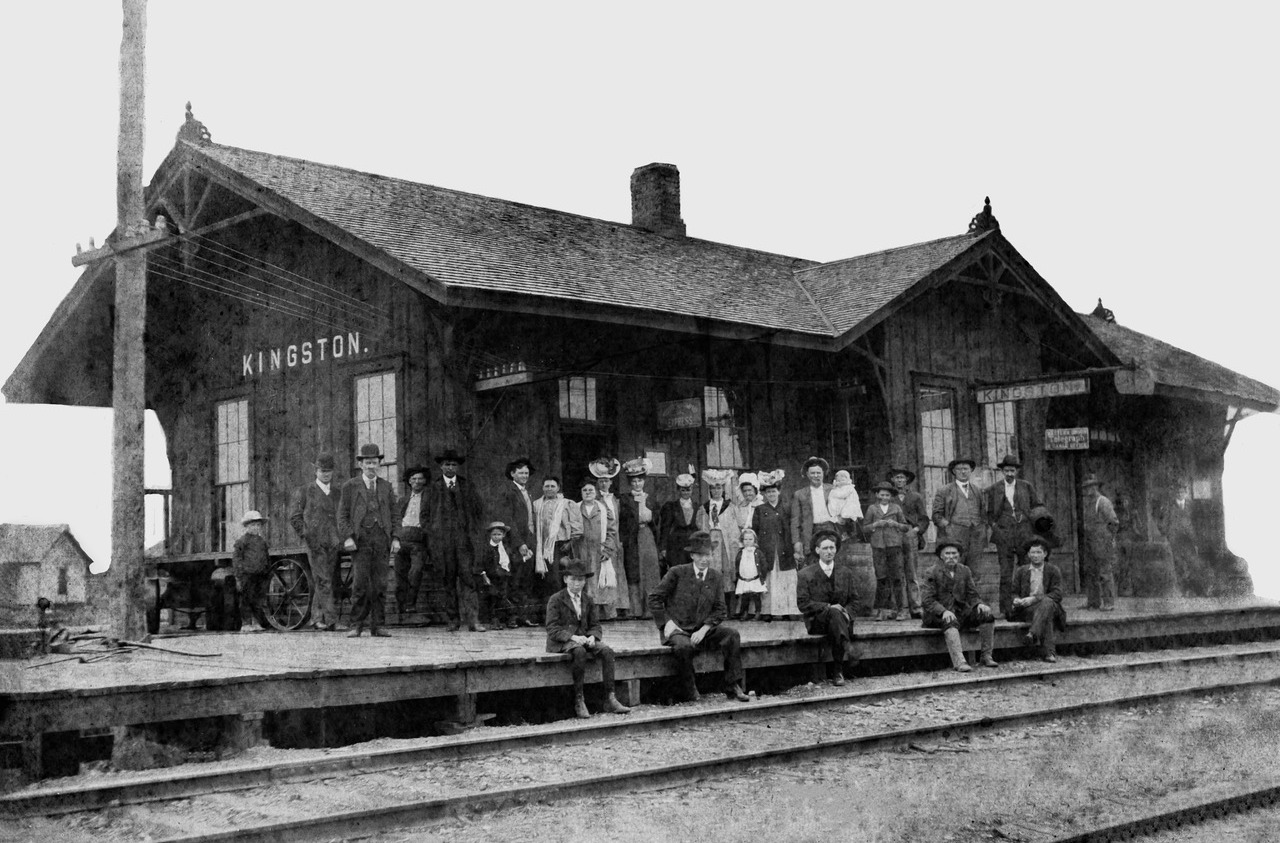
If Part II told the story of the railroad coming into Madill, then Part III must tell the sterner truth that so often followed the rails in Indian Territory. A railroad did not merely serve towns that were already there. Sometimes it made them. Sometimes it passed older places by and left them to wither in the grass. Sometimes, with no ceremony at all, it shifted the very center of life from one community to another.
That is the story south of Madill. It is the story of King’s Town, a recognized post office community, watching the future slip just beyond its reach. It is also the story of a new place—Helen—laid out on open Chickasaw land before a single rail had been spiked in that ground, born of foresight, connection, and aclearunderstandingofwhat the coming railroad would mean. J. Hamp Willis did not wait for the train to arrive. He anticipated it. Working within the unsettled legal ground of the Curtis Act era, he established a townsite where the line was expected to pass, placing his wager not on what was, but on what was coming.
When the Frisco finally drove its line south, it confirmed that judgment. The rails did not bend toward King’sTown.Theyraninstead totheplaceWillishadchosen. And there, beside newly laid steel, rose a depot first known as Helen Station—a plain frame building that wouldbecomethehingeupon which the future of an entire community would turn.
Long before the depot at Helen was raised, long before the first whistle sounded south of Madill, and long before Kingston stood where it stands today, the land itself had already traveled a hard road. What later generations would simply call Chickasaw land had not always been Chickasawland.Thecountry that would one day hold King’s Chapel, King’s Town, Helen, Kingston, Madill, and Woodville had passed through removal, treaty, negotiation, and political separation before a single rail touched it. In the early nineteenth century, the Choctaw and Chickasaw peoples still lived far to the east, in ancestral homelands that had been theirs for generations beyond memory. Then came removal.
In 1830, under the Treaty of Dancing Rabbit Creek, the Choctaw Nation ceded its easternhomelandandagreed toremovewestwardintowhat became Indian Territory. That treaty uprooted not merely households, but a civilization of churches, farms, cemeteries, schools, and family lines, carrying them into a strange country under promises that history would later show to be frail things indeed. The land that would one day become Marshall County and hold Kingston and Helen entered thatwesternChoctawdomain by force of federal policy.
The Chickasaw Nation soon followed, though not on exactly the same footing. In 1832,bytheTreatyofPontotoc Creek, the Chickasaws ceded their Mississippi homeland. Yet unlike the Choctaws, they were not at once planted upon a wholly separate western domain of their own. Instead, they were compelled to negotiate for a place in Indian Territory, and those negotiations led them into arrangements with the Choctaw Nation. Through the agreement commonly associated with Doaksville in 1837, a Chickasaw District was established within the Choctaw Nation, and the Chickasaw people began their westward removal that same year. For a time, they lived upon the western portion of Choctaw lands under that negotiated arrangement, present on the ground and exercising a degreeofself-governmentbut not yet standing upon a fully separate territorial footing.
Thattransitionalcondition lasted until June 22, 1855, when the Treaty with the Choctaw and Chickasaw formally separated the two nations, both politically and territorially. That treaty addressed the “political connection heretofore existing” between them, guaranteed the lands within the defined Choctaw and Chickasaw country to the members of the tribes “to be held in common,” and recognized rights-of-way for railroads and telegraphs through the country. Even there, long before the Frisco camesouththroughMarshall County, the legal ground had already been prepared for the coming of iron. By the mid-nineteenth century, the country that would later hold King’s Chapel and Helen had therefore passed through several legal lives: first as part of the western Choctaw lands created by removal under Dancing Rabbit Creek, then as the western portion occupied by the Chickasaws under their later arrangements, and finally as part of the distinct Chickasaw Nation after the 1855 separation treaty.
Even then, the land was not held in the way later generations came to think of land. It was not divided into private tracts marked by fences and deeds. It was held in common under tribal lawandcustom.Amanmight settle there. He might build a home, graze cattle, run a store, or raise a family. But he did not hold fee-simple title to a surveyed parcel in the later American sense. That point is essential to this story and must be kept plain: when the railroad first entered this country, the land along its route was still tribal land of the Chickasaw Nation, unallotted and held in common.
It was onto that land, communal and open and still carryingthememoryoftreaty and removal, that Jeff King came around 1890.
Little is known of Jeff King beyond the outline of what he did, but often a man’s work tells the truth where the records fall silent. He settled upon the open prairie in what was then the Chickasaw Nation at a time when the area was still largely range land, primitive and untamed, used chiefly for grazing. Great herds of cattle moved across it. There was no town there. No depot. No streets laid in measured blocks. No line of storefronts. Only grass, distance, wind, livestock, and possibility.
King began in the plain old wayfrontiermenoftenbegan. He built a home. More telling still, he began a schoolhouse. That detail matters, because a man building only for himself erects a cabin, but a manbuildingforasettlement raises a school. He called the place King’s Chapel. The name spoke not of ownership but of purpose. It impliedcommunity,worship, instruction,andpermanence. He did not claim legal title, because no such private title existed. He did something older and more elemental than that. He created a place.
But the prairie gave no warranty of tomorrow. Before the schoolhouse and other improvements could be completed, Jeff King fell ill and died. He did not live to see what he had begun come fully into being. He was buried there somewhere upon that same ground, but the exact location of his grave slipped away with time. His resting place is now known only to God.
And yet the place endured. Another man, whose name has not survived in the records, took up the cause of growing King’s Chapel after Jeff King’s death. He completed the schoolhouse and built several additional structures, both business and residential. That forgotten figure deserves a kind of quiet honor, for without him King’s effort might well have died in the grass. Instead, the settlement moved forward underthoseunnamedhands. In honor of Jeff King, the growing community became King’s Town. In time, as names are worn smooth by daily speech, that became Kingston.
By April 4, 1894, the community had taken on enough substance and permanence to receive a post office, with John F. Robinson serving as postmaster. That was no small detail. A post office was recognition. It fixed a place within the federal system. It marked a settlement as a destination, a node of communication, a place that officially existed beyond the memories of those who lived there. A general store stood there. A cotton gin. Several other businesses. The schoolhouse served also as a church, as so many early community buildings did. By every practical measure, it was a town.
ButitwasnottheKingston of today.
What many do not realize is that the Kingston of 1894 stood about two and a half miles southwest of the present-day Kingston. In 1894, nothing existed in the area of the present town but prairie and pastureland. The old town, the first Kingston, grew where Jeff King had planted the first stake at King’s Chapel. The place that nowbearsthenameKingston had not yet been born.
Into that earlier Kingston came a young man in 1897, twenty-four years old, newly married, ambitious, and unusually well placed within the social and political world of the Chickasaw Nation. His name was James Hampton Willis, better known as J. Hamp Willis. He came from the prominent Willis family of southern Pickens County. His father, Raleigh Britton Willis, was the pioneer who founded the community of Willis, Oklahoma. His wife, Emma Mildred Harris, was herself from a prominent Chickasaw family, the daughter of Robert Maxwell Harris, then Governor of the Chickasaw Nation.
Those ties mattered. They placed J. Hamp Willis near the current of information andinfluenceintheTerritory. But connection alone never built a town, and Willis did not live off family prestige alone. He opened a store in Kingston and became part of its economic life. Trade moved through his doors. He established himself among its people. About a year after their marriage and after opening his store there, he and Emma had their only child, a daughter named Helen Robenia Willis. Helen wasbornonJanuary29,1898, in that original Kingston, the old King’s Chapel / King’s Town settlement southwest of the present location.
Even as Willis was putting down roots, the larger legal and political order in Indian Territory was shifting beneath everyone’s feet. In the 1890s, the federal government, through the Dawes Commission, began dismantling the communal landholding system of the Five Civilized Tribes. The Commission’s work involved identifying tribal citizens, creating official rolls, and preparing the way for allotment, the division of tribal lands into individual holdings. It was not a mere clerical exercise. It was a transformation in the meaning of land, sovereignty, and daily life. But the process was incomplete. The old communal system still existed even as the machinery of allotment was being prepared.
Into that unsettled interval came the Curtis Act of 1898. The Act is rightly remembered as one of the great blows against tribal governmental power in Indian Territory. Yet for this story one provision matters especially: the Curtis Act authorized the creation and formal recognition of townsites on tribal land before allotment had been completed.Thatmeanttowns could be laid out on tribal land even while the land remained unallotted and not privately owned in fee by individuals.Suchplacescould be surveyed, occupied, built upon, and later formalized. The law created, in effect, a bridge between the world of common tribal landholding andthecomingworldofdeeds and allotments.
That bridge is where Helen was born.
Around1900,theSt.Louis– San Francisco Railway, the Frisco, began building its line southward through Indian Territory toward Texas. The railroad did not follow established communities out of courtesy. It moved according to grade, distance, water, and efficiency. It cut its own course. When the line was finally run through that part of the Chickasaw Nation, it bypassed Oakland and it bypassed King’s Town. That fact must be stated plainly. The two established communities in that part of the country that had been designated as post office towns were Oakland and King’s Town. They were not nameless outposts. They were recognized places, fixed in the federal system by the presence of post offices. And the railroad still passed them by.
Geography matters here. Oakland lay west of Madill. Aylesworth lay east. King’s Town, and the later Helen and Kingston, lay south of Madill, with Woodville farther south toward the Red River. Coming south, the Frisco did not turn toward Oakland, and it did not bend toward King’s Town. It ran east of Oakland and about two and a half miles northeast of old King’s Town. In that quiet decision, first laiddowninsurveysandthen fixed in steel, the future of that country shifted.
And here one correction must remain clear from start to finish: none of the land along the Frisco route at that time was privately owned by anyone other than the tribe, because no private individual ownership yet existed there. The land along the route remained tribal land of the Chickasaw Nation, held in common and unallotted. J. Hamp Willis did not buy fee title along the route in the modern sense. He could not. No such private title yet existed. Instead, acting within the legal environment created by the Curtis Act and the dawning work of the Dawes Commission, he established a community where the railroad had chosen to pass.
That distinction matters because it places Helen in its true setting. Helen was not simply the result of a man speculating in titled real estatebeforeotherssawwhat was coming. It was the result of a man understanding that the railroad had chosen a new center of gravity and then moving, lawfully and practically, to create a townsite there while the land was still tribal, unallotted, and held in common.
When word of the route reached him and when the line itself took shape, Willis sawwhatitmeant.Hemoved his store from old Kingston to thenewlineandbeganlaying out a community there. Streets were imagined before they were measured. Lots were spoken of before deeds could exist in the later sense. He established a townsite around the railroad line under the legal possibilities then available in Indian Territory. He named the place Helen, after his little daughter.
Thus, the town of Helen was born.
The station that was established at Helen was not just a small wooden structure set beside the rails as an afterthought. It was the visible sign that the railroad had made its choice. Before that moment, freight, dry goods, hardware, and livestock for the area had often been hauled by wagon from Texas points such as Denison and Pottsboro. After the station appeared at Helen, businessmen from old KingstonandfromCliffmoved toward the townsite to gain access to the railroad. That onemovementtellsthewhole tale. The depot shortened the distance. It altered supply lines. It shifted the center of commerce. It became the place where produce, cotton, livestock, groceries, newspapers, passengers, mail, rumors, and hope all met. In a country where a post office gave a place legal recognition, a depot gave it economic destiny.
In those years around 1900, the Frisco did not build its depots in isolation, nor did it rely upon whatever materials might happen to be at hand on the prairie. It built them as part of the railroad’s moving organism. Thelineadvancedsouthward in stages—grading crews first, then track gangs laying rail and ties, and behind them the rolling supply of the railroad’s own construction trains. Those trains carried not only rails and spikes, but also lumber, millwork, hardware, windows, doors, roofing, and countless other materials needed to erect the structures that would follow thetrack.Therailroaddidnot wait for towns to supply it. It supplied the towns.
Just as importantly, the Friscodidnotleavethedesign of its depots to local builders or to chance. It did not send for architects to dream up each station anew. Instead, it relied on its own engineering departments—men in the BridgeandBuildingdivisions who designed structures not for ornament, but for function,economy,andspeed. Theseengineersworkedfrom standardized plans, refined across hundreds of miles of track, creating depot designs that could be repeated, adjusted, and erected with remarkable efficiency. What emergedwasnotarchitecture in the romantic sense, but a disciplined form of industrial design—every wall, every room, every measurement governed by the needs of freight,passengers,andtime.
In a settled country, a builder might look to local timber yards or brick kilns. But in Indian Territory at the turn of the century— particularly in places like the open country south of Madill—such resources were often scarce or entirely absent. There were no large commercial lumber operations within immediate reach, nor any established supply houses capable of furnishing the standardized materialstheFriscorequired. The railroad solved that problem the only way it could: it brought its world with it. Lumber was cut and milled elsewhere—often in Arkansas, Missouri, or East Texas—andshippedinbyrail asfastasthetrackcouldcarry it. Doors and windows were pre-sized. Trim and beaded ceiling boards were milled to standard dimensions. Even nails, hinges, stovepipes, and lamp fixtures arrived by train, stacked and sorted for quick use.
Once the rails reached a designated station point, construction followed close behind with a kind of practiced urgency. Crews leveled the ground and set block or pier foundations, using local stone where it could be found and shipped materials where it could not. From there, the building rose quickly. Framing lumber— brought in on the very trains that had just opened the country—was cut and assembled on site, the walls clad in board-and-batten, the roof framed and shingled in short order. Inside, yellow pine floors were laid, beaded ceiling boards fitted, and partitions framed to divide the structure into its working parts. What emerged was not a work of ornament, but of purpose—built fast, built strong, and built to serve.
Though the prairie offered little in the way of finished materials, it still contributed its share. Local men were often hired for the work, and nearby ground supplied sand and gravel for platforms and approaches.Buttheessential substance of the depot— the lumber, the millwork, the fixtures, even its very proportions—arrived by rail. The same line that would soon carry cotton, grain, and passengers into Helen first carried in the pieces of the depot itself. In that sense, the building was both a product of the railroad and proof of its advance, set down upon the prairie almost as soon as the track reached it.
This speed and uniformity were no accident. The Frisco relied on standardized plans, refined across years of expansion, that allowed its engineers to reproduce dependable stations with remarkable efficiency. The combination depot— long, narrow, and carefully arranged—placedtheagent’s office at its center, with waiting rooms to one side and a freight room to the other, all aligned along the track. It was a design repeated from town to town, familiar to railroad men and instantly functional wherever it stood. A transferred agent stepping into a new station would find the same logic waiting for him: the office at the heart, the platform at the edge, the steady rhythm of trains governing the day. In that way, the Frisco’s depots were not individual expressions, but parts of a larger system—each one a measured response to the same demands, each one carrying the same internal order.
The Kingston depot, erected in 1900, followed that pattern closely. It was a practical frame structure set on block foundations, with six-inch walls and a modestly pitched gabled roof. Its exterior, finished in board-and-batten, spoke of durability rather than display. Inside, yellow pine floors and beaded board walls gave the rooms a clean, ordered appearance. The building was heated by stoves, lit by twelve electric lamps, and served by an outside toilet. Along its length ran a gravel platform, edged in places with timber curbing, where freight, passengers, mail sacks, and express parcels all passed through in the dailyexchangebetweentown and rail. At 74 feet 2 inches in length, it was substantial enough to handle the needs of a growing community, yet modest enough to reflect the realities of a frontier still finding its footing.
That plan reveals far more than mere dimensions—it shows the true character of the Helen depot. This was no grand station built for display, but a working Frisco combination depot, where every function of railroad life was drawn together under one roof. Passenger service, ticketing, telegraph work, segregated waiting areas, and freight handling were all arranged within a single elongated frame structure, each space defined by necessity rather than ornament. The white waiting room measured 19 feet 5 inches by 19 feet, adjoining an 11-by-23-foot office that served as the building's operational heart. Beyond it stood a separate room labeled “Negro,” measuring 10 by 19 feet, and at the far end lay the freight room—19 feet 1 inch by 30 feet 11 inches— broad and open, built to carry the real weight of the town’s commerce. Along the tracksidestretchedthegravel platform, where goods were loaded, passengers stepped aboard,andtherhythmofthe railroad met the daily life of the community.
Those room labels, plain and unadorned, fix the depot firmly in its time. The building was not only a place of movement, but a reflection of the social order that shaped it. At its center, the office housed the agent’s desk, telegraph instruments, records, and ticket window— the nerve center through which information and commerceflowed.Thefreight room, larger than any other space, makes clear what mattered most. Depots in towns like Helen were not built chiefly for travelers, but fortrade.Theyhandledsacks, crates, trunks, harness, feed, hardware, dry goods, seed, cotton samples, express shipments,andnewspapers— the entire material life of the surrounding country. The waiting rooms, divided by custom and law, tell the rest of the story. The depot was not just a gateway to the wider world, but a place where the structures of that world—economic and social alike—werelaidoutintimber and floorboards for all to see. Onecanalmostreconstruct the daily life of the place from the plan itself. On a cold morning, the stoves would already be lit. The agent would be at work in the office, where freight bills, waybills, telegraph messages, and passenger business all converged. Farmers and merchants would come to ask about shipments, outgoing freight, and the train’s expected arrival time. Cotton men would watch the platform. Travelers would gather in the waiting rooms. Wagons would back toward the freight room. Men would shoulder crates and sacks. Children would come just to watch the train arrive. News from the wider world would step off the platform in the form of letters, newspapers, strangers, and gossip. In a town like Helen, the depot was never merely a building. It was the town’s pulse.
The first business in Helen was J. Hamp Willis’s store, which had been moved from Kingston to the new townsite. That was a practical act, but symbolic too. Commerce moved first, and the future shifted with it. Soon, two more stores and two residences were moved from Kingston to Helen as if the settlement itself were physically migrating toward the station. Dr. E. F. Lewis became the first permanent settler.
AroundNovember1,1900, acollectionwastakentobuild a schoolhouse for Helen. The schoolwascompletedonApril 15, 1901. E. R. MacReedy became the first teacher and later the editor of the Helen Weekly Herald newspaper. The schoolhouse served as the place of worship for all the churches in town until 1904, when the Methodists built their own church. Two years later, a Baptist church was completed. These are not stray facts. They show how quickly the depot settlement grew beyond a siding. It became a community in the full sense of the word.
The new town drew notice. A Denison newspaper described Helen in glowing language: “Helen is 25 miles north of Denison. It has the most beautiful and healthful location on the entire Frisco railroad, and there is no more attractive township in the entire Indian Territory. It is in the centre of a large and rich belt of grazing and farminglands,andcommands a wide stretch of Territory, east and west, which yearly yields bounteous harvests of small grain, corn and cotton. Helen sits in beauty on the hills, and its citizens can see nightly the lights of Denison and Sherman, 25 and 35 miles away.” It was booster language, certainly, but it also captured a visible truth. The railroad had chosen this place, and everything around it was rising to meet that choice.
By around 1903, the first brick building in Helen had been built. It still stands today on the northwest corner of Highway 70 and Main Street. The first bank was established in 1903. In 1905, a National Bank was organized and bought out the original bank. The National Bank built the second brick building in Helen in 1905, and it still stands. These two brick buildings are the only surviving structures built in Helen itself and remain as physical witnesses to the town’s early years and to the commercial life that gathered around the depot.
Around 1905, Helen was no crude camp clustered around a siding. It had become a booming town. It had seven dry goods and grocery stores, two hardware stores, one lumber yard, two blacksmith shops, two banks, one barbershop, one livery stable, one cotton yard and elevator, two hotels, and about 800 inhabitants. It had commerce, services, lodging, a newspaper, schools, churches, and the railroad. It had nearly everything a town of that time could want.
Everything except one thing.
A post office. What Helen lacked, old Kingston still possessed.
Helen petitioned the United States Postal Service for a post office, but the request was denied because another town in Indian TerritorywasnamedHelena, and postal authorities feared confusionbetweenthenames.
Today, a distance of about two miles between the railroad town and the post office town would seem minor. In 1905, it was not. If the railroad stopped at Helen but the mail went to Kingston, then life in that country was split between two nearby points. Goods arriving by rail came to Helen.MailwenttoKingston. Wagon travel between the two was inconvenient and time-consuming.
Thus, by the middle of the first decade of the twentieth century, two nearby towns stood in an unstablerelationship.Onone hand was Helen, a bustling railroad town with banks, hotels, stores, a newspaper, a school, churches, and the tracks of the Frisco. On the other hand was old Kingston, Jeff King’s Town, which had businesses, a school, a fair number of residents, and a post office, but no railroad. Oklahoma history is full of towns that prospered or died based on whether the railroad chose them. In that age, the rails mattered almost beyond exaggeration. Townswitharailroadusually flourished. Towns without one often faded.
The solution came, but in stages.
To resolve the dilemma of a railroad in one place and a post office in another, the Kingston post office was moved to Helen. When that happened, the remaining businesses in old Kingston followed. King’s Town, Jeff King’s old settlement southwest of the present site, was all but finished. It was absorbed by Helen. In one sense, Kingston died there as a distinct geographical settlement.Butthepostoffice retained the name Kingston even after being moved to Helen. That produced a new confusion. The town was Helen. The railroad station was Helen. The post office designation was Kingston. Folks in Helen were also in Kingston. Folks from old Kingston were now in Helen. Freight shipped by rail went to Helen. Mail went to Kingston. The same place wore two names.
That two-town identity could not last.
So, in 1906, Helen petitioned the Frisco Railroad to rename the train station Kingston. The railroad agreed. Now the station was Kingston. The post office was in Kingston. But the town itself was still legally Helen. One final step remained.
On November 2 , 1906, Helen was legally incorporated as Kingston.
That was the end of Helen as a legal name, but not the end of what Helen had built. It was also the end of old King’s Town as a separate settlement, but not the end of Jeff King’s legacy. Two towns died, so to speak, and became one. The original King’s Chapel/ Kings Town settlement lost its physical primacy but gave the surviving community its name.Helenlostitsnamebut supplied the site, the depot, the railroad, the growth, and the future. The result was Kingston: the present town, standing not on the site of old Jeff King’s settlement, but on the site of railroad-era Helen.
And so, in the deepest historical sense, Kingston is Helen,andHelenisKingston.
That truth is easy to miss unless one slows down long enoughtowalktheoldground in the mind. The Kingston of today is not simply the continuation of Jeff King’s first settlement, nor is it merely a railroad town conjured from nothing by J. Hamp Willis. It is the child of both places. It was born out of the foothold at King’s Chapel, carried forward by an unknown man who finished the work Jeff King began, strengthened by the designation of King’s Town as a post office community, reshaped by the arrival of J. Hamp Willis, redirected by the Curtis Act and the Dawes-era townsite system, and finally fixed in place by the railroad’s decision to bypass Oakland and King’s Town and stop instead on unallotted Chickasaw land two and a half miles to the northeast.
J. Hamp Willis’s life continued well beyond Helen's founding. A few years later, he became a mining inspector for the Chickasaw Nation, a position he held for eighteen years. After that service, he returned to his home in Kingston and operated a grain business until his death in 1940. The last eleven years of his life, he ran that business from his bed, stricken by an illness that left him paralyzed. His widow, Emma, lived until 1965. Both are buried in the Kingston Cemetery. Their daughterHelen,whosename had once been given to a town, married Royal Palmer Lewis. They later moved to Oklahoma City, where she lived until her death in 1977. She and Royal are buried in Maysville in Garvin County, and they had two children.
As for Jeff King, the first man whose effort set the storyinmotion,hisbiography remains sparse and his grave unmarked. Yet his name endured, and that too is a kind of monument. He came to the open prairie, built a home and a schoolhouse, and called the place King’s Chapel. He died before the work was finished, but the place did not die with him. Another man carried it forward. A post office fixed it in the federal system. King’s Town became a recognized place—real, settled, and known.
What followed, however, marked a turning that was not the same as what had happened at Madill.
At Madill, the railroad named the place and, in naming it, set the chain in motionthatbroughtthetown into being. There, the iron road came first, and the town gathered itself around it.
South of Madill, the order was different.
Helen did not spring fully formed from the railroad’s hand. It existed—if only just—before the rails arrived. J. Hamp Willis, standing close enough to the current of informationtosensewhatwas coming, did not wait for the train. He moved ahead of it. With just enough knowledge of the surveyed line, he chose his ground on unallotted Chickasawlandandlaidouta settlement where he believed the railroad would pass. He named it Helen, after his daughter. It was not yet a railroad town. It was a wager.
When the Frisco finally camethrough,itdidnotcreate Helen—but it confirmed it. At the same time, it passed King’s Town by. And in that quiet decision, everything changed. The center shifted. The life that had gathered at King’s Chapel and King’s Town began to move. The post office followed. The businesses followed. The people followed. The station rose.Thenamechanged.And in time, two places became one.
That is why the depot must stand at the center of this story—not as a creator in every sense, but as the final authority. The railroad did not create the land. It did not create the treaties that made the land Chickasaw land. It did not create Jeff King’s first settlement. And in Helen’s case, it did not even create the first outline of the town itself. But it chose where the future would gather, and in that choice it rendered its judgment.
The depot fixed that judgment in timber, boardand- battenwalls,yellow-pine floors, waiting rooms, office space, freight room, platform, stove heat, and lamplight. Around it came the stores, the churches, the banks, the hotels, the school, the newspaper, the post office, and finally the very name Kingston.
In Madill, the Frisco announced itself.
South of Madill, at Helen, it decided.
It showed that a depot was not merely a convenience for a town already formed. In Indian Territory, a depot could be confirmation or denial. It could lift one place into the current of the future and leave another standing just beyond it. It could shift a post office, draw businesses across the prairie, and force law, custom, and local identity to rearrangethemselvesaround a platform and a timetable.
The sound did not come first here.
The town did. Then the rails. Then the station. Andonlyafterwarddidthe law, the mail, and the name settle themselves around what the railroad had finally confirmed.
And the line did not end there.
In Part IV, the rails will carryusfarthersouth,beyond Kingston, to the next stop on the line—Woodville—where the same iron judgment would again meet a different