
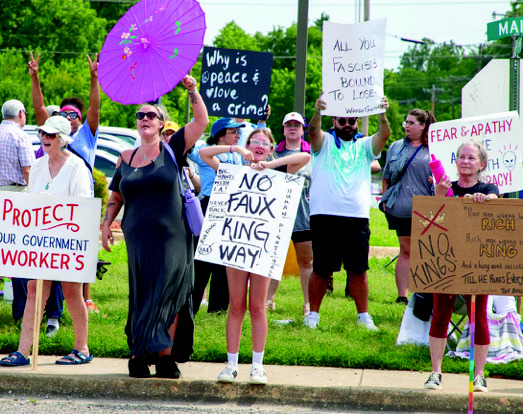
In big cities and smaller towns all across Oklahoma, the “No Kings” protests unfolded as a powerful display of grassroots democracy. Drawing inspiration from a nationwide day of resistance, local demonstrations - held in alignment with the U.S. Army’s 250th-anniversary parade in Washington, D.C. -wereunmistakablypeaceful and focused firmly on democratic values.
In Oklahoma City, hundreds, possibly over a thousand, converged at Scissortail Park before marching to City Hall Park. Organized by Indivisible Oklahoma and 50501 OK, the rally emphasized nonviolence and unity. Public Safety Commissioner Tim Tipton reinforced this, stating law enforcement would curb any instigators but would protect the constitutional right to protest. Notably, Jonathan Van Ness of Queer Eye joined the crowd, describing in social media posts a “peaceful protest and thousands came out” in Oklahoma City.
Even though Marshall County did not have any protests, Bryan County had one in Durant. Many Durant residents held their protest on Main Street and 12th Avenue.
Jane Hicks, co-organizer oftheDurantprotest,saidthe protests weren't to promote hate, but to promote unity.
“Ithinkthatitdoesn’tmatter if you’re a Republican or Democrat, you’re American,” Hicks said in an interview with the Durant Democrat. “We’re here because we love America.Wewanttokeepthe Constitution. We don’t want to be forced into anybody telling uswhattodoandwethink a lot of people feel that way.”
NicoleMillerwasstanding on the opposite side of the street, and said she was there to spread the word of Jesus.
' “Because this world is full of hate and the world needs Jesus,” Miller said. “I’ll stand alone to let everybody know that he is the only king. He’s king of all kings.
Tulsa hosted three major gatherings, at 71st and Memorial, 41st and Yale and downtown. Despite rainy weather, hundreds rallied with signs denouncing ICE and Trump-era authoritarianism. Though a small number ofcounter-protesterswith Trump flags and firearms were present, there were no violent confrontations. Tulsa policemaintainedapresence, and the protests remained orderly.
The “No Kings” protests, part of the broader 50501 movement, opposed what participants viewed as growing authoritarianism, from large-scale deportations to federal militarization. Oklahoma activists rallied behind messages such as “Hands Off Social Security,” “No Kings” and “Protect the Constitution,” aligning with nationwide themes that included immigrant and civil rights, government overreach and military spectacle.
Unlike the tragic shooting of a demonstrator in Utah, which was a notable exception, Oklahoma’s protests were free of violence or arrests. Lawenforcement,organizers and participants alike emphasized nonviolence, the norm across roughly 2,000 events nationwide. June 14 marked the largest singleday rally in U.S. history, with over five million Americans across 2,000+ sites calling out perceived authoritarian impulses in the Trump administration.
Inspired by the 50501 slogan, “50 protests, 50 states, one movement”, demonstrators opposed the overlap of Trump’s 79th birthday and the military parade, which critics argued resembled monarchical pageantry. Oklahoma’s No Kings events were consistently peaceful, coordinatedwithlawenforcement and free from major disturbances.
The presence of police officials like Commissioner Tipton and Tulsa officers suggest authorities anticipated potential unrest, but the protests stayed resolutely nonviolent. The rallies opposed the conflation of presidential powerwithmilitaryspectacle and monarchic hallmarks, calling attention to immigration policies, ICE actions and threats to democratic institutions, and reinforcing democracy through peaceful, organized grassroots action. These gatherings in Oklahoma echoed a nationwide civic surge, and demonstrated that, even here, across conservative landscapes, Americans remain committed to democratic values and willing to defend them through principled nonviolence.