
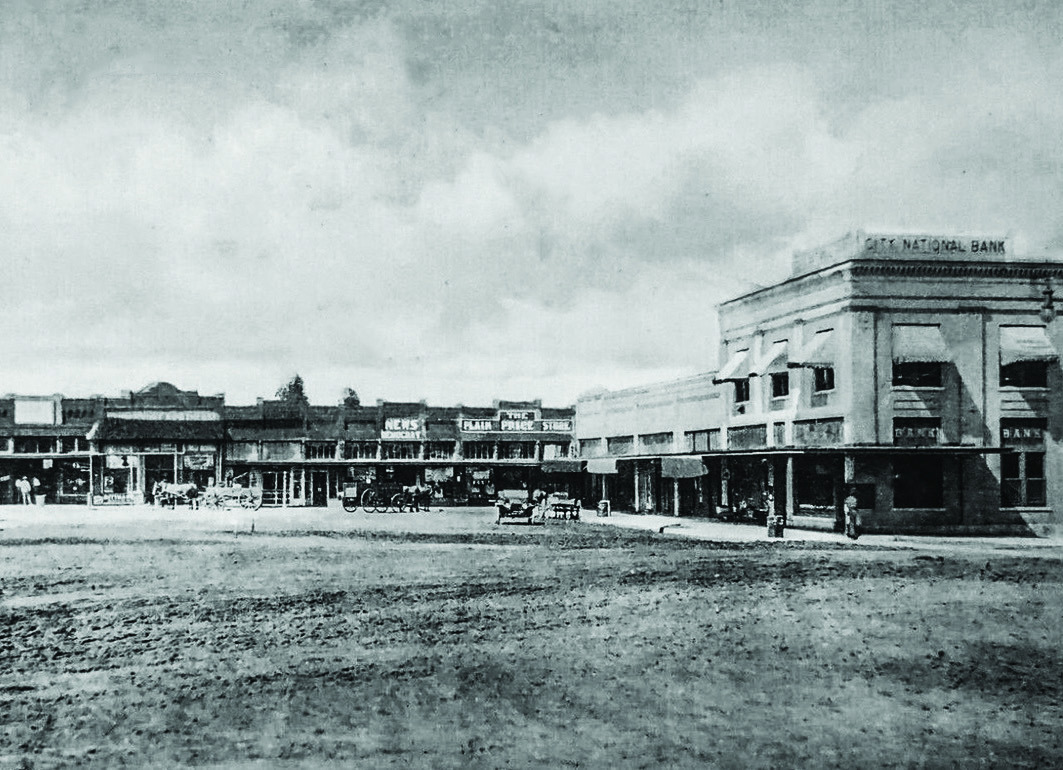
On the northwest corner of Main and the Square sits what we now know as the Madill Professional Building. Next to the Courthouse, it may be the most beautiful of all the remaining historic buildings of the downtown/ square portion of Madill. The building is one of six Marshall County locations listed on the National Register of Historic Places. The other five are James H. Bounds Barn, Haley’s Point Archaeological Site, the Marshall County Courthouse, the Madill Post Office and the Oakland School.
Interestingly, her history has been clouded with misinformation and incorrect reporting. And sadly, that misinformation is even present in the federal and state historic preservation documentation.
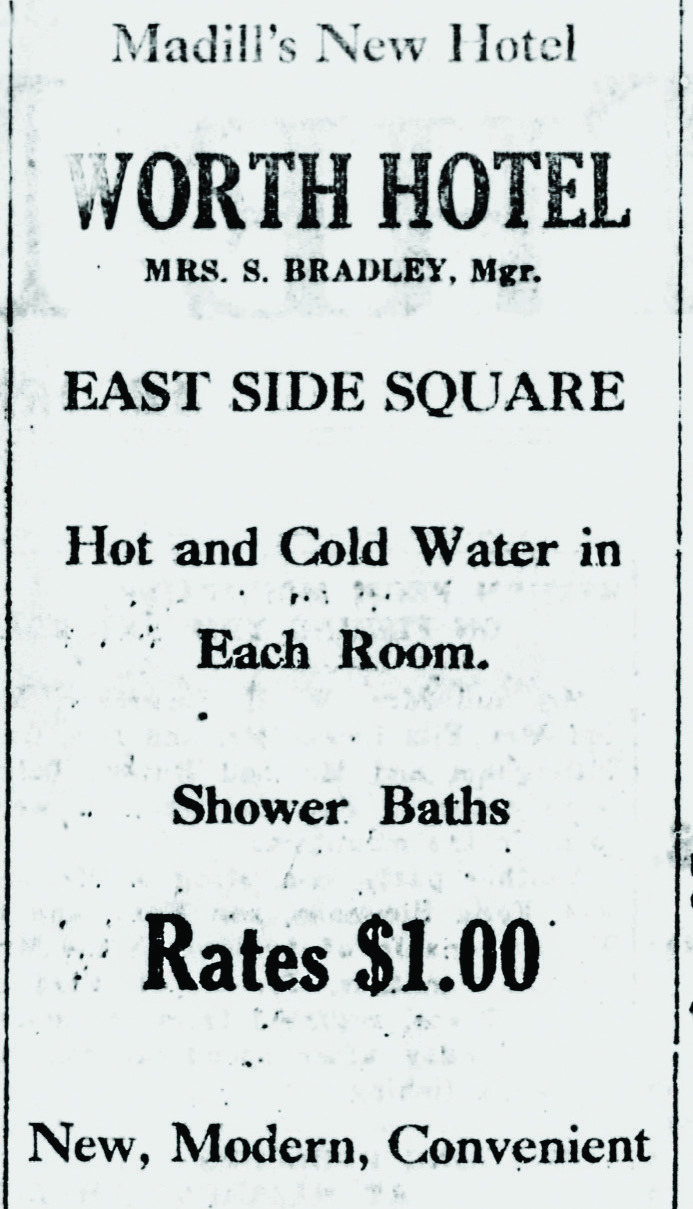
In 1985, the building was listed on the National Register following an application by the Department of Geography at Oklahoma State University and the State Historic Preservation office. The application for listing on the National Register was supported by a discussion of the building’s history. The source of the historical information contained in the application was listed as a “personal interview with Charles Sullivan in 1984” and a book by Ettie Gibson Willis, A History of Marshall County, 1938. These sources alleged that the building was built in 1914 as the Worth Hotel. In the early days of Madill, there was a hotel called the Worth Hotel, but it was not located on the square. That Worth Hotel was a smaller, two-story wooden structure. Besides a photo, there is little to no information about that hotel.
The National Register of Historic Places application contains the following alleged historical account.
“The Worth Hotel is both historically and architecturally significant because it is the oldest oil boom era hotel which remains in original condition in Madill, Oklahoma and it is the only remaining example of Plains Commercial architecture in Madill, Oklahoma.
“Constructed in 1914, one year after the Healdton/ Hewitt oil field was opened, the Worth Hotel was one of the first permanent lodging facilities to be built in Madill as a result of the boom period. Established in 1901, the town of Madill experienced a period of rapid growth when the Healdton/Hewitt oil field came into its own as a major oil field. Lodging facilities, no matter how meager, were always in short supply and the early 'boom chasers' pitched tents, camped on the ground, or secured lodging in local farm homes. Hastily erected housing, such as shotguns, followed the 'tent city' stage. As the commercial and social environment of oil boom communities stabilized, more permanent structures were necessary in order to accommodate oil field businessmen who migrated in and out of the fields to transact business concerning sale of lease sites, production and marketing of petroleum, and transportation of crude oil and gas to distant refineries.”
“LocatedonMainStreetin the central business district of Madill, the Worth Hotel fulfilled this important commercial function from 1914 to 1930 when the Healdton/ Hewitt field began to decline. It continued to serve the community as a hotel until 1975 when the Deltec Corporation purchased the building and converted it into an office building known as the Plaza Professional Building.”
“The nominated property represents the only remaining example of Plains Commercial architecture in Madill, Oklahoma. The two-story structure embodies several of the features which preceded the Chicago School of taller buildings. Typical of small-town Great Plains commercial buildings which evolved during the late nineteenth and early twentieth century, the Worth Hotel is rectangular shaped with a flat roof and modestly decorated terminating cornice. For an oil boom era commercial building, ornamentation is unusually intricate and elaborate. The brickwork frieze features extensive corbels, miniature dentils, and diamond-shaped elements. Furthermore, the walls on two sides are highlighted by pilaster strips topped by masonry capitals. Set below the capitals are ornately designed inverted cross elements.”
“Although several hotels were constructed in Madill during the oil boom period from 1913 to 1930, the majority werewoodframeandhave either been destroyed by oil field fires or razed. One other oil boom era hotel still stands in the town, however, it has been significantly altered to accommodate a peanut shelling business.PlainsCommercial architecture is common in the small towns of south central Oklahoma, however, few have the ornately designed brickwork that the Worth Hotel possesses nor have they Remained intact.”
“The Worth Hotel has continuously served the commercial needs of Madill, Oklahoma for 70 years and during that time period has had minimal alterations thereby retaining its Plains Commercial architectural integrity.”
While the narrative in the application is a nice read, it is wrong.
First, the building was not built in 1914, as alleged in the application. It was built in 1911. While not a major error, this does mean the building is older than thought. However, the biggest error is that the building was not built as a hotel. Ross and Tom Hollingsworth, the men who commissioned the building, built it not as a hotel but as an office building, they named the Hollingsworth Building.
The Hollingsworth Brothers came to Madill in 1901 when the town was newly formed and had a population of only 300 souls. In 1901, they opened a grocery store onthenorthwestcornerofthe square, which they ran until 1907.Then,in1907,TomHollingsworth became the Head Cashier of the City National Bank of Madill, which had recently been chartered, and he left the hardware store.
In early 1911, the Hollingsworth brothers began plans to build a new building on the square's northwest corner. From 1901 to about 1910, that corner was occupied by a wood frame structure that housed various drug or merchandise stores for the first nine years of Madill’s existence. By 1911, the entire east side of the square's northwestcornerwasvacant.
Construction on the Hollingsworth Building began in late February, and by the second week of March, the foundation was being laid. By April, the superstructure wascompleted,andthebrickwork began. By mid-May, the brickwork was nearing completion and work had commenced on four small buildings on the east side of the Hollingsworth Building. By August 1, 1911, the building was completed and ready for occupancy.
The Hollingsworth Building was the first brick structure on the east side of the northeast corner of Market Square. At that time, the Courthouse had not yet been constructed and the area where the courthouse now stands served as a public market and was an open lot with grass, trees and two city water wells.
As soon as the building was complete, the Hollingsworth Brothers hosted a “ball” for the young people of Madill. They arranged for the Sherman Orchestra from Sherman, Texas, to provide the music. A Marshall CountyNews-Democrat report stated that “pretty and prettily dressed ladies and handsome young men made the event one that will long stand out in the memory of those attending. The young people attending were a “who’s who” of Madill’s most well-known citizens.
Doctors Bray and Robinson moved their offices to the second floor of the building in the first week of August. Also moving to the building were Attorneys A.W. Rison and O.P. Jones. The real estate firm of Haddock & Lewis also moved to the offices on the second floor.
Then, in mid-August, the building became home to the City National Bank of Madill and the McLelland-Hollingsworth Hardware Company.
After the completion of the Hollingsworth Building, four more brick buildings were built to the north, completing that portion of the NE corner of the square. Those buildings were owned by the Hollingsworth brothers, Ms. W.T. Berry, Judge J. W. Falkner and the Vandervort Brothers. The Vandervorts opened a store in their space. Then, in 1913, the Madill Times newspaper moved to the first building due east of the Hollingsworth Building.
The City National Bank operated in the building from 1911 to 1917, when its name was changed to Guaranty State Bank. Guaranty State Bank operated in the same space until October 10, 1927, when it failed and closed.
In 1922, Tom Hollingsworth died of a heart attack. After Tom's death, his brother Ross continued operating the building and the Hollingsworth Brothers hardware store.
In May 1928, Ross Hollingsworth converted the upper floor of the building to the Hotel Hollingsworth. An article from the Madill Record stated, 'The Hotel Hollingsworth under the management of Mrs. Sudie Bradley will be thrown open to the public.” The article also stated that “the new Madill hotel will occupy the entire upper floor of the Hollingsworth building, known as the old Guaranty State Bank building.” “Carpenters and painters have been busy forsometimechangingtheoffice building into a hotel. The owner, Ross Hollingsworth, has added modern hotel fixtures, placing carpets and the usual hotel furniture in each room.” Finally, the article stated, 'A ladies rest room will be provided on the upper floor while a downstairs lobby may be established with the occupancy of the quarters formerly occupied by the defunct Guaranty State Bank.” Thehotelhad15guestrooms.
The lobby was not added then as all the first-floor spaces were rented out to other business concerns. Earl Ayres operated his real estate business in one of the spaces, Ollie Beard operated his Guaranty Abstract Company in another, and Charlie Williams ran a Traveler’s Insurance Company office in another. Also, the Culbertson Brothers Gas Company located their office in the space that had formerly been the bank offices.
Before the hotel opened, its name was changed to the Worth Hotel. Then, in January 1929, Sudie Bradley retired, and Mrs. Florence Clark, Sam Hollingsworth's sister-in-law,becamethenew manager of the Worth Hotel.
One of the more interesting businesses to open in the building was a bowling alley. Willard Payne from Coalgate opened it in January 1931 withequipmentfromanalley in Atoka. The bowling alley was on the north side of the first floor next to the old bank headquarters. Sadly, the bowling alley did not last long and was moved to a different location.
Finally, in August 1932, the Beard abstract company, Ayres Real Estate and Traveler’s Insurance, moved to the building adjoining Watt’s Funeral Home. This move was precipitated by Hollingsworth’s desire to remodel the first floor to add a nice hotel lobby.
The hotel lobby was completed in September 1932 and placed in the former bank office. A stairway was also added on the east side of the lobby, providing a second means of access to the secondfloor hotel. The original stairway was located on the west front of the building. Also added in the lobby was the Beam-ThompsonDrugStore. The drugstore included a soda fountain, bottled soft drinks, ice cream, cigars, magazines and a complete line of packaged drugs. The north and east sections of the first floor of the building continued to house offices. Over the years, those offices housed a dentist, a shoe shop, a dress shop and more.
Sadly, in October 1932, Ross Hollingsworth passed unexpectedly. His death was a shock to the community and a major loss for Madill. Ross and Tom were both active members of the Madill Church of Christ and at the time of his death, Ross was serving on the Madill School Board.
Following Ross's death, the family sold the building to Mr. and Mrs. J. H. Kelly of Madill. The Kellys then operated the hotel from 1933 until 1946, when they sold the building and hotel to Mr. and Mrs. Bennett from Wagoner, Oklahoma. Upon their purchase, minor remodeling was done. The Bennetts had been involved in the oil and gas business in Wagoner but retired to Madill.Despitepromisesthat no rooms would be converted to apartments, within a short time, two or three rooms had been rented out long-term to oil company employees. But within months, the Bennetts put the hotel up for sale, running adsintheMadillRecord.
In June 1947, the building was sold to Jim Dowdy who also had recently purchased a large brick building on the south side of the square. The Madill Record quoted Mr. Dowdy saying, “I bought these buildings because I felt they were a good investment. I have confidence in the future of Madill and realize that it is going to grow and develop. I don’t believe a better, safer place could be found for an investment.”
Shortly after purchasing the building, Jim Dowdy closed the hotel for a major remodel. The building was completely rewired, and new plumbing was installed throughout. Tile floors were laid, soundproofing was added to the walls, all windows were restored, weather stripping was added, and Venetian blinds were put in every room. All the bedrooms received new furniture with Beautyrest mattresses and box springs, and ranch-style furniture. But the biggest upgrade was the addition of a private bath in each guestroom. Some rooms had showers and other bathtubs. Dowdy also contemplated adding a third floor to the building and installing elevator service. However, this never occurred. However, he would eventually add airconditioning to the building. In all, Dowdy spent over $10,000 for the remodel.
The hotel finally reopened in October 1949. At the time of reopening, Dowdy had also installedalargeneon“Dowdy Hotel” sign at the top of the building and smaller neon signs at the south and west entrances.
In 1963, Dowdy opened the James C. Dowdy Furniture Store. The store sold a complete line of furniture, household furnishings and appliances. It was located on the north half and most of the east portion of the first floor. That space had originally housed the Hollingsworth HardwareStorebuthadbeen used as a furniture store for many years. In 1917, the Hollingsworth brothers added furniture to their hardware business, and over time, the furniture store became more profitable and became a major part of the business. Dowdy also sold Motorola televisions, radios and stereo hi-fi sets. He also sold Kelvinator appliances, including refrigerators, freezers, washers and dryers. Eventually, Dowdy added RCA Electronics and other major appliance brands. The entire front of the building was remodeled toaccommodatehisfurniture store, and new fixtures were installed.
The building continued to be operated as a hotel until 1975 when it was purchased by the Deltec Corporation and turned into the office building we see today.
While the building did not begin life as a hotel, as has been believed for decades, it was, as it is now, a professional building. So, it is fitting that today, the building exists as an office building, just as Tom and Ross Hollingsworth originally intended.
This coming August, the building will celebrate its 113th birthday. It is a building that should be honored and appreciated by the peopleofMadillandMarshall County. May it continue serving the people of Madill for another 113 years.
Courtesy photo