
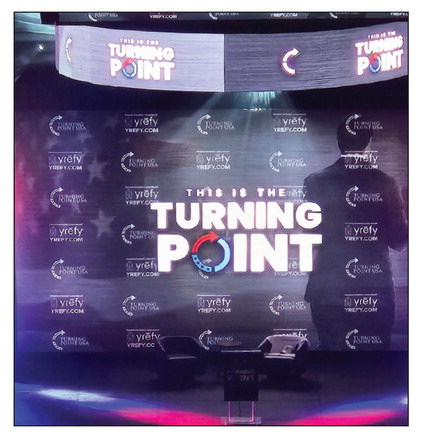
On the evening of October 16, the Turning Point USA tour stop on the OU campus drew a large crowd to the university's venue (the event had apparently been moved into the larger Lloyd Noble Center to accommodate the turnout). The purpose of the event was in part to carry forward the legacy of the organization’s founder, Charlie Kirk,whowasfatally shot earlier this year; the promotional materials for the tour describe it as “a chance to honor Charlie’s mission and keep the fight alive.”
The featured speakers included Kevin Stitt, governor of Oklahoma; Savannah Chrisley, a realitytelevision personality; and Russell Brand, an English comedian and actor. Governor Stitt opened the event by reflecting on the conservative movement’s challenge and framing the moment as one of moral urgency.
He spoke directly about the shooting death of Kirk, invoking the event as a rallying point for free-speech advocacy and for conservative youthactivism.Heended his prepared remarks with a prayer, asking for “boldness to face the enemy,” using explicitly spiritual language to frame the cause in existential terms.
After Stitt’s address, Brand took the stage. Brand, known for his comedic work and earlier controversies, spoke about his personal spiritual journey, linking it to questions of meaning, personal responsibility and what he termed the “crisis of identity” facing younger generations.
He also took audience questions, an unscripted portion of the program, during which he was asked about his trial in the U.K. (scheduled for next year) on rape and sexual-assault allegations. Though the event organizers did not emphasize this topic, Brand addressed it obliquely, acknowledging the scrutiny in his life and framing his current work as a form of redemption.
Security at the event was heightened, but no major incidents were reported. Chrisley’s appearance added a different tone: drawing from her background in reality television and her public faith, she spoke about the role of young women in public life, the importance of authenticity and rejecting what she described as “cultural cynicism.” Her remarks were less overtly policy-oriented than Stitt’s or Brand’s, but she connected to the audience of college students by speaking about social-media pressures, mental health and the need for purpose.
The event organizers presented her as a “celebrity influencer” aimedatexpanding the tour’s appeal beyond pure politics. While Chrisley’s speech was relatively short, it appeared to resonate with attendees seeking more than political talk, some commented that the emotional tone of her remarks “softened” the harder edges of the rest of the program.
Following the formal speeches, the program included a question-and-answer session, where students and other attendees asked questionsrangingfrom“what do you see as the biggest threat to free speech on campus?” to “how should young conservatives engage given the cultural climate today?”
The answers varied: Stitt focused on policy, Brand on personal transformation and spiritual life and Chrisley on cultural and media engagement. In terms of logistics, the shift to the Lloyd Noble Center came after reports that the original venue (the smaller McCasland Field House) would not suffice.
Eventsignageemphasized “FREE SPEECH IS ONLY FREE IF WE USE OUR VOICES.” Estimates of attendance were not published by the organizers, but local reporting described a “large crowd” and said security and logistical arrangements were tight.
While the event proceeded without major disruption, it took place in a charged political climate. The recent death of Kirk had placed the organization’s tour in the spotlight,andtheappearance of Brand (with pending legal issues) and Chrisley (with popular culture credentials) seemed designed to broaden the tour’s reach beyond traditional campusconservative audiences.
Local commentary noted that the combination of a state governor with popculture figures underscored the hybrid strategy of the group mixing politics, celebrity, faithandyouthactivism. The event at the University of Oklahoma represented more than a campus speech: it was a deliberate effort by Turning Point USA to re-energize its mission in the wake of its founder’s death, to engage a younger generation through