
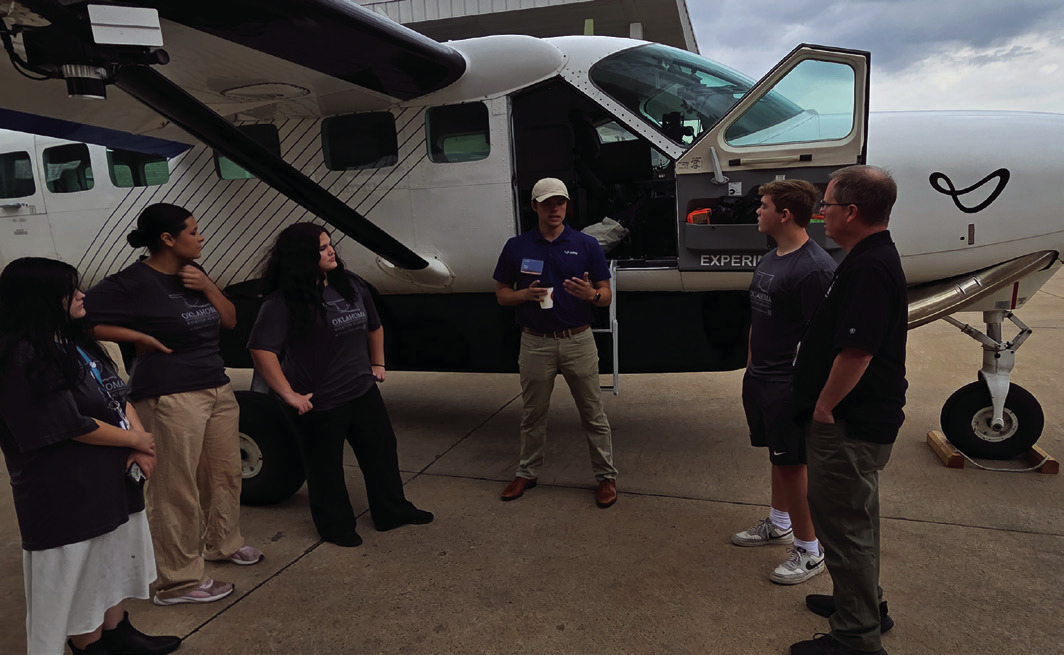
The future of aviation quietly taxied down a runway Tuesday, Sept. 29, as aviation students, industry representatives and Oklahoma lawmakers gathered at an AAR Corporation hangar to watch a Joby Aviation aircraft demonstrate technology that could change the way people and cargo move through the skies.
The aircraft, a modified Cessna Caravan known as the J208, was in Oklahoma City as part of Joby Aviation’s coast-to-coast tour, showcasing autonomous flight capabilities and exploring how the technology could eventually operate within the nation’s existing airspace. Following a small pre-flight press conference, the aircraft taxied from the AAR hangar toward the runway.
Moments later, it lifted into the sky and headed toward its next destination, leaving those gathered with a firsthand look at aviation technology that is moving fromexperimentationtoward real-world applications. As the aircraft disappeared toward the horizon, the moment seemed to capture the distance autonomous aviation is beginning to cover, “You're on the other side, as the skyline splits in two / Miles away from seeing you.”
Before the flight, Greg Bowles, chief policy officer for Joby Aviation, joined Dr. Katrina Ayers, Rep. Emily Gise and Sen. Paul Rosino for a discussion about the aircraft,autonomousaviation andthefutureofadvancedair mobility. Rosino emphasized that autonomous aircraft representawaveofthefuture and said education will be imperative if Oklahoma and the nation are going to stay ahead of the trend.
For the aviation students watching from the hangar, the demonstration provided an opportunity to see the future operating in real time rather than simply reading about autonomous systems in a classroom. The visit also highlighted Oklahoma's growing role in the development and testing of advanced aviation technologies.
Oklahoma is participating in the Federal Aviation Administration's eVTOL Integration Pilot Program, an initiative designed to bring government agencies, aviation companies and other partners together to determine how electric vertical takeoff and landing aircraft and other advanced air mobility systems can be safely integrated into the nation's airspace.
The program is intended to give regulators and industry an opportunity to work through the practical challenges associated with the emerging technology, including safety, airspace integration, infrastructure, training and operations. The acronym eVTOL refers to electric vertical takeoff and landing aircraft, a category of aircraft expected to play a significant role in the emerging advanced air mobility industry.
Joby is perhaps best known for developing electric air taxis, but the aircraft demonstrated Tuesday represented another piece ofthecompany'sautonomous aviation work. The J208 is based on an existing Cessna Caravan airframe that has been equipped with Joby's autonomous flight technology.
The aircraft is capable of performing flight operations without a pilot physically sitting in the cockpit, while remaining under human supervision. That distinction is important as aviation officials consider how autonomous aircraft will interact with traditional airplanes and the existing air traffic control system.
The goal is not simply to demonstrate that an aircraft can fly itself. The larger challenge is determining how autonomous aircraft can safely become part of an airspace system that currently depends heavily on pilots, air traffic controllers and established procedures.
Oklahoma City provides a particularly appropriate setting for that conversation. The city is home to a large aviation and aerospace community, including the FAA's Mike Monroney AeronauticalCenter,making the state a natural location for discussions about the future of aviation.
For students considering careersinaviation,Tuesday's demonstration also offered a glimpse at how dramatically the industry could change during their professional lives. The next generation of aviation workers may not only fly aircraft.
They could monitor autonomous fleets, manage advanced air mobility n e tworks, mai n tain increasingly sophisticated systems or develop the software and technology that allowsaircrafttooperatewith less direct human control. That makes education a central component of the transition.
As Rosino noted, staying ahead of the technology will require preparing students before the technology becomes commonplace. The eVTOL Integration Pilot Program is intended to help bridge that gap between emerging technology and everydayaviationbyallowing government and industry to learn through actual operations.
Joby's coast-to-coast tour is part of that broader effort to demonstrate what autonomous aircraft can do and generate experience that could help shape future regulations and operating procedures. On Tuesday, the lesson was visible from the runway.
An aircraft that traditionally would have required a pilot in the cockpit taxied into position, accelerated down the runway and climbed into the Oklahoma sky under autonomous control. For the students and aviation professionalswatching,itwas more than a demonstration flight. It was a glimpse at an industry already beginning to change, and a reminder that the aviation careers of tomorrow may look very different from those of today.