
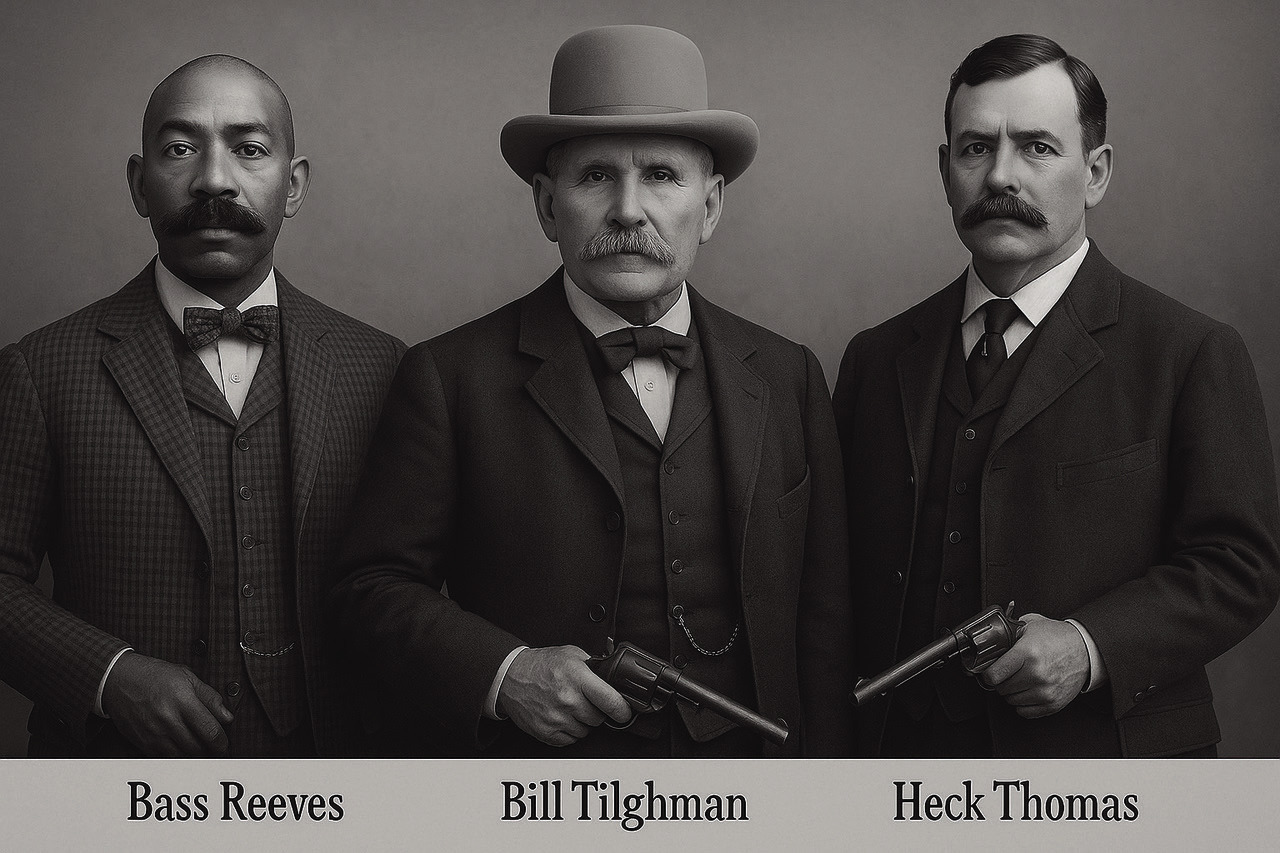
The Enforcers of the Frontier: Deputy U.S. Marshals in Indian TerritoryThe frontier of Indian Territory was more than a lawless noman’s- land—it was a vast, dangerous proving ground for the toughest lawmen in American history. None faced greater odds than the Deputy U.S. Marshals who served under Judge Isaac Parker from the Fort Smith federal court. Their jurisdiction covered nearly 35,000 square miles of Indian Territory, an area characterized by dense forests, mountain hideouts, and communities out of reach of most federal authority. Here, where outlaws fled and justice often rode alone, a few men stood as the only barrier between civilization and chaos. They were not perfect, and many would fall in the line of duty, yet their names endure. The most famous of these Marshals wereBassReeves,Heck Thomas, and Bill Tilghman. Each of these men became a legend, and one met his end at the hands of a Marshall County man.
Deputy U.S. Marshal Bass Reeves (1838–1910) In the turbulent crucible of 19th-centuryAmerica,where slavery, Civil War, and westward expansion collided in a blaze of violence and transformation, few men emerged with as much grit, resilience, and moral clarity as Deputy U.S. Marshal Bass Reeves. Born into bondage in the shadow of Arkansas’s Ozark foothills, Reeves would rise, through sheer will, uncanny intelligence, and unrelenting integrity, to become one of the greatest lawmen the American frontier ever produced.
He was born in July 1838 in Crawford County, Arkansas, into slavery. His owner was William Steele Reeves, a prominent Arkansas planter who would later relocate his family and their enslaved laborers, includingyoungBass, to Lamar and Grayson counties in Texas. At the time, Texas had recently been annexed to the Union and was seething with unrest. As the Reeves family traveled west, theyfollowedtheruggedpath of Trammel’s Trace, a trail worn into the soil by Spanish explorers and traders. Young Bass, then just eight years old, reportedly walked barefoot alongside the wagon caravan as it crossed the Red River, staying carefully clear of Indian Territory, then viewed as a lawless sanctuary for outcasts, fugitives, anddisplacedNativenations.
On the Reeves plantation in Texas, Bass labored with livestock and supplied water to field hands. His mother, Paralee, a woman of deep strength and quiet concern, worried about her son’s sharp wit and defiant spirit. She knew the dangers of a young Black boy who could not be broken. Bass amused himself by listening to old tales, memorizing songs, and watching the world with eyes that missed nothing. It was a mind that would one day hold hundreds of fugitives’ names, descriptions, and crimes, down to the last scar or twitch, without once needing pen or paper.
Bass was forced to accompany George Reeves, son of William Reeves and a Confederate officer, into battle as his personal valet. Colonel George R. Reeves would later become the speaker of the House in the Texas legislature. Somewhere during the war, whether over a card game or as part of a larger act of rebellion, Bass escaped. Family stories suggest the two fought during a heated gambling dispute, and Bass fled across the Red River into Indian Territory, where the lawsoftheUnitedStatesheld little sway and the future remained unwritten.
In the wild tangle of Indian Territory, Bass Reeves found refuge—and purpose. He is believed to have allied himself with the Union-sympathizing Cherokee Nation and possibly served with one of the Indian Home Guard Regiments. He became intimately familiar with the Muscogee language, Creek customs, and the lands of the Choctaw and Seminole nations. It was there, amid the trails and tribal strongholds, that Reeves built the foundation for his later success. He would say later that he knew Indian Territory “like a cook knows her kitchen.”
After emancipation, Bass settled near Van Buren, Arkansas. Hemarriedawoman of mixed heritage named Jennie and raised a large family. He made his living as a farmer but also earned extra income guiding U.S. marshals through the Indian Territory. His encyclopedic knowledge of the landscape, customs, and hiding places made him an invaluable scout. In time, he was noticed by the men who mattered.
In 1875, when the infamous Judge Isaac C. Parker— the “Hanging Judge”— was appointed to the federal court in Fort Smith, Arkansas, he ordered U.S. Marshal James Fagan to hire 200 deputy marshals to bring order to his jurisdiction. Judge Parker's jurisdiction encompassed a vast area, including all of Indian Territory and eleven western counties of Arkansas. This area was roughly 74,000 square miles. Among the first selected was Bass Reeves. With that, a new chapter in American law enforcement began.
Reevesisbelievedtobeone of the first African Americans commissioned as a deputy U.S. marshal west of the Mississippi River. He was 6 feet 2 inches tall, weighed 180 pounds, and carried himself with a dignity that defied the social norms of the time. He rode strong horses, wore a long coat that flowed behind him on the trail, and carried a Colt revolver on each hip—ambidextrous and deadly accurate with either hand. Reeves never learned to read or write, but had each warrant read aloud and memorized every detail.
He patrolled an enormous and perilous domain. His jurisdiction stretchedfromFort Smith to Fort Reno, Fort Sill, and Anadarko, including all of the Chickasaw and Choctaw Nations.Eachexpedition could last anywhere from weeks to months. A typical ride required a wagon, a cook, and at least one posseman. In 1897, Reeves was transferred to Wetumka, Indian Territory, and a year later to Muskogee. From there, he continued his relentless pursuit of criminals.
During his 32-year career, Bass Reeves is said to have arrested more than 3,000 individuals for federal offenses ranging from bootlegging to murder. He killed at least fourteen men in the line of duty. His bravery, discretion, and efficiency earned him praise from all quarters— Black, white, and Native alike. Muskogee Police Chief Bud Ledbetter, a respected lawman in his own right, once remarked, “The veteran Negro deputy never quailed in facing any man.”
Newspapers in the region were filled with accounts of Reeves’s exploits. On November 28, 1901, the Chickasaw Enterprise reported on his staggering arrest record. The Muskogee Times Democrat recalled in a 1909 article: “In the early days when the Indian country was overridden with outlaws, Reeves would herd into Fort Smith, often single-handed, bands of men charged with crimes from bootleggingtomurder.”Some of his bounty hauls reportedly earned him thousands of dollars—a king’s ransom in those days.
Perhaps the greatest testament to Reeves’s fidelity to justice was his arrest of his own son. When Reeves was issued a federal warrant for his son’s arrest on a murder charge, he did not flinch. He tracked down the young man and brought him in to face the law.
WhenOklahomaachieved statehood in 1907, the need for federal marshals diminished. Reeves transitioned to serve with the Muskogee Police Department. He continued to work until illness forced him to retire. On January 12, 1910, Bass Reeves passed away, mourned by a community that had come to see him not only as a lawman but as a symbol of moral courage.
Upon his death, the Muskogee Phoenix wrote: “In the history of the early days of EasternOklahomathename of Bass Reeves has a place in the front rank among those who cleansed out the old Indian Territory of outlaws and desperadoes… He got his man as often as any of the deputies.”
Bass Reeves did more than arrest criminals—he carved out justice in a place and time where it barely existed. A Black man born into slavery, he became a living paradox of the American West: a figure both feared and admired, respected and legendary. He was a sentinel on horseback, a protector of order, and an enforcer of the law in a world built to deny him every advantage.
His story, often overlooked in traditional Western lore, stands as one of the most outstanding accounts of honor and justice ever told. In every crooked canyon and lonely prairie trail he rode, Bass Reeves carried the authority of the law—and the unyielding burden of conscience.
He remains one of the greatest peace officers in the history of the American frontier.
Deputy U.S. Marshal Henry Andrew “Heck” Thomas (1850–1912) Henry Andrew 'Heck' Thomas, born on January 6, 1850, in Oxford, Georgia, was the youngest of twelve childrenborntoLovickPierce Thomas and Martha Ann Fullwood Bedell Thomas. From an early age, Thomas was exposed to the raw realities of violence, discipline, and duty. At the tender age of twelve, he served as a courier in the Confederate Army during the Civil War and was present at the Second Battle of Bull Run. Although still a child, he witnessed the horrors of war firsthand, an experience that undoubtedly forged his steely resolve and prepared him for the rugged path of frontier justice that lay ahead.
By age eighteen, Thomas had become a police officer in Atlanta, Georgia. In 1871, he married Isabelle Gray, and the couple had five children: Henry, Belle, Albert, Mary Jo, and Lovick. Seeking greater opportunities, Thomas moved his family to Texas, where he secured employment as a messenger with the Texas Express Company. In this role, he collaborated with company detectives and gained invaluable experience in tracking down outlaws, including the notorious Sam Bass gang. These formative years solidified his skillset as a relentless tracker and fearless lawman.
By 1886, Thomas was appointed a Deputy U.S. Marshal under Judge Isaac ParkerattheFederalDistrict Court of Western Arkansas. He served in this role until 1900, patrolling the dangerous expanses of the Oklahoma and Indian Territories. His jurisdiction covered a lawless landscape infested with outlaws, renegades, and gang members, and Thomas distinguished himself as one of the most courageous and dependable lawmen of the age. His dedication, incorruptibility, and relentless pursuit of justice quickly became legendary.
Among his most notable contributions was his tireless pursuit of several infamous outlaw gangs, including the Doolin Gang and the Jennings Gang, as well as various other fugitives who sought refuge in the complex geography of Indian Territory. His pursuit of the Doolin Gang in particular would come to define his legacy. After years of tracking the elusive Bill Doolin, leader of the gang, Thomas led the posse that killed Doolin in August 1896, ending one of the most violent chapters of outlawry in the region.
However, the frontier life came at a personal cost. In 1888, his wife Isabelle, wearied by the hardship and danger of life in the Indian Territory, took their children and returned to Georgia. The couple divorced soon after. ThomaslatermarriedMattie Mowbray, with whom he had three more children: Henry Hale (who died in infancy), Harley, and Beth.
Following Oklahoma's statehood in 1907, Thomas was appointed the first chief of police for the newly formed city of Lawton. He served in that capacity for seven years, bringing order and professionalism to the city's law enforcement during its early, tumultuous years. In 1910, he briefly returned to service as a deputy marshal for the Western District of Oklahoma.
Henry Andrew 'Heck' Thomas died of heart failure on August 14, 1912, in Lawton, Oklahoma. He was buried with honor in Lawton's Highland Cemetery. Alongside his fellow lawmen Bill TilghmanandChrisMadsen, Thomas was recognized as one of the 'Three Guardsmen' of Oklahoma, a trio whose dogged efforts were instrumental in subduing the last vestiges of outlawry in Indian Territory. To this day, he remains celebrated as one of the most effective and respected lawmen of the American frontier.
Deputy U.S. Marshal William Matthew 'Bill' Tilghman Jr. (1852-1924) IntheannalsofOklahoma and American frontier history, few figures shine as brightly—or conclude as tragically—as William Matthew 'Bill'TilghmanJr.Born on the Fourth of July, 1854, in Fort Dodge, Iowa, his life began on the same day that the United States marked its independence—a date symbolic of a man destined to devote his existence to the difficult work of defending law and order in one of the last truly lawless expanses of the American frontier. For seventy years, Tilghman’s life would weave into the veryfabricoftheOldWest—a blend of myth, manhunt, and myth-makingthatmadehim one of the final standardbearers of frontier justice.
He was the third of six children born to William Matthew Tilghman Sr. and Amanda Shepherd Tilghman. In 1857, the Tilghman family moved to the newly created Kansas Territory, settling on a farm near Atchison, where the young Bill grew up amidst the prairie winds, the slow encroachment of civilization, and the shadows cast by political uncertainty and frontier violence. As a boy, he absorbed the values of grit, independence, andpersistence.These would become the hallmarks of his later service to law and order.
By the age of sixteen, Tilghman had entered the rugged tradeofbuffalohunting— a perilous yet lucrative enterprise in the era of railroad expansion. The hides of the American bison brought high prices, and between September 1, 1871, and April 1, 1872, Tilghman claimed to have killed more than 3,300 buffalo. Thisstaggeringnumber, which he touted as a personal record, became part of his legend. Through that harsh and blood-stained work, he developed exceptional marksmanship, wilderness tracking, and survival skills. According to later accounts from his second wife, Zoe Agnes Stratton Tilghman, he also killed two Cheyenne braves who approached him while hunting—an act he claimed was done out of fear that they would torture him if he surrendered.
These early experiences brought Tilghman into contact with the United States Army, for which he briefly served as a scout. This role provided him with exposure to organized military operations and enhanced his familiarity with Indian Territory and the volatile frontier geography.
In 1877, at the age of 23, he was appointed deputy sheriff ofFordCounty,Kansas.That same year, he married Flora Kendall, a widowed mother, andestablishedasmallranch on a homestead near Dodge City. Dodge City in the late 1870s was a hotbed of cattle drives, saloon shootouts, and lawlessness. The town’s reputation as the “wickedest little city in the West” was not exaggerated. It was in this gritty crucible that Tilghman honed his skills in law enforcement.
During this period, he also tried his hand at business. He partnered with Henry Garris toopentheCrystalPalaceSaloon and later ran the Oasis Saloon, which he eventually sold to his brother Frank. Despite the challenges of balancingsaloonkeepingand law enforcement, Tilghman gained a reputation for his cool temperament and fearless demeanor.
His early law career was not without controversy. Within weeks of his appointment as deputy sheriff under SheriffBatMasterson,Tilghman was accused of being an accessory to a train robbery. Although the charges were dismissed, the incident tarnished his early record. He was again arrested by Masterson in 1878 on charges of horse theft, which also resulted in dismissal due to lack of evidence.
Undeterred, Tilghman continued his path in law enforcement. In1883,PatrickF. Sughruewaselectedsheriffof Ford County and appointed Tilghman as his deputy. In 1884, Tilghman was made city marshal of Dodge City. During his two years as marshal, he imposed peace on one of the most violent cowtowns in the American West. Citizens presented him with a solid gold badge in appreciation. He was said to have driven out the dangerous and elusive 'Mysterious' Dave Mather, although the historical record on this matter is contested. Nonetheless, his role in transforming Dodge City from chaos to civility was widely acknowledged.
Tilghman resigned as city marshal in 1886 to tend to his ranching interests, but disaster struck in the form of the Great Blizzard of 1886, which wiped out his cattle. By 1888, Tilghman was back in law enforcement and found himself embroiled in the violent Wichita County seat war. On July 4, he shot and killed Ed Prather during a barroom standoff—a death that a coroner’s jury later ruled justifiable. The next year, he became involved in the Gray County seat conflict and sustained a sprained ankle during a confrontation.
With the opening of the UnassignedLandsduringthe Oklahoma Land Run of April 22, 1889, Tilghman moved south and claimed land near Guthrie. He built a structure on Oklahoma Avenue and turned its rent into capital for his new ventures. Later, he moved to Perry following the 1893 Cherokee Outlet Opening and served as a peace officer. On September 17, 1893, he shot and killed anoutlawknownasCrescent Sam in the line of duty.
During the 1890s, he was appointed Deputy U.S. Marshal in Indian Territory, operating under the infamous Judge Isaac Parker, the “Hanging Judge” of Fort Smith. It was here that Tilghman formed one-third of the renowned law enforcement triumvirate known as the “Three Guardsmen” alongside Heck Thomas and Chris Madsen. Together, they brought down scores of outlaws, including the Doolin-Dalton Gang, often referredtoastheWildBunch.
In 1895, Tilghman and Thomas wounded and captured William F. “Little Bill” Raidler. Then in 1896, Tilghman achieved one of the most daring feats in Western law enforcement history: the single-handed arrest of Wild Bunch leader Bill Doolin in a bathhouse in Eureka Springs,Arkansas.Tilghman grappled with the outlaw, disarmed him, and sent a telegram to Marshal Evett Dumas Nix: “I have him. We will be there tomorrow.”
Thousands greeted them at the Guthrie station. But the celebration didn’t last long. Doolin escaped from jail just six months later and was hunted down and killed by Heck Thomas’s posse. Tilghman, despite having arrested Doolin himself, never received the promised reward.
With the end of the Doolin Gang in sight—many members being killed or captured—Tilghman’s fame grew. In 1899, he established the Oakland Stock Farm, importing thoroughbreds including Chant, winner of the 1894 Kentucky Derby. In 1900 and again in 1902, he was elected sheriff of Lincoln County. His first wife Flora, from whom he had long been estranged, died in 1900. In 1903, Tilghman married 22-year-old Zoe Agnes Stratton. They would have three sons: Tench, Richard, and Woodrow.
Tilghman turned to politics and public life in the early 1900s. He attended the 1904 Democratic National Convention and later served as an Oklahoma State Senator beginning in 1910. A year later, he became chief of police in Oklahoma City, where he served a notable two-year term cleaning up vice and corruption.
By 1915, he entered yet another new frontier: silent film. Alongside his friends and fellow marshals Nix and Madsen, he formed the Eagle Film Company and produced 'The Passing of the Oklahoma Outlaws,' a dramatization of his exploits. Tilghman co-wrote, directed, and starred in the film. Though most of it has been lost, it is still considered a pioneering work of early Western cinema.
InAugust1924,Tilghman, then seventy years old, was called out of retirement one final time. Cromwell, Oklahoma, had descended into a den of bootlegging, brothels, and corrupt officials, exacerbated by the oil boom. Governor Martin Trapp appointed Tilghman a special officer to restoreorder.Heacceptedthe assignment with his typical quiet resolve.
On the night of November 1, 1924, Tilghman confronted federal prohibition agent Wiley Lynn outside a Cromwell dance hall. Witnesses said Lynn, possibly intoxicated, was attempting to enter the dance hall to execute a liquor search. Tilghman, alarmed by Lynn’s behavior, attempted to stop him. A scuffle followed. Tilghman reportedly disarmed Lynn once, but Lynn drew a hidden second pistol and shot the old lawmantwice.Tilghmandied instantly.
News reports from the time read: “In an altercation at Cromwell on last Saturday, Wiley Lynn, federal enforcement officer, shot and instantly killed William (Bill) Tilghman. The shooting occurred on the streets of Cromwell immediately in front of a dance hall which Lynn alleges he was upon the point of entering for the purpose of searching the premises for liquor.”
Lynn, a native of Madill, Oklahoma, and son of respected citizen Elzie Lynn, was arraigned before a United States commissioner in Holdenville and released on bond. Despite public outcry and damning witness statements, he was acquitted after claiming self-defense. Speaking to reporters, he said, “I had to shoot Uncle Bill or get shot.”
But justice has a memory. On July 17, 1932, in Madill, Wiley Lynn entered the Corner Drug Store, reportedly searching for night watchman John Glenn, with whomhehadalong-standing grudge. Instead, he encountered town officer Crockett Long. Witnesses say Lynn entered with a pistol in hand, his withered right hand steadying the gun.
“Crockett, throw up your hands!” Lynn shouted. Long, partially deaf, did not respond. Lynn stepped forward and muttered, “I’m going to get you some time. It might as well be now.” A shootout ensued. In the melee, Lynn, Long, Rhoda Watkins, and John Hilburn were all struck by gunfire. Watkins was killed. Hilburn was wounded in the knee. Lynn staggered across the street, handed his pistol to funeral director Paul Watts, and collapsed. “Bill, I’m afraid I’m going to die. I’m shot all to pieces,” he said.
Zoe Tilghman, upon hearing the news, is said to have remarked bitterly, “No jury onearthcanacquithimnow.”
Bill Tilghman’s body was laid in state in the rotunda of the Oklahoma State Capitol— the first law enforcement officer ever to receive such an honor. He wasburied in Chandler, Oklahoma. A park now bears his name.
In life, Tilghman was a buffalo hunter, lawman, rancher, saloonkeeper, U.S. Marshal, filmmaker, politician, and enforcer of justice in a time and place where law was little more than a whispered promise. In death, he became a legend.
Tilghman’s tale is not merely one of action and adventure, but one of principle. He was a man who stood between chaos and civilization, between the smoke of saloons and the silence of the gallows. His long life and the violent arc that closed it remain one of the most evocative andenduringsagasofthe American West.
Thelivesofthesemen,and their tireless pursuit of justice in the face of overwhelming odds, helped transform Indian Territory from a haven of fugitives into a region slowly nudged toward order. They were flawed men, living in violent times. But without them, the American frontier might have devoured itself entirely. Their guns carried justice, and their grit forged peace.
Next Week, Part III – The Outlaws.