
In the late 1930s, as Overton Bounds served as Governor E. W. Marland’s pilot and worked as a Port of Entry Agent, storm clouds of global conflict gathered over Europe. The United States remained far from the battlefield, hesitant yet vigilant. However, within the halls of the War Department, a different kind of storm brewed—aflurryofplanning, mobilization, and innovation aimed at transforming a modest air force into an aerial armada. At the center of this transformation was an unprecedented partnership between the military and the civilian aviation sector: the establishment of Contract Flight Training Schools. These institutions would become the backbone of America’s pilot training efforts during the Second World War.
As of January 1939, the United States Army Air Corps (USAAC) ranked seventh among the world’s military air forces. With just 1,700 aircraft (including trainers) and fewer than 20,000 personnel, its size and capability paled in comparison to the German Luftwaffe, which boasted over 9,000 aircraft and a force already battle-hardened by campaigns in Spain and Poland. The realization that war was likely inevitable drove key figures, particularly General HenryH.'Hap'Arnold,toact decisively.
General Arnold, commander of the USAAC, recognized that the United States could not wait for war to arrive at its doorstep. One of his key initiatives was to expand the capacity for pilot training. The only Army-run flight school, Randolph Field in Texas, could train only about 500 pilots per year—a figure that was woefully inadequate for the demands ahead. Arnold’s solution was radical: to utilize civilian flight schools for the early stages of military pilot training.
In 1939, the War Department established the Civilian Contract Flying School Program. It authorized specific private flight schools to conduct primary flight training for USAAC cadets. This program not only accelerated the speed and scale of pilot training but also enabled the Army to conserve its limited instructional resources and aircraft for more advanced phases of flight preparation.
Under the contract system, these civilian-operated schools were required to adhere to stringent military standards. Each facility needed to construct or provide adequate airfields, hangars, classrooms, barracks, and mess halls. Most importantly, they had to hire experienced civilian flight instructors to teach cadets under military supervision. By 1940, the first 12 schools wereselected,andbythetime of Pearl Harbor, the number had increased to 26.
Army Air Corps pilot training was divided into three phases. The first phase was primary flight training, which lasted approximately 10 weeks. During this phase, cadets flew about 60 to 65 hours in basic trainers such as the Fairchild PT-19, PT17 Stearman, or Ryan PT22. Instruction emphasized basic maneuvers, takeoffs, landings, navigation, and aerobatics.
Thesecondphaseinvolved basic flight training. This phase occurred at military bases where cadets progressed tomoreadvancedaircraft and learned formation flying, instrument navigation, and cross-country flight.
The third and final phase was advanced flight training. This final phase involved specialization—either single-engineormulti-engine aircraft. Completion of this phase earned cadets their silver wings and commissioned officer status.
The contract schools were unique in structure. While the training was under military control, the infrastructure, instructors, and operations were civilian. An army detachment on-site provided command, discipline, and medical services. Military check pilots conducted the final evaluations.
This model offered multiple advantages. It relieved pressure on military resources, drew upon the expertise of a growing civilian aviation industry, and decentralized training, making it harder for enemy forces to target.
For many young men, enrollment in a contract flight school marked their first exposuretoaviationandmilitary life. Daily routines were rigorous: physical training at dawn, ground school lectures throughout the day, flight sessions in the morning and afternoon, and study periods at night.
The training program in the contract flight school program included ground school, whichcoveredaerodynamics, engines,weather,navigation, andregulations.Afterground school came primary flight training, which was equally demanding. Most schools utilized the open-cockpit PT-19 airplane. Though discipline was strict, civilian instructors and cadets developed a unique camaraderie. Many instructors, often older men who had flown in barnstorming shows or the mail service, became lifelong mentors.
Flyingwasdangerous.Cadets were young, sometimes just 18 or 19, and mistakes were frequent. Weather, mechanical failures, and human error claimed hundreds of aircraft and lives. WashoutratesinthePrimary phase often exceeded 30%. Only those who displayed discipline, coordination, and nerve would advance.
After the U.S. entered the war in December 1941, the contract flight school program expanded rapidly. By 1943, 62 such schools were operating across 29 states. Each school trained hundreds of cadets at any given time, with some overseeing 500 to 700 trainees, more than 100 aircraft, and numerous instructors.
Auxiliary airfields were often constructed nearby to alleviate traffic at the main fields. These fields allowed students to practice takeoffs, landings, and emergency procedures. The operation of these schools became logistical marvels, combining military efficiency with civilian innovation.
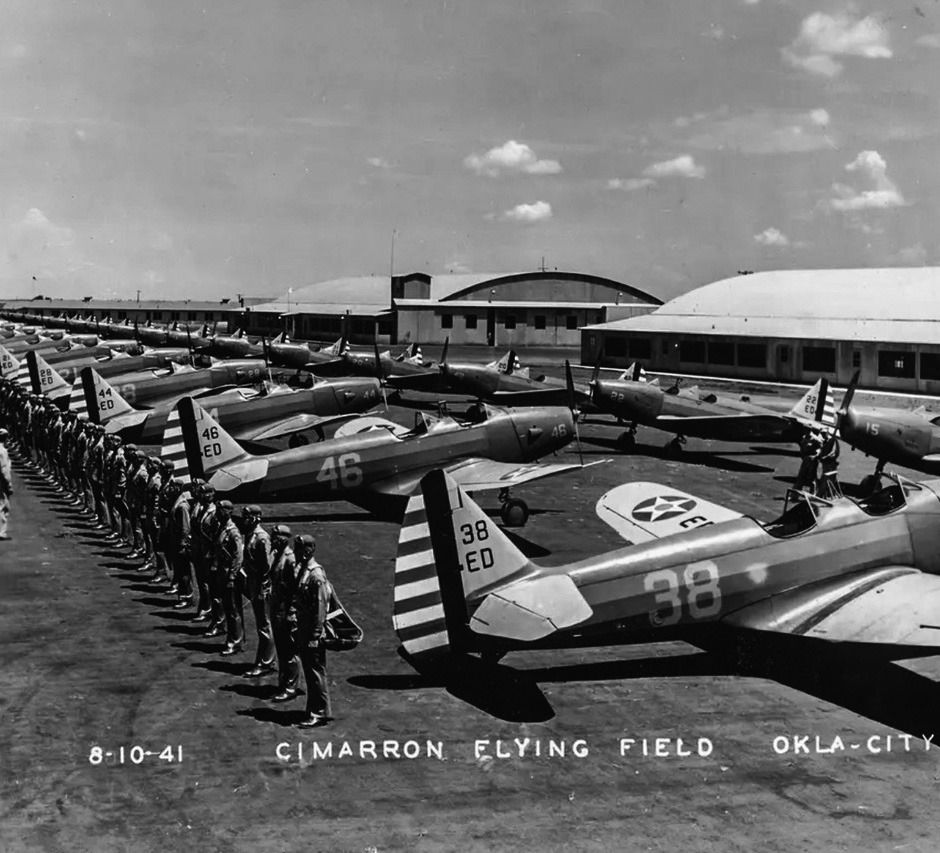
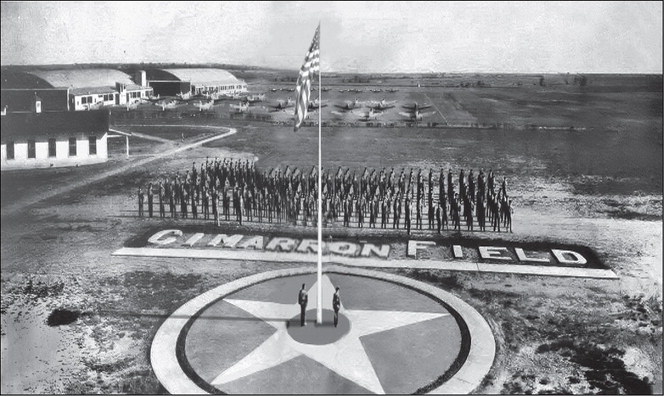
As the Air Corps Training program was stepped up from 7,000 pilots a year to 12,000 and now to 30,000, an additional group of schools was studied to open up still more primary training schools. Oklahoma Air College successfully received a War Department contract for an Army Primary Training School in December, one of the ten new schools added to the 18 already in existence. From the time its application was accepted by the Gulf Coast Air Corps Training Center until its personnel, flight and maintenance nucleus, and airdrome base wereinspectedandapproved, CimarronField(Yukon,OK), operated by Clarence E. Page and his Oklahoma Air College, was born. At Cimarron Field, over 4,000 cadets were trained for almost four years. PT-19s filled its five grass runways, and cadets trained year-round,enduringsearing summers and frigid winters.
Cimarron Field, spearheaded by aviator and entrepreneur Clarence E. Page, was among the first 26. On January 16, 1941, the first spade of dirt was turned on 240 acres just outside Yukon. The site was carefully chosen to avoid busy air routes from Oklahoma City to Wichita and Dallas. Buffalo wallows were filled, hangars erected, barracks framed, and just sixty-two days later, on March 23, 1941, the school was dedicated, ready to mold warriors of the sky. Every possible measure was taken to ensure the efficient operation oftheAirCorpsprogram, notforgettingthewelfareand comfort of flying cadets.
Cimarron Field was a bustling mix of military precision and civilian enterprise. Civilian instructors, mechanics, and office staff worked alongside Army base commanders and military check pilots to push each cadet to their limits.
Cadets underwent 10week courses, including ground school lessons in meteorology, navigation,mathematics, and aircraft systems, followed by 65 hours of flight training in Fairchild PT-19 Cornells. The PT-19 was built from wood and fabric to preserve strategic metals. It lacked an electrical system and communication was oneway, facilitated through the 'Gosport' system—a rubber hose connecting the instructor’s mouthpiece to the cadet’s ears. Starting required hand cranks.
Flight training at Cimarron was not for the fainthearted. With no radios or modern navigation systems, cadets learned from muscle memory, instinct, and repetition. Training occurred year-round, with only rain or temperatures below 15 degrees halting operations. Heavy leather flight jackets were standard winter gear in the open cockpits.
The first class graduated in May 1941 with 24 cadets; the final class in August 1944 produced 177. Throughout 34 classes, 6,078 cadets enrolled. Roughly32.7%—1,989 cadets—washed out, unable to meet the rigorous standards. Some 150 aircraft crashed during training, and the human toll was sobering: 12 deaths at Cimarron Field, including 10 in the air.
As the war intensified, the USAAC demanded more output. Cimarron expanded quickly: a third hangar was under construction by December 1941, and a fourth followed. Even then, it wasn’t enough.In1942,theAirForces commissioned a sister field innearbyElReno—Mustang Field. Also operated by Page and his partners, it housed fourhangarsandmatchedCimarron inintensity.Mustang suffered at least 11 fatalities during its operation.
At their training peak, both bases fielded at least 500 cadets and 100 PT-19 aircraft each.MustangandCimarron fields created an aviation ecosystem in central Oklahoma that would ultimately feed the war machine with disciplined, skilled pilots.
Of the 62 primary flight schools, only three—including Cimarron—were authorized to train West Point cadets, a distinction reserved for schools with exceptional facilities and leadership. The presence of these elite future officers elevated the prestige and pressure of the mission.
As the Allies gained control of the skies and victory drewnear,theArmyAirForces began to reduce training capacity. The need for new pilots started to decline as the tide of war turned in favor of the Allies in 1944. The Army Air Forces began consolidating and closing schools. By theendof1944,mostcontract primary schools had been deactivated. Cimarron Field, for example, graduated its final class in August 1944.
Many schoolstransitioned to civil airports, while others faded into history. Their legacy, however, endures in the thousands of aviators they produced.
One by one, the contract schools closed. Cimarron graduated its last class on August 1, 1944.
Decades later, on Labor Day 1978, Cimarron Field was renamed in honor of its founder—Clarence E. Page Airport. Only two of its original hangars remain; thebarracks,classrooms,and mess halls are gone. But the ghosts of the Greatest Generation linger in the wind, whispering stories to those who listen.
TheContractFlightTraining School program was an unqualified success. It trained more than 250,000 cadets between 1939 and 1944, turning the United States into the world's greatest airpower by the war's end. It demonstrated the viability of public-private partnerships in national defense and helped establish a strong postwar civil aviation industry.
Veterans of these programs would go on to serve not only in the skies over Europe and the Pacific but also in Korea and Vietnam, playing key roles during the ColdWarasleadersintheAir Force. The contract schools laid the foundation for today’s Air Education and Training Command and fostered the broader philosophy of distributed training.
The Cimarron Field and Mustang Field Museum was created to preserve that legacy, dedicated to the 23 fallen at the two bases and the many more who gave their lives after leaving them. The museum ensures that these sacred training grounds and the men who passed through them are not forgotten through photos, documents, and restored memorabilia.
The story of Cimarron Field is not one of grand battles or famous generals. It is the story of ordinary young men learning to fly in an extraordinary time, guided by civilians and soldiers who knew the stakes. From handcranked aircraft and Gosport tubes to the roar of engines and the heartbreak of lost lives, Cimarron was where boys became men, and men took flight toward freedom.
Today, as small aircraft taxi on Clarence E. Page’s runways, they ride on the wings of history, where once the sky was not a hobby—but a battlefield in training.
In the crucible of world conflict, America reached into its open plains and bustling towns to turn farmers, students, and mechanics into aviators. The contract flight schools of the United States Army Air Corps were more than training grounds—they were cradles of courage, engines of ingenuity, and symbols of a nation’s will to soar. Though many of their runways are now silent and their hangars weathered, the legacy of these schools lives on in every freedom-loving sky.
Their story reminds us that victory in war often begins far from the battlefield— in classrooms, workshops, and in the skies above a thousand humble fields where wings were first earned.
When Cimarron Field opened in 1941, the Oklahoma Air College hired Marshall County’s Fly Boy, Overton Martin “Rusty” Bounds, as the flight director of the army's primary flight training program. Just as he had done in WWI, Bounds was once again tasked with training United States Army Air Corps pilots to prepare them for war. Pilots trained by Bounds would eventually fight in the skies over Europe or the South Pacific.
Come back next week for the conclusion.