
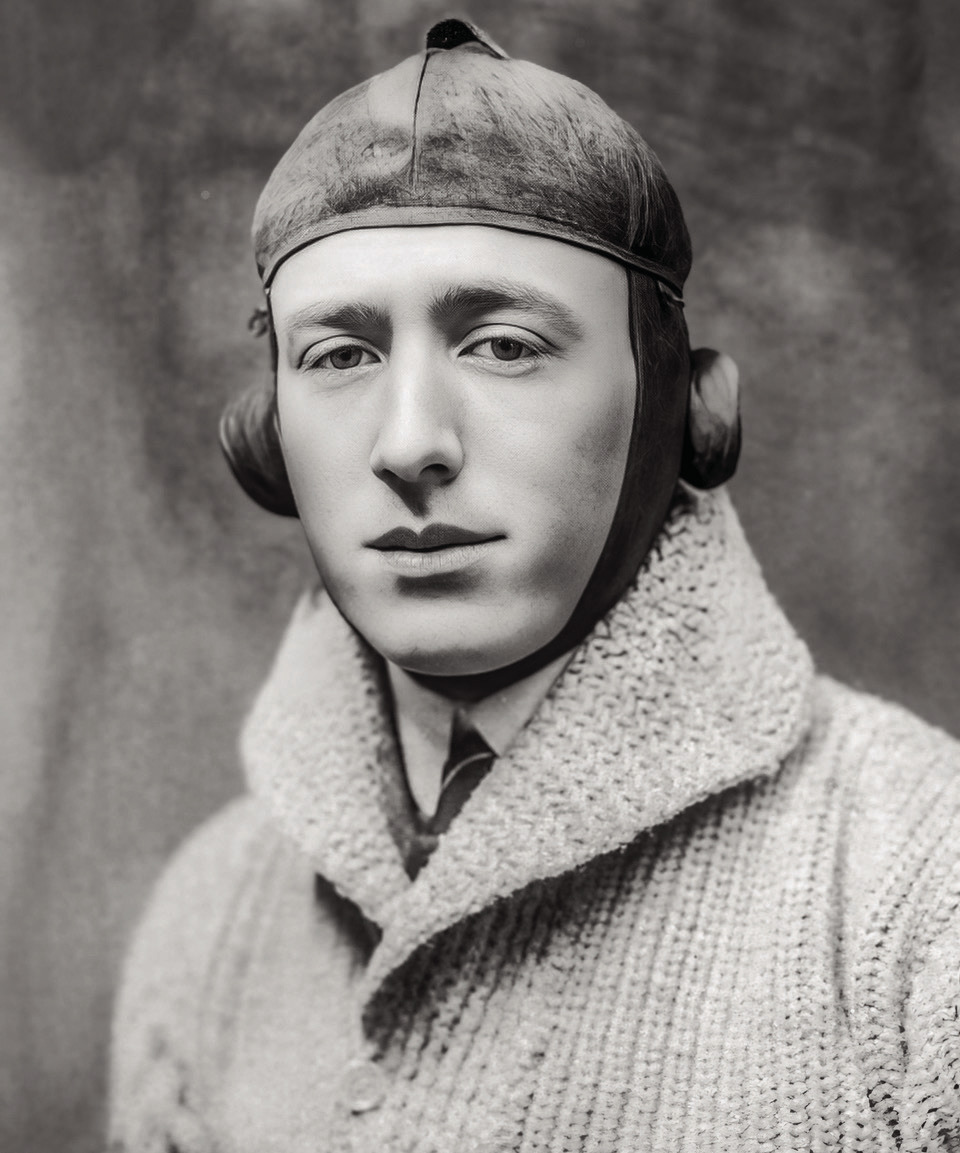
Overton Martin “Rusty” Bounds had already established himself as a daring pioneer in early aviation by 1915. From teaching himself to fly at the Schiller School of Aviation to thrilling crowds with death-defying stunts at county fairs and air exhibitions, he became one of Oklahoma’s most celebrated aviators. His feats, including America’s first recorded instance ofskywritingandbeing the first pilot to deliver mail from an airplane, earning him the designation “the father of airmail” by the Kansas City Star, Overton demonstrated his skill and forward-thinking approach to aviation. Yet, his story did not end there.
As his reputation soared, so did his ambitions. In the years that followed, he continued to push the boundaries of flight, advancing both aerial performance and aviation technology. His contributions extended beyond entertainment—hisinventive mind led to the development of crucial safety features still used in aircraft today and beyond. In this next chapter of Bounds’ life, we explore how he transformed from a barnstorming sensation into an aviation innovator, solidifying his place in the history of American flight.
On July 28, 1914, the world wasthrownintoturmoilwhen Austria-Hungary declared war on Serbia, igniting what would soon become a global conflict. This war, sparked by the assassination of Archduke Franz Ferdinand in Sarajevo, quickly escalated as alliances were called upon, drawing major powers into battle. Germany supported Austria-Hungary, while Russia mobilized in defense of Serbia. As a result of these alliances, France and Britain soon became embroiled in the conflict. What had begun as a regional dispute threatened to engulf Europe in war.
In the United States, President Woodrow Wilson urged Americans to remain neutral, emphasizing that the nation should be “impartial in thought as well as in action.” Despite this stance, the escalating war raised questions about America’s role on the world stage. While many citizens supported neutrality, others believed the nation should prepare for possible intervention. Reports of German aggression and the rapid mobilization of European forces only intensified debates in Washington about whether the United States should strengthen its military in anticipation of potential involvement.
At the time, the U.S. military was relatively small compared to the massive armies fielded in Europe. However, preparations for national defense quietlybegan.TheArmy andNationalGuardincreased their training efforts, while the Navy reviewed fleet readiness in case of emergency. Onenotabledevelopmentwas the early training of military pilots. With military leaders recognizing the growing importance of air power in modern warfare, this training marked an important step toward strengtheningAmerica’s military capabilities.
The United States began training pilots to fly in World War I in 1916 before officially entering the war. The U.S. ArmyestablishedtheAviation Section of the Signal Corps in 1914. Serious pilot training efforts began in 1916 at North Island, San Diego, California, and Mineola, Long Island, New York.
When the U.S. entered the war in April 1917, pilot training rapidly expanded, with new training fields such as Kelly Field in Texas and Chanute Field in Illinois. The American Expeditionary Forces (AEF) also sent pilots to France, Canada, and Great Britain for advanced combat training. By the war's end, the U.S. had trained more than 10,000 pilots, though relatively few saw combat before the Armistice in November 1918.
At this time, as Overton’s reputation in aviation grew, so did his role in shaping the future of military aviation. His daring stunts and technical expertise had already cemented himasaleadingfigure in early American flight. Still, his influence expanded even further when he became the Chief Instructor of the First Aero Company of the New York National Guard in Mineola, Long Island, New York.
The First Aero Company, established in 1915, was the first organized aviation unit of the U.S. National Guard and one of the earliest military aviationgroupsinthecountry. This unit played a critical role in preparing American pilots for aerial warfare just as the world was plunging into the chaos of World War I. As Chief Instructor, Bounds was responsible for training pilots, refining flight techniques, and advancing military aviation strategies at a time when aerial combat and reconnaissance were still in their infancy.
His expertise and handson experience made him an invaluable asset in shaping the skills of future wartime aviators. His appointment as Chief Instructor underscored his mastery of flight and positioned him at the forefront of America’s military aviation development. Bounds would elevate his knowledge and passion for aviation to even greater heights, influencing the trajectories of both military and civilian aviation.
For the next year and a half, Bounds lead the training of thousands of American pilots. During this time, the United States Army pled with Bounds to accept a commission as a Lieutenant in the United States Army Air Service, the forerunner to the ArmyAirCorp. Overton,however, declined the request and remained a civilian instructor for the Army Air Service. He believed he could better serve his country and the training of army pilots by remaining a civilian instructor.
After spending several months as the chief instructor for the Army Air Service, Overton was offered a position as the chief test pilot for the Standard Aircraft Corporation, the leading company tasked with designing and building warplanes for the United States.
As the United States entered World War I in April 1917, the military needed to rapidly build up aircraft for pilot training, reconnaissance, and combat operations. At the time, aviation was still a new and evolving field, and the U.S. lagged behind European nations in aircraft production and pilot training. The government turned to various aircraft manufacturers, including the Standard Aircraft Corporation, to meet this demand.
The Standard Aircraft Corporation was one of the most important American aircraft manufacturers during World War I, playing a crucial role in training pilots and advancing military aviation. Founded in 1916 in Founded in Plainfield, New Jersey, Standard Aircraft quickly became one of the leading suppliers for the U.S. Army Air Service. The company specialized in producing reliable, easy-to-fly planes that could train pilots efficiently before transitioning to more advanced aircraft. Although it was relatively short-lived, the Standard Aircraft Corporation made significant contributions to early U.S. aviation.
During World War I, Standard Aircraft produced several military aircraft models, each designed for different roles. The three most notable aircraft produced were the Standard J-1, Standard Hseries, and Standard E-1.
One of Standard Aircraft’s most significant contributions was the J-1, a primary training aircraft used by the U.S. Army Air Service. It was designed to train new pilots before they moved on to combat planes. The J-1 was a biplane with a simple design, making it easy for flight instructors to teach aviation fundamentals.
However, the J-1 faced strong competition from the more famous Curtiss JN-4 “Jenny,” which ultimately became the U.S. military’s preferred trainer due to its better handling and reliability. Despite this, the J-1 was still widely used in flight schools, and many American pilots took their first flight in a Standard J-1.
The Standard H-2 and H-3 models were designed for reconnaissance missions and artillery spotting. These aircraft were used to gather intelligence, helping military commanders track enemy movements and direct artillery fire more accurately.
Although the H-series aircraft were effective, they were soon overshadowed by more advanced European reconnaissance planes. However, they represented an important step forward in U.S. military aviation, as they allowed American forces to experiment with aerial reconnaissance.
The Standard E-1 was the company’s attempt at a fighter aircraft, designed as a scout and light attack plane. Although it was one of America’s first efforts at creating a single-seat fighter, it saw limited service due to the rapidadvancementsinfighter aircraft technology. The E-1 did not see combat, but its development contributed to the evolution of fighter plane design in the U.S.
Overton was the pilot selected to test each of these aircraft and then train others to pilot them. At that time, Marshall County’s Overton Bounds became the highestpaid pilot in United States history up to that date. One of Overton’s duties was to testfly eachairplanedesignedand manufactured by Standard Aircraft Corporation.
On May 18, 1916, The Marshall County News-Democrat reported, “Overton Bounds has been appointed Pilot Instructor for the First Aero Company National Guards of New York. Overton Bounds is a homeboy who commenced the study of Aviation about two years ago and has made rapid advancement in his chosen profession; his many friends congratulate him on securing an appointment with the New York National Guards and are satisfied that he will make good and continue to make advancement.”
And the Woodville Banner reported the following on August 31, 1916. “While in New York City buying fall and winter goods for the Scott Dry Goods Company of this City, Mr. M. Scott visited the aviation camp where Overton Bounds is the head instructor for the government. Overton took Mr. Scott for a flight in one of the large high powered two, passenger 'Curtis planes to an altitude of 2,000 feet. While at this height, Overton stopped the engine for the purpose of pointing out points of interest to Mr. Scott, but Mr. Scott thought something had gone wrong and he wanted to pray, until he heard Overton's voice. Mr. Scott says the streets of the city looked like they were about a foot wide, and he could step across a city block; he could see no people at all.”
“Overton Bounds is head instructor at this Government aviation camp and has the reputation of being the best aviator and instructor in the government service. The government has tried to get him to enlist in the regular service as a lieutenant but he has refused to accept this appointment. We are glad to report the success this young Madill man is attaining and that he is gradually climbing to the top of the ladder in his chosen profession.”
After serving as the chief test pilot for the Standard Aircraft Corporation, Overton began performing flying expositions across the country to showcase the company’s aircraft. Over Valentine’s Day weekend in 1917, he flew several demonstration flights in Sea Breeze Florida. The St. Louis Globe-Democrat reported on February 18, 1917, the following. “ST. LOUISANS ENJOY SEA-BREEZE DINNER. ST.VALENTINEDAY. They also Witness Experimental FlyingbyGovernment Aviators.”
SEABREEZE,FLA.February 17-St.Valentine'sDaywas observed at The Clarendon Hotel. Tuesday night, with a special St. Valentine's dinner, in honor of the younger element in the hotel, which is a large one this year, and among whom large number of dinner parties were made up for the occasion.”
“At the hangar of the Standard Aero Corporation of New York, which is engaged exclusively in the manufacture of airplanes for the United States Government, interesting experimental flying has been going on during the week with two new machines completed during the last two months, which represent the latest types military airplane, one a reconnaissance airplane, and the other a military training machine. They are two of more than seventy airplanes of a similar type which the corporation has built for the United States government since the beginning of the war. The trial flights are being made under the direction of W. D. Judkins, vice president of the corporation, while Overton M. Bounds, formerly trainer of aeronautical pilots for the United States at Mineola, Long Island, is doing the flying. The last few days, observations by visitors have been confined solely to the beach and the plazas of The Clarendon, as since the latest American war developments, the corporation has received instructions from the United States Government to admit no visitors to the hangar.”
Over the next several months, Overton traveled across the country, demonstrating the various airplanes manufactured by Standard. Eventually, Overton became involved with the United States Committee on Public Information, working alongside George Creel. Together, they performed demonstrations, including Overton’s most prominent exhibition, flying over the nation’s capital building in April 1918.
With the United States entering World War I in April 1917, President Woodrow Wilson needed a way to unite the country behind the war effort and silence opposition. Because of this, he created the Committee on Public Information (CPI) and appointed George Creel as its chairman. The CPI’s mission was to promote patriotism, encourage enlistment, and ensure Americans fully supported the war. However, instead of relying on coercion or force, Creel believed in “expression, not repression”—meaning he sought to persuade rather thanintimidatethepublicinto backing the war effort.
George Creel was born in Lafayette County, Missouri, in 1876. By the early 20th century, he had established himself as a progressive journalist and muckraker. As a newspaper editor, he fought against corruption and social injustices, earning a reputation for his investigative reporting and strong editorial voice. His progressive ideals and belief in the power of mass communication made him a natural choice when President Woodrow Wilson sought someone to lead the country’s first official war propaganda office.
Under Creel’s leadership, the CPI became the first largescale governmentpropaganda agency in the United States, using newspapers, posters, films, and speeches to rally American support for the war. While his work effectively mobilized the nation, it also raisedseriousethicalconcerns about censorship, manipulation, and the suppression of dissent.
On April 3, 1918, Overton piloted a Standard Aircraft Corporation plane, with Creel as a passenger, putting on a major exhibition over the United States Capitol in Washington, D.C. The exhibition was the most prominent of the war, witnessed by tens of thousands of people and reported in nearly every newspaper nationwide.
The Boston Globe reported on the spectacle on April 4, 1918,bywriting,“Washington D.C.--With George Creel, chairman of the committee on public information, as a passenger, Overton M. Bounds, a pilot of the Standard Aero Corporation, today looped the loop and performed the tailspin, nosedive, 'falling leaf,' and other fighting airplane evolutions over the capitol. The machine, which is being demonstrated here before government experts, is an advanced military training plane.”
However, as big as the news of Overton’s exploits was around the country, it was nothing compared to the excitement back home in Madill and across Marshall County. Following his exhibitions in Washington D.C., the Madill Record wrote on April 11, 1918. “Overton Bounds, an Oklahoma boy, has been thrilling thousands of Washingtonians and war department officials every afternoon for the past week in a series of spectacular aerial gymnastics. Bounds, who is a professional aviator, is here demonstrating to war department officials a new type of battle plane that is manufacturedatElizabeth,N. J. He flew from Dayton, Ohio to Washington. covering a distanceof400milesbyairline in five hours and twenty-two minutes. Bounds made his first flights in Washington Easter Sunday afternoon and had as his passenger J. Berry King, of Tahlequah, who is a first lieutenant in the provost marshal's office.”
“Bounds' repertoire of flying stunts includes more spectacular and daring fetes than have been executed by members of the Royal Flying Corps, who have been flying around Washington for the past six weeks.
Bounds home is at Madill, in Marshall county. His parents reside there now. He was formerly a student of the state university at Norman, and has been flying for two years. - Washington News Agent.”
“The above story from the daily press of last Sunday is self-explanatory. Overton Bounds is serving his country. He is a patriotic young man who is giving his all for Old Glory. If there is a part of the service in which we should feel proud it is the aviation section; because the aeroplane, we believe, is going to be the greatest of any one factor in winning the war. The young man who enters the aviation service must submit to a severe and dangerous training. He must meet the enemy in mid-air and there defeat himor else meet death.”
“Overton Bounds is a Marshall County boy, a boy we all love,aboyweknowisdoinghis full duty toward destroying that Prussian menace which has threatened the entire civilized world. And knowing that this boy, this boy from our hometown, is giving his life if need be, that right and justice shall prevail-we cannot help wonderingaboutthemanwho refuses to buy a Liberty Bond to supply him with food and clothing, fighting material; we say we surrender if that man can go to bed and have
Photo courtesy of the Oklahoma Historical Society